Natalie Daher | Longreads | April 2018 | 15 minutes (4,014 words)
The subjects of cultural critic Michelle Dean’s new bookSharp: The Women Who Made an Art of Having an Opinion — including Dorothy Parker, Janet Malcolm, Joan Didion and Nora Ephron — have appeared in Dean’s writing and interviews again and again over the years. It’s not difficult to see how Dean would develop a fascination with opinionated women — she is one herself. Lawyer-turned-crime reporter, literary critic, and Gawker alumnus, Michelle Dean’s has had her own “sharp” opinions on topics ranging from fashion to politics, from #MeToo to the Amityville Horror.
The book is more than just a series of biographical sketches. Dean is fascinated by the connections between these literary women — their real-life relationships, their debates, and the ways they were pitted against each other in a male-dominated field.
We spoke by phone between New York and Los Angeles and discussed writing about famous writers, the media, editors, and feminism.
* * *
You started your career as a lawyer, then you transitioned into journalism. You’ve written about crime, law, women, books — how did those experiences prepare you to write this first book?
I don’t come from a particularly literary background. I only came to think about literary life relatively late. I was an undergraduate debater, which is a deeply nerdy and embarrassing thing to admit, but also really formative for me. I ended up in law school by a circuitous route.
I think you can see a lot of that spirit in the book, because there’s one level on which the book is just an argument for debate, or for spirited argument, which is something that you’d think the world doesn’t lack right now. Except that a lot of it isn’t reasoned, or witty, or eloquent, or perceptive. It’s just yelling all the time. Lawyering is thinking and reasoning by principle. In that sense, it ties into sharpness pretty easily.
To my way of thinking, this advice is really aimed at those people who have been talking for years about one day wanting to be a writer, but who haven’t started writing anything yet despite having the time, emotional space, and capacity to do so. But far too often, it’s thrown around like a qualification that must be met every day.
I think we need to give ourselves a break; to stop feeling guilty when life events conspire to overwhelm us. You are not less of a writer when you take time off to care for yourself or your family.
Writers write.
But not at the expense of their own well-bring.
Have you ever guilt-tripped yourself for not writing? How do you feel about this advice?”
My lonely ice cold body was enwrapped
By golden love and warmth quite unsurpassed
I saw in my mind’s eye a tunnel black
To which I sped on a deep railway track
But as the golden kindness covered me
A sheet of tears fell like a mystery
I thanked the Person whom I could not see
And turned away from blackness ‘victory.
The struggle to return was not serene
I lived for months in struggle and sore pain
Yet I seemed to sense all would be well.
But of such stories who will ever tell?
The glory of the Lord is real and here.
No drugs are needed but our groans and tears
Let the smoke not hide the fires
The guns of shame
Educated, dumbstruck liars
Against their origins conspired
So many maimed
And in the burning darkness angels came
To wash in mothers’ tears
Understanding the disdained
Their tortured and their fears
Why play any game
When all we want is calm.
Where is the truth, the balm?
Did Jesus come?
Turn back, live again, he said to me
Do not wander in the darkness anymore
One wrong move might give death victory
We are each connected to that tree
The sunlit top, the roots hid in earth’s floor
Come back, live again, he asked of me
While we live, we’ll live with dignity
Not scrabbling for the gold in blood and gore
One more lie will give sin victory
The kindness of the Golden Light was clear
And left an image in my mind’s deep core
Come back, live your life, he then soothed me
Do not ever wonder why you’re here
We’re here to live and living shall restore
What our suffering self has found so dear
I had never seen the Light before
Only Christ the tyger with his roar
Come back, live through pain, he asked of me
One right step will give love victory
Nearly all of the people who spoke Yiddish died in the Holocaust and Israel decided to bring back Hebrew which was used in the Liturgy.New words had to be added but it has been successful
Otterburn,cauldron bubble
Osmotherly as a wet hen
Leeds men on
Leicester….A hearse,a hearse.My condom for a hearse.
Huddersfield the balls and the bats
Granchester a pardon.
Cambridge and rail.
Ware in the world are you now my dear man?
Hertford here ,bridge 1 mile,long distance thrower on holiday
Pendlebury,spindle worry.
Baden Baden,caught on
Newcastle 1 mile
Gateshead ahead.
Middlesborough, workers fight
Stockton on Toes
Billingham ICI
Tyne and Wear estuaries for all
When I was not quite 15, my dad, who was the kindest of fathers, decided that I should learn what ‘real’ work meant. He was a trade union leader, head of what is now the PCS – the Public and Commercial Services Union – having come to that brand of socialism via a youthful commitment to communism. His particular union served that branch of the public sector which included office cleaners. Indeed, it was his proud boast that he had been responsible for unionising the public sector cleaners.
I was lucky enough to have reached secondary school age during the period that state scholarships were made available to public schools. I had won a scholarship to St Paul’s, then as now one of the top girls’ schools in the country, but my father’s egalitarian principles had been tested by this piece of good fortune. My mother finally persuaded him that I should accept the place, but he was always concerned that I keep my feet on the ground and he never let me forget how the unprivileged had to live.
So when, that year, I asked for money to go on holiday, he said it was time I learnt to work for it.
“Ok, so written and spoken language are different. Does that make written language worse?
If you want people to read and understand what you write, yes. Written language is more complex, which makes it more work to read. It’s also more formal and distant, which gives the reader’s attention permission to drift. But perhaps worst of all, the complex sentences and fancy words give you, the writer, the false impression that you’re saying more than you actually are.
You don’t need complex sentences to express complex ideas. When specialists in some abstruse topic talk to one another about ideas in their field, they don’t use sentences any more complex than they do when talking about what to have for lunch. They use different words, certainly. But even those they use no more than necessary. And in my experience, the harder the subject, the more informally experts speak. Partly, I think, because they have less to prove, and partly because the harder the ideas you’re talking about, the less you can afford to let language get in the way.
Informal language is the athletic clothing of ideas.
I’m not saying spoken language always works best. Poetry is as much music as text, so you can say things you wouldn’t say in conversation. And there are a handful of writers who can get away with using fancy language in prose. And then of course there are cases where writers don’t want to make it easy to understand what they’re saying—in corporate announcements of bad news, for example, or at the more bogus end of the humanities. But for nearly everyone else, spoken language is better.”
R: That’s so tragic. Why does it become harder to connect the longer you are lonely?
ML: There’s an interesting theory.
We depend on others to feel secure. When we feel lonely, we feel like there’s a permanent threat. It might not be a real threat, but we perceive things as threatening.
So what this amounts to when we’re in a normal, neutral social situation, we’re more likely to interpret the other person as being threatening. Someone might look at us in a neutral way, and the lonely person will think, “This person doesn’t like me.”
Barmouth where the pubs bite
Harlech where they don’t wash their hair
Skipton. they miss one or two
Preston, they don’t iron everything
Bury,a large cemetery
Didsbury,I did bury him
Swinton where the pigs are heavy
Salford. where they hoard selfies
Northampton, near Ampton but a long way from
Southampton
Ham is in West London but not in Golders Green
Wimbledon.What is a wimble?
She said she’s from Worcester and it rhymes with fluster.What sauce!
He’s from Southall, Southwell. or Southport. I can’ tell as he speaks a dialect
She said,Go to Blackpool? I am an out and out racist.What a pity she never learned geography.But was there a pool there once?
If I close my eyes will Morecambe?
I liked Settle but he liked Dent.So we wanted to emigrate to Jaffa but as we are English they said they didn’t want us.Can you blame them?
I thought with us not being Arabs it might be ok.But we did buy some lovely oranges
Actually,my granny was from Egypt but I don’t look like her except I am not white.
I don’t know how to describe my colour.Medium beige? The man at the border was darker than me.But the Ashkenazi are as white as snow.
Submitted by MigrationUser on Wed, 05/25/2016 – 11:30
A new poll of the rudest (and funniest) place names in the UK has been released.
The poll, the brain child of comedian Chris Ramsey in collaboration with Swiftcover.com asked residents to vote for the most bizarre and hilarious place names they could think of in the United Kingdom.
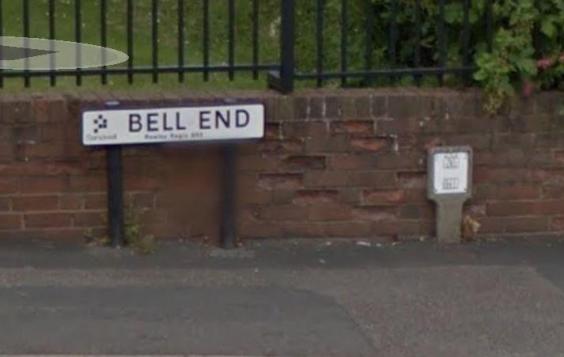
Topping the list this year is “Bell End” on 36.35 per cent. Rather suitably, Bell End is located in the village of “Lickey End”, Worcestershire.
Here’s the top 10 in full:
1. Bell End, Worcestershire – 36.35%
Photo: Google Street View
2. Brown Willy, Cornwall – 34.25%
3. Boggy Bottom, Hertfordshire – 30.55%
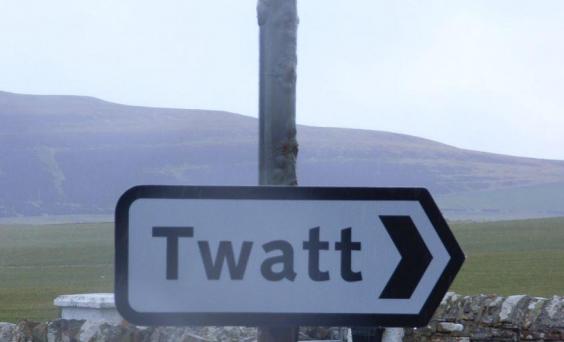
4. Twatt, Orkney – 26.20%
Photo: Google Street View
5. Nob End, South Lancashire – 26.15%
6. Fanny Barks, Durham – 24.45%
7. Scratchy Bottom, Dorset – 24.35%
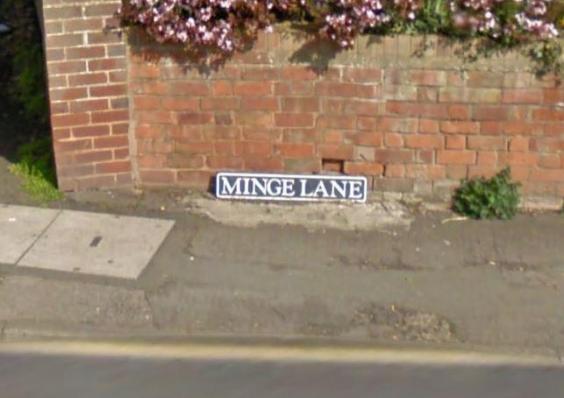
8. Minge Lane, Worcestershire – 23.80%
Photo: Google Street View
9. Dicks Mount, Suffolk – 23.25%
10. Crotch Crescent, Oxford –22.25%
Photo: Google Street ViewAn honourable mention goes to Camrose, Pembrokeshire, which in January this year was briefly renamed “Cumrose”. The mistake was a result of a council blunder which printed Cumrose on a street sign to the amusement of local residents.
If you never go out,you won’t need to worry about losing keys or bus passes.
It seems an extreme solution.
I wonder if some of our neuroses are based on that kind of thinking?
Afraid of being rejected…become a loner for ever
Afraid you are ugly…… wear horrible clothes.
Afraid you can’t do maths…. join a religious order.
Afraid of being a virgin at the age of 21? Get married at 20.That;s a bit out of date!
Afraid of dying? Commit suicide to get it over with.That’s mad.
Afraid of food? I can’t think what to say.Try cheese and bread.
Afraid of aliens? Join the club
You know this experience, sometimes when you are browsing in a bookshop you come across a book with a wonderful title. This happened to me as student when I saw a book with this title:
“The courage to be ”
by Paul Tillich
I was going through a very hard time indeed and just the title alone helped me as no one I knew had ever said it takes courage to live well.So I bought this book and dipped in. I found it interesting and thoughtful.Sometimes I would just look at the front cover and repeat the title.I had discovered mantra meditation.in a sense.
This morning I was listening to a radio programme about poetry in England and tidying up. Suddenly my old battered copy fell out of a shelf and into my hand.And I said, thank you. Because I had lost this companion and now it’s restored to me when I need again to say the words to help me in a personal crisis.
The Courage to Be
And to recognise the power of words on the human mind and thus to take care of self and others and what we say to them for they too are struggling humans as we ourselves are.
And to discover virtue is not faux piety which suddenly reminded me that Tillich had a weakness for women. He was no plaster saint. I am not saying. I approve.
Had he stayed in Germany he would no doubt have been imprisoned even killed like Dietrich Bonhoeffer.He would not have been silent
Books… they save lives. I was so grateful and still am for education, books, people who talk to me .Had I lived a few years earlier it would have been different.
Tillich was expelled from Germany in 1933,the first non-Jewish theologian to have this honor bestowed on him.I never saw him but I love him for his writing.
If you take a selfie of your hair
Do not try to stand beside a bear
A man was killed,I saw it on the News
The bear was injured but he got some views.
Prepare yourself,your face may be a shock
Your eyelids droop and lines run like a flock
Your lips are thinner than a matchstick now
But with some aid, you’ll find a lipstick new
But if you’re loved and loving,be polite
Men can be unfaithful in the night
He can dream of loving Sarah Jane
Her hair is silk and gold,does that explain?
And we women dream of other men
Walking through the poppy fields again
Oh, Alfred, my beloved, do not go
Do  not leave, but warmth to me bestow,
Lie beside me in my bed all night
Succour me when stormy dreams affright.

Oh , Alfred, tis your eyes  that turn me on
The green and golden light is never gone.
Affection constant,  touch and feeling shared.
I am not embarrassed when you stare.

For you , the  gallant male, have ever  seen
My naked form well lit by  Jove’s sunbeams
And if I wear a gown of winceyette
You love it ,as it’s made for paws of cat.

Alfred  ,we can’t marry   yet I fear.
Cats can’t read the Book of Common Prayer.
My sister and I had a lot to talk about but when she got home she rang sounding mor animated to say she and her daughter in law loved my new hairstyle.Unfortunately the main difference is that it is shorter at the back and longer on top and in front which does not show in a photograph.When we had major things ro discuss it’s good they could think about my hair!I had been about to buy a wig.To satisfy my family who may be reading I shall take a selfie of the back of my head later on
Myself someyears ago,carefully hiding my hair which stopped growing owing to underactive thyroid gland.,Unfortunately after treatment I became extravagent.So if your wife’s habits alter it may not be lack of will power it may be her glands…even my glasses were more upmarket.Lord knows why when I have not been able to have a social life and my cat does not mind what I look like.My husband did like me in bright colours.Sometimes I even wore clothes.
“Misattribution of arousal falls under the self-perception theory. This theory goes back as far as William James, one of the founders of psychology. It posits your attitudes are shaped by observing your own behavior and trying to make sense of it. For instance, James would say if you saw a cricket on your arm and then flailed about rubbing your body up and down while screaming incoherently, you would later assume you had experienced fear and might then believe you were afraid of crickets. Self-perception theory says you look back on a situation like this as if in an audience trying to understand your own motivations. Sometimes, you jump to conclusions without all the facts. As with many theories, there is much research left to be done and plenty of debate, but in many ways James was right. You often do act as observer of your actions, a witness to your thoughts, and you form beliefs about your self based on those observations. Psychologist Fritz Strack devised a simple experiment in 1988 in which he had subjects hold a pen straight out between their incisors and bare their teeth as they read cartoon strips. The subjects tended to find the cartoons funnier than when they held the pen between their lips instead. Between the teeth, some of the muscles used for smiling were contracted, and between the lips they contracted some of the muscles used for frowning. He concluded the subjects felt themselves smiling and decided somewhere deep in their minds they must be enjoying the comics. When they felt themselves frowning, they assumed they thought the comics were dull. In a similar experiment in 1980 by Gary Wells and Richard Petty at the University of Alberta subjects were asked to test out headphones by either nodding or shaking their heads while listening to a pundit delivering an editorial. Sure enough, when questioned later the nodders tended to agree with the opinion of the speaker more than the shakers. In 2003, Jens Förster at International University Bremen asked volunteers to rate food items as they moved across a large screen. Sometimes the food names moved up and down, and sometimes side to side, thus producing unconscious nodding or head shaking. As in the pundit study, people tended to say they preferred the foods which made them nod unless they were gross. In Förster’s and other similar studies, positive and negative opinions became stronger, but if a person hated broccoli, for example, no amount of head nodding would change their mind.
Arousal can fill up the spaces in your brain when you least expect it. It could be a rousing movie trailer or a plea for mercy from a distant person reaching out over YouTube. Like a coterie of prairie dogs standing alert as if living periscopes, your ancestors were built to pay attention when it mattered, but with cognition comes pattern recognition and all the silly ways you misinterpret your inputs. The source of your emotional states is often difficult or impossible to detect. The time to pay attention can pass, or the details become lodged in a place underneath consciousness. In those instances you feel, but you know not why. When you find yourself in this situation you tend to lock onto a target, especially if there is another person who fits with the narrative you are about to spin. It feels good to assume you’ve discovered what is “
“As you will learn, the latest evidence coming out of social science is clear: Humans value being good members of their tribes much more than they value being correct, so much so that we will choose to be wrong if it keeps us in good standing with our peers.”
” People in new situations instinctively form groups. Those groups develop their own language quirks, in-jokes, norms, values and so on. You’ve probably suspected zombies, or bombs, or economic collapse would lead to a battle over who runs Bartertown. In this study, all they had to do was introduce competition for resources and summer camp became Lord of the Flies.
What you may not have noticed though is how much of this behavior is gurgling right below the surface of your consciousness day-to-day. You aren’t sharpening spears, but at some level you are contemplating your place in society, contemplating your allegiances and your opponents. You see yourself as part of some groups and not others, and like those boys you spend a lot of time defining outsiders. The way you see others is deeply affected by something psychologists call the illusion of asymmetric insight, but to understand it let’s first consider how groups, like people, have identities – and like people, those identities aren’t exactly real.
Source: “The Breakfast Club,” 1985, Universal
Hopefully by now you’ve had one of those late-night conversations fueled by exhaustion, elation, fear or drugs in which you and your friends finally admit you are all bullshitting each other. If you haven’t, go watch The Breakfast Club and come back. The idea is this: You put on a mask and uniform before leaving for work. You put on another set for school. You have costume for friends of different persuasions and one just for family. Who you are alone is not who you are with a lover or a friend. You quick-change like Superman in a phone booth when you bump into old friends from high school at the grocery store, or the ex in line for the movie. When you part, you quick-change back and tell the person you are with why you appeared so strange for a moment. They understand, after all, they are also in disguise. It’s not a new or novel concept, the idea of multiple identities for multiple occasions, but it’s also not something you talk about often. The idea is old enough that the word person derives from persona – a Latin word for the masks Greek actors sometimes wore so people in the back rows of a performance could see who was on stage. This concept – actors and performance, persona and masks – has been intertwined and adopted throughout history. Shakespeare said, “all the world’s a stage, and all the men and women merely players.” William James said a person “has as many social selves as there are individuals who recognize him.” Carl Jung was particularly fond of the concept of the persona saying it was “that which in reality one is not, but which oneself as well as others think one is.” It’s an old idea, but you and everyone else seems to stumble onto it anew in adolescence, forget about it for a while, and suddenly remember again from time to time when you feel like an impostor or a fraud. It’s ok, that’s a natural feeling, and if you don’t step back occasionally and feel funky about how you are wearing a socially constructed mask and uniform you are probably a psychopath.
Social media confounds the issue. You are a public relations masterpiece. Not only are you free to create alternate selves for forums, websites and digital watering holes, but from one social media service to the next you control the output of your persona. The clever tweets, the photos of your delectable triumphs with the oven and mixing bowl, the funny meme you send out into the firmament that you check back on for comments, the new thing you own, the new place you visited – they tell a story of who you want to be, who you ought to be. They satisfy something. Is anyone clicking on all these links? Is anyone smirking at this video? Are my responses being scoured for grammatical infractions? You ask these questions and others, even if they don’t rise to the surface.
The recent fuss over the over-sharing, over the loss of privacy is just noisy ignorance. You know, as a citizen of the Internet, you obfuscate the truth of your character. You hide your fears and transgressions and vulnerable yearnings for meaning, for purpose, for connection. In a world where you can control everything presented to an audience both domestic or imaginary, what is laid bare depends on who you believe is on the other side of the screen. You fret over your father or your aunt asking to be your Facebook friend. What will they think of that version of you? In flesh or photons, it seems built-in, this desire to conceal some aspects of yourself in one group while exposing them in others. You can be vulnerable in many different ways but not all at once it seems.
So, you don social masks just like every human going back to the first campfires. You seem rather confident in them, in their ability to communicate and conceal that which you want on display and that which you wish was not. Groups too don these masks. Political parties establish platforms, companies give employees handbooks, countries write out constitutions, tree houses post club rules. Every human gathering and institution from the Gay Pride Parade to the KKK works to remain connected by developing a set a norms and values which signals to members when they are dealing with members of the in-group and help identify others as part of the out-group. The peculiar thing though is that once you feel this, once you feel included in a human institution or ideology, you can’t help but see outsiders through a warped lens called the illusion of asymmetric insight.
How well do you know your friends? Pick one out of the bunch, someone you interact with often. Do you see the little ways she lies to herself and others? Do you secretly know what is holding him back, but also recognize the beautiful talents he doesn’t appreciate? Do you know what she wants, what she is likely to do in most situations, what she will argue about and what she will let slide? Do you notice when he is posturing and when he is vulnerable? Do you know the perfect gift? Do you wish she had never went out with so-and-so? Do you sometimes say with confidence, “You should have been there. You would have loved it,” about things you enjoyed for them, by proxy? Research shows you probably feel all these things and more. You see your friends, your family, your coworkers and peers as semipermeable beings. You label them with ease. You see them as the artist, the grouch, the slacker and the overachiever. “He did what? Oh, that’s no surprise.” You know who will watch the meteor shower with you and who will pass. You know who to ask about spark plugs and who to ask about planting a vegetable garden. You can, you believe, put yourself in his or her shoes and predict his or her behavior in just about any situation. You believe every person not you is an open book. Of course, the research shows they believe the same thing about you.
In 2001, Emily Pronin and Lee Ross at Stanford along with Justin Kruger at the University of Illinois and Kenneth Savitsky at Williams College conducted a series of experiments exploring why you see people this way.
In the first experiment they had people fill out a questionnaire asking them to think of a best friend and rate how well they believed they knew him or her. They showed the subjects a series of photos showing an iceberg submerged in varying levels of water and asked them to circle the one which corresponded to how much of the “essential nature” they felt they could see of their friends. How much, they asked, of your friend’s true self is visible and much is hidden below the surface? They then had the subjects take a second questionnaire which turned the questions around asking them to put themselves in the minds of their friends. How much of their own iceberg did they think their friends could see? Most people rated their insight into their best friend as keen. They saw more of the iceberg floating above the water line. In the other direction they felt the insight their friend’s possessed of them was lacking, most of their own self was submerged.
This and many other studies show you believe you see more of other people’s icebergs than they see of yours; meanwhile, they think the same thing about you.
The same researchers asked people to describe a time when they feel most like themselves. Most subjects, 78 percent, described something internal and unobservable like the feeling of seeing their child excel or the rush of applause after playing for an audience. When asked to describe when they believed friends or relatives were most illustrative of their personalities, they described internal feelings only 28 percent of the time. Instead, they tended to describe actions. Tom is most like Tom when he is telling a dirty joke. Jill is most like Jill when she is rock climbing. You can’t see internal states of others, so you generally don’t use those states to describe their personalities.”
We were alone together
In this  long  thin sitting room.
I would draw on my laptop,
While he  stared  out at the moon.


We were alone together
Now I’m alone, alone.
I am  studying poetry
His number's not  on my new phone.


We were alone together
As I sat by his hospital bed.
He still didn’t speak but then he winked
As I laid my cool hand on his head.


I wish I could be  there now beside you
Together and never alone
I wish I could there  be with you quietly
And you were not cold as this stone.
What is so frightening, and why I think we keep talking around the red herring of Trump’s putative insanity, is the possibility that it might not exist. I keep coming back to the slogan with which Lyndon Johnson brilliantly capitalized on Goldwater’s public humiliation: “In your guts, you know he’s nuts”. Do we, though? Before he became president, did anyone think Trump was nuts? I’m trying to remember what I thought of him before all of this and I can’t. Because alongside the terrifying possibility that a man with a serious uncontrolled mental disorder has the nuclear football, is the equally terrifying possibility that a perfectly sane but petty, stupid, tyrannical, and evil man has the nuclear football and might very well use it in a fit of pique. Not because he’s ill and “can’t help it”, but because he just doesn’t care enough not to. What if the evil of Trump isn’t madness at all, but something innate in humanity that no psychiatric diagnosis or psychoanalytic interpretation can remove?
This is the thing I can’t accept, the gaping hole that opens up beneath me when I try to think through how someone like this could wind up in power. It’s not just that Trump is awful, but that he’s a mirror to our own – my own – awfulness. This is unbearable to think of, so to get around it it’s tempting to think of Trump as some kind of anomaly, an aberration who doesn’t count as the normal stream of humanity, rather than a figure who appears over and over and over in human history – the stupid, nasty demagogue who wants nothing but power and attention and doesn’t care how they get it.”

 https://longreads.com/2018/04/04/sharp-women-writers-an-interview-with-michelle-dean/


 Otterburn,cauldron bubble







 2016
2016




 How my heart speaks