I caught this morning morning’s minion, kingdom
of daylight’s dauphin, dapple-dawn-drawn Falcon, in
his riding
Of the rolling level underneath him steady air, and striding
High there, how he rung upon the rein of a wimpling wing
In his ecstasy! then off, off forth on swing,
As a skate’s heel sweeps smooth on a bow-bend: the hurl
and gliding
Rebuffed the big wind. My heart in hiding
Stirred for a bird, – the achieve of, the mastery of the thing!
Brute beauty and valour and act, oh, air, pride, plume, here
Buckle! AND the fire that breaks from thee then, a billion
Times told lovelier, more dangerous, O my chevalier!
No wonder of it: shèer plòd makes plough down sillion
Shine, and blue-bleak embers, ah my dear,
Fall, gall themselves, and gash gold vermilion.
I understand Finland has very advanced social systems. What impresses you most about it?
Khaya: What impresses me is the accountability and transparency on how public funds and taxpayers’ money are used in creating a dignified and decent living for all. The accessibility of education, free and everyone’s right, regardless of background, impresses me the most.
Sherry: It impresses me as well. In North America, we are losing rights left and right at the moment.
When did you first begin to write? Did it help you with the culture shock of finding yourself in a new place?
Khaya: Ah! The famous question…*laughs*. I can’t say for sure. As a child I preferred to write than to talk. This means I did a lot of letter writing, you know, more like the Dorothy Osborne kind of writing; long reports about rural life to my cousins and friends living in cities.
But it was when I moved to Finland that I actually started putting meaningful stories down. It was a way of dealing with culture shock, and so words became my friends.
Sherry: I love that: “words became my friends.” They do give comfort. When did you branch into poetry?
Khaya: I don’t think I branched out into poetry, Sherry. I’ve always been in it, even before I attempted to write it. I’ve always been a lover and a reader of poetry with influences such as S.E.K. Mqhayi and Tiyo Soga (Xhosa poets/writers), to name just a few.
I even had a crush on John Keats himself, during my high school years…*laughs* when a boy trying to impress me recited Keats’ Endymion. I thought, wow! I want to do that. But then I went to study business and got swept away a bit, whilst I chased the bottom line.
So, I returned and pursued poetry seriously, when I got stuck in my novel writing; a project that is still pending. Luckily at the time, I was also doing studies in English Philology (as part of a career change), and the process of writing poetry sort of came naturally.
Sherry: I love that you branch out in all directions, exploring all life offers. What do you love about poetry? What makes it sing for you?
Khaya: I love how poetry pushes limits with language and form. Its ability to make us pause, be in the moment, and remind us that water is still wet. The process of birthing a poem; the whisper, the nudge, the build-up and the release that eventually leads me to write with urgency. That like any other art form, poetry doesn’t belong to the creator but to the people.
To quote one of my writer friends, Khutsie Kasale, “Poetry is something more sacred and authentic. It is a gift of words birthed through the artist that come straight from the hands of God.”
So, I love that poetry means different things to different people depending on where it finds them.
Sherry: Such a good explanation! I read on your blog that you come from the Xhosa people, who have a strong tradition of oral storytelling. Do you think that is reflected in your poetry, that you are carrying on the tradition in your work? Do you remember a grandmother or someone in your family, who told great stories that caused you, as a little girl, to dream?
Khaya: I mentioned earlier on that I don’t think I branched out into poetry, I’ve always been in it. By this I mean, a Xhosa child, (or an African child for that matter), learns quite early in life who they are. That is, a knowledge of their origin, past history and culture because African cultures pride themselves on clan names.
So, a child learns about the notion of iziduko/izibongo through chanting of a multitude of family clan names; ancestors and heroes (living and dead) from the elders.
Chanting of clan praises is poetry itself; oral poetry that overlaps with a song. Thus, in my writing I’m always trying to emulate that rhythm and harmony.
Sherry: I envy you that rich cultural heritage. I see it, too, among the First Nations people where I live – such an ancient, proud, traditional culture.
Would you like to share three of your poems here, and tell us a bit about each one?
Khaya: Before I share, it’s important to point that my work often examines duality of an immigrant life; loss and gain. And the “I” doesn’t always mean the writer but the speaker.
Word Roots
Of origins I do not know
Theories varied and accepted
Making sense and no sense
Words are my friends.
Words that go forward
In prose and in books
Words that return
In verse and in song.
Of classical and medieval
Renaissance and modern
It’s Twa, the forage and pastoral
Tshawe, the ancestral heroes I seek
Diminished words found
Not in history books
Accepted words whose
History is esteemed
It’s Nongqawuse‘s words I thirst;
A prophecy from uQamata
Words older than writing
Dramatic and creative
Praise poems of no particular
Historical period. Folk tales
Of Tokoloshe terrifying
Children and adults alike.
Infidel words, beginnings
I do not know but whose
Oral tradition leaves me
Smitten in a trance
Speaking in tongues
Descending the Great Lakes
Borrowing from Khoi
To click a sound.
A tradition of Xhosa poetry
Whose metre measured not
In literary magazines, yet rhyme
Rings loud in Grahamstown
Words murmured teasing
With foreplay, words chanted
Exploding into a climax
Do scratch an itch
Spoken and sung
Barbaric and censored
Roots of word
I seek.
Khaya: This poem examines relationship with languages. It was inspired by a Poetry Festival held in my city, Tampere, in 2015. The theme was Syntyjä, Syviä, loosely translated as “root of words”.
Journeys I’ve Travelled
I’ve been to the north
I’ve been to the south
Journeys —
left me floating in between
(where both worlds depart)
and with no claim to either.
Suburbia no longer white
we sip tea and spend hours
discussing weather, whilst
the sun shines in black rural.
In song and dance we quench
— thirst vanquished.
I’ve been to the city
I’ve been to the country
Allow me the misguided view
with diluted memories, for
I build a world with these
smatterings of my life.
Khaya: I think this one is self-explanatory.
Summer
What would you have me say of you?
Ours is an obscure relationship
You led me believe I was your baby
A summer baby―
Because down south, October simmers
Spring overlapping with summer.
What would you have me say of you?
As if immaterial, now you tell me I am
An autumn baby―
Because up north, October teases
Skies weep fearful of winter.
Khaya: And the last is a poem excerpt from my upcoming chapbook that I’m hoping to release in spring 2018. I wrote it in celebration of the centenary of Finland’s Independence.
Sherry: Thank you for these, Khaya. You express yourself so well. I especially love the Xhosa words included in your poem. And we look forward to your book.
When you aren’t writing, what other activities do you enjoy?
Khaya: During my spare time, I can be found wandering in nature, hiking and backpacking, amongst other things, with my husband.
Why not take a holiday in the Vatican State especially if you are wanted by the police here or in Australia and you are a Cardinal.
How about going to Poland and asking what anti-Semitism ever did for them?
Don’t buy a raffle ticket in Saudi Arabia.Gambling is illegal.
Don’t go to Egypt with your own Mummy
On the Golan Heights you get a good view of Israel.Soon it will be in Israel
If you go to Gaza don’t strip unless forced to by the Border Guards.Smile and be friendly.It annoys some of them.
If you go to Jerusalem, wear long sleeves even if you are a nudist
In a Mosque, be decently dressed.If you remember what it means
Don’t bear or bare arms anywhere in the Middle East
That cheap 15 day trip to Damascus might end early when the Bomb drops.We know who has one.
Don’t complain that the French don’t speak English.Complain if they do
If in the Holy Land,pray.
Pray anyway
Remember the flu in 1918 killed more people than two world wars .Is giving your enemies flu the best revenge?
I wish we were Muslims as the clothes Christians and atheists wear are so revealing it’s enough to make a man or woman go mad with either rage or lust or both.It’s embarrasing living here as only immigrants dress nicely [ and me![
I reckon a stay at home holiday and a donation to the Red Cross might be the answer for me.
When Edmund Wilson dismissed the poetry of the Civil War as “versified journalism” in 1962, he summed up a common set of critiques: American poetry of the era is mostly nationalist doggerel, with little in the way of formal innovation. On the contrary, argues scholar Faith Barrett. In her new book, To Fight Aloud Is Very Brave,Barrett contends that a broad range of 19th-century writers used verse during the Civil War to negotiate complicated territory, both personal and public. Taking its title from a poem by Emily Dickinson, Barrett’s book also argues that Civil War poetry was much more formally destabilizing than scholars have traditionally acknowledged.
The book explores work by Northern writers such as Emily Dickinson, Walt Whitman, and black abolitionist poet Frances Ellen Watkins Harper, along with amateur “soldier-poets” and several Southern poets, including the so-called poet laureate of the Confederacy, Henry Timrod. Barrett devotes a chapter to Herman Melville’s little-read postwar collection Battle-Pieces, and another to the close connection between poetry and songs during the war.
Barrett co-edited a 2005 anthology of Civil War poetry called Words for the Hour, and her own published poetry includes a 2001 chapbook, Invisible Axis. She spoke with the Poetry Foundation from Appleton, Wisconsin, where she teaches English and creative writing at Lawrence University.
You write that the Civil War was a “poetry-fueled war.” What do you mean by that?
Poetry in mid-19th-century America was ubiquitous in a way that it just isn’t now. It was everywhere in newspapers and magazines, children were learning it in school…. Americans were encountering poetry on a weekly basis, if not a daily basis, in the Civil War era, and that’s a profound difference from contemporary poetry and its place in our culture.
There are so many accounts in newspapers of soldiers dying with a poem in their pockets, poems written on a scrap of paper folded up inside a book; so many accounts of songs or poems being sung or read to political leaders at particular moments. For example, after Lincoln announced the second call for a draft … James Sloan Gibbons wrote this song poem called “Three Hundred Thousand More,” which he supposedly sang to Lincoln in his office one day. So there’s a kind of immediacy of impact, that poetry is actually, I suggest, shaping events, not just responding or reflecting on them
The gravity of loss brought me to earth
Beneath the rotting leaves, I lay with worms. |
I wondered if I were of any worth.
No more to be enchanted by love’s mirth,
I with unnamed particles was turned.
The weight of loss bears down the heart to earth.
I could not rise alone but saw a path
While I slept a unity had formed
I learned I need not think of what I’m worth
My sorrow brought no guilt nor fear of wrath
I am both eagle and the twisted worm
In my little grave, I loved the earth.
Like the adder, shocked into rebirth.
I from silent underworld had learned
Not to judge the soul about its worth.
I shall not fear the flames of hell that burn
When blackness is accepted, may one learn?
The weight of loss breaks down the soul to earth
With dusty shredded leaves, we then converse
Who should speak, which people have a voice?
Can we trust the ones who’ve told such lies
Post-truth, post-God, post meaning, post remorse?
If we’re wounded, who shall give recourse?
Does it matter to them what we’re tortured by?
Who should speak, which people own their voice?
If we hear bad news, what is its source?
See the bodies hear the babies cry,
Post-truth, post-God, post meaning, post remorse?
Can we spread democracy by force?
Is it still democracy post-war?
Who should speak, which people own their voice?
Which of all the methods is the choice?
What is politics the reason for,
Post-truth, post-God, post meaning, post remorse?
If I speak, will you believe I lie?
The tongues of angels whisper, what of Troy
Who should speak, which people have a voice?
Post-truth, post-God, post meaning, post remorse
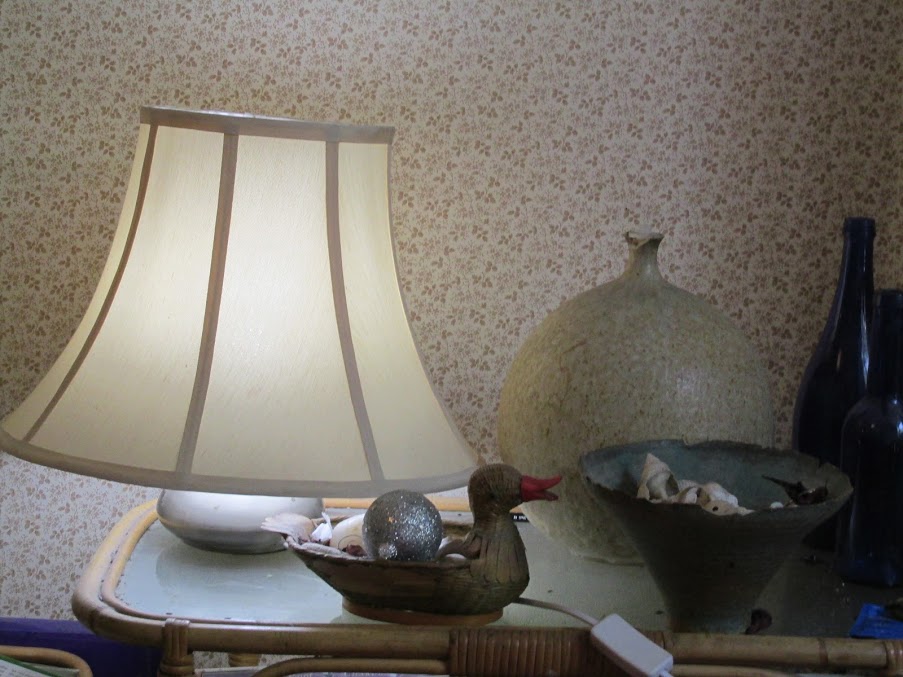
Broken by your fall, the last you had
The lamp and base separated evermore
But now the light shines through the shade, I’m glad
I feel the love is lit deep in my core
The base stands all alone no more to be
Except for its own beauty and its grace
Reminders of those journeys to the sea
Aldeburgh beach and joyfilled face.
So on these parts, once unified, shall live
I need not throw them out with rubbish and old tins
The shade gives shadows I’m familiar with
The rounded base has boldly its self shown
What once was one has now become two parts
Each of them gives solace to my heart
I just spoke to them about the inaccessibility of my local train station

I got the answer: it is expensive to make them accessible to the Government have given them till 2030 to do the work.By then I might be dead.
Moorfields Hospital is next to this train line but I’d have to get a cab and the traffic is hell.
Maybe a bath could be installed instead of a seat.The seats are uncomfortable
Extract
Joan Jagger, 70, above, retired foster carer
“I’m furious. I use the buses all the time if I want to go to Camden or the West End. But I have arthritis and back problems and if I have to stand up for too long it’s agony. The seats are essential for people like me. You can also put your shopping on them to save bending down. Only one person wanted the seats taken away because she said kids were congregating here but since the CCTV camera was put up there is no problem. We were never asked first, and we want them back straight away.”
Olivia Leun, 36, who works in the Fortune Food café next to the bus stop
“Everyone’s very angry about it. We’re raising a petition to TfL to bring the seats back. They didn’t consult anybody first, they just took them away. There’s a lot of elderly people and pregnant women who need to sit down. We would like to let them sit in the shop but we can’t for insurance reasons. As a community we need to sort this out. There used to be trouble here but not any more, now there’s a camera right there. It doesn’t make sense.”
“Stevens first delivered “Relations Between Poetry and Painting” as a lecture at New York’s Metropolitan Museum of Art in 1951. In this piece, Stevens explored the parallel attributes of poetry and painting, beginning with reference to adages that apply to both poets and painters and culminating with the emphatic conclusion that “it would be tragic not to realize the extent of man’s dependence on the arts.”
This crescendo in his argument is based on the notion that, in an age of disbelief, the arts in general are a “compensation for what has been lost. Men feel that the imagination is the next greatest power to faith: the reigning prince.” Stevens argues that, because poetry and painting operate at the juncture between imagination and reality, these arts assume a prophetic stature and become a “vital assertion of self in a world where nothing but the self remains, if that remains.””
It might be on the Mediterranean Sea but the place is very over-crowded, 2 million or more in one little country and although the border has a fence the IDF might fire through the fence if they can’t understand PRESS in English or if if your T shirt says
I am a lunatic
I am an algebra-ist
I am in crisis.
I am anti-cement.
I am high on anti-psychotics
I had a retinal crisis
My mother was a porcupine
Philip Wrath
Portnoy was a saint
I love Trains
I am gender free.
I love Moses
God made Trump
The big stain.
Philip Roth is dead.
Bury the past
Start over
Love your neighbour
Cain or Abel?
Mea maxima culpa
I went into a Turkish coffee shop today, but they had no turkeys

So I went to Starbucks and asked if I could bring my horse in.The next thing, the police arrived and decide I was mentally unusual.Too clever by half a horse.
The dental nurse held up this little white thing with a tail about 18 inches long.
I said, thanks but I’d rather have a cat.She said,
This is your wisdom tooth.
I can’t understand how that nerve fitted inside my gum.And to think, there are a few more like it.No wonder I am neurotic.How would you like it if your nerves were 4 standard deviations North of the mean,median or mode?
It’s been there a long time so I miss it.I feel this great gap in myself.I thought it was my soul but only Kafka would think like that.And me.
I went into Costa’s and they let me go to the front of the queue as I was wearing my tooth as a pendant.The root goes round my neck which saves buying a chain.Well, it cost enough to have it out! Maybe it was the white stick.Or the horse.This is my data from Facebook.Feel free to share.I did and look at me now.Maybe you’d do better not to.
It’s the eyes,isn’t it? Cancer and bereavement, it would be odd if I looked happy.Even if I was
In the space that dreams dwell in
where love and hate and life begin,
where swiftly the deep rivers flow
from those lost lands of long ago.
I wander through wild poppy fields
Underfoot the dark earth yields….
I see the flowering fruit trees start
Their blossoms gather round my heart…
I hear the sparrows sing with joy
And bees their busy wings employ.
In those lost lands I saw your face
And now I long for your embrace.
Are you real,am I deceived?
From this earth we all must leave.
Earth to earth and ash to ash
Glory,pride and boasting pass.
Leave me soon,my dearest one
For I,too, will be called on.
True love lasts and truth is real
Keep to that and such ideals..
Earth to earth, we rest in clay
We must give all self away
Softly on this earth I roam
Seeking still my love and home,
for until the very end
Love and kindnss may descend.
Soft as wings of butterflies
Tears well up and wet my eyes.
My heart has melted into yours
Thus we grow and die like flowers
I went out tempted by gold sun and flowers
On the anniversary of my loss
I looked at roses, tears fell down in showers
I wandered round the market for long hours
No-one home to worry or get cross
I went out to admire both sun and flowers
Then suddenly black clouds moved in and glowered
But in the flowering rose I was engrossed
I looked at it while tears fell down as showers
I am one with nature as she powers
The rain outside, the rain inside,dear God.
I went out looking for your favourite flowers
I am silent in the lonely wooden tower
Where Jesus gazed, where dwelt the first white dove
I fondly wish the home was once more ours
With my naked hand, I touch your glove
Remembering all the days of our sweet love
I went out for the sun and soft white flowers
I looked at roses, tears fell ─overpowered.
For two generations, in what we can call the Yitzhak Rabin era, the leaders of Israel and of Palestinians tried, sometimes dysfunctionally and bloodily, to address this wrong and find two homelands around the pre-1967 borders.
But sometime in the 1990s, a mental shift occurred. Extremism grew on the Israeli side, exemplified by the ultranationalist who murdered Rabin, but it exploded on the Palestinian side. Palestinian extremism took on many of the shapes recognizable in extremism everywhere.
First, the question shifted from “What to do?” to “Whom to blame?” The debates were less about how to take steps toward a livable future and more about who is responsible for the sins of the past. The central activity became moral condemnation, with vindication as the ultimate goal.
Second, the dream of total victory became the only acceptable dream. In normal politics, certain longstanding debates are never really settled; competing parties instead reach an accommodation that works in the moment. But extremists stop trying to win partial victories, insisting that someday they will get everything they want — that someday the other side will magically disappear.
Third, extremists over time replace strategic thinking with theatrical thinking. Strategic thinking is about the relation of means to ends: How do we use what we have to get to where we want to go? Theatrical thinking is both more cynical and more messianic: How do we create a martyrdom performance that will show the world how oppressed we are?
Palestinian politics has shifted. It shifted from 1967 thinking to 1948 thinking. If you read the Palestinian leader Mahmoud Abbas’s April 30 speech or much of the commentary published over the past week, it’s clear that some powerful Palestinians now believe that the creation of the state of Israel is the wrong that needs to be addressed, not the expansion and occupation.
My finger nails keep breaking,they’re so thin
And my hair has forty partings,love has gone
It’s falling out,I looks like an old cat
There is no glory as it is so flat
I don’t know if my skin will will join in too
We need more protein, eggs and vindaloo.
The Indian ladies’ hair looks very glam
Rubbed with olive oil and brushed out femme
Why don’t we wear hats and veils when out
Convert to Islam, with a hijab flaunt.
Mystery attracts the aging man
Wear silk clothes or nothing if you can
Our God is hair and so we sacrifice
Days and weeks of out eternal life
Why not do more exercise, it’s fun
Come to Gaza, with the sea and sun
Run away from bullets, here they come
Butterflies are bullets and they’re bombs
Bombs don’t have to weigh a million tons
Why not do more running, it’s such fun
It makes us women dash from those big guns
Tear gas makes us cry till overcome
Run away from bullets; watch them come~~
It’s a kind of evolution that’s begun
Wiping out the inferior type of man
Why not see bones knitting, it’s such fun
It’s enough to change a harlot to a nun
See the children savaged now and them
Dart away from bullets, Hate again
Many’ve left us for the world to come
The God is harsh ans cold, he’s called Vulcan
Why not do more exercise, it’s fun
Running from those bullets, gassed and stunned
When I was first doing this I found it very anxiety producing as it was unknown territory.I never saw any when I was a young person.Then when I was 21 I saw a Monet.After that I loved all those Impressionists and Cezanne.Finally seeing a Picasso made me fall to the ground.My knees went weak and my legs gave way.It happened again when I saw Lincoln Cathedral floodlit.I hope not to do any more falls as I am not so rubbery as I used to be.
Is there anyone else who has had an experience like that?