1. Stop watching television. Instead, read as much as possible.
If you’re just starting out as a writer, your television should be the first thing to go. It’s “poisonous to creativity,” he says. Writers need to look into themselves and turn toward the life of the imagination.
To do so, they should read as much as they can. King takes a book with him everywhere he goes, and even reads during meals. “If you want to be a writer, you must do two things above all others: read a lot and write a lot,” he says. Read widely, and constantly work to refine and redefine your own work as you do so.
2. Prepare for more failure and criticism than you think you can deal with.
King compares writing fiction to crossing the Atlantic Ocean in a bathtub, because in both, “there’s plenty of opportunity for self-doubt.” Not only will you doubt yourself, but other people will doubt you, too. “If you write (or paint or dance or sculpt or sing, I suppose), someone will try to make you feel lousy about it, that’s all,” writes King.
Oftentimes, you have to continue writing even when you don’t feel like it. “Stopping a piece of work just because it’s hard, either emotionally or imaginatively, is a bad idea,” he writes. And when you fail, King suggests that you remain positive. “Optimism is a perfectly legitimate response to failure.”
3. Don’t waste time trying to please people.
According to King, rudeness should be the least of your concerns. “If you intend to write as truthfully as you can, your days as a member of polite society are numbered anyway,” he writes. King used to be ashamed of what he wrote, especially after receiving angry letters accusing him of being bigoted, homophobic, murderous, and even psychopathic.
By the age of 40, he realized that every decent writer has been accused of being a waste of talent. King has definitely come to terms with it. He writes, “If you disapprove, I can only shrug my shoulders. It’s what I have.” You can’t please all of your readers all the time, so King advises that you stop worrying.
4. Write primarily for yourself.
You should write because it brings you happiness and fulfillment. As King says, “I did it for the pure joy of the thing. And if you can do it for joy, you can do it forever.”
Writer Kurt Vonnegut provides a similar insight: “Find a subject you care about and which you in your heart feel others should care about,” he says. “It is this genuine caring, not your games with language, which will be the most compelling and seductive element in your style.”
What to me may seem a worthless weed Bears its little flowers to create seeds Thus it spreads itself as Love requires Humble speedwell,hear of our desires.
In the pavements cracks were home to grass The sidestep slabs were broken like thick glass When heavy frost came, rain formed frozen pools I trod in them as I tore up to school
The crackling ice, the mist dropped on the park Our ginger cat, the trees, the dog that barked Our mother in the kitchen making tea The oven by the fire, the big door key
Little signs spark tender memories The future fiction, gone the past abyss
Dear ArthurThank you for the watch from Switzerland unfortunately after 50 years it has broken can you please send me another one I will send you my new address separately
If you have remarried please do not burden your wife with any stories about me you know quite well that you are far too introverted to be married to someone like myself and I’ll give you a favour very unsociable that is by studying classics every night in bed
The bed was much too small weshould have got a king size one
My it’s so easy to know what one should have done 40 years too late and it’s quite possible that you’ve been extremely happy with a young woman extroverts and lively disposition.
Do you think much of Google voice dictation
04 is it any good inferring human happiness from a phone even if it is a large roll
I have published 32 books under my own nameof poetry I do not use your surname anymore in fact I forgot what it is but luckily I still have your email address so I can write to you even though I don’t know who you are does it matter my letters to people practising my English and getting ideas and sometimes the letter itself turns into a poem so I can just publish it straight away without doing anything else to it isn’t it wonderful
It is not the most popular kind of book I need to move into soft romantic fiction or cruel horrible thrillers incorporating sexual assault and murder I don’t think I’m going to do that 0 I will have to write something gentle but in this world do you think there’s any pointwas there any point in the reign of Henry VIII
Get many books have been written about him combining murder sex violence passion and possibly possibly love what did Henry VII my love
0 I don’t know if any historians would have research that did love just mean desire for a beautiful woman who will give you children feel a strong desire or did it mean that you will care about them qs much you care about yourself well I don’t think so not you didn’t care a damn where handball in went after their breakup so you decided to have a head cut off so beautiful that she would never talk to anybody else about their marital secrets and it’s potency or lack of it that’s all I have time for now
According to the dictionary definition – ‘if someone becomes institutionalised, they gradually become less able to think and act independently, because of having lived for a long time under the rules of an institution.25 May 2021
Oh,steam iron how I love your heat And how you make my clothes so neat. A flat iron is no use to me No open fire is here,you see. And thought I liked the flickering coals I feared those faces that looked droll. They were in the flames and peered At anyone who ventured near. I wonder how the people past Kept their trousers neat and pressed. Now I’ve bought a hand steamer To keep the germs off my femurs I didn’t like to say,my crotch In case the devil is on watch. I never ever used to think My body perfume was distinct. And yet it may appeal to men I don’t want to try again. One dear husband is enough Though he did enjoy a cough He had asthma and bad eyes Looking out with wild surmise. He saw my golden hair float by As by his window it did fly All at once he fell for me And we sat by an apple tree. His clothes were wrinkled so I thought I would iron them for a start. He could darn and polish floors Cook lamb chops and apple cores. So my steam iron sees much use I wonder if it’s self abuse For as a woman feminist I’m not meant to iron vests I’m not meant to boil men;s socks Nor their pants of interlock I’m not meant to make them tea. What a naughty person,me! I must confess these wicked sins Then I’ll polish my cake tins. Satan wants me down in hell Don’t say he needs my iron as well As he was an angel proud I’ll save him into One Drive Cloud.
When the fruit has rotted on the stalk Bruised and broken like the poor in need When leaders meet but rarely truly talk When children caught in cross fire lie and bleed
Don’t we see God’s Kingdom is a joke Ones hundred million lj bodies broke They lost once and love dies in ktheir gore
Utopia, evolution, grandiose plans Sacrifice yourself for those to come We saw the little children hand in hand Ground mines blow them up, they could not run
One thing’s clear, God’s here or not at all The future’s fiction, yet I hear its callt
The heart is struck a blow, can we live on? The pain, the blood, the wound ca’t be undone Lying in the rocks, so grey, so doomed Death is waiting in the sitting room
Imperceptibly our minds are changed The contents we examine, rearrange No energy for living and new games Like a worn out puma,limping, lame
The animal, our being, our poor flesh Wishes for relief or even death Yet as the sun burns through the maple leaves Who can tell what else we may perceive?
Life and death, those twins walk on white cliffs I stumbled once,I froze,I turned from death. Then I found the wild rose and its thorns The pain of grasping love, the treasure shown
The future is yet fiction,I’ll be damned. Come to me and hold my lovely hand
Stan was reading the paper at 9 pm when the front door bell rang.Emile,his delightful tomcat who was asleep,nearly jumped out of his skin. Stan opened the front door cautiously. “Goodnight,sir.” remarked the handsome man standing there. impassively “Goodnight?”Said Stan confusedly,”But I’ve never seen you before.Are you the sandman who comes to put little children to sleep?” “Good evening,sir.” the man continued,”I’m so sorry my English is so poor.I am studying David McChrystal’s Cambridge Encyclopedia of the English Language and I’m still a trifle mystified by it.” “What do you want?”Stan asked him. ”What do I want? I want to study philosophy and write a novel like Iris Murdoch did ” “No,no.” said Stan” I mean,why are you here ?” “A good question,why are we here? Do we have a mission in life or are we here as a result of mere chance and happenstance or even serendipity or did God send us on purpose ?” “I mean,why are you here ringing my doorbell at this time of the night?” “Shouldn’t that be evening,sir?” The stranger enquired sardonically yet politely. “Look.are you after something?” “Well,I’m after getting people to go to church or other place of worship.” “Are you partly Irish?”Stan asked him plaintively. “What’s happening,”called Mary from her study where she was reading a critique of Principia Mathematica for the seventeenth time. “God only knows!” said Stan. Mary came to the front door.She wore a green silk blouse with a jade necklace, a pair of smart jeans from Per Una and some pink trainers with yellow laces.On her face she wore Lancome of Paris light beige foundation,strawberry pink lipstick and purple mascarafrom Clinique.Her perfume was by Beyonce. “Goodnight,madam” said the stranger. “I think that’s slightly rude,” said Mary.”If you’ve never met someone before it’s inappropriate to say goodnight.” “Well,you aren’t in bed,” he replied laboriously. “What has that got to do with it?” she asked “Inappropriate is often used to refer to sexual behaviour.” “Well,who are you?” she whispered politely. “I’m the new curate!””I’m Polish and I’m here ” “Well,I’m sorry I don’t know a single word of Polish.would you like to speak in Latin?” “Ite,missa est!”The curate exclaimed. “Uno reductio ad absurdum”Stan muttered seductively. “That’s Italian,UNO” cried Mary shyly. “Well,it’s pretty similar.” Stan said ironically; “Well,I must go,”said the curate anxiously “You’ve not been yet so how can you go?” Mary asked mathematically, demonstrating the futility of logic. “I don’t know,sir.Good evening,good afternoon,good morning.”the red faced man screamed as he ran hurriedly down the garden path. “Are we Catholics ?”Mary asked Stan. “Oh,I can’t remember,” he said.”Do we go to any church,synagogue or mosque?” “Well,we may be non-practising at it all, I suppose.” “Perhaps we’d better start practising,” he murmured affectionately. “Oh,if you insist,” she replied in an un-wifely roguish tone. “That’s right,blame it all on the man.In my experience it’s you who is keener than me on all of that.” “What are you talking about?”she enquired seductively.Prayer? Suddenly the door bell rang.It was the curate. “Goodnight” he called.”goodnight” “Goodnight, old man” they responded in their reserved English fashion. “Mioaw” cried Emile,”Mioaw,miaow,miaow. And so pray all of us.Amen Donations via PayaFriend.com
I want the day,I want the night. I want the dark.I want the light. I want to see and to be seen,~ And not to lose my precious dreams
The sun has set, grey clouds turn black,
The day just gone will not come back.
I’ll rest in quiet reverie
Until the reaper’s scythe takes me. And then I drop and mix with dust, Till worms and beetles sate their lust. And fall into ten thousand motes, And dance, in sunlight, music’s notes.
No more striving ,no more ambition
No more fighting,no competition.
Every particle’s the same
Without even a unique name.
And, side by side, we all are one, The lusts of life have been and gone. We dwell with dirt and grain and sand At last we’ve reached the Promised Land
Rosa awoke later than she liked to which indicates a control freak element in her personality.She had stayed at her desk till the sun was rising writing her intriguing diary. which she hoped would rival Sylvia Plath’s.
She got up gingerly and made herself a cup of tea in a china mug on a work surface in her lovely peach and teal kitchen Passing water into a small bottle for the doctor to have analysed was a task even the most brilliant find hard.Rosa was not even the averagely brilliant amongst the brilliants of history like Plataho, Aristittle ,Simone de Boredwoy or Blazed Rascal not to mention St Coal,
.She grabbed her mobile as a dying man at his wife’s hand and rang the cab service. she used now she was unable to see properly or ride her bike. Hello,it’s Rosa Benchez here.Can a driver pick up my urine sample and take it to the surgery for me.Thank you so much. No problem, the manager told her and soon afterwards a young man with dangling earrings arrived.She showed him the sample hidden inside a Sainsbury’s shopping bag.He looked puzzled but agreed on payment of £259.89 She realised she had not eaten any breakfast so decided to have an early lunch instead
.As she ate her toasted cheese and snake oil she fell into a daydream.She was with her online man friend walking through a huge field of her favourite flowers,cyclamen.They were walking along companionably without holding hands but together whilst also being apart which was delightful.This was agreeable since she had never met this very charming man in the flesh.He was called XY Matrix although his parents had never studied algebra as far as historians can tell.Could it be a pseudonym? Maybe he was being raised to be a mathematical prodigy but he became a writer and musician and managed to earn a good income and he had a beautiful detached house filled with antiques and ceramic lamps like Freud’ study.In fact ,he had copied that from historical photos and descriptions and one day he planned to become a therapist. Rosie and Fox as she called him got on well and shared a liking for poetry and music.Sometimes he had sent her music as attachments on his emails.He seemed to love Wagner and Britten which is a curious combination to the British woman.He loved Britten’s Donne’s Sonnets sung by the stunning tenor Ian Bostridge.
After lunch, Rosa opened her laptop.She found an email from Fox. You have been here and broken all my windows and my bath is ruined,he wrote.I am moving house to get away from you.And I am having plastic windows. Rosa was alarmed as it defied common sense She did not know where his house was and it was in another country.So she emailed him back, What is wrong ,dear?You only said 2 days ago that my poetry had helped your sick friend when you went to visit him in the hospital Waiting anxiously for his answer, she sipped some coffee and looked at her friend Dolly walk by, dressed in a pink suede jacket and black linen culottes with matching red boots.
Where is Dolly going she wondered pensively,feeling like a cloud floating over Rydal Water in the winter not knowing which way the wind might blow it After two hours of utter silence, she decided to wait until the evening when she had put away the groceries and written a triolet or two.She was keen to do it before she lost the impetus The whole evening went by so she emailed him again.But again he did not reply. The next morning she found a letter on the doormat.
1,Rancour Villas
Horror Lane
Dumbtown Dear Rosa I thought you would be kind and gentle like your poetry but you have wounded me.You asked me what date my dental appointment was which was an invasion of my privacy.You told me you would not mind if your son was gay whereas to me it is a sin to indulge those sick appetites and you should not encourage him Signed XYM A dental appointment? It’s not as if she had asked him if had a sexually transmitted disease or whether he believed in Jesus as his Saviour.Nor had she asked him if he liked to smoke cigars in bed nor if he let Lassie his sheepdog sleep on the bed and cuddle with him
.For all she knew, the dog might be his partner or even his wife She emailed him as she felt anxious in case he was having a breakdown.He replied, saying she was not who he thought and he was finished with her. I wonder who he thought I was, she asked herself as she sat with tears in her eyes feeling concerned about what was really going on in his dear mind.Her cat Lucy ran up and sat on the arm of the chair gazing frenziedly at her owner and mother Don’t worry Lucy.I am sure I will soon be ok.This must be a mistake.I think he has got paranoia which gets worse and then better
Having read a little of the book online she decided it had some useful tips which could also apply to people who were not paranoid ,like always being polite,never telling lies and never arguing.As it was only £1899 she placed an order.If her friend was really ill she did not want to make him worse.
On the other hand ,who knows what his real motives might be.He could be a sadist or have got many women friends and not enough time to keep them all happy.He might even be gay and be using her to see if he could love a woman at a distance better than one in the flesh.
We have to admit that often none of us know why we do certain things.As a friend used to say
It seemed a good idea at the time.
And so cry all of us.
Sob,sob.
Wasting life when we would like to dance Walk in ferny woods. exchange a glance
Why no decent person at our head Jesus Christ,no b*gger understood
Why be happy when you could feel mad? Glad that Donald Trump is not your dad Don’t let logic, reason or plain thought Sell you something Mother never bought
Why not let the police take all control? They know how to score a self made goal They can kill a man and wound a child Yet kneel down in Church along the aisle
Holding a black Bible in one hand Will not take you to the Promised Land Cain and Abel,Jacob and Esau Does he hopen to start another War?
As the old man fell towards his death They offered us a handrail for the bath I was so shattered by their wilful lies I could not speak, my saliva had all dried
He was walking albeit slowly when at home When they took him off I heard the groan Lost inside his head, no wife nearby Even Satan would have wept that night
Gabriel and Satan, hand- in -hand Neither one will ever understand We humans waste so much,we’re almost blind Full of envy,hate and so unkind
Hypervigilance — the elevated state of constantly assessing potential threats around you — is often the result of a trauma. People who have been in combat, have survived abuse, or have posttraumatic stress disorder (PTSD) can exhibit hypervigilance.
PTSD can be caused by a wide variety of incidents. Some of these traumatic events include:
Living through a dangerous event
Experiencing a serious or frightening injury
Seeing another person get seriously hurt or die
Feeling horror or extreme fear
Experiencing trauma of any kind, and having no support afterward
Living through multiple losses or traumas back-to-back
Rather, they described “institutionalization” as a chronic biopsychosocial state brought on by incarceration and characterized by anxiety, depression, hypervigilance, and a disabling combination of social withdrawal and/or aggression.16 Jul 2019
I bought more cyclamen and thought of you Wandering through wild flowers by my side I don’t know where to put them,they might die Then I would feel so sad and lonely blue
All we read of pain and love is true. Yet we let our hearts stay open wide I bought some cyclamen and wanted you Wandering through wild flowers by my side
I have loved not widely but a few I have touched on bliss and when it flies I have touched the grief that truly lies I bought these little flowers and thought of you
“We have to find the humility to be open to experience every single day and to allow ourselves to learn something,” Ms. May wrote in “Enchantment.”
This, she acknowledges, “is easier said than done.”
“Let yourself go past those thoughts that tell you it’s silly or pointless or a waste of time, or you’re far too busy to possibly do this,” Ms. May said during the interview. “Instead give yourself permission to want that in the first place — to crave that contact with the sacred, and that feeling of being able to commune with something that’s bigger than you are.”
Entering a state of wonder is akin to using a muscle, Ms. May said. Put yourself in that mind-set more often and it gradually becomes easier.
the answers she gave to a New Zealand journalist recently about the effects of loneliness and the “beautiful benefits” of solitude. And here’s her blog about how desperately important connection and communication can be in a time of pandemic.
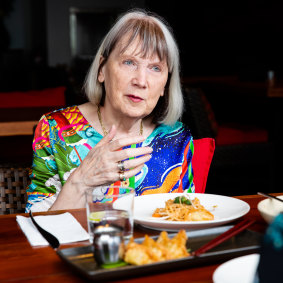
“I know how distracting it can be if you are having an interesting conversation and have to eat and order as well,” she says. “Although I won’t be eating much. But you must order something that you would really like, perhaps duck or prawns; that would make me feel a lot better.” I tell her that I am happy with her vegetarian choices of golden tofu (which she says “sounds lovely”), crispy dumplings and pad Thai.
Infuzions Thai in Cammeray is our venue because of its proximity to a studio where the Balmain-based Dowrick has been recording the audio book for Intimacy and Solitude.As it happens, recording has been completed, so there is plenty of time to move around the largely empty restaurant in search of the best spot for recording and photography.
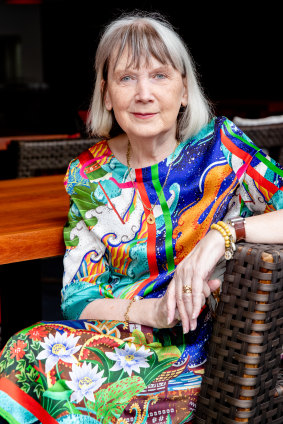
Stephanie DowrickCREDIT:EDWINA PICKLES
Dowrick’s vibrantly patterned dress, in what interior designers would call “jewel” colours, blends well with the richly coloured Thai cushions and warm woods. “Lead, Kindly Light,” she jokes, quoting a famous hymn, as we search for the most flattering spot. In addition to being a versatile author of almost 20 fiction and non-fiction books, and a psychotherapist, Dowrick is an interfaith minister who was based at Pitt Street Uniting Church from 2006 to 2017. More recently she has been co-leading “sacred gatherings” at the InnerSpace Centre in Five Dock.
Advertisement
null
It quickly becomes clear that the meal is secondary to Dowrick, who I have met several times over the years through her publishing work and journalism. She wrote a popular Inner Life column for Good Weekend between 2001 and 2010, and was a regular guest of both Geraldine Doogue and Tony Delroy on ABC radio. These days she contributes opinion pieces to newspapers, primarily on social justice, human rights and ethical issues. And as she is my friend on Facebook, I am also aware of the joy she reaps as a mother and grandparent – and of her “later life” marriage in 2017 to Darwin-based paediatrician and health activist Paul Bauert. (“Because he lives 4000 kilometres from my home, I can continue to evolve my understanding of intimacy as well as solitude!”)
Today, and perhaps always, conversation and ideas interest her. Dowrick is a woman of intense blue eyes, a direct gaze and gently probing questions; she invites confidence and confidences, and indeed becomes the interviewer as much as the subject. It is fortunate that she arrived with her background dossier.
Stephanie Dowrick.CREDIT:EDWINA PICKLES
First published in 1991, Intimacy and Solitude was an international bestseller and has been revised and expanded several times since then. The latest edition was sparked by a recognition that the unpredictable events of 2020 had made the book’s message more relevant than ever. It is an encouragement for readers, a message of hope that blends readable case studies with deeply considered but accessible wisdom. Dowrick is convinced that we all have the potential to respond to both familiar and new situations freshly and creatively, especially if we renew our closeness to ourselves and to other people.
Comedian and author Magda Szubanski, musician Clare Bowditch and politician Kristina Keneally are among her raft of fans.
“If the pandemic taught us anything at all, it is that we are utterly and inevitably connected – and not only with this earth on which we wholly depend in all its brilliance, beauty, fearsomenesss and biodiversity,” Dowrick writes in her new 7000-word introductory essay. “COVID-19 showed us plainly that we protect ourselves best by willingly and generously protecting one another – even when separate or ‘distanced’.
“As powerful as those two potent words are individually – intimacy and solitude – they together describe and evoke a steadiness of inner support and resourcefulness that brings more than resilience and inevitably extends beyond ourselves to other people.”
‘My instinct has been unwavering: that not just I, but most of us, want to do at least somewhat better in our connections with others.’
Dowrick says that in addition to interviewing many people for the book, and “surveying screeds of psychological wisdom for the finest ideas”, she reviewed her own rich catalogue of “missteps” as well as what had made life “most worth living”. “My instinct has been unwavering: that not just I, but most of us, want to do at least somewhat better in our connections with others.
“A relatively healthy sense of self lets you accept what others can give you, even when it isn’t quite what you yearned for … It’s also dependent on trusting that your life matters – whether or not it is lauded by others. And that you deserve to care for yourself as respectfully and supportively as you would a trusted and cared-for friend.”
Golden tofu on crispy wonton with crushed peanuts.CREDIT:EDWINA PICKLES
Dowrick was born in New Zealand and spent some of her formative years in isolated Maori and Pacific Island communities, where her parents were teaching. Her mother, Mary, died in her late 30s, when Dowrick was eight. It was, of course, a truly terrible experience and not one that she wishes to dwell on overly in an interview.
However, in her book she writes of the loss, which has affected the rest of her life: “Unsurprisingly, I was incapable of much self-care, never mind what ‘independence’ adds up to. I had gained immeasurably from the years of unstinting love my mother could give me when she lived. She was also, in her moral and emotional intelligence, in her creativity and pride in her profession as a gifted teacher and her commitment to service to others, an exceptional example to me.”
In the late 1960s, a lack of career opportunities in New Zealand for a clever and determined young woman led Dowrick to head for London where, with delight, she fell into book publishing (where senior women were still a rarity and her colleagues, mostly men from public schools, addressed each other by their surnames).
Crispy dumplings with leek, mushroom and ginger.CREDIT:EDWINA PICKLES
Her star rose. At the height of “second wave” feminism, in 1977, she convinced British publishing entrepreneur Naim Attallah to back a groundbreaking feminist imprint, The Women’s Press, and became its first managing director. Writers Janet Frame, Andrea Dworkin, Michele Roberts and Lisa Alther were among those who joined the list and, in 1983, with the Commonwealth publication of Alice Walker’s Pulitzer Prize-winning The Color Purple, commercial success was added to its cult status.
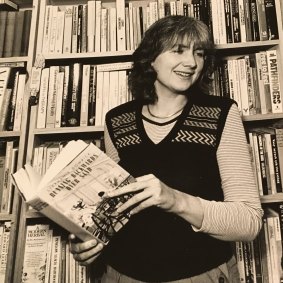
Stephanie Dowrick in 1985 after the publication of her first novel ‘Running Backwards Over Sand’.
Shortly afterwards, Dowrick moved to Sydney and had two children, Kezia and Gabriel, in quick succession; her first novel, Running Backwards over Sand, which tells of a journey of self-exploration by a young woman who has lost her mother, was published in 1985. Subsequently, she worked part-time as a publisher at Allen & Unwin and broadened her writing to focus on self-development and further explored spirituality, most particularly through the work of German poet Rainer Maria Rilke (on whom she wrote a PhD thesis that evolved into a book, In the Company of Rilke).
On learning to live with isolation, the author, an “impatient patient” who fell ill for four months and was in hospital for 10 weeks before the pandemic hit, says that while the lockdown was a crisis of communication for social beings it could also offer “an opportunity to consider with fresh interest how we can more thoughtfully support others – receiving with grace and gratitude what they may have to give”.
Pad Thai with tofu.CREDIT:EDWINA PICKLES
While many have been feeling “flat”, she says it is important to be more consciously open to receiving, even when what’s coming your way doesn’t quite fit your expectations of how things should be. Like any change, some detachment is needed to see things anew, as is stillness, which is best achieved by not being constantly busy. (“Being busy is for me a psychological defence.”)
“In illness, our world shrinks. In social isolation, our world shrinks. Yet it’s precisely now that our vision must enlarge. Choosing to be the smallest bit more generous, perhaps more tolerant in both directions (giving and receiving), is itself an act of empowerment, an act of self-respect and even love – for ourselves and for all with whom we share this planet.
The bill please.CREDIT:SYDNEY MORNING HERALD
“When we’re down, our thoughts leap into a future that’s frightening. When we slow down, by contrast, we can experience this moment and – when we can – infuse it with greater vitality and hope. We can surround people and situations with the energies of loving-kindness and care, rather than anxiety or raw terror. And when we do this, we ourselves will benefit.”
The afternoon is slipping away, but Dowrick proposes we move on to coffee and pavlova. She wants to ask me some more questions.
Infuzions Cammeray
439 Miller St, Cammeray
(02) 9957 1122
Daily, 11.30am-9.30pm
Intimacy and Solitude by Stephanie Dowrick is out now from Allen & Unwin.Save
Shona Martyn is Spectrum Editor at The Sydney Morning Herald. She was previously the Publishing Director of HarperCollins, the founding editor of HQ magazine and an editor of Good Weekend.Connect via email.
Le cœur a ses raisons que la raison ne connaît point.
— Blaise Pascal
The heart has its reasons that reason knows not of.
I. Why this review, and why here?
Karen Armstrong is a historian of religion whose erudition and insights have justly earned her great renown. Her books, such as A History of God and The Battle for God establish her as a social philosopher, as well. As such, she is a companion to Jane Jacobs, whose latest book Dark Age Ahead was reviewed in issue 104. The two of them are essential to understanding the present time. They show in both grand outline and detail how culture, politics and economics have interwoven to shape the world we live in at the beginning of the 21st century.
Bewildering Stories is very happy to have published articles and reviews in non-fiction. Our fiction has frequently featured alternate history and alternate futures. We now find ourselves at a historical juncture that many science-fiction writers have foreseen or alluded to but, I suggest, have not fully understood. They and we need to know what our history really is and what alternatives it proposes. It behooves us to listen intently to Jane Jacobs and Karen Armstrong.
II. What is fundamentalism?
[ for III. The history of fundamentalism see the entire article]
Armstrong traces the history of three fundamentalist movements:
in Judaism, especially in the state of Israel;
in Islam, first in Egypt among the Sunnis and then in Iran, among the Shi’ites;
and, finally, in American Protestantism.]
A. A general description
The best summary can be found in Karen Armstrong’s own “New Preface,” written a month or two after September 11, 2001. The terrorist attacks — “made for television” — on the centers of American economic and military power changed nothing in the conclusions of the first edition, published the year before; they only confirmed Karen Armstrong’s worst fears: a worldwide cultural rift is headed — in my terms — toward a global civil war. At best it is being fought in the realms of culture, politics and economics; at worst it spills over onto battlefields.
Karen Armstrong doesn’t like the term “fundamentalism.” It originated in the United States in the early 20th century, and its use has only recently spread to include more than some forms of American Protestantism. The term implies that fundamentalism is a monolithic reactionary movement and is similar in all religions.
Fundamentalism is not monolithic: it is as faction-ridden as any religion. And it is only vaguely similar between religions: the Jewish and Moslem versions emphasize observance and practice; Christianity is unique in emphasizing adherence to formal doctrine. Nor is fundamentalism reactionary: “The term also gives the impression that fundamentalists are inherently conservative and wedded to the past, whereas their ideas are essentially modern and highly innovative” (p. xii).
But Armstrong admits that the term has been consecrated by usage; we’re stuck with it. It is a “militant piety” that has emerged in every major religious tradition. She summarizes the definition proposed by the eminent scholars Martin Marty and R. Scott Appleby: “[Fundamentalisms] are embattled forms of spirituality, which have emerged as a response to a perceived crisis. They are engaged in a conflict with enemies whose secularist policies and beliefs seem inimical to religion itself” (p. xiii).
The fundamentalist world view implies some corollaries. Fundamentalists…see their struggle not as one of conventional politics but as a cosmic war between good and evil;fear annihilation;affirm their identity by selecting doctrines and practices from the past;often withdraw from mainstream society and create a counterculture;absorb the pragmatic rationalism of modernity;create an ideology and action plan under the guidance of charismatic leaders;
eventually fight back and attempt to resacralize a skeptical world.
Armstrong sums up the confrontation:
Even the most peaceful and law-abiding are perplexing, because they seem so adamantly opposed to many of the most positive values of modern society. Fundamentalists have no time for democracy, pluralism, religious toleration, peacekeeping, free speech, or the separation of church and state (p. xi).
B. The fundamentalist rationale
Why would anyone embrace such authoritarian thinking? For reasons that seemed good at the time: “This battle for God was an attempt to fill the void at the heart of a society based on scientific rationalism” (p. 370).
“Human beings find it almost impossible to live without a sense that, despite the distressing evidence to the contrary, life has ultimate meaning and value” (p. 135). Mythos — mythology and its cults — provides that meaning; it basically answers the question “why.” Logos — rationalism and science — answers the question “how.” Logos may heal the body but only mythos can heal the spirit.
In the pre-modern world, both mythology and rationalism were mutually indispensable. In our time, logos has become predominant and, according to an epigram of Jean-Paul Sartre’s that Armstrong is fond of citing, it has left a “God-shaped hole” in modern consciousness. And that “hole” is going to be filled somehow.
A similar philosophical adaptation has happened before. In the Axial Age of 700-200 BCE, trade began to replace agriculture as a prime source of wealth. The pagan fertility gods became irrelevant to people who were gaining a wider knowledge of the world. Ever practical, humanity replaced the old, local gods with the world religions we know today.
Now we are living in a Second Axial Age, where science has been added to land and trade as a prime source of wealth. And the old religions must once again redefine themselves and adapt lest they be discarded as irrelevant
Show me a poem written in lines with 5 beats so-so poetry is like music it’s more like music than a kiss. This is really funny what it’s coming out with Siri absolutely hilarious I can’t type my laughter
I can hear it myself I can hear it anyway all the different forms of poetry have some of the qualities in music even free verse those although it’s hard to explain it sometimes I remember when I first began writing that all my writing is in free verse and my brother said to me how do you know when to end the line and I said you just get a sense of it the fence and then you go onto a new line but before someone else might disagree with I think when I think back to him as a long ones that I wrote like him but the one about the end man or possibly young woman leaving to join the army because I’m always broken out saying goodbye to her mother and the mother is grieving the Lions are actually very short um which seem to fit in with um the feelings and although I didn’t realise it was on the 11th of September also some people in America route to me to thank you for writing it because it was 9/11 but I didn’t I didn’t contraflow I think a lot of things that we knew my husband is going to die before I even though the doctor salty with left till about November and he died on the 1st of June but we already celebrating 30th anniversary I don’t know whether he really but you know they gave me some tears, a special kind of cake and um at least I felt in myself doing had his and say when it turns I didn’t find it too painful although unfortunately the next year I did find it very painful but then that’s the price you paid until I find that 7 people want to know soon as they seem to be angry when you’re grieving Mr if they’ll never been married or had a close relationship they must be so envious that the fitness think you shouldn’t complain when you lose it and when you’re grieving you know exactly complaining that you lost it but you’re trying to adapt yourself to being one person without someone who is always like part of yourself in some ways although my husband was actually very much further than private and we both work for with another in fish outside of our relationship but you know what is the Silverstone Home and away is scanning emotional security that you know that when you go home with somebody that will listen to you I’m just sending middle of writing a book or something but they will listen to you and possibly come for you if you need it I know that adults can live without having the same with all the time but we are animals and animals tend to like to be with her animals ,animals like themselves because with animals like themselves there is a mate when it’s the right season and the home hunt together and they can now look after their young together this is sleeping it really that they want to which types of Arran to like to do that human being this day seem to like to sleep in the heat not anymore but I think in the past and in the house like the ones where I live out there any similar only had two bedrooms wh for the mother and the father are all the children respect to the dead in the other room at the top of the bottom I don’t know when I don’t know what happened when they reach puberty Avenue in one family only have two children the morning when the children reach puberty they’re all slept with the mother and the boys check with the follow through the mother and the father themselves didn’t after sleep together praxitelous plastic wrap suit practice trip together with me and children at school right now shouldn’t be saying this way if it’s not very nice visit me while I’m just kind of thinking about the fact that turn to be alone in the house in which you lived with your loved ones for many years is quite difficult but on the other hand it’s familiar I don’t think I’d like to go somewhere completely different at the moment but some people my02 you know I’ll get married a few weeks after they’ve been removed because of the contrary to be in the same house all to be alone. There’s an American writer called Joyce Carol Oates and she wrote a book about at the death of Ivan and how it affected her and not matter of fact she got married again and see ya Rafi died and she’s got heavily criticised for having written this week about loss and pain and Mirena when probably by the time it was published showing already remarried but I mean she didn’t mean that she hasn’t started losing the first husband. Actually they do you say that if you been happily married you more likely to get married again but I don’t think that I would like to get married again because it is quite an old phone to get to know somebody and it will be very easy to find someone who sings pleasant it interesting in a certain amount of chemistry how much to tell if you’d expect at this ungodly reason but there are some things I believe that smell is very important that you like the way they smell that that’s so but then you might find out there and all sorts of peculiar habits so light I want to see friends of mine they had a man the friend who is the at the weekend or with whom they went out to concerts and things like that and and left them in the Mail on Sunday but they didn’t actually live together in the same house all the time ironically what are these women displaying Me toys and me because I was talking to her on the phone and my husband will learn quite well I need to cook them in and he came in and he said and they didn’t read it and she said I don’t owe anyone just I thought to myself that’s because you wouldn’t marry your partner who wanted to marry you and you refuse and if you had married him it was very well you could have bought all your food in, you could have gone to a restaurant or you have 2 boxes in Marks and Spencer’s with you and pretending that you can have it or eat it must have been able to cook because it is period wanted split up because of her and then I don’t know what he lived on that Tuesday feeling well Friday Saturday and Sunday so that’s how the leftovers for those when he will need to make himself and me London if you think you’ll be happy until he got you won’t feel and then they laugh died









































 What do you say to a new teapot?


 How my heart speaks