
He writes like an iron bic-ed amateur
He is ill,but literate
A new EU law says women must wear bikinis in Tesco’s or wrestle with unarmed policemen in the Forum.Which do you prefer?
She is literate and beautifully formed
He’s reads swell in any form
I never like to show off my sun gnats.They bite the hand that wrote them
It’s the Sybillines that count
Make sure you do writhe all day to start with
There’s no such thing as a poetic horse.
Remember stress is useful in poetry only
She has a very worried accent.
She asked me was I very foreign.I said I was about two standard abbreviations from the mean.And by golly,they are very mean
Don’t bother about Eugenie’s ass
If you can read and write you can learn a lot of bad things and pass them on to cause more harm and sin
Month: Sep 2016

And yet my vision may deceive as guide
As heavy blankets hurt my tender joints
So bills unpaid weigh on my flattened heart
And tasks I can’t complete to hell do point
And darkness does my soul long time assault
Yet to the innocent who pass me by
These black demonic ills are hard to see
And though I trudge they seem to think I fly
While my heart sinks and soon no more will be.
What being will caress my tender limbs
And soften muscles now as hard as steel?
What human arm will drag me from the rim
Of well so deep its waters have congealed?
And yet my vision may deceive as guide
Blind fantasy sees mice as lions wild.
Share this:
It seems to speak
Her grief so palpable ,it seems to speak
Her vocal chords once soft are stiff and pained
Her face deep hurt,. her body taut yet weak
Her grief so palpable , ah, please,please speak
Ill tempered men have pleasured in her shrieks
Yet when such grief ‘s been tempered and refined
The vocal cords might be enjoyed again
Her grief so palpable . why don’t we speak?
Her body bends, we should have taken pains
Share this:
Palpable

Merriam Webster
palpable
Definition
1 : capable of being touched or felt : tangible
2 : easily perceptible : noticeable
3 : easily perceptible by the mind : manifest
Examples
The tension in the courtroom was palpable as the jury foreman stood to announce the verdict.
“The beautifully shot, meditative film takes on a palpable sense of urgency after Maria makes a fateful move, leaving both the young woman and her family in a quandary that forces them to deal with the outside world, including a harrowing trip to a hospital where no one understands their language.” — David Lewis, The San Francisco Chronicle, 26 Aug. 2016
Did You Know?
The word palpable has been used in English since the 14th century. It derives from the Latin word palpare, meaning “to stroke” or “to caress”—the same root that gives us the word palpitation. The Latin verb is also a linguistic ancestor of the verb feel. Palpable can be used to describe things that can be felt through the skin, such as a person’s pulse, but even more frequently it is used in reference to things that cannot be touched but are still so easy to perceive that it is as though they could be touched—such as “a palpable tension in the air.”
Share this:

Late summer


Share this:

Then, recognised, by heart and soul,
My mind today is like a magnet.
It attracts those small
yet potent words
that fit its present thoughts;
creates a replica
of wounds afresh.
If, like a welcome sun,
new light will shine for me,
reveals,
transforms.
I’ll then
perceive
those frozen narratives of loss
as only part of me,
New words,
New sentences.
New narratives,
New stories made from generous recognitions grow,
if what’s perceived is held,
like iron in the fire,
till transformation comes.
Burned into being by this blazing,
Transmuted,changed.
New conceptions
linked to draw, as from a different view. point.
Then, recognised, by heart and soul,
They shall combine to makes a new and larger whole.
Share this:

A life in writing
An excellent article
Why do Poets write Iambic Pentameter?
Good writing and thinking

- May 14, 2009 Tweaked & corrected some typos.
 Because it wasn’t there.
During the sixteenth century, which culminated in poets like Drayton, Sidney, Spenser, Daniel, and Shakespeare, English was seen as common and vulgar – fit for record keeping. Latin was still considered, by many, to be the language of true literature. Latin was essentially the second language of every educated Elizabethan and many poets, even the much later Milton, wrote poetry in Latin rather than English.
Iambic Pentameter originated as an attempt to develop a meter for the English language legitimizing English as an alternative and equal to Latin (as a language also capable of great poetry and literature).  Since meter was a feature of all great Latin poetry, it was deemed essential that an equivalent be developed for the English Language. But poets couldn’t simply adopt Latin’s dactylic hexameter or dactylic pentameter lines. Latin uses quantitative meter…
View original post 5,862 more words
Share this:
THE SECOND COMING by: W. B. Yeats (1865-1939)
|
 URNING and turning in the widening gyre
Share this:

And learn the feeling Arts
Shall we cling to grudges from the past.
Distorting vision;injuring our hearts?
Shall we loosen that tight grip at last?
Shall we cling to grudges from the past,
When grace is waiting for all us poor outcasts?
Soon enough we sinners shall depart
Shall we cling to grudges from the past,
With derision ;injuring our hearts?
Shall we choose to hold our wounded heart
Yet not retaliate and hurt this friend or foe?
For indulged anger grows and war can start
Shall we choose to hold our wounded heart
Contain our rage and learn the feeling Arts?
For all of us have traversed Arctic snow
Shall we choose to hold our wounded heart
Yet not retaliate and hurt this once loved foe?
Share this:
Loving winter
Winter love comes when we near the end
Yet do not wish for solitude each day.
Cupid wtth his arrows may descend
He jokes with us and invites us out to play.
Winter love may come amidst the snow
When frost bites noses and nips fingers dear.
But despite her age a woman out may go
To walk her lover and content appear..
The age of frost has not entered my heart
My mind has filled with fresh and new desires
The problems come when lovers desperate
Show contempt and start a bitter pyre.
Yet winter love can grip me despite flaws
Hope and laughter circle me uncaused.
Share this:
Structure of a triolet
A
B
A (repeat first line)
a (rhymes with first line)
b (rhymes with second line)
A (repeat first line)
B (repeat second line)
The summer weighs us down with sullen heat
Even cats and dogs sit still as stones
Gone are early flowers with fragrance sweet
The summer weighs us down with sullen heat
The hot flagstones return my angry beat
As people scurry by ears to their phones.
The summer weighs us down with sullen heat
Even cats and dogs sit still as stones
Share this:
The Langdale Pikes are fearsome to dead hens
The Langdale Pikes are fearsome to dead hens
Whose feet are used to engraved golden roads
The Langdale Pikes are fearsome unless penned
But from the heights you cannot see a toad.
Though mountains can allure us like a whore
They cast huge shadows onto Network Rail
You cannot tell a sculpture,je t’adore
Despite the surplus in next Winter’s Tails
They test my soul with glue like a quagmire
One has to have a head and a big ass
Sheep prefer the local red-haired deer
Who rescue them when donkeys miss the path
Should we learn to lose our fear of light
From the peak we see all human blight
Share this:
Emile pushes Stan out of bed

-
Stan awoke feeling very thirsty.My, this bed is much too hard,he thought.He put out his hand and felt some wood not far away.It was his desk.Emile was lying on Stan’s stomach purring.
You fell out of bed,the little cat miaowed.Luckily I clung on with my claws and I am ok sleeping down here….I can see mice better.
Well,it’s not ok with me,Stan informed him gently.How can I get up from here?
He picked up the Cambridge Companion to Sylvia Plath and banged on his desk softly.
Mary was awake and heard a strange sound.She got up and found Stan lying on the floor with his head by his desk.
Emile wanted to sleep by the wall,you see.,he told her.
Then he rolled over and I fell out.That is logically and scientifically unsensible,Mary told him.Surely Emile is not so big that his weight was enough to knock you out of the bed? It is against the law of gravityAnyway,why don’t you get up?
I like it down here,the old man lied to her optimistically.
Rubbish,Mary said,then she picked up the phone and rang 999.
Hello,she said.My cat is very upset as he feels guilty for pushing my aged husband out of bed.
How terrible for you,the man answered.I’ll send an ambulance right away.
Mary opened the front door and left it unlatched whilst she lit the electric lights with a match.
How do you feel now Stan,she enquired tying her red polyester fleece dressing gown a bit tighter before the paramedics arrival
I am thirsty,give me some brandy,he ordered her politely as he was full of kindness
They said not to let you or Emile drink or eat
Blooming ridiculous,he told her in a manly fashion.
Soon the ambulance arrived and the paramedics were running up the stairs to see the poor cat. Mary fainted so they laid her on the bed whilst they comforted Emile and cleaned his paws.Then they picked up Stan and laid him right next to Mary,his wife.
Why don’t you have a bigger bed,one asked Stan.
Bigger than what,he responded academically.
Well,if you were any fatter you’d not be able to lie next to your wife.
True,he replied but my wife is too large.I keep hoping she will lose weight.
I shall make you some tea the female paramedic told them forcefully
Well,you don’t seem to be hurt,the other one told Stan, but the cat may need therapy or counselling because of the guilt he will feel.
He’s not a Catholic ,I hope?
No, he’s Jewish,Stan shouted implausibly.
That’s alright then.How do cats get to be Jewish anyhow?
It’s their souls,Mary said…they are all waiting up there for a suitable place to be reborn and some choose to be cats.
But how can you tell? he asked wonderingly.They have no prayer shawls
They miaow in Hebrew,Mary said loftily.And they like to sing the psalms before bed.
But how do you know it’s Hebrew,he replied.Do you speak it?
No, it’s just he hates bacon and pepperoni and always wears a hat so it seems he must be one of Jesus’s friends,but not Judas of course.I suppose Jesus wore a hat but it’s never been found as yet.Not even being sold as a relic.Well,that’s intriguing.Do you think Emile might be the Messiah?
Oh,dear.We never thought of that.Will he have to go to Galilee and catch fish and walk on water?
No, he can go to Rome and tell the Pope that the Church is not what God planned.
I hope they don’t kill him,Mary cried sadly.
God will not be very happy.
I didn’t know God had moods,Stan said.
He has post-creative depressive disorder….no wonder when we look round the world.
Still they did try,I’ll say that for him or her.
And so say all of us.
For he’s a very good yeller,he’s a very good yeller
A cat’s life is a fuss.Miaow.
Share this:

Stopping by Woods on a Snowy Evening
BY ROBERT FROST
Whose woods these are I think I know.
His house is in the village though;
He will not see me stopping here
To watch his woods fill up with snow.
My little horse must think it queer
To stop without a farmhouse near
Between the woods and frozen lake
The darkest evening of the year.
He gives his harness bells a shake
To ask if there is some mistake.
The only other sound’s the sweep
Of easy wind and downy flake.
The woods are lovely, dark and deep,
But I have promises to keep,
And miles to go before I sleep,
And miles to go before I sleep.
Share this:

Why do poets use iambic pentameter?
https://poemshape.wordpress.com/2009/04/17/why-do-poets-write-iambic-pentameter/
Extract:
The Fall of Iambic Pentameter
By the end of the Victorian Era (1837-1901), and in the hands of the worst poets, Iambic Pentameter had become little more than an exercise in filling-in-the-blanks. The rules governing the meter were inflexible and predictable. It was time for a change. The poet most credited with making that change is Ezra Pound. Whether or not Pound was, himself, a great poet, remains debatable. Most would say that he was not. What is indisputable is his influence on and associations with poets who were great or nearly great: Yeats, T.S. Eliot (whose poetry he closely edited), 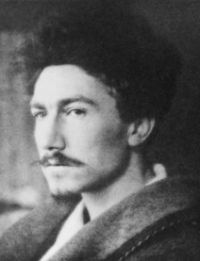 Frost, William Carlos Williams, Marriane Moore. It was Pound who forcefully rejected the all too predictable sing-song patterns of the worst Victorian verse, who helped initiate the writing of free verse among English speaking poets. And the free verse that Pound initiated has become the indisputably dominant verse form of the 20th century and 21st century, more pervasive and ubiquitous than any other verse form in the history of English Poetry – more so than all metrical poems combined. While succeeding generations during the last 100 years, in one way or another, have rejected almost every element of the prior generation’s poetics, none of them have meaningfully questioned their parents’ verse form. The ubiquity and predictability of free verse has become as stifling as Iambic Pentameter during the Victorian era.
But not all poets followed Pound’s lead.
A wonderful thing happened. With the collapse of the Victorian aesthetic, poets who still wrote traditional poetry were also freed to experiment. Robert Frost, William Butler Yeats, E.E. Cummings,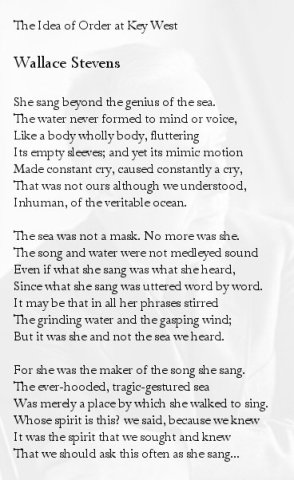 Wallace Stevens all infused Iambic Pentameter with fresh ideas and innovations. Stevens, Frost and Yeats stretched the meter in ways that it hadn’t been stretched since the days of the Elizabethan and Jacobean Dramatists. Robert Frost’s genius for inflection in speech was greatly enhanced by his anapestic variant feet. His poems, The Road Not Taken, and Birches both exhibit his innovative use of anapests to lend his verse a more colloquial feel. The links are to two of my own posts.
T.S. Eliot interspersed passages of free verse with blank verse.
Wallace Stevens, like Thomas Middleton, pushed Iambic Pentameter to the point of dissolution. But Stevens’ most famous poem, The Idea of Order at Key West, is elegant blank verse – as skillfully written as any poem before it.
Yeats also enriched his meter with variant feet that no Victorian poet would have attempted. His great poem,Sailing to Byzantium, is written in blank verse, as is The Second Coming.
Yeats, Frost, Stevens, Eliot, Pound all came of age during the closing years of the Victorian Era. They carry on the tradition of the last 500 years, informed by the innovations of their contemporaries. They were the last. Poets growing up after the moderns have grown up in a century of free verse. As with all great artistic movements, many practitioners of the new free-verse aesthetic were quick to rationalize their aesthetic by vilifying the practitioners of traditionalpoetry. Writers of metrical poetry were accused (and still are) of anti-Americanism (poetry written in meter and rhyme were seen as beholden to British poetry), patriarchal oppression (on the baseless assertion that meter was a male paradigm), of moral and ethical corruption. Hard to believe? The preface to Rebel Angels writes:
One of the most notorious attacks upon poets who have the affrontery to use rhyme and meter was Diane Wakoski’s essay, “The New Conservatism in American Poetry” (American Book Review, May-June 1986), which denounced poets as diverse as John Holander, Robert Pinsky, T.S. Eliot, and Robert Frost for using techniques Wakoski considered Eurocentric. She is particularly incensed with younger poets writing in measure.
Share this:

Trying to glimpse another through their veil.
I embraced the ambiguity like a bride
Who fears disclosing that her face is fake
And while we’re on the subject, I take pride
In stealing water colours from the lake
Ambiguous in intentions we don’t know
We send out signals full of first class news
If this rebounds an artist might then show
Our vision rests upon our point of view
Seventeen types of clarity are mine
Fifteen from my mind and two from pride
From this glass I make a view divine
Though Sunday someone said they thought I lied.
Ambiguously ,we hover by the scales
Trying to glimpse another through their veil.
Share this:
This is very good

https://www.poets.org/poetsorg/text/how-read-poem-0
Williams admits in these lines that poetry is often difficult. He also suggests that a poet depends on the effort of a reader; somehow, a reader must “complete” what the poet has begun.
Share this:

But now it is what McCall Smith calls “late”
Sometimes when bereft I’d love a snail
Though it might wet my bed with silvery trails
Would snails be lonely living in my house?
Shall I be but fit to love some louse?
I hugged a rowan tree and now it’s dead
The council said they’ll give me oak instead
It stood upon the pavement by the gate
But now it is what McCall Smith calls “late”
I wonder if self massage is the thing
Some perfumed lotion stolen on the wing.
I stroked my arms with Cream E45
Now they say I’m not allowed to drive!
I was sad but now I am at peace
All I needed was a plate of eggs and grease.
Share this:
But shall I help the blind to lose their creeds?
I empathise with ladies in great need
Though I prefer a cape where they like coats
But I have got a crutch and cannot speed
Nor can I with my smartphone walk and read
But shall I help the blind to lose their creeds?
In my hand I carry a large tote
Full of silken scarves and hearts that bleed
Share this:
As I ran off and thousands were in chase
I can’t buy any clothes for I’ve no space
Yet in the autumn women like new coats
I wonder should I transform my pale face
And wear a golden necklace for its grace
Though it might prick a lover in embrace
At least it would sort out the men from goats
As I ran off and thousands were in chase
Share this:
On the road to Dent
On the road to Dent there was a pool
A river in the dale had made a loop
So out your clothes and into it you lept
While tame sheep wandered round me in a group
Eating ginger biscuits as they trooped.
On the road to Dent there is a pool
To pass it by,you’d have to be a fool
Share this:
When we feel
I do not wish to feel this sadness now
But who decides,who chooses what we feel?
If I were strong I might use a large plough
To knock my feelings level when they grow
Bur that is not allowed by God and co.
Yet who denies his measuring the real?
I do not wish to feel this sadness now
Think, who derides,who cackles when we feel?
Share this:
Why a poet writes
https://www.poets.org/poetsorg/text/why-i-write
The possibility of suffering being redeemed by art, being made meaningful and thus real (as opposed to merely actual, something that happens to exist, happens to occur), is still vital to me. Art reminds us of the uniqueness, particularity, and intrinsic value of things, including ourselves. I sometimes have little sense of myself as existing in the world in any significant way outside of my poetry. That’s where my real life is, the only life that’s actually mine. So there’s also the wish to rescue myself from my own quotidian existence, which is me but is at the same time not me at all. I am its, but it’s not mine. For most of us most of the time, life is a succession of empty moments. You’re born, you go through x experiences, you die, and then you’re gone. No one always burns with Pater’s hard, gem-like flame. There’s a certain emptiness to existence that I look to poetry, my own poetry and the poetry of others, to fulfill or transcend. I have a strong sense of things going out of existence at every second, fading away at the very moment of their coming into bloom: in the midst of life we are in death, as the Book of Common Prayer puts it.
In that sense everyone is drowning, everything is drowning, every moment of living is a moment of drowning. I have a strong sense of the fragility of the things we shore up against the ruin which is life: the fragility of natural beauty but also of artistic beauty, which is meant to arrest death but embodies death in that very arrest. Goethe’s Faust is damned when he says, “Oh moment, stay.”
Share this:
Daniel Hoffman, 1923 – 2013

This is where it is published

Arriving at last

It has stumbled across the harsh
Stones, the black marshes.

True to itself, by what craft
And strength it has, it has come
As a sole survivor returns

From the steep pass.
Carved on memory’s staff
The legend is nearly decipherable.
It has lived up to its vows

If it endures
The journey through the dark places
To bear witness,
Casting its message
In a sort of singing.
From Beyond Silence: Selected Shorter Poems, 1948-2003 by Daniel Hoffman. Copyright © 2003 by Daniel Hoffman. Reproduced with permission
Share this:

OK you are not Shakespeare, now get back to work
“If you want to write, or really to create anything, you have to risk falling on your face. How much easier to sit back and snipe at the efforts of yourself and others. How sophisticated you can become, your own contribution unimpeachable, because it does not exist. Sometimes insightful, always acute, the inner critic can become your closest literary friend, the one who tells you the truth, the one who makes you laugh at yourself and punctures your delusions.”
Share this:

Putting in the Seed by Robert Frost


Share this:

A Time to Talk By Robert Frost
When a friend calls to me from the road
And slows his horse to a meaning walk,
I don’t stand still and look around
On all the hills I haven’t hoed,
And shout from where I am, ‘What is it?’
No, not as there is a time to talk.
I thrust my hoe in the mellow ground,
Blade-end up and five feet tall,
And plod: I go up to the stone wall
For a friendly visit.
Source: http://www.familyfriendpoems.com/poem/a-time-to-talk
#FamilyFriendPoems
Share this:
We wished to see the flowers when in full bloom
We ‘d hoped to see the rose gardens in June
But on the 1st he died and travelled on
We both enjoyed the roses in full bloom
We used the dark to see the stars and moon
But by the 1st I found that he was gone
We hoped to see the rose gardens in June
As I tell, dark death arrived too soon
And took away the life of a dear man
We wished to see the flowers when in full bloom
As he lay,I sang to him the psalms
I knew before the doctor’s he was going.
We meant to see the rose gardens in June
Then there with me he re-encountered calm
I had not gone there with a plan
We longed to see the flowers enchanting blooms
May was cold and bitter with alarm
That was when he fell , yet rose again
We hoped to see the rose gardens in June
We loved the scent of roses in their time
Share this:
“Hope” is the thing with feathers
This first line is often quoted but often people don’t knpw where it comes from
You might try singing it to the melody of “The yellow rose of Texas”
“Hope” is the thing with feathers –
That perches in the soul –
And sings the tune without the words –
And never stops – at all –
And sweetest – in the Gale – is heard –
And sore must be the storm –
That could abash the little Bird
That kept so many warm –
I’ve heard it in the chillest land –
And on the strangest Sea –
Yet – never – in Extremity,
It asked a crumb – of me.

 How my heart speaks