
 Her hems looked as if she had studied all of non-Euclidean geometry and wanted us to know it
Her orange pleated culottes were unpleated after an hour on the bus
Her velvet trenchcoat would ensure she would lose, single handed, WW3 before it even began
Her knicker length denim shorts and shrunken T shirt made groping a dreadfully un-PC temptation to the men selling ripe mangoes and pears.And the women too.
Her head was extraordinarily big so she was fortunate in having two large feet and a a yard [with a brick lavatory, once the last word in elegance]
He said her thesis was on Quantum Dramatics and Lunar Division.I don’t believe a word of it
He said , in general it’s a real nativity.
Her trench-coat had holes all over for drainage.Suitable for ladies with hot gushes
In bed she wore a velvet sheath and long loves
If you have cramp. wear a loose light dress and kippers
She had a T shirt with her IQ printed on the front.In Chinese.Was it wise?Was it fair?
I had one made saying,Je suis le moron de Tel Aviv. I don’t know any Hebrew.And they don’t know me neither.
Her underwear was absolutely pure silk unfortunately as she suffered from cystitis and often could not wait.Wear towelling knickers and a big skirt and you will be completely safe from men,bugs and fashionable desires
Month: Apr 2018

Gather ye coal dust by T.May.

I took this photo in 2008
Don’t believe him, it’s just a contincnce trick
She shelled pea shells in the she store
Gather ye coal dust by T.May.
He’s a psychowrath and sociodeath made into one
That’s not a man,it’s my husband.
He’s my brother-in-flaw.
Can I carry my sister?
She was my aunt by barrage
He tells lies as if he was born to tweet.
If he is a liar, I’ll eat my cat
He’s as honest as the ploy is wrong.
He tried to talk me into his shed.
I don’t know what the Eskimos know
{ that line occurred to me in a dream, and I was singing it]
If all goes well,I’ll be wool soon
He was my sweetheart for a shower or two
I don’t like delta x.It comes and goes and yet all calculus depends on it.Talk about quantum dramatics!
Why do x,y, and z stand for the unknown? I’d prefer names like John,Mike and Fred
dJohn/dFred =3 times round the houses at the speed of fright
I never understood physics and I don’t know y.
He was a mutation alright.He had no strings on his violamb
She used to eat cake for its interference and i-songs
Share this:

The poet contemplates the nature of reality
https://www.poetryfoundation.org/poems/145594/the-poet-contemplates-the-nature-of-reality
The Poet Contemplates the Nature of Reality
On the side of the road a deer, frozen, frigid.
Go back to your life, the voice said.
What is my life? she wondered. For months she lost
herself in work—Freud said work is as important
as love to the soul—and at night she sat with a boy,
forcing him to practice his violin, helping him recite his notes.
Then the ice thawed and the deer came to life.
She saw her jump over the fence, she saw her in the twilight,
how free she looked. She saw her eyes shiny as marbles,
as much a part of this world as the fence a worker
pounds into the earth. At night she still sat with the boy.
He’s learning “Au Claire de la Lune.”
Do you know it? He has established a relationship
with his violin. He knows that it takes practice to master it:
the accuracy of each note, to wrestle his feelings to the listener.
But he’s impatient. Sometimes what he hears and feels
are not always the same. Again, the poet says.
She knows if he tries to silence his fervor, he might not ever know
who he is. The poet contemplates whether a deer can dream.
Rich blood-red berries on a branch, pachysandra in the garden.
A soft warm bed in the leaves.
Share this:

Symphony of science
Share this:
Covered in ink
After I had my wisdom tooth out I got a UTI so my brain is a bit off!I hope now I am on antibiotics I shall be able to write again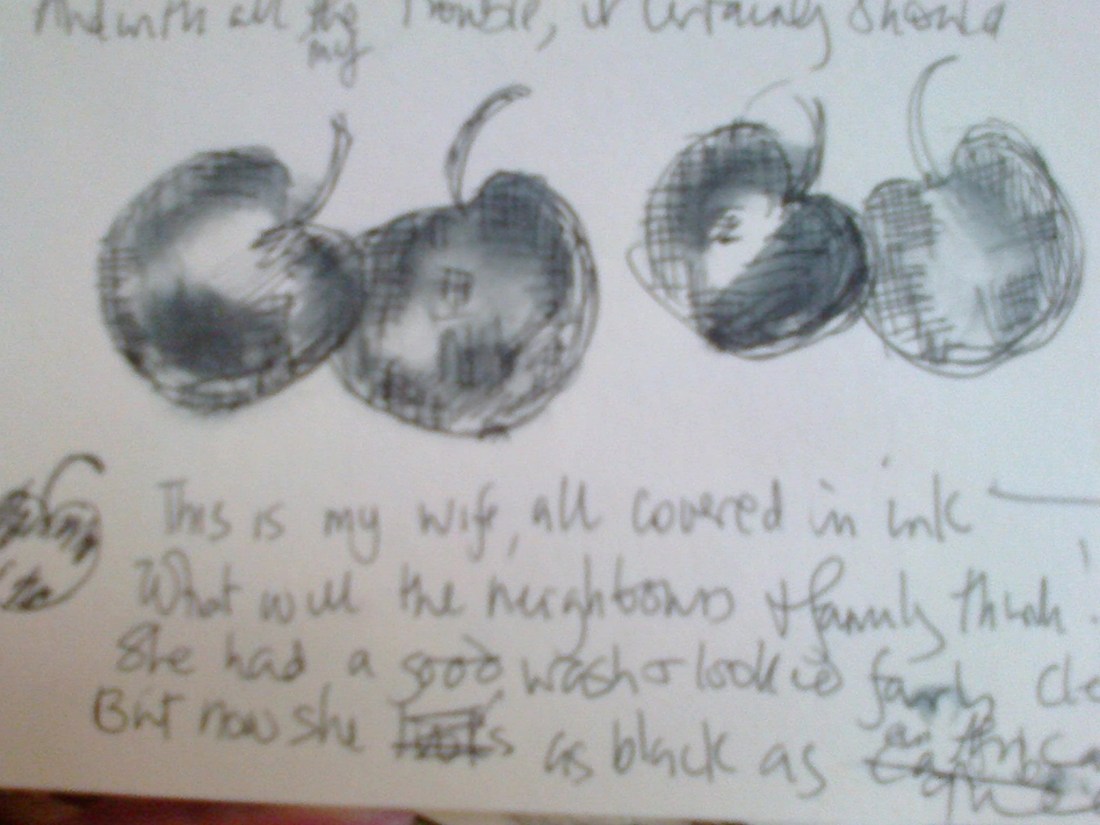
Share this:

Yet shadows give the depth and height to life
A gentle growth of fragile spring time plants
Takes our minds off wasps and biting ants
In Nature we can see the cruel and kind
As we do in our own human minds.
The shadow hides behind the perfect form
Soon the flower will wither, all forlorn
Yet shadows give the depth and height to life
The shadow and its form are man and wife
We look for sunny days and pleasures green
To love in meadows and inside our dreams
But winter will descend despite our pleas
As soil and earth desire the cold to grieve
Look at what opposes love’s desires
Then let your human heart burn in the Fire.
Share this:
Where angels must not tread, there love agrees
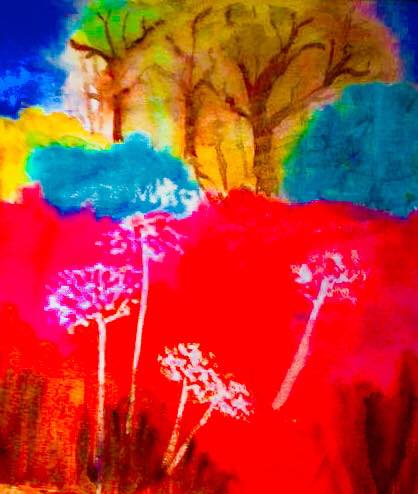
By my sister copyright
Colours make us think of love and joy
Forgot the hate beneath which may annoy
As we need respite from the strain of life
So a husband needs a kindly wife
Forget the new age politics and rights
The PC speech that our desire will blight
Underneath there is a river deep
Where man and woman live and love may leap
The old men still remember with their hearts
The young may never feel the union start
For underneath the gossip and the sleaze
Where angels must not tread, there love agrees
Let the silence of the evening sky
Give us sense to live and sense to die
Share this:

Where all our darkest shadows live.
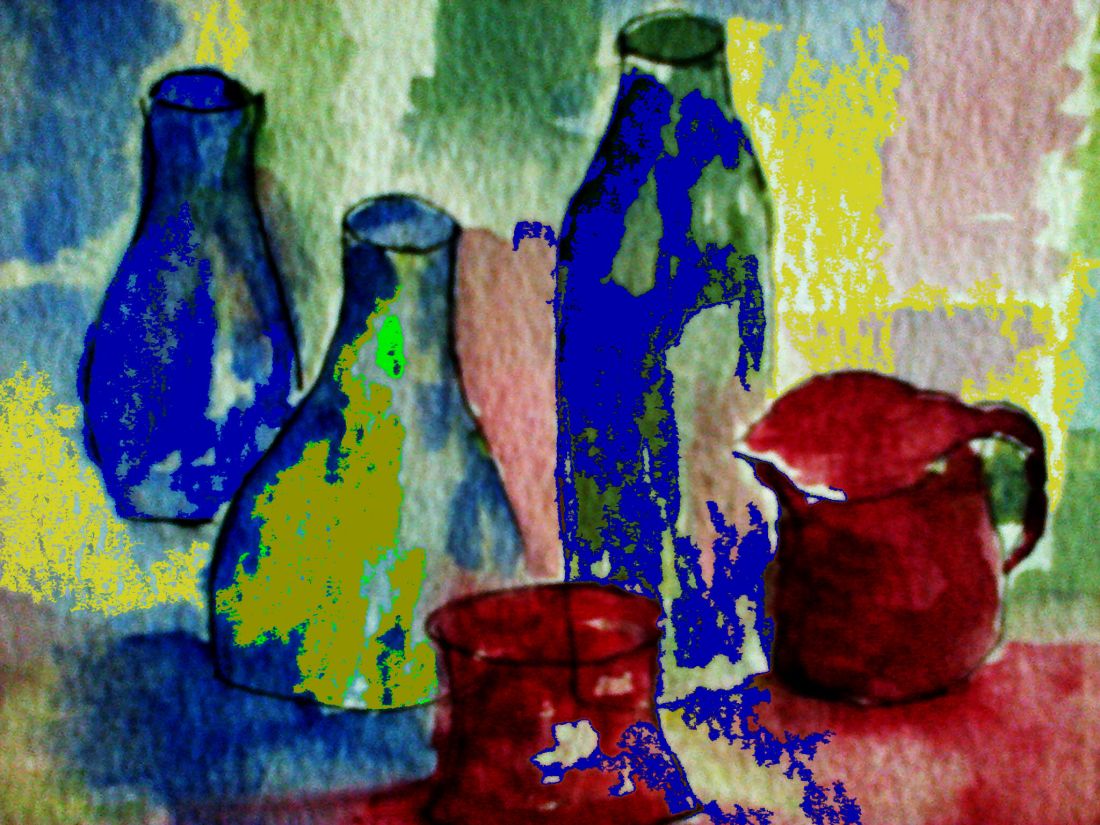
The trees’ roots wind beneath the grass.
Grass so perfect,neatly mown.
In roots entangled,serpents mass
Beneath the fruit trees which now groan.
Another,darker world beneath,
Where the roots stark homes do give
To tiny creatures which there seethe,
Where all our darkest shadows live.
From here a serpent malice took
From our neglect what we hate.
We see the surface , do not look
At what lies deeper ,till too late.
And so we live, both deaf and blind
To the depths of our own minds
Share this:

Rising Sap by Mike Flemming

Share this:

Rhetoric
noun: rhetoric
-
the art of effective or persuasive speaking or writing, especially the exploitation of figures of speech and other compositional techniques.“he is using a common figure of rhetoric, hyperbole”
synonyms: oratory, eloquence, power of speech, command of language, expression, way with words, delivery, diction “he was considered to excel in this form of rhetoric”-
language designed to have a persuasive or impressive effect, but which is often regarded as lacking in sincerity or meaningful content.“all we have from the Opposition is empty rhetoric”
synonyms: bombast, loftiness, turgidity, grandiloquence, magniloquence, ornateness, portentousness, pomposity, boastfulness, boasting, bragging, heroics, hyperbole, extravagant language, purple prose, pompousness, sonorousness; More
-
Origin
Middle English: from Old French rethorique, via Latin from Greek rhētorikē (tekhnē) ‘(art) of rhetoric’, from rhētōr ‘rhetor’.
Share this:

An old manor house in Harlowbury


Feeling is the highest art of all
How like a prison is a body lame
The mind  calls up desires and feels no shame
But bones and joints all give us  piercing pain
And  who will pay insurance or  take blame?

In my prison,I accept demands
I exercise  and write words out by hand
Encourage heart and  soon  will understand
While down the channel  runs a little sand

I read King Lear and thought the king a  fool
He did not live nor die as monarchs rule
Now I’m stuck inside a structure cruel
I'm the the nail which hides inside the jewel

The body’s more important than the soul
Feeling is the highest art of all
Share this:
He got divorced as he could not bear Lynn

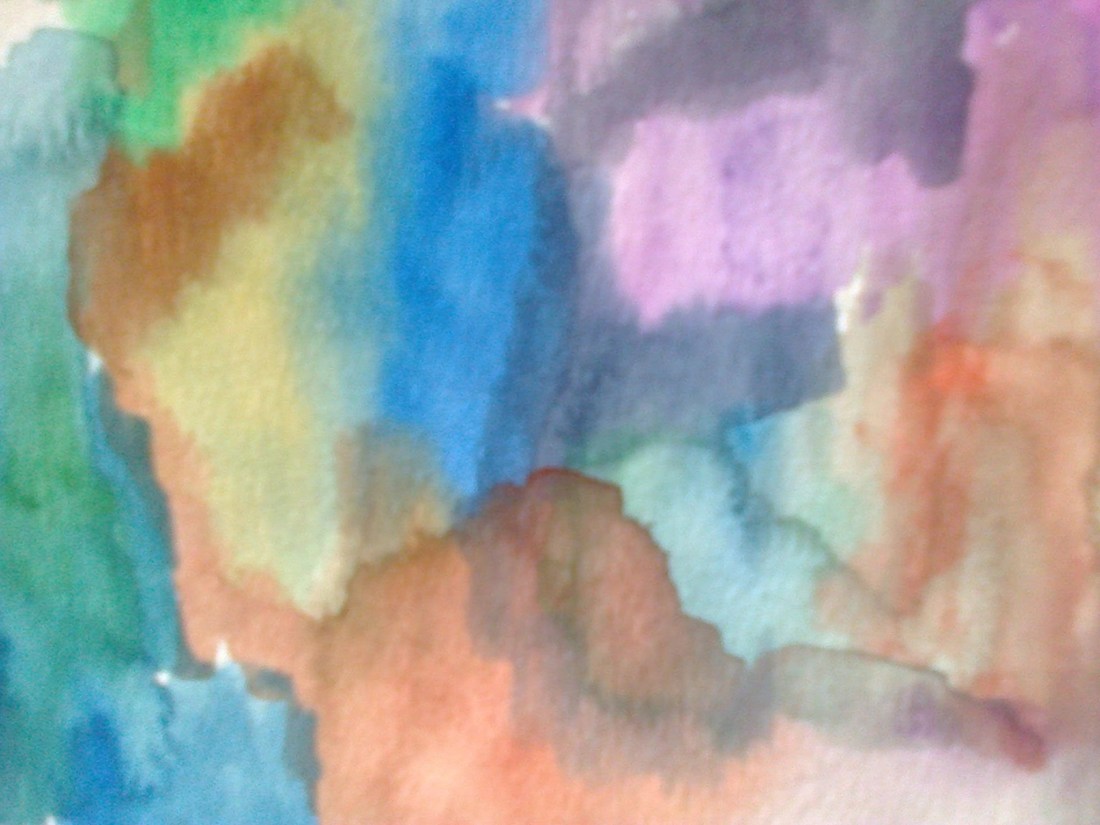
Image from watercolour by author
He got divorced as he could not bear Lynn
He could not roam
He was such a rotter,damn
Some flew,Hugh trekked
Could you cope in Argon?
He stole Joanna’s berg.
He leads her by the nose.
He was too loose for her.
I envy Enna.
The hamster,damn..
He kept his head in Bury.
And as glass goes, he went.
He’s done Dee already
Don’t tell Aviv.
How about we go Haifa?
I will not love a man till I can sail to Gaza without asking ,Is Raoul in?
Who is Ray ‘ell?
Don’t Bask all night, we can’t leave Kat alone here.
Oh,my pyre knees.
I can’t bear new yolk eggs.
Why not dun caster?
It’s Hull here.
Share this:

Not tonight
Not tonight,I’ve lost my wisdom tooth
That’s about six you’ve lost since we got engaged.How many jaws have you got?
Not tonight,I feel blue
You look red to me!
Not tonight,I am reading the Bible
Doesn’t it tell you a wife must obey her husband?
Is that rape if you order me about?
It depends on whether you like it
I do like it sometimes
But when?
That’s what I am wondering.
Not tonight,I am writing a poem
A limerick?
A postmodern mimic’s life
If you’d told me your IQ was 189 I’d never have married you.
But it’s not 189
That’s what they all say.
Not tonight I am sleeping with the cat
Can I not join in?
Not tonight I have toothache
Where?
My glands swelled so I can’t tell
Surely you can open your mouth?
I’m too fastidious.
Well,can you eat?
I’d love a piece of cake.
Can I bribe you?
I doubt it.I am too scrupulous.
I’ll give you a new car
I can’t drive
Why not?
I like the man to drive.
I see.But if you won’t open the door he can’t get in
Why, is it locked?
Probably but I might get lucky
You’re worse than Leonard Cohen.
I didn’t know you slept with him.
Well. it looked like him.
It?
Maybe a daydream.
I could have danced all night but I was marking the algebraic topology exam
Share this:

Not tonight,dearest,I have to gargle with salt water
https://www.poets.org/poetsorg/text/poems-passion-and-sex
“The phrase “carpe diem,” from a quote by Horace, means “seize the day,” and is often used to describe persuasive poetry designed to convince the object of the poet’s desire to make love—for time is short, as the argument goes, and anything might happen. Other arguments range from the existential to the absurd, and poets make their points persistently in an astounding variety of ways, using every metrical and technical device to show off their wit and prowess. Perhaps the most famous example is Robert Herrick’s poem, “To the Virgins, Make Much of Time” where he begins, “Gather ye rosebuds while ye may.” Another famous example is Andrew Marvell’s argument in “To His Coy Mistress,”
Now let us sport us while we may;
And now, like am’rous birds of prey,
Rather at once our time devour,
Than languish in his slow-chapp’d power.
Let us roll all our strength, and all
Our sweetness, up into one ball;
And tear our pleasures with rough strife
Thorough the iron gates of life.
Thus, though we cannot make our sun
Stand still, yet we will make him run.
The form has inspired both imitations and satires. In reply to Christopher Marlowe’s shepherd, who begged his nymph to “Come live with me and be my love,” Sir Walter Raleigh let his nymph knowingly reply:
If all the world and love were young,
And truth in every shepherd’s tongue,
These pretty pleasures might me move
To live with thee and be thy love.
The companion piece to the carpe diem poem might well be the aubade, a form in which the poet begs his lover to stay in bed and mourns the rising of the sun because it means that they must part. John Donne’s poem, “The Sun Rising,” is one of the earliest examples:
Busy old fool, unruly Sun,
Why dost thou thus,
Through windows, and through curtains, call on us?”
Share this:

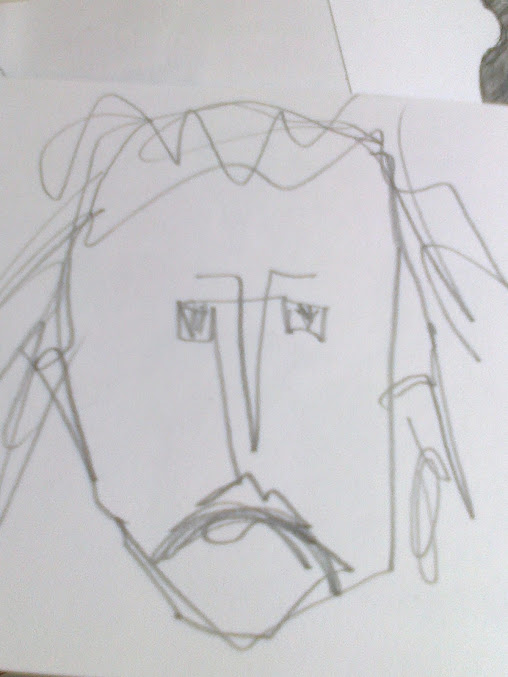
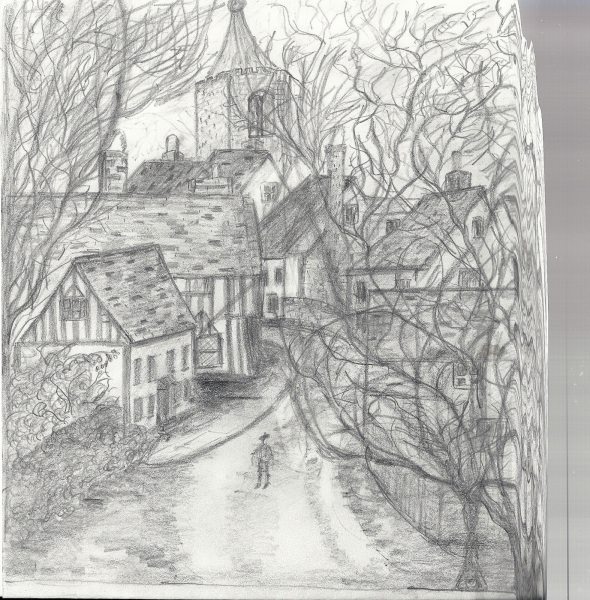
From my old sketchbook

Share this:

The end of the lamp
 The lamp is still in pieces as I stare
The shade leans like a cripple, like myself
It shows the place that we should never bare
I may be wrong to let my mind be lured
In thinking to restore this ancient wealth
The lamp is still in pieces as I stare
This lamp is not a lamp as it can’t share
The light it should throw on our human stealth
It shows the loss that I don’t want to bear
Is love for ever, does it need our care?
Or should we rid ourself of what it tells?
The lamp is still in pieces as I stare
I harmed myself by cutting off my hair
What I have to offer would not sell
I feel the loss that I don’t want to bear
A female Oedipus, a myth unfolds
The truth can blind as well as any nail
The lamp is still in pieces as I stare
It shows a place that is no longer there
Share this:

How do you go insane? Shame can be a trigger


How can I go insane? A discussion on Quora
The sunk cost fallacy or “let bygones be bygones”
 https://youarenotsosmart.com/2011/03/25/the-sunk-cost-fallacy/
!The Misconception: You make rational decisions based on the future value of objects, investments and experiences.
The Truth: Your decisions are tainted by the emotional investments you accumulate, and the more you invest in something the harder it becomes to abandon it.”
Extract
” Kahneman says organisms that placed more urgency on avoiding threats than they did on maximizing opportunities were more likely to pass on their genes. So, over time, the prospect of losses has become a more powerful motivator on your behavior than the promise of gains. Whenever possible, you try to avoid losses of any kind, and when comparing losses to gains you don’t treat them equally. The results of his experiments and the results of many others who’ve replicated and expanded on them have teased out a inborn loss aversion ratio. When offered a chance to accept or reject a gamble, most people refuse to make take a bet unless the possible payoff is around double the potential loss.
Behavioral economist Dan Ariely adds a fascinating twist to loss aversion in his book, Predictably Irrational. He writes that when factoring the costs of any exchange, you tend to focus more on what you may lose in the bargain than on what you stand to gain. The “pain of paying,” as he puts it, arises whenever you must give up anything you own. The precise amount doesn’t matter at first. You’ll feel the pain no matter what price you must pay, and it will influence your decisions and behaviors.
In one of his experiments, Ariely set up a booth in a well-trafficked area. Passersby could purchase chocolates – Hershey’s Kisses for one penny a piece or Lindt Truffles for fifteen cents each. The majority of people who faced this offer chose the truffles. It was a fine deal considering the quality differences and the normal prices of both items. Ariely then set up another booth with the same two choices but lowered the price by one cent each, thus making the kisses cost nothing and the truffles cost 14 cents each. This time, the vast majority of people selected the kisses instead of the truffles.
If people acted on pure mathematical logic, explained Ariely, there should have been no change in the behavior of the subjects. The price difference was the same. But you don’t think in that way. Your loss aversion system is always vigilant, waiting on standby to keep you from giving up more than you can afford to spare, so you calculate the balance between cost and reward whenever possible. He speculates that this is why you accumulate free tchotchkes you don’t really want or need and why you find it so tempting to accept shady deals if they include free gifts or choose decent services that offer free shipping over better services that do not. When anything is offered free of charge, Ariely believes your loss aversion system remains inactive. Without it, you don’t weigh the pros and cons with as much attention to detail as you would if you had to factor in potential losses.
Share this:

Is revenge sweet?
 http://www.emotionalcompetency.com/revenge.htm
Quotations
The paradox of revenge has inspired many thoughtful quotations. Here are some favorites:
- “Resentment is like taking poison and hoping the other person dies.” ~ St. Augustine
- “There is no revenge so complete as forgiveness.” ~ Josh Billings (1818 – 1885)
- “In taking revenge, a man is but even with his enemy; but in passing it over, he is superior.” ~ Sir Francis Bacon (1561 – 1626)
- “Live well. It is the greatest revenge.” ~ The Talmud
Share this:

“Steve Pinker is wrong”
 https://www.theguardian.com/books/2015/mar/13/john-gray-steven-pinker-wrong-violence-war-declining
“Co-authoring an article with Pinker in the New York Times (“War Really Is Going Out of Style”), the scholar of international relations Joshua L Goldstein presented a similar view in Winning the War on War: the Decline of Armed Conflict Worldwide (2011). Earlier, the political scientist John E Mueller (whose work Pinker and Goldstein reference) argued in Retreat from Doomsday: The Obsolescence of Major War (1989) that the institution of war was disappearing, with the civil wars of recent times being more like conflicts among criminal gangs. Pronounced in the summer of 1989 when liberal democracy seemed to be triumphant, Francis Fukuyama’s declaration of “the end of history” – the disappearance of large-scale violent conflict between rival political systems – was a version of the same message.
Another proponent of the Long Peace is the well-known utilitarian philosopher Peter Singer, who has praised The Better Angels of Our Nature as “a supremely important book … a masterly achievement. Pinker convincingly demonstrates that there has been a dramatic decline in violence, and he is persuasive about the causes of that decline.” In a forthcoming book, The Most Good You Can Do, Singer describes altruism as “an emerging movement” with the potential to fundamentally alter the way humans live.
Among the causes of the outbreak of altruism, Pinker and Singer attach particular importance to the ascendancy of Enlightenment thinking. Reviewing Pinker, Singer writes: “During the Enlightenment, in 17th- and 18th-century Europe and countries under European influence, an important change occurred. People began to look askance at forms of violence that had previously been taken for granted: slavery, torture, despotism, duelling and extreme forms of punishment … Pinker refers to this as ‘the humanitarian revolution’.” Here too Pinker and Singer belong in a contemporary orthodoxy. With other beliefs crumbling, many seek to return to what they piously describe as “Enlightenment values”. But these values were not as unambiguously benign as is nowadays commonly supposed. John Locke denied America’s indigenous peoples any legal claim to the country’s “wild woods and uncultivated wastes”; Voltaire promoted the “pre-Adamite” theory of human development according to which Jews were remnants of an earlier and inferior humanoid species; Kant maintained that Africans were innately inclined to the practice of slavery; the utilitarian Jeremy Benthamdeveloped the project of an ideal penitentiary, the Panopticon, where inmates would be kept in solitary confinement under constant surveillance. None of these views is discussed by Singer or Pinker. More generally, there is no mention of the powerful illiberal current in Enlightenment thinking, expressed in the Jacobins and the Bolsheviks, which advocated and practised methodical violence as a means of improving society.
Share this:

Talking to Steve Pinker
https://mosaicscience.com/story/pinker/
“Does any kind of spirituality, however non-religiously defined, play a role in his life?
“I’m afraid of using the word ‘spiritual’,” he says. “I mean, I have a sense of awe and wonder – a sense of intellectual vertigo in pondering certain questions. I hesitate to use the word ‘spiritual’ just because it comes with so much baggage about the supernatural.”
Pinker’s next book, The Sense of Style, will be a style manual for writers incorporating insights from cognitive psychology and linguistics. For example, it will offer advice on how to get around “the curse of knowledge” – the difficulty writers face in being unable to place themselves in the mind of a reader who doesn’t already know as much as the writer knows. Or the question of how to relate to one’s imagined reader: insights from psychology, Pinker will argue, show that the appropriate metaphor to keep in mind is one of vision – that “the stance you take as a writer ought to be to pretend that you’re pointing out something in the world that your reader could see with his own eyes if only he were given an unobstructed view”.!
Share this:

Simile,synonym, sin for evermore
Poetry just hints while prose can flourish more
[As in giving speeches, Oh, Lord, they are too long]
To persuade us to give our money for the new Cathedral door
I met the new schoolmaster ,oh,my eye, he is a bore
I wish instead of yapping on he put his thoughts in song
Lieder may well hint while prose embroiders more
I heard the women talking, they want to share their lore
I hope they do not gossip ,as we know what is damned wrong:
To persuade us to give our money for the new Cathedral door
I am not a hinter, yet explaining is a chore
I ‘m a victim to my scruples,they send me round the bend
Prose’s too articulate, Poetry hints ,oh metaphor!
Simile,synonym, sin for evermore
Though Jesus is our saviour,absolution will depend
On how much gold we offer for the new Cathedral door
Never give up hope yet look at Jesus’ end
See continued horrors in the so called “Holy” Land
Poetry will hint while prose will labour sure
To persuade the golden calf to come ram the new church door
Share this:
Literary devices:Accumulation or ” The More the Merrier” [ not used by poets!]
Since I posted an article which said prose accumulates I thought I should explain it.This article is good
ACCUMULATION
Definition of Accumulation
Accumulation is a figure of speech in rhetoric that creates a list or gathers scattered ideas in a way that builds up, emphasizes, or summarizes the main point. Accumulation is an example of addition in rhetoric, using a “more the merrier” approach to illustrating the theme of a passage. Addition in rhetoric is also known as adiectio, while the definition of accumulation is the same as that of congeries and accumulatio. Accumulation is part of a group of figures of speech in rhetoric called enumeratio. Note that accumulation often has some repetition included, especially anaphora in which a word is repeated at the beginning of successive clauses or sentences. However, to qualify as accumulation the repetition must have a sense of adding on to a list and not simply repeating the same thing over and over.
To read more use the link above
The word accumulation comes from the Latin word for “to amass.”
Common Examples of Accumulation
There are many famous examples of accumulation in speeches, songs, interviews, advertisements, and so on. Here are some examples of accumulation, both famous and more obscure:
I’ve been to:
Boston, Charleston, Dayton, Louisiana,
Washington, Houston, Kingston, Texarkana,
Monterey, Faraday, Santa Fe, Tallapoosa,
Glen Rock, Black Rock, Little Rock, Oskaloosa,
Tennessee to Tennesse Chicopee, Spirit Lake,
Grand Lake, Devils Lake, Crater Lake, for Pete’s sake.
—“I’ve Been Everywhere” by Johnny Cash
St. Augustine founded it. Becket died for it. Chaucer wrote about it. Cromwell shot at it. Hitler bombed it. Time is destroying it. Will you save it?
—Slogan for Canterbury Cathedral in England
Share this:

The dentist is clever
After the dentist took out my wisdom tooth she told me to sit still for a while.As I was doing that the nurse dangled something in front of me.I was wondering is if she wanted to give it to me. so put out my hand.
She said,It’s your tooth.Well it was covered in blood and had roots like mature carrot.They were over the moon because they knew [ I did not]’ that it was going to be difficult.
My roots are twice as long as the average so some folk must have short roots.The roots contain a nerve so my nerves are huge.Does that make me more sensitive than average?I’ve never heard it mentioned.But it may explain why human beings vary so much.I can’t watch violent films or films about hospitals especially late at night.My friend can watch anything.Well, maybe not ANYTHING
I am intrigued by these physical aspects.Some folk have very narrow arteries.I never thought much about this
Share this:
The difference between poetry and prose
 https://www.poetryfoundation.org/harriet/2012/04/the-difference-between-poetry-and-prose
The Difference Between Poetry and Prose
Prose is all about accumulation (a morality of work), while poetry as it is practiced today is about the isolation of feelings (an aesthetics of omission). Among other things, prose is principally an ethical project, while poetry is amoral, a tampering with truths which the world of prose (and its naturalistic approach to mimesis) takes for granted. Poetry creates its own truth, which at times is the same truth as the world’s, and sometimes not. Whatever the case, its mimesis is always a rearrangement, at a molecular level, of that axis between the “seen” and the “felt” (that coal chute which connects the childish eye to the Socratic heart), which, were it not for poetry, with its misguided elenchus, would remain obscured. In both classical and modern languages it is poetry that evolves first and is only much later followed by prose, as though in a language’s childhood, as in our own, poetry were the more efficient communicator of ideas. Whether this has to do with the nature of ideation or some characteristic intrinsic to the material evolution of tongues has never been adequately decided. Probably this evolution, from poetry to prose, depends on synergy—between the passion for thought and enthusiasm for new means. Technology also played a roll. With the spread of the printing press after 1440, texts no longer had to be memorized. Poetry’s inbuilt mnemonics (rhyme, meter, refrain, line breaks) were no longer essential for processing and holding on to knowledge. Little hard drives were suddenly everywhere available. But even a century later, in Elizabethan England, English prose had not yet come close to achieving the flexibility of poetry. One need only compare Shakespeare’s blank verse soliloquies to the abashed prose of one of the Elizabethans’ greatest disputants, Richard Hooker, or to the Martin Marprelate tracts. These are differences not only in talent but ones inherent to the medium. Even the King James Bible, “the noblest monument of English prose,” cannot compare to the blank verse of Shakespeare.
Share this:

A bit tired!
 I|
I|
I had my wisdom tooth out and even saw an X ray on the screen.Modern methods are much better but it is tiring loosing blood etc.I hope I will feel much better than I have been now.I feel so tired I could do what old people do and fall asleep in the chair
What a sunny day.Really beautiful
Share this:

Wisdom of teeth
Well,I just had one pulled out.So I am feeling the after effects.But I can share some photos


Share this:

Life is like

Life is when you can’t afford a picture and you decide to paint your own and then become a famous artist without really trying
Life is like when you lose your comb and have to decide whether to brush your hair with a toothbrush or a clothes brush.Or to just pour a jug of water over your head
Life is like you’re just starting a painting in the Art Class copying from a picture.The someone stands behind you and says.My,you’re ambitious.
Life is like you pay £100 for a filling in your wisdom tooth which then aches so much you have to have it out costing ,who knows?
Life is like you hate the dark winter but you can no longer tolerate heat
Life is like you are admiring your husband’s refusal to rush then you find he’s dying of a heart condition and can barely move at all
Life is like , your sick husband falls on the floor in the night and when you ring 999 you find they are very busy as it is a Bank Holiday so after 3 hours you have to get the police.
Life is like you order tea and it comes as a nug of hot water and a tea bag
Life is like you are having a wisdom tooth out and your neighbour tells you how terrible it will be and how someone nearly died from that
Share this:

How we can improve our memories

https://www.fastcompany.com/40524058/use-these-five-tricks-to-never-forget-something-important-again
“GET READY FOR INFORMATION
A lot of memory is about paying attention. “It sounds obvious, but we live in a day when our attention span is very fickle, because there’s so much coming at us all the time,” says Dellis. “Force yourself to be laser-focused on one thing at a time.”
For example, when Dellis meets people and wants to learn their names, the first thing he does before asking their name is to mentally ask himself, “What is this person’s name?” over and over.”

 How my heart speaks