I bit the cat

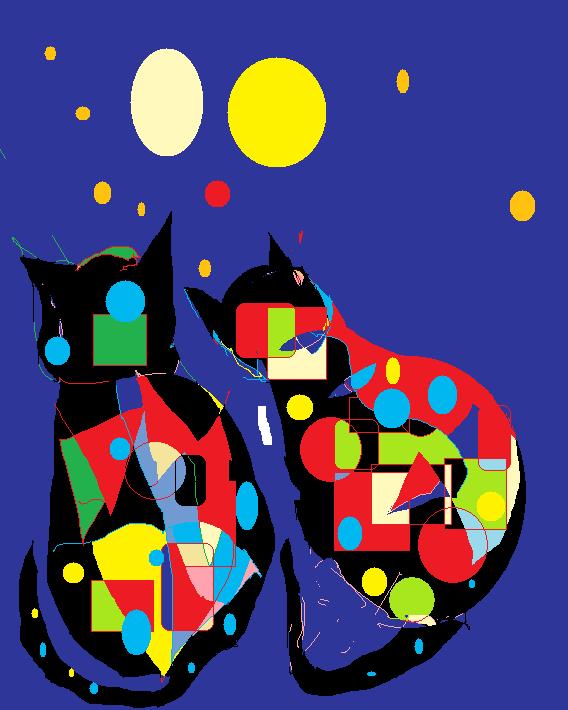
New cats today
I bit the cat because the cat bit me
Yet I was  wrong for this will  make him worse
Now I shall be tried  for harming  fleas

A cat may bite from curiosity
I was wrong to   swear and even curse
I bit the cat because the cat bit me

I forgot to buy the carrots and the peas.
Neither have I  booked the cat a hearse
Oh, no I shall be tried for eating  fleas


Learn  my lesson, it is  almost free
My cat has died and it will hit my purse
I bit the cat because the cat bit me

I have no cat  to sit upon my knee
No longer will he linger by the hearth
I always thought that puss would outlive me

I feel I have destroyed my moral worth
No longer should I dwell on this sweet earth
I bit the cat because the cat bit me
Where’s  our love and whose the victory?


Yellow shoes

I spilt the coffee on my yellow shoes
Why I wore them cleaning,do not ask
Now I got those nasty summer blues

Discussing women’s clothing is taboo
Apart from wondering if they wear a mask
I spilt the coffee on my yellow shoes

If I wear thick clothing I’ll get flu
In the  heat I do not want to bask
Now I got those nasty summer blues

I wonder if a canal boat built for two
Would be a good investment that would last
I threw the coffee on my yellow shoes

They say contact with nature’s good for you
But  my own time  has turned to golden dust
Photons  give  men rights to  turn to glue

Some go frigid, others suffer lust
I’ll be your  sweetheart if you say I must
I spilt the coffee on my yellow shoe
No more will I attend at Waterloo


Poetry and form

\

Photo0076 - Copy - Copyhttp://www.poetry.org/whatis.htm

Nature of Poetry

Poetry can be differentiated most of the time from prose, which is language meant to convey meaning in a more expansive and less condensed way, frequently using more complete logical or narrative structures than poetry does. This does not necessarily imply that poetry is illogical, but rather that poetry is often created from the need to escape the logical, as well as expressing feelings and other expressions in a tight, condensed manner. English Romantic poet John Keats termed this escape from logic Negative Capability. A further complication is that prose poetry combines the characteristics of poetry with the superficial appearance of prose, such as in Robert Frost’s poem, “Home Burial.” Other forms include narrative poetry and dramatic poetry, both of which are used to tell stories and so resemble novels and plays. However, both these forms of poetry use the specific features of verse composition to make these stories more memorable or to enhance them in some way.

What is generally accepted as “great” poetry is debatable in many cases. “Great” poetry usually follows the characteristics listed above, but it is also set apart by its complexity and sophistication. “Great” poetry generally captures images vividly and in an original, refreshing way, while weaving together an intricate combination of elements like theme tension, complex emotion, and profound reflective thought. For examples of what is considered “great” poetry, visit the Pulitzer prize and Nobel prize sections for poetry.


Poetry and form

Compared with prose, poetry depends less on the linguistic units of sentences and paragraphs, and more on units of organisation that are purely poetic. The typical structural elements are the line, couplet, strophe, stanza, and verse paragraph.

Lines may be self-contained units of sense, as in the well-known lines from William Shakespeare’s Hamlet:

To be, or not to be: that is the question.

Alternatively a line may end in mid-phrase or sentence:

Whether ’tis nobler in the mind to suffer

this linguistic unit is completed in the next line,

The slings and arrows of outrageous fortune.

This technique is called enjambment, and is used to create a sense of expectation in the reader and/or to add a dynamic to the movement of the verse.In many instances, the effectiveness of a poem derives from the tension between the use of linguistic and formal units. With the advent of printing, poets gained greater control over the visual presentation of their work. As a result, the use of these formal elements, and of the white space they help create, became an important part of the poet’s toolbox. Modernist poetry tends to take this to an extreme, with the placement of individual lines or groups of lines on the page forming an integral part of the poem’s composition. In its most extreme form, this leads to the writing of concrete poetry.

” Poetry and form

Compared with prose, poetry depends less on the linguistic units of sentences and paragraphs, and more on units of organisation that are purely poetic. The typical structural elements are the line, couplet, strophe, stanza, and verse paragraph.

Lines may be self-contained units of sense, as in the well-known lines from William Shakespeare’s Hamlet:

To be, or not to be: that is the question.

Alternatively a line may end in mid-phrase or sentence:

Whether ’tis nobler in the mind to suffer

this linguistic unit is completed in the next line,

The slings and arrows of outrageous fortune.

This technique is called enjambment, and is used to create a sense of expectation in the reader and/or to add a dynamic to the movement of the verse.

In many instances, the effectiveness of a poem derives from the tension between the use of linguistic and formal units. With the advent of printing, poets gained greater control over the visual presentation of their work. As a result, the use of these formal elements, and of the white space they help create, became an important part of the poet’s toolbox. Modernist poetry tends to take this to an extreme, with the placement of individual lines or groups of lines on the page forming an integral part of the poem’s composition. In its most extreme form, this leads to the writing of concrete poetry”

Like the dust motes dancing

Structures

In our language structures link up words
Sentences are  the first and may  be last
So many lovely friends, he cried, I heard.

To structure modern families seems  hard
We move around for work at such a cost
In our thinking, structures build from words.

Society no longer makes us learn
And our religious feeling has been lost
How to find friends when the structure’s  gone?

In our living, we need  forms to  learn
Yet are they gone, must science take on the task?
In some lives,  the structures  have been burned

Order, pattern, grammar, all in turn
Shape our feelings till we  are possessed
In society, structures support words.

Let no-one from this culture be outcast
Let no-one die  like lepers shunned,alas
In our language, structures link our words.
Humans spoke in sentences we heard.


Sentences

Our conversation’s more like music than we think
The melody remains without the words.
We improvise in moments from few hints

With counterpoint, we make  harmonic  links
Our speech has echoes of the song of birds.
Our conversation’s more like music than we think

Is our tongue of rubber or of flint?
Some can make us speechless  with their words
Wounded, suicidal, hacked  by taunts

Becoming mute’s a sign of death that haunts
We live without our being, all unspared
Our conversation’s  far more   tragic than we think

We  respond  with silent sorrow to cruel hints
Vulnerable to lack or trapped and tied
From our little landscape, we depart

Our sentences,  our beings, will abide
If we are tuned up well and do not lie
Our conversation’s more like music than we think
We improvise  or die; oh, pointed hints!


Flexible language

DSC00054“I think flexibility, humility, and multilingualism should take the place of sticklerism, arrogance, and nationalism when we think about language. ”
― Robert Lane Greene, You Are What You Speak: Grammar Grouches, Language Laws and the Power of Words

The holy land that all but I’ve forgot.

I bought myself a cotton coat online
So big I’ll have to wrap  it round with twine
I think a smallish man could get in too,
Or a cat and dog who wish to be the crew!

Or in the winter when it’s  icy cold
I could put on three jumpers  and look bold
The doctor will then nag me as obese
Maybe I’d do better in a fleece

It said it was real denim but it’s faux
Denim don’t grow where this weirdo’s  grown.
The meaning of the word has clearly changed
I sit outside with cats all  well arranged

I think that it would make a lovely sail
For a yacht in Morecambe Bay manned by a snail
I’d  pull the ropes and look at Arnside Knott.
The holy land that all but I’ve forgot.

On second thoughts it looks  like a great tent
The shortish sleeves could function as air vents
A generous towel can be my undersheet
I’ll rent my bedrooms out and be replete

When dawn arrives I’ll wash myself in dew
And pull off snails that lay beside my knee
I’ll put on my pyjamas made of string
And aertex vest  invisible in Spring

I feel my destiny is drawing near
As I can love all ants without much fear
I can sell the house and live with Alice Springs
In a field of buttercups with wings

Oh, when you grow older be discreet
Pretend you are a queen with hobnailed feet.


But gold or diamonds glorify the bed.

When ancient peoples sacrificed to god
They offered up the best of what they had.
The king’s own son would be the frequent choice
As insulting a god was seen as vice.

And when a man goes courting for a bride
He offers  her a ring that satisfies
He does not give her tin or zinc or lead
But gold or diamonds glorify the bed.

Yet here in modern or post-modern times
We offer up the lowest as our sacrifice.
And so the wealthy shall go straight to hell
As murderers of the sick and poor who fell.

In the past, the rich gave to the poor
But now they burned them up in Grenfell Tower.


Panic dances all day

Those who used to control
The governed and  exacted a toll
Now look like scared cats
Or failed acrobats
Theresa May is not good at all


The country is filled with strange doubts
And violent uncivilised louts
Panic dances all day
Preventing our play
Except for the worries we count

I crept into the space between the words

It seemed to me,  my vision and  my mind
A template to project into the world
Brought you into being by my side.

I miss you, love, so slow the seconds wind.
I crept into the space between the words
I  made you in  my vision and  my mind

Is there only chaos, no design?
Are we dust around the spaces whirled?
I bring you into being by these lines

I smell your skin and see your eyes alive
I move my head but you have disappeared
It seems  both from my vision and  my mind

Why did all the pit props fall down blind?
I crept beneath  black  coal, with darkness smeared
A  person alien to humankind

Where is death, when it’s no longer feared?
What is love, when no-one else is here?
I imagined  you in  vision and in mind
Reality is so much more unkind

Can human sacrifice expunge our sins?

I felt the sun’s heat on the wheelie bins
The plastic lids and handles stung my hand
The rumbling wheels made their own  ugly din

I bumped my leg and nearly burned my shins
This work is more familiar to a man
I felt the sun’s heat on the wheelie bins

They spoil my garden and  ignite my pen
I wish the PM would issue a ban
The rumbling wheels made their own  ugly din


Can human sacrifice expunge our sins?
Grenfell Tower, a Death Camp I see now
I felt the sun’s heat on the vicious bin.

Men in power fought red tape, grumbling, grim.
The sacrificial victims died by fire or blow
The voices of democracy grew dim

A neighbour said they’re  illegals, eeh by gum,
So as they burned, no one will ever know
I smelled the smoke of Auschwitz rippling in.

Where thou goest , I will also go
The Christian world sure writes a damning show
My heart cracked and I fell into the bin
They grumbling  made their own   darned ugly din


A wild trapped cat

How like a prison is my cubicle.

Yet I feel safe enclosed in this space.

‘Tis often claimed to be indubitable

That introverts desire a private place.


We suffer when with crowds and noise we mix.

We suffer from wild talking and blind eyes.

We suffer from the extroverts cruel tricks.

And ponder long on wherefores and on  why’s,


Life can be so painful we retreat

We jail ourselves to gain some mental peace

Yet all the world’s  our pleasure and it’s sweet.

So can a  prisoner gain their own release?


An introvert  is like a wild,trapped cat,

Which blindly scratches those on whom it’s spat.

Who invented the word “meme”?

http://mentalfloss.com/article/61843/what-is-a-memeLifetime's Grumpy Cat's Worst Christmas Ever

“In 1976, Richard Dawkins, the English evolutionary biologist, proposed an idea in his book, The Selfish Gene: What if ideas were like organisms, where they could breed and mutate? These ideas, he claimed, are actually the basis for human culture, and they are born in the brain.

Dawkins’s research is primarily in genetics. He has argued that all life relies on replication. But unlike cells, ideas do not rely on a chemical basis for survival. They begin from a single location—the brain—and spread outward, jumping from one vessel to another, battling for attention. Some ideas are more successful, which may be due to an element of truth they carry, while others slowly die out. Some may not be accurate, but society has accepted these ideas for so long that they are just accepted (think about pictures of Jesus or George Washington; while these may not be what they actually looked like, almost all art now portrays these men in the same way).

Dawkins needed a name for this concept. He proposed calling it mimeme, from the Greek word meaning “that which is replicated.” He wrote in his book, “I hope my classicist friends will forgive me if I abbreviate mimeme to meme.” He felt the monosyllabic word would be more fitting because it sounds similar to “gene.” “If it is any consolation,” he continued, “it could alternatively be thought of as being related to ‘memory,’ or to the French word même. It should be pronounced to rhyme with ‘cream.’””

Modern day neologisms

Photo0555 b

54 Great Examples of Modern-Day Neologisms


The Washington Post Neologism Competition

Every year The Washington Post runs an annual competition in which the readers of the newspaper are asked to submit alternative meanings to existing words. The results are often extremely amusing. Here are examples of  Washington Post neologisms:

1. Coffee (n.), the person upon whom one coughs.
2. Flabbergasted (adj.), appalled over how much weight you have gained.
3. Abdicate (v.), to give up all hope of ever having a flat stomach.
4. Esplanade (v.), to attempt an explanation while drunk.
5. Willy-nilly (adj.), impotent.
6. Negligent (adj.), describes a condition in which you absentmindedly
answer the door in your nightgown.
7. Lymph (v.), to walk with a lisp.
8. Gargoyle (n.), olive-flavored mouthwash.
9. Flatulance (n.) emergency vehicle that picks you up after you are run over
by a steamroller.
10. Balderdash (n.), a rapidly receding hairline.
11. Testicle (n.), a humorous question on an exam.
12. Rectitude (n.), the formal, dignified bearing adopted by proctologists.
13. Pokemon (n), a Rastafarian proctologist.
14. Oyster (n.), a person who sprinkles his conversation with Yiddishisms.
15. Frisbeetarianism (n.), The belief that when you die, your Soul flies up
onto the roof and gets stuck there.
16. Circumvent (n.), an opening in the front of boxer shorts worn by Jewish men.


 I’m not a woman in that sense, not me!

I ironed my tea towels and a shopping bag
The bag hid in the washing basket, see?
A Lowry picture  on it seems to sag

Ironing kills the germs but is a fag
But then I had a mug of boiling tea
I ironed my tea towels and a shopping bag

I am unable now to read a women’s mag.
I’m not a woman in that sense, not me!
That Lowry picture makes my spirits sag.

If you iron clothes they look neat, not bad!
And maybe heat will kill a lurking flea
I ironed my tea towels and a shopping bag

The pressed towels take less space.my mother nagged
I wish she were with me so she could see.
That Lowry picture makes my spirits sag.


My jeans were there but I forgot, oh, me!
I have wide trousers, what depravity!
I ironed my pillowcases and that bag.
A Lowry picture  on it seems to sag


I fear that they will hatch

The menu’s very limited today
The eggs so old, I fear that they will hatch
The bacon’s off ,the bread is green and dry.

Have a cracker, they look quite ok
The cheese is blue, here you are, just catch
The menu’s very limited today

The ham is here; oh, no I tell a lie.
I’ll warm baked beans if I can find a match
The bacon’s off ,the bread is green and dry.

Do you recall the Fray Bentos steak pie?
A tin only the starving could unlatch
The menu’s very limited today

I wonder could  I get protein from flies?
I cannot bear the awful thought, I flinch
The bacon’s off , the bread is green and dry.

Can I order pizza by the inch?
Or how about I fry the frozen mince?
The menu’s very limited today
The bacon’s off , the bread is green and dry.


Believing one knows God is idolatry

NGC_7331_Acquired_with_the_Schulman_Telescope_at_the_Mount_Lemmon_SkyCenter-1200x799
https://www.theguardian.com/commentisfree/belief/2013/jan/08/god-unknowable-faith

“Faith is not the progressive unearthing of God’s nature but a recognition that he/she is fundamentally unknowable. The signpost points not to growing certainty but towards increasing non-knowing. This is not as outrageous as it seems. An apophatic thread, a belief that the only way to conceive of God is through conceding that he is ineffable, runs throughout Christian history. Jan Van Ruysbroeck, the 14th century Augustinian and man of prayer, maintained that “God is immeasurable and incomprehensible, unattainable and unfathomable”. St John of the Cross, one of the pillars of western mysticism, put it even more succinctly: “If a man wishes to be sure of the road he travels on, he must close his eyes and walk in the dark.”

This redirectioning of the spiritual path has fruitful offshoots. We no longer have to ask why God orders the world in such an unsatisfactory way, allowing cancer cells and war to proliferate. Nor do we have to bombard him with prayer in order to achieve our desired ends. Such dialogue is only sustainable if you posit a personal being.”

The funny way we dress

IMG_3495_large

I have observed a  lot of changes in women’s clothes.I have been asked aggressively why I wear a skirt [it’s easier to wee in fields].I have been told off for making bread even when I taught maths which was in itself an encouragement to females.
What makes me laugh is how we wear new fashions.You may have notice cropped trousers have become the latest thing.However, if you wear horrible old socks of grey nylon you may not look very good.You can’t just wear one new item, your whole outfit has to match.Otherwise, save money or buy longer merrier socks or wear bare feet.
Why would we want to wear jumpsuits?Very hard to wee if you have one on!Maybe one has to wear a nappy?
Otherwise, as everybody else is wearing their pyjamas in the town centre do whatever you like .Public space has disappeared.We are all in little bubbles on our phones.We don’t mind what anyone else looks like

With buttercups so bright the memory lasts

midsummer days evoke  the entrancing past
where children played in joyous, daisied fields
with buttercups so bright the memory lasts
a freedom that our conscious growth will steal.

those stones and leaves and many coloured flowers
were gathered into images that glow
yet later we forget those treasured hours
when for a while we lived in life’s deep flow

we did not look and see, but felt at one
we lived as did the birds high in the trees
now we see and write yet unity has gone
we  cannot be  like flowers well filled with bees

to lose ourselves in nature is a joy
which to our adult selves we must restore

Free creative writing courses from top Universities like the OU

photo-2 12http://www.stumbleupon.com/su/1I2mOC/1hRQsJSMu:DTjI$+0o/diplomaguide.com/articles/Online_Creative_Writing_Courses_Offered_Free_by_Top_Universities_and_Educational_Websites.html

Elusive inner presence, other me 2

Elusive inner presence, other me,
Those bubbles on the water surface tell
Of life we cannot  speak about  nor see

We have many layers, currents pulled
Dynamic, swaying, living, dark unquelled.
Elusive inner presence, other me.

The philosophers like Langer will agree
A symbol is as deep as any well.
With life we barely  speak about  or see

A mermaid’s tail may flicker from the sea
The  rhythm of waves our senses well compelled
Elusive inner presence, other me.


Humanity is like  a living tree
If one leaf falls there is no plangent bell
For what  we cannot  speak about  nor see

A coat embroidered three dimensionally
Will seize our eye and heart and soul as well
Elusive inner presence, other me.

The inner one  must live in privacy,
Betrayed by none in marvelled secrecy.
Elusive inner presence, other me,
A life we  barely speak about  or see