Metaphors are dead, yet telling lies.

Scientists tell us what the wise might think
That frosty chill makes poor old people die
See, it’s in the Guardian in ink.

I wonder if it harms the eyes to wink?
Do fluorescent light tubes injure flies
Scientists tell us what the odd might think.

Why do women dress their lips in pink?
What do genes do when their bearer dies?
See, it’s in the Daily Groat in ink

Do you know in daydreams we can’t blink?
Metaphors are dead, yet telling lies.
Scientists tell us what the wireless think!

Re open minds, the light gets through the chinks
If my mind is closed, I’m sterilised
I’ll put it in a Telegraph in ink.

Wittgenstein said  our metaphors aren’t lies
Concrete thinking is no use in life
Scientists tell us what we cannot think!
Ye Gods, it’s in the Oxford mag in mink.


Too proud to live

I met a man who boasted of his prayers
And of the great good works that he would do
He wrote to someone dying  in despair
Who are you that I should pray for you?

This puts him on a level with the Lord
He  will not pray for us, he bears contempt
He  will not let the free flow of his words
Add to the songs of love all  heaven sent

But who is going to be the Judge of all?
Who can ask us rightly, who are you?
No human being  is too low, too small
For God to use them in his retinue.

The man who judges others, his self harms
Fascinated by the image of his charms.

Fear not ignorance

The scientific approach to the phenomenon of human nature enables us to be ignorant without being frightened, and without, therefore, having to invent all sorts of weird theories to explain away our gaps in knowledge.

How like a song unsung, unmusical

I cannot write a serious poem without some part of me wanting to make it funny.

Photo0065_001

How like a prison is my cubicle
Within four walls, I know I am entrapped.
How like a song unsung, unmusical,
My state of mind so far has not been mapped.

Inside my heart, I used to have a room
Where space and grace and nature all did dwell.
But then a false man led me to my doom
The details I will never ever  tell.

My walls fell down like Jericho of old.
My love became my enemy, my hate.
With rubble my heart filled, alas, not gold.
My enemy was once my warmest mate

What seems to be the truth is but a lie
Take me to the woods and let me  die
Photo1815
Take me to the pub to eat pork pie
Give me cardboard wings for I can fly

Primrose way

Thprimroses-fairhaven

https://plantscientist.wordpress.com/2013/04/27/organism-of-the-week-primrose-primula-vulgaris/

Very lovely blog about primroses


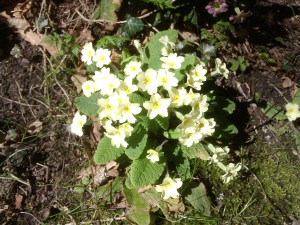
“During a field trip in Pembrokeshire as an undergraduate student I spent a couple of days studying primrose flowers. Wild primrose flowers are typically a pale yellow colour like those pictured above but white and pink forms are also seen. There are two forms of flowers, which look almost identical apart from the position of the stigma (female part) and the anthers (male part holding the pollen) in the flower tube in the centre. In “pin” flowers the stigma is positioned at the top of the tube with the anthers positioned halfway down. In “thrum” flowers the stigma is instead positioned halfway down the tube with the anthers at the top.

"Thrum" flower type. The anthers are visible at the top of the flower tube with the stigma underneath about halfway down (not visible).

Pin form. The stigma is at the top of the tube above the anthers (not visible).

The two flower types were first described by Charles Darwin in 1862 (1) and he also observed that the pollen produced by the pin flowers was smaller than that of the thrum flowers. He performed a number of crosses (where he took pollen from one flower and placed it on the stigma of another)  between pin-to-pin, thrum-to-thrum, pin-to-thrum, and thrum-to-pin flowers and found that the crosses between the different flower types were more fertile than those between flowers of the same type.”

Guilt and more

8282959_f520http://www.skylightto.com/interviews/dr-donald-carveth-guilt/


Do you identify a difference between guilt and shame? 

Yes I do. There are two main types of guilt: The first is punitive guilt, in which “I’m whipping myself”, and that’s almost indistinguishable from shame, which is a narcissistic emotion. In shame, my mind is entirely on myself. We often think of selfishness or narcissism as focusing on “how great I am” but it’s equally narcissistic to be going on all the time about how terrible you are. Shame is self-persecution. It’s a horrible feeling. You beat yourself up, and once in a while, in order to stop beating yourself up, you beat somebody else up- that’s the scapegoat mechanism. When I’m depressed, my superego has me in its crosshairs, but if I can shift someone else into its crosshairs: “That guy over there is the sinner, let’s attack him instead of attacking me.” People can get relief from depression by targeting somebody else. All of this is destructive guilt.

But there’s another kind of guilt altogether, which is reparative guilt: your mind is not on yourself, it’s on the person you’ve injured. The move into reparative guilt is a move out of narcissism. We get our minds off ourselves long enough to actually see the harm we’ve done to others, and to be concerned about them, and to want to do something to make it right.

The example I use is, “I’ve injured someone, and he’s bleeding in the corner. With persecutory guilt or shame, I’m flagellating, I’m such a terrible person.” But that’s useless to the guy who’s bleeding. If I put down the cat-o-nine tails, go get the first aid kit, and start bandaging- that’s reparative guilt.

So guilt can lead to better behaviour. 

Yes. Now I make a distinction between the conscience and the superego. The superego is the inner, moralistic, hanging-judge torturer. Superego is about aggression turned on the self and sometimes on scapegoats.

Conscience is quite separate. Conscience is grounded in love, is grounded in concern. You give love, because you were cared for, and you know you have an obligation to give care back. When you’re out of sync with your conscience, or doing something wrong, Conscience bothers you. By contrast, the superego tortures you- the superego’s attitude is, “OK I caught you in wrongdoing, good. Now I can do what I like to do, which is beat the shit out you.” Conscience doesn’t react that way. The conscience is saddened by the fact that you’re doing wrong. It encourages you to turn around and do right, it calls you to contrition and pulls you to apology and to reparative action, and that is useful guilt.

I like that. Let’s talk about Skylight.

As background: Kyra worked in Tom’s restaurant, and they had an affair while Tom was married to Alice. Kyra was very close to the family, including Alice and Tom’s son, Edward. After six years, Alice discovered the affair, and Kyra abruptly removed herself from their lives. Tom’s relationship with Alice never recovered; Alice became ill and died. Kyra has now moved to a low-income neighbourhood and taken a job teaching very difficult students. Skylight shows us Tom’s and Kyra’s first meeting, 3 years after the end of their affair.

What do you observe in the characters?

My reactions to the play deepened every time I read it. On the first read, you’re very aware of what a bombastic narcissistic character Tom is; and he’s also a symbol, and a critique, of Thatcher’s neoliberal market fundamentalism nonsense. He’s likeable, intelligent, charming, energetic, but he’s easy to identify as a narcissist and a coward. When the wife he’s been unfaithful to is dying, his act of reparation is to throw money, which is nothing to him; he builds her a house, but he can’t face her.

My initial tendency was to see Kyra as a bit of a victim of this narcissistic male, but I think she’s pretty guilty in her own way. She felt fine sleeping with her friend Alice’s husband as long as Alice didn’t know. So now, Kyra’s freezing in this tiny, shoddy apartment, a little bit like she’s sent herself to jail– Tom calls it Siberia. But she would not have to continue in this bread-and-water prison if she came consciously to terms with her guilt. If she did that, she could get over it. So she’s paying a big price for her failure to acknowledge her guilt. And now she’s unconsciously making reparation for her sins by becoming a devoted teacher.

And yet, after Alice discovered the affair, Kyra had 3 years to make true reparations before Alice’s death, but instead, she vanished.

And now, her first words to Tom after a 3-year separation– she doesn’t even say hello- she says, “I’m not guilty.” 

Exactly! She’s making a joke, but as you say, it’s the first thing that comes out of her mouth, which indicates how guilty she really is.

photo1815_001_001


Oh– I wanted to mention this quotation from a Yeats poem at the beginning of the play:

“We had fed the heart on fantasies; the heart’s grown brutal from the fare.”

So here, Kyra and Tom had the illusion that they could help themselves to this fantasy of pleasure and that it wouldn’t hurt anyone as long as they kept it secret. Well that is a total illusion, because ultimately there are no secrets. Even in physics, scientists say everything connects. A butterfly flaps its wings in the Amazon; it affects the weather in Toronto. People have this illusion that there is a hiding place, but it all comes out, and it affects us. Tom and Kyra are maintaining this illusion that their affair is not hurtful, and so…

…the heart has grown brutal as a result.

Repressed guilt and shame are toxic. It’s not the guilt and shame themselves that have a toxic effect, it’s the repression of them, the avoidance of them. So I think it’s a perfect epigraph for the play. Illusions are hard to see through– that’s why we need other people who see us better than we can see ourselves.

(laughing) You should know.

(laughing) Well, it works both ways! One of the great things about doing this work is that the patient sees me as well. When you work with patients intensively for a long period of time, they get to see your weak spots, biases, blind spots… and they tell you about it!

Oh! Can you tell me some of the things they’ve called out?

Sure! One said, “You know, Don, when they called it a Talking Cure, they meant the patient talks!” (laughing)

(laughing) How does that feel?

Well, sometimes… (laughs). But really, I like it, because they’re teaching me something. You know, sometimes I’m clumsy, sometimes I’m arrogant, sometimes I’m wrong, sometimes I’m sleepy, and the patient is going to tell me the ways in which I’m not perfect!

But I’m also getting real gratitude. Sometimes people will thank me with tears in their eyes, and this makes me feel very good. And you don’t get the good without the other side of it. It’s a very deep kind of connectedness with other people, and it’s very gratifying work.

Why did you become an analyst?

When I was younger, I was unhappy, I was self-punishing by getting depressed, by not letting myself be as successful as I otherwise could- and by not being able to write my doctoral dissertation! So I started analysis, because I knew that there was something wrong with me. I had done all of the trendy therapies- this was the sixties- but it was useless. And so, my very first psychiatrist—when I fired him—said, “Consider psychoanalysis.” And I said, “What, they still do that thing with the couch?” But within a matter of weeks I knew this was the therapy for me. I started to change, overcame the writer’s block, wrote the PhD, got the PhD and a tenure-track position, and I started publishing. And as soon as I got tenure, I applied to train as an analyst, and I’ve been practicing ever since. But it started out with a need to deal with my own personal issues, and only then did it turn into a career.

As someone who’s read the play several times, and as someone who has professional insights about its themes- what do you think audiences will take away from Skylight?

I think the audience will be quite moved, and they’ll be shaken. But also entertained. The dialogue is incredibly amusing; some of Tom’s diatribes are hilarious, and Kyra has such a dry, acerbic wit- this is a play that should really be enjoyed. But it’s going to shake people as well.

Our average reading age is 9

colouredlove1http://www.see-a-voice.org/marketing-ad/effective-communication/readability/


Readability

The average reading age of the UK population is 9 years – that is, they have achieved the reading ability normally expected of a 9 year old.
The Guardian has a reading age of 14 and the Sun has a reading age of 8.

Considering the readability of your copy will benefit many people, including blind and partially sighted people.

This is an example of a possible paragraph written for the access page of a brochure:

At every performance where audio description is provided, there is also an opportunity for a touch tour of the stage and set. Touch tours give visually impaired patrons an opportunity to familiarise themselves with the set and costumes before the show to enhance their enjoyment of the production.

This sample has a reading age of 24 and, therefore, it excludes the vast majority of its intended readers.

Here is an alternate version of the copy:

There will be a touch tour before every audio described performance. This gives you the chance get to know the set and costumes. Patrons tell us this means they enjoy the show more.

It now has a reading age of 10. All we’ve done is use shorter sentences and shorter, everyday words.

On the DOWNLOADS page you can print out instructions on how to calculate the reading age of a piece of text using the FOG INDEX or a tool within Microsoft WORD.

Scannable copy

One way of improving readability for everyone is to create scannable copy. This makes it easy for people to go quickly to the information they are interested in.

Take a look at the extracts overleaf from The Sun and The Guardian on 25 August 2008. Which one is easiest to scan and why?

Two newspaper scans. On the left a clipping from The Sun, and on the right The Guardian. Both feature the same new item about David Cameron's stolen bicycle.

What you can do …

• Use bold to take the reader to key words.

• Use meaningful subheadings (explain what’s in it for them).

Deja woo…I already fell out of love

Deja mew…. the cat’s upset already
Deja new…. a logical impossibility
Deja you….I met you before
Deja true… an axiom
Deja due……..your payment is late
Deja slew… he was dead before I shot him, sir.
Deja new…second hand
Deja blue….. inborn sadness
Deja vile….original sin
Deja bile————-I   had indigestion earlier
Deja smile……I won’t laugh again
Deja flew……I love you no more/I have gone
Deja dew—————-will it drop off?
Deja who…..I know you but not your name
Deja new………old
Deja phew….. that was hard

I found your diary

I found your diary with  a date to meet
A friend  you loved and cherished all these years
But life itself made that a  raw, cold cheat
For when it came you were no longer here.

I admired your life force and your wit
The act, illusion, call it what we must.
You did not hurry into death’s cold pit
Nor where you eager to  break down into dust

Yet you did not fight  the coming freeze
Like a cat that senses its own end
No longer could  you speak, yet  lay at ease
Until the curtain’s calm and kind descent

On New Year’s  Day two thousand and fifteen
We  did not know that this was our last scene


Tenderly you stroked my crooked feet

Shall I miss the journeys that we made
Up sheer cliffs and through deep muddy yards
Chased by  geese and then in heather laid?
I cannot catch you now, it is too far.

You cleaned my boots back in the cottage sweet
On the bed, you covered  me in  coats
Tenderly you stroked my crooked feet
And hot and sugared tea you once more brought

A dog stopped by and held out its clean paw
It shook your hand and gazed with amber eyes
Remote and cold, the Hartland Cliffs we saw
Where have you got to now, my love, disguised?

Danger and delight then drew us on
I cannot find your face, where have you gone?

The journey by Thomas Hardy

Hereto I come to view a voiceless ghost;
Whither, O whither will its whim now draw me?
Up the cliff, down, till I’m lonely, lost,
And the unseen waters’ ejaculations awe me. the sound of the sea
Where you will next be there’s no knowing,
Facing round about me everywhere,
With your nut-coloured hair,
And gray eyes, and rose-flush coming and going. Emma’s rose pink cheeks
Yes: I have re-entered your olden haunts at last; the places where you often used to go
Through the years, through the dead scenes I have tracked you;
What have you now found to say of our past –
Viewed across the dark space wherein I have lacked you?
Summer gave us sweets, but autumn wrought division?
Things were not lastly as firstly well
With us twain, you tell? twain – two
But all’s closed now, despite Time’s derision. derision – mocking
I see what you are doing: you are leading me on
To the spots we knew when we haunted here together, often used to go
The waterfall, above which the mist-bow shone
At the then fair hour in the then fair weather,
And the cave just under, with a voice still so hollow
That it seems to call out to me from forty years ago,
When you were all aglow,
And not the thin ghost that I now frailly follow!
Ignorant of what there is flitting here to see, flitting – moving quickly from place to place
The waked birds preen and the seals flop lazily, preen – clean themselves, arrange their feathers
Soon you will have, Dear, to vanish from me, ghosts are said to vanish at daybreak
For the stars close their shutters and the dawn whitens hazily.
Trust me, I mind not, though Life lours, lours – looks gloomy
The bringing me here; nay, bring me here again!
I am just the same as when
Our days were a joy, and our paths through flowers.

Dannie Abse’s best poems


Spring 2012 049

From Valediction:

“In this exile called old age
I live between nostalgia and rage.
This is the land of fools and fear.
Thanks be. I’m lucky to be here.”


http://www.telegraph.co.uk/culture/books/11127571/Dannie-Abse-his-greatest-poems.html

Poetry for beginners

Photo0380
https://www.theguardian.com/books/2005/jan/27/poetry.schools


“Finally, the acid test: now the process is over, will the students involved be hooked on poetry? “I think so,” Summers says, thoughtfully. “I’m not sure that it’ll have made them into natural-born purchasers of every poetry collection that comes out – I wouldn’t blame them if it hadn’t – but I certainly think it made them see that there is a much bigger world of poetry out there than they’d realised. The generic curse of the way poetry is delivered at secondary level these days is that it’s about appreciation, not readership. The situation these kids found themselves in – three days to read with no pressure on them apart from having to make a few cups of coffee – was a privilege, a luxury. And I don’t think it’s one they’ll forget.” Morrissey agrees: “I think the students felt quite” – she hesitates – “liberated, in a way, by the fact that this was primarily an exercise in enthusiasm, not criticism. There was a power in going off the curriculum and not having to constantly consider and quantify that they responded to. It was really fresh. Hopefully the readers will feel that, too.”

It looks as though they do. A copy of Fifty Strong has been sent out to every secondary school and sixth form college in the UK, and so far the responses have been resoundingly positive. Paul Summers thinks he knows why. “Without them being pushed, they covered everything – from domestic violence to bloody war in the former Yugoslavia to broken hearts and death,” he says “That pretty much sums it up.”

What our teenage reviewers thought

‘A lively and absorbing collection’

There’s a poem for every young person to relate to in Fifty Strong. This mature selection conveys powerful emotions while covering a broad range of topics including love, death, war and adoption. I particularly liked the use of poems from other languages and cultures and found it interesting to see them written in their original to

The advantage of having a poetry anthology selected by teenagers for teenagers is that all the poems reflect aspects of adolescent life. It ensures that the anthology includes not only the obviously teenage poems that deal with unrequited love, betrayal, and loneliness, but also poems that address important wider issues “

Dear,dear

Nuneham_20151025-4

Dear All

I was thinking last night that I should give some advice to women about to marry.
Be sure you know your fiancee’s name before you get married.Then put into your phone or address book.Then if you feel so inclined, you can shout it when you make love.Maybe not on your honeymoon as a hotel is not very private.But when you get home it will be satisfying to scream” Sigmund” at midnight unless you are asleep.
Find out how much money you have coming in and decide to spend it as fast as you can as that will spur him on to earn even more.You can still work but why not  retrain as a therapist as  you can share your horror stories with your husband
Psychoanalysts earn a lot but may have to start work at 4 am to fit in  people who want to come before work
When you have a baby, teach your husband how to bottle feed so if he does get up at 4 am he can feed the baby while he listens to his first patient.Then he can write a book about how helpful his patient found this.Or not.
See things in a different way.Marriage is good for you but only if you have achieved object constancy.I have not done so myself so I am never sure if my husband is the same man I married.He seems less a particle and more like a wave as he never keeps still.I find him somewhat annoying in bed.
That reminds me we need a new mattress as not the centre is higher than the sides which means I roll off and so does he.Not to mention our cat Felicity and her 3 kittens.They are very bold as they don’t leave the room when we embrace and also they follow me into the bathroom too.As they don’t understand English I can’t make them go away.I  will not slap them or curse.I am already rather wicked.
I can’t write it here but I am a spy.For whom I have no idea.I keep a journal about everyone in this street and their odd behaviour.I am sure someone will buy it off me soon
I can smell the cloves in my bread and butter pudding.So I will continue later~Cheery bye
Kristy

genderless

The altar’s stripped,  the rituals are nightmares.

The still, small voice no longer can be heard.
The  sacred, silent space  unoccupied
No burning bush nor tempest speak The Word.

We centre our   whole self on the absurd
For iPads cannot pass through any eye
The still, small voice no longer can be heard.

God no longer feels inclined to share.
The golden cloud  of angels  cannot fly
No burning bush nor tempest speak The Word.

The altar’s stripped,  the rituals are nightmares.
The ancient priest says Mass and wonders why
The still, small voice no longer can be heard.

A  virtual wall stops grace from being shared.
Jesus is made flesh and  silent dies
No burning bush nor tempest speak The Word.

No one is an island, John Donne cried
But now there is no truth to satisfy
The still ,small voice no longer can be heard.
No burning bush nor tempest speak The Word.

The Lord transplants the Burning Bush.

From  desert sands to burning bush;
Moses  on Mount Horeb learned
The ten commandments ,bold in truth

By Canvey Island, waters rush.
The Hasidic from East London turn
No  desert sands nor burning bush

There are reasons, I’m bemused.
Will God be with the tidal turn?
The ten commandments, hauled in truth

In their memory of  Negev
For  hot spaces they may yearn;
Ache  for sand and burning bush

Sand a-plenty they will have.
On Canvey Isle, their innards churn.
The little children tease with love

Over Canvey, cherubs blush
For they too  have felt the pain,
Ache  for sun and burning bush

Now joyous children freely play
Who would think they’d come this way?
By Canvey Isle,  Thames’ waters rush.
The Lord transplants the Burning Bush.

Hasidic Jews are moving to Canvey Island as London house prices rise

30002
https://www.theguardian.com/global/2017/oct/08/shalom-canvey-island-haredi-jews-moving-to-essex?CMP=share_btn_link

They love the peace and being by the sea.The locals seem very welcoming as many of them were from East and NE London.After the war the government built new houses there.There is a railway station so commuting is easy

The new Messiah


The new Messiah will fly on a great horse
A burning stallion arched in perfect grace
As he crosses Europe he perceives
The scattered remnants of his fellow Jews

The Jews who buried live made Poland heave.
The ashes of the ones cremated grieve.
On he rides but where is he to go?
We do not see him coming from afar

Does he come to give acclaim to us
The Christian folk who made the Jews accursed?
Or does he ride to tell us not to wait
There is no Kingdom for old Europe’s State.

We deny that we’re complicit and what’s worse
Any nation state’s as bad as us.

The story of the Jews by Simon Schama

1594

https://www.theguardian.com/books/2017/oct/08/the-story-of-the-jews-belonging-1492-1900-review-simon-schama-fight-to-fit-in

“The first volume of Simon Schama’s mammoth undertaking, The Story of the Jews, ended two and a half thousand years after it began, with the Spanish Inquisition and the expulsion of Jews from Iberia. The second volume, entitled, with more than a smidgen of irony, Belonging, begins in the Venice ghetto, where many victims of that expulsion found uneasy refuge.

Some had fled from Portugal, where, during the Easter of 1506, about 2,000 “New Christians” (Jews who had been forced to convert) were slaughtered in three days. “The ostensible cause,” writes Schama, “was a vocal comment made by a New Christian in church to the effect that a miraculous illumination on the face of the Saviour on the cross might have been a mere effect of candlelight.”

That incident warrants only passing mention, but it’s a shocking reminder of just how vulnerable Jews have been in Europe over many centuries.

Belonging, which covers the period from 1492 to 1900, is concerned with the Jewish search for security and the efforts – both coerced and voluntary – at assimilation in Europe (there are brief excursions to other settlements, in America, and as far off as China).

Jews have traditionally been caught in a double bind: not trusted as a distinct minority, and trusted even less when they attempt to adopt the majority culture/religion.

It’s a position that has led to repeated cycles of persecution, expulsion, confinement and a ceaseless hankering to be accepted. That, in essence, is the story of the Jews and Schama lays it out in rich, complex and fascinating detail.

Although this is an ambitious doorstop of a book, Schama is not interested in history writ large. His signature method is to recount the plight of individuals against the swirling backdrop of events. It’s a high-wire approach that can leave the reader wondering if the extended anecdotes – a tragic conman in 16th-century Venice, rumours of a Jewish sex cult in 18th-century Moldova – will ever reach the firm ground of historical import.

I see you but it is a film

I am here, in this air, walking through the bodies
Of the ghosts who still converse, read  the news and eat
I walk straight through  them, their life goes on
Am I a ghost or is it them?
And the two old ladies who lived here
The spaces between the particles
Inside the particles
Are where such ghosts may live
So close, yet so infinitely distant,
From the other people on  the earth
I see you but it is a film
It’s running backwards
So we might wave as we cross over
Or are we looking the other way?
Looping around we travel in this funfair of novel life
On the big dipper, we fly off  like freed  flowers
Embellishing the air with faint colour as we leave a trace behind

Merry New Day

PANO_20170908_195532 12

Dear all
Well at this rate, I’ll not be finished with this until next year so I am sending another instalment.The problem is, I have become intoxicated by musing on the difference between evocation and explanation.I do too much of the latter and not enough of the former.However, I apologise as I know you are not likely to care about such things.Well, that’s unkind of me to assume you are all intellectually  feeble, as it were.After all, you have all those children to worry about.
Unfortunately, I have not got grandchildren at Cambridge to boast about although my mother’s cousin was once the Head of Preston Technical College which is now part of a University.And my mother did go to a Secondary Grammar School which was hard to get into then as it was fee paying and only gave one scholarship a year.She was very bright
My one and only son has emigrated to Transylvania as Brexit made him ill.Or was it Australia? Anyway he emails me every week and I see his wife is very tanned so maybe they are in Sydney , after all.
I feel so disappointed as I wished him to be within easy reach.However, he does not feel the same way as I do
.An over-scrupulous, over-articulate, man-mad she-wolf was just one label he liked to repeat.But I still adore him.My daughter is more attuned to me and we speak on the phone every five years or so.She lives next door so at least I see her through the window.She must be ambivalent about me.
My intellectual knowledge is no help with such difficult problems.A pity my husband was always busy practising psychoanalysis and never had time for me.I did get into one of his books  under other names.”Difficult Doris” and ” Alice and the Paranoid-Wits-Sold position ” or something similar
When we used to enjoy sex, he never mentioned that position to me once.I would have been happy to do anything he fancied except speak to him.He said he wished I would call out his name instead of screaming like a cat having a nightmare.
I could not tell him I had forgotten his name and I was even unsure if he was the  same man I had married, but politeness restrained me.
After all, another man would have been pretty similar in his needs.So why bother asking for more information.He was earning a lot of money so that was ok.I had a mock fur coat and two real plastic handbags.And three pairs of odd shoes.
Well, I am afraid I have eaten  my bread and butter pudding so I must go and get some more.
I hope you have a great Jewish, Muslim,post-Christian and Atheistic New Year whenever it comes.I can’t remember all that anymore.Every day is new to me.
Cheers,Kristy

Photo0083

A solo ghost does time

I seem to live in two worlds at on time
In one the normal rites of marriage  carry on
This present me’s a  solo ghost confined.

As a ghost, I do not feel resigned.
I remember when I was the married one.
I seem to live in two worlds at one time

Now my man  is reading out my rhymes
We laugh and murmur till the dinner’s done
In the glass, I watch that ghost confined.

I wonder if there’s any tool designed
To take away the ghost that’s catching on
Do I live in two worlds but one time?

Can I persuade the ghost she should resign
For am I not the real, the only one?
In the glass, I see a ghost confined.

See how that married woman seeks to con.
She is not a person, she is dumb.
I long to live in two worlds at one time.
This present me’s a  soloist arraigned


The trinity of love is God  and also man

I heard your radio  playing Chopin then
I ‘d put it by your chair, the memory’s clear
I know  I will play Mozart, lovely one

I ache to feel your presence since you’ve gone
The string quintets float to my mind, love cures
I heard your radio  playing Chopin then

We were three but now I am just one
The conjoined part in death must disappear
I don’t know if I’ll  find my heart again

The trinity of love is God  and also man
If we trust then love will reappear
I will play the Mozart strings, what then?

Woman is  the  stranger, overcome
Before we love, we must attain desire
I don’t know if I’ll  find my soul again

We must lay in coal for inner fires
The spirit is eternal, God, Messiah.
I heard your radio  playing Chopin then
I will be by Mozart quintets won

Occam’s razor


6390429_8d9779479d_m.jpghttps://simple.wikipedia.org/wiki/Occam%27s_razor

“History

William of Ockham, a Franciscan friar who studied logic in the 14th century, first made this principle well known.[1] In Latin it is sometimes called lex parsimoniae, or “the law of briefness”. William of Ockham supposedly (see below) wrote it in Latin as:

  • Entia non sunt multiplicanda praeter necessitatem.[1]

This translates roughly as:

  • More things should not be used than are necessary.

This means that if there are several possible ways that something might have happened, the way that uses the fewest guesses is probably the right one. However, Occam’s razor only applies when the simple explanation and complex explanation both work equally well. If a more complex explanation does a better job than a simpler one, then you should use the complex one.

Occam’s razor is a principle, not an actual razor: the word ‘razor’ is a metaphor. Occam’s razor gets rid of unnecessary explanations just like a razor shaves off extra hair.[2] This description is a violation of Occam’s razor.”


Trump’s razor

Photo0083

https://www.haaretz.com/us-news/1.815879

 
“The problem with the Trump-is-actually-clever theory is that his outlandish statements and unfounded assertions don’t just harm America’s international image or divide its own population – they often do the most damage to Trump himself. The U.S. president has shot himself in the foot so regularly that it is only natural to assume he may not be the sharpest pencil in the box. He fired FBI Director James Comey, a move which Steve Bannon described as the worst presidential mistake ever, but then made things much worse for himself by admitting, contrary to the official line, that he did so because of the investigation of his ties to Russia. Trump made sure that even if Special Counsel Robert Mueller didn’t collect enough evidence on the alleged collusion, he would always be able to nail Trump on obstruction of justice. The same is true of Trump’s ham-handed effort to concoct a cover story for his son Donald’s hitherto unreported meeting with a Russian lawyer with close ties to the Kremlin, which fell apart within hours. Or the time he undermined administration efforts to claim that his Muslim ban was anything but by confirming that this is exactly what it was. And so on and so forth.
Intelligence is no guarantee of success, of course. Jimmy Carter had an IQ of 176, but most Americans consider him to be the worst U.S. president in modern times. Trump came to the White House with less useful or general knowledge than his predecessors, but his uniqueness lies with the fact that he seems uninterested in learning. He disdains the mainstream media, doesn’t trust his intelligence briefings and seems to rely on Fox News and even loonier right-wing news sites for his basic information about the world. He has admitted that he often makes decisions without knowing the facts, not a trait usually associated with the astute.
Josh Marshall of Talking Points Memo wrote an article about Trump’s suspected dimness, which spawned the term “Trump’s Razor” after “Occam’s Razor,” of which Netanyahu is fond. Whereas Occam’s Razor stipulates that where there are several possible explanations for something, the simplest one is usually correct, Trump’s Razor says that where there are several possible explanations for something Trump has said or done, the stupidest is always the right one. But even if we assume that Trump is far from stupid, and definitely not a “moron,” most people would agree that both his election and his presidency are an insult to America’s intelligence, as well as the world’s.


read more: https://www.haaretz.com/us-news/1.815879


Love and friendship by Emily Bronte

https://www.poetryfoundation.org/poems/50537/love-and-friendship


Love and Friendship

Love is like the wild rose-briar,
Friendship like the holly-tree—
The holly is dark when the rose-briar blooms
But which will bloom most constantly?
The wild rose-briar is sweet in spring,
Its summer blossoms scent the air;
Yet wait till winter comes again
And who will call the wild-briar fair?
Then scorn the silly rose-wreath now
And deck thee with the holly’s sheen,
That when December blights thy brow
He still may leave thy garland green

How do you stay happy ?

8282959_f520

https://www.theguardian.com/lifeandstyle/gallery/2016/jan/12/your-thoughts-how-do-you-stay-happy


1200

Anxious faces, tense  like sad, wild birds

Looking through the window at the crowd
Anxious faces, tense  like sad, wild birds
I saw this city covered in a shroud.

I heard a violinist play with head unbowed
Yet all her  ears  could find was wild discord,
Why listen to the Nazis’ fathers now?

I  have felt the future disallowed
Communities turned into shuffling hordes.
I see my London bows down in her shroud.

A few can see, but they are not the proud
It’s  getting late, who saves their vision rare?
I’m looking through the windows at the crowd

The sun is bright so highlights black and blood.
Male politicians stroke their nuts and swear.
The shroud  in Selfies makes a  big, sweet cloud

How do they have the nerve, how do they dare
To sell to us the means to film despair?
Looking through the door at Friday crowds
I  touched their flames, red, urgent; hellish clowns