So called paradoxical traits of creative people

Oxford_2017-2
https://www.fastcompany.com/3016689/10-paradoxical-traits-of-creative-people

10. CREATIVE PEOPLE’S OPENNESS AND SENSITIVITY OFTEN EXPOSES THEM TO SUFFERING AND PAIN, YET ALSO TO A GREAT DEAL OF ENJOYMENT.

“Perhaps the most important quality, the one that is most consistently present in all creative individuals, is the ability to enjoy the process of creation for its own sake. Without this trait, poets would give up striving for perfection and would write commercial jingles, economists would work for banks where they would earn at least twice as much as they do at universities, and physicists would stop doing basic research and join industrial laboratories where the conditions are better and the expectations more predictable.”

Paradoxical or not, what I have learned most is that there is no formula for individual creation. As Mihay says, “creative individuals are remarkable for their ability to adapt to almost any situation and to make do with whatever is at hand to reach their goals.” So, more than anything else, what it takes to be creative is resourcefulness and the courage not to give up.

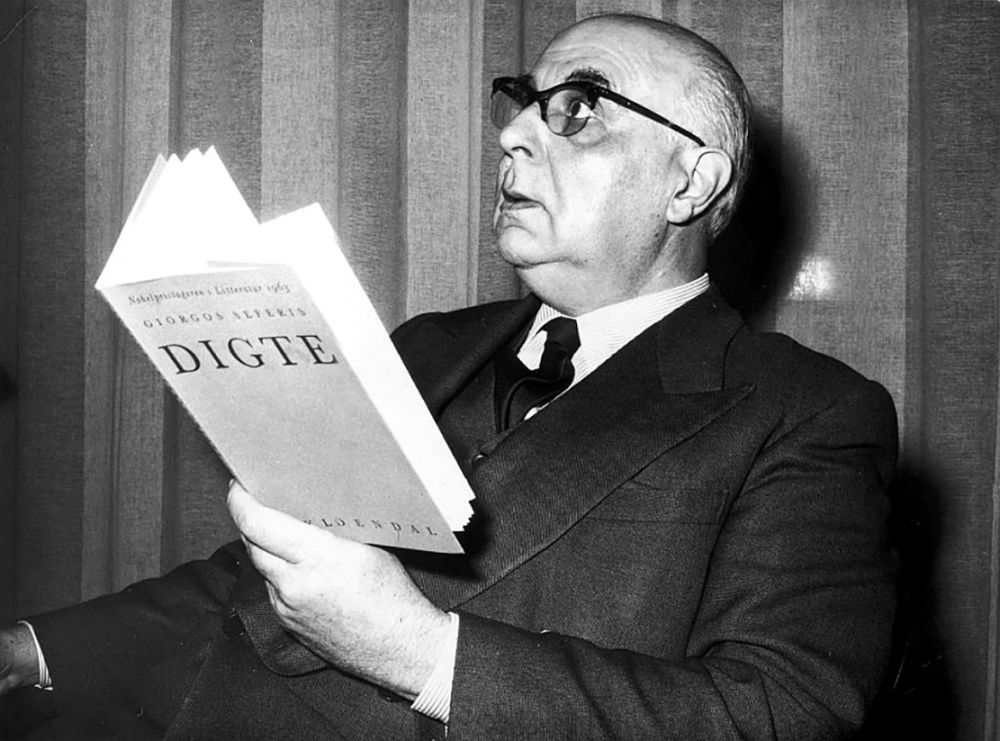
The art of poetry with George Seferis

Nuneham_2017-1https://www.theparisreview.org/interviews/4112/george-seferis-the-art-of-poetry-no-13-george-seferis


Interviewed by Edmund Keeley

ISSUE 50, FALL 1970

undefined

INTERVIEWER

Do you think there’s an advantage—as I think Cavafy would probably have thought—to being in dialogue with historians? In other words, do you feel that history has something particular to say to the poet?

SEFERIS

If you remember, Cavafy was proud of having a sense of history. He used to say: “I am a man of history”—something like that, I don’t remember the exact quotation. I am not that way; but still, I feel the pressure of history. In another way, perhaps: more mythological, more abstract, or more concrete . . . I don’t know.

INTERVIEWER

How about the relation of the Greek poet to his particular historical tradition? You once said that there is no ancient Greece in Greece. What did you mean by that exactly?

SEFERIS

I meant Greece is a continuous process. In English the expression “ancient Greece” includes the meaning of “finished,” whereas for us Greece goes on living, for better or for worse; it is in life, has not expired yet. That is a fact. One can make the same argument when one discusses the pronunciation of ancient Greek. Your scholars in America or in England or in France may be quite right in adopting the Erasmic pronunciation: for them Greek is a dead language; but for us it is another story. The fact is, you consider that ancient Greek has terminated its function at a certain point, and this enables you to pronounce it—with my regrets—in an arbitrary way.

INTERVIEWER

Then you obviously see the Greek tradition in language, as well as in other things, as a continuous process. That is not the belief of some classical and Byzantine scholars in this country—and, I suppose, elsewhere.

SEFERIS

You know why that happens? Because the subject, the history, of Greece is so large that each scholar limits himself to a certain period or branch, and nothing exists outside of it. For example, Gibbon considered that a thousand years of life were a decline. How can a people be in decline for a thousand years? After all, between the Homeric poems and the birth of Christ eight hundred years elapsed—or something like that—and then presumably there were a thousand years of decline.

INTERVIEWER

On the question of the Greek poet’s relation to his tradition, it has always seemed to me that the Greek poet has an advantage over his Anglo-Saxon counterpart who makes use of Greek mythology and sometimes even of Greek landscape. I remember years ago when I was writing a thesis on what I thought were English influences in the poetry of Cavafy and Seferis, I asked you about certain images that crop up in your landscape, for example, the symbolic meaning of the statues that appear in your work. You turned to me and said: “But those are real statues. They existed in a landscape I had seen.” What I think you were saying is that you always start with the fact of a living, actual setting and move from there to any universal meaning that might be contained in it.

SEFERIS

An illustration of that from someone who is a specialist in classical statues came the other day from an English scholar who was lecturing about the statuary of the Parthenon. I went up to congratulate him after his lecture, and he said to me, as I remember: “But you have a line which expresses something of what I meant when you say ‘the statues are not the ruins—we are the ruins.’” I mean I was astonished that a scholar of his caliber was using a line from me to illustrate a point.

INTERVIEWER

The imagery that a poet gets from his childhood is something we’ve discussed before. You once distinguished yourself from the average Englishman by suggesting that donkeys probably did for you what footballs and cars might do for them. I remember you also talked about the sea and the sailors of your native village near Smyrna.

Can modern poetry be saved?

Nuneham_2017-4

https://www.theatlantic.com/entertainment/archive/2013/06/can-modern-poetry-be-saved/314001/


“The responses so far have been either skeptical or overwrought. Charles is somewhat dismissive: “Could this essay in Harper’s spark a real literary wrestling match? Possibly, although poets are pretty inured to these well-worn grievances. Edmundson admits early on that Ralph Waldo Emerson preached essentially the same complaint 170 years ago.” At The Huffington Post, meanwhile, the poet Seth Abramson published a 2,500 word sermon against the idea of poetic decline. “Contemporary American poetry nourishes and enlivens and congregates and educates and in some cases even saves us the very same way poetry has always done for those with the willingness to stop speaking and listen,” he writes. Edmundson clearly touched a nerve among those invested in preserving poetry’s stature.

At the same time, Edmundson’s premise requires some scrutiny. He focuses primarily on the species of poet whose work appears in organs like The New Yorker, where verse is treated, much like the magazine’s infamous cartoons, as page filler, utterly subordinate to the long-form journalism and fiction that dominates the magazine’s feature well. “Many of the poems published in, say, The New Yorker feel just like the linguistic equivalent of a vanilla-scented candle,” the author Courtney Queeney noted in 2009. A year later, Slate observed that New Yorker poems tend to obsess over the craft of poetry itself. By design, New Yorkerpoems don’t distract or tantalize. They don’t grasp for what lies beyond, much less the reality before us. They don’t question authority. Of course, this may concern members of the literati like Mark Edmundson. But it is not exactly proof of a decaying form.

By the same token, Edmundson’s strict focus on the country’s most famous poets — Paul Muldoon, Anne Carson, John Ashbery, Charles Simic, and on and on — seems to suggest that our systems of awards and fame are far more flawed than the bulging corpus of American poetry. If your media diet comprises The New YorkerThe New York Times, and (presumably) Harper’s — and the books these publications endorse — it seems a little silly to be shocked at the lack of poems that attempt to seriously challenge arrangements of power or revolutionize the way humans think. Remember: Walt Whitman self-published Leaves of Grass! It’s not unimaginable to think that the most potent verse resides in a digital file on the servers of CreateSpace. Fame, even literary fame, is still simply fame, not a categorical claim on a work’s quality or impact.”

Golden sun has reason to defy!

The sun came out as yellow in the sky
Golden like a giant lemon pie
I feel so happy, I will not ask  why

Do we need a season’s alibi
Glinting sun will calculate no pi
The sun came out as yellow in the sky

The acers burn and  they are never dyed
Golden sun has made me see allies
I feel so happy, I don’t know quite why

Logic and its rules do not apply.
Golden sun has reason to defy!
The sun came out as yellow in the sky

If we live, it follows we will die
There was never pi in any sky
I feel so happy, I don’t wonder why

Sometimes the whole world seems set awry
Especially if you are a trapped house fly
The sun came out as yellow in the sky
I feel so happy, I’m a living guy.

Descry

TrappedFlyhttps://www.merriam-webster.com/word-of-the-day


Definition

1 : to catch sight of

2 : find outdiscover

Examples

In their research, the psychologists descried an association between violent crime and hot weather.

“Recent construction work on the Borough side had uncovered a cache of human bones. Builders soon reported strange noises and moving objects, and some refused to work. A visiting medium claimed to descry hundreds of tortured souls, including the shade of Guy Fawkes.” — Matt Brown, Time Out, 20 Feb. 2008


Did You Know?

With descry and the more common decry (“to express strong disapproval of”), we have a case of linguistic double-dipping. That is, English borrowed from the same French root twice. Both words ultimately come from the Old French verb decrier, meaning “to proclaim” or “to decry.” English speakers borrowed the term as descryin the 14th century and used it to mean “to proclaim” or “to spy out from a distance” (as a watchman might), and eventually simply “to catch sight of” or “discover.” Meanwhile, in French, decrier itself developed into the modern French décrier (“to disparage, to decry”). English speakers borrowed this word as decry in the 17th century. Be careful not to confuse descry and decry. They may be close relatives, but in modern English they have distinct meanings.

A mournful saxophone and heap of stones

Oh Swedish dramas fill the screens again
Furniture of birch  where murder hides
The end of summer and the evening sun

Men and women blond and equal stand
No gap at all and yet it is too wide
Those Swedish dramas fill the screens again

A mournful saxophone and heap of stones
When shall we see once more the bartered bride?
The end of summer and the evening sun.

As from the tomb, the murder victim rose………
Jesus Christ! His hands were open wide
Those myths and dreams will fill the screens  of man

Soon the epic Europe scheme disclosed
As the visions and the words elide
The end of summer and the evening’s done

Why was love not love but hate disguised?
Infernos red now burn the Nazis’ eyes
Yes, Europe’s dramas fill the screens again
The end  is nearer  than the evening sun

In Western nations civilised, insane

From the vulnerable God. this Jesus came
To know and love his creatures here on earth
He has no power; he shares our human pain

The tortured, weak and lost are his, he claims.
For he has suffered, died  without much worth
From the vulnerable God. a Christ has come

In silence and despair and shattered dreams
The souls of those who torture  negates birth
Not all powerful,  yet god shares our pain

While in the nations civilised, insane
Our  greed, our lies, our cruelty are a curse
Through a wounded God. a good man  came

In certain states of mind, prayer has no aim
Deep within the dark, hope comes to birth
God is with us, voiceless  burning, maimed

Cain and Abel, brothers  linked  by death
Today, that murder rises, is surpassed
From the broken god., this Jesus came
Human, suffering,  he too feels this pain.

Arched like a fallen moon


old man,bending over,
arched like a fallen moon
in a dark lilac November sky.
joy and pain wrestle my heart across the emptiness
and toss it up like a damp rocket
to fall in a hidden corner where mice live.
would that not be a good ending, to be dust
to these little creatures nesting
in my chewed green twine and my tartan basket?
They have eyes and shiver in my hand when I rescue them
from the cat…
as any heart might.
now night falls on the newspaper basket
where the damp Times and the Guardian mix into glue
and tomorrow the sun will rise
and it will just be  garbage
with no poetic undertones nor deathly hushes.
in the heather lit by silver light
you stand on a hilltop like a god
looking over his domain.
strong and now weak
it’s the human condition
everlasting life is too dangerous for  mankind.
silent, motionless, home of beetles
bit by bit we fall away
into the mother soil
with cracked jugs and dropped coins
for a future academic to dig into.
a transparent hand touches me.
who are you?

Lucian Freud .. a tribute

Life and death opposed,
Drawn to and by this prolific genius.
Pictures fell from his eyes,
Like tears.
Children given life.
Creating as he could,
An England richer by his gifts.
Where else might he have given so much?
The work became the man.
Portraits rising from the canvas
To meet in a new space
That he discovered.
And after loss, the gift.

Don’t start thinking

The cat is watching you

When Mary was coming downstairs  she realised she had lost weight.Her skirt was slipping down
.Oh,dear, she said to Emile, I hope it  is not unwearable.
Don’t worry,said Emile.You can put a  pin into it

She replied tactfully,yes I will when I get to the bottom of the stairs but before Mary. got to the bottom her skirt fallen off completely and she was only wearing a brown silk petticoats and a pair of teal coloured tights.
You look nice Emile said. Maybe you don’t need to wear a skirt you  can wear  a  petticoat instead,
Thank you very much, said Mary but the weather is very cold and a silk petticoat is not warm enough for going into the town although I suppose I could put a very warm long coat over the top. Suppose I went into a restaurant and felt too hot then I would have to take off my coat and then everybody would see my petticoat.
Life is made up of Conundrums like this and the secret is not to start thinking this way in the first place; once you do this is very hard to stop.
Some of Mary’s friends say to her. Are you sleeping alright or how are you sleeping?
Mary never answers because she knows that if you start thinking about that this a lot it’s not good for you as you can spend all day worrying about whether you are going to be able to sleep that night.
We have no control over our sleep, she pondered, but we can’t afford to ruminate  as it causes mental illness .Rumination cuts people off from the world as they are always looking inside themselves.
Similarly being a perfectionist is very bad for you because again you’re not thinking about the work that you’re producing and  enjoying it you are always wondering is this good enough or shall I start again oh I am so stupid etc
It is possible ,Mary has found,  to control what you allow yourself to think about.You can cut you thought off before it gets going.
Anything that makes you keep thinking about yourself all the time will create a wall around you.Other people can detect this wall; it makes them avoid you.
In general, we should have a few  walls as possible both internal and external
Just then the doorbell rang. it was  Annie the ex-mistress of Mary ‘s husband Stan.
Hello she cried, how do you like my new coat
Don’t tell me you’ve got another one, Mary  sighed
I didn’t buy it Annie murmured. That  sweet lady who lives opposite told me that she has put on a lot of weight and she can’t wear this  anymore; she asked me if I would like it
But you have already got about 20  Mary said, but I like this one.It’s a lovely colour; is it what we call teal or is it Kingfisher Blue?
I don’t know but it seems to match my other clothes and you know I do like a change.You prefer just to have one coat and wear it all the time unless you are going out to your special functions, hen you might wear your  best coat, which is the brown one isn’t it which Stan used to like because he said it hung well
Yes, he did like that very much and I was wearing it only yesterday as it is very warm. I would like to have more clothes like you do but I seem to be too busy to go shopping
Annie gazed up with her large round eyes upon which she was wearing turquoise and magenta eyeshadow and bright blue mascara which clashed with her purple lipstick from East Saint Lawless.
That purple lipstick  does not match your coat nor your eyeshadow Mary told her
Well , I think that a perfect costume puts men off.So it’s better to do something wrong and anyway, a lot of men are colour blind so they won’t know that it’s the wrong shade of lipstick. I think that coral would look better and I shall buy some next time I go into the term because teal and coral look very nice together.Purple is good with blues
Actually, Mary said , purple makes you look as if you’ve got heart disease or anaemia.
Thanks a lot, shouted Annie. What kind of friend are you
I am an honest friend ,Mary replied in a warm voice.I think that I don’t often say things which distress you but sometimes knowing that you would like to meet another man I  feel impelled to give you my point of view.
That’s very kind of you said Annie but I think now I am too old to find a man who wants a mistress because a younger man could get a younger mistress and an older man maybe past bothering about mistresses and love and such things.And where can I find one, anyway.
I don’t agree, said Mary I think if you look very nice a man may be very proud to take you out and have you hanging from his arm like a trophy even if he is not able to proceed very far with bodily love. After all, everybody likes someone to talk to and  some companionship; someone to help them out when they are feeling unwell
As long as that is it is mutual I don’t see anything wrong with it.
The two women stared out of the window and saw a wood pigeon on the shed.Maybe it’s better to be a bird, Mary thought aimlessly before she put  on the kettle for a lovely cup of tea and some chocolate fingers
Tea is the best drink in the afternoon.
And so say all of us.

How poetry can change lives

Lilium-African-Lady-2

http://www.telegraph.co.uk/culture/books/poetryandplaybookreviews/9020436/How-poetry-can-change-lives.html


“There are poems that have, literally, changed my life, because they have changed the way I looked at and listened to the world; there are poems that, on repeated reading, have gradually revealed to me areas of my own experience that, for reasons both personal and societal, I had lost sight of; and there are poems that I have read over and over again, knowing they contained some secret knowledge that I had yet to discover, but refused to give up on. So, at the most basic level, poetry is important because it makes us think, it opens us up to wonder and the sometimes astonishing possibilities of language. It is, in its subtle yet powerful way, a discipline for re-engaging with a world we take too much for granted.

When the purveyors of bottom-line thinking call a mountain or a lake a “natural resource”, something to be merely exploited and used up, poetry reminds us that lakes and mountains are more than items on a spreadsheet; when a dictatorship imprisons and tortures its citizens, people write poems because the rhythms of poetry and the way it uses language to celebrate and to honour, rather than to denigrate and abuse, is akin to the rhythms and attentiveness of justice. Central to this attentiveness is the key ingredient of poetry, the metaphor, which Hannah Arendt defined as “the means by which the oneness of the world is poetically brought about”. It’s that power to bring things together, to unify experience as “the music of what happens”, that the best poetry achieves.

Most of us feel that this is true of the great dead poets society of history, of Shakespeare and Milton, of Coleridge and Shelley and, of course, of TS Eliot, an American who re-envisioned and so renewed and enriched our idea of England. Yet I would argue that poetry is, or can be, as central to our experience now as it has ever been. To read “I Am Your Waiter Tonight And My Name Is Dmitri”, by the great contemporary American poet, Robert Hass, at the height of George W Bush’s xenophobic repudiation of “Old Europe”, was to be reminded not just of the injustice and futility of war, but also of the very richness and complexity of history that Bush sought to expunge.”

Jules Henry on infinite need

33nsoc
Human beings have the capacity to learn to want almost any conceivable material object. Given, then, the emergence of a modern industrial culture capable of producing almost anything, the time is ripe for opening the storehouse of infinite need!… It is the modern Pandora’s box, and its plagues are loose upon the world.

Unblank Verse


The leaves are turning red on my computer
The apples ripen better on TV.
But my friend says red won’t suit her
So for a new blue coat, she makes a plea.

But as I only learned to speak in BASIC
I do not know if she will understand.
If I write a letter, she’ll deface it.
For my letters tend to be too bland

An email is a different sort of kettle
Not the type we use for boiling fish
So let the old men find their mettle
And get a frozen fish from off a dish

Toss it into Heinz baked beans a-boiling
Let it simmer for a few long days
Then invite a friend for utter spoiling.
I’m sure she’ll inundate you with her praise.

Follow up with custard creams in gravy.
Serve the peanut butter on a tray
That’s what folk eat the Navy.
Eat and eat and pray and disobey.

Not dead yet

MAGGIE-S-WALKER-Maternity-Clothing-Top-Fashion-Maternity-font-b-Clothes-b-font-Summer-Batwing-Sleeve

For the last three years,I have had the problem of what to wear at night.Because inevitably someone will ring the doorbell before I dress.As I get my shopping online I don’t want to miss this and pay £10 for a cab to some sorting office.
In fact, have we ever thought about what and why we wear certain things  in bed?
Before washing machines, we didn’t want our day clothes ruined by sleeping in them but that is what we might do now.Though ironing would get problematic, unless all people in the house do their own.
And we don’t want to be too hot.So wearing a dressing gown is perhaps not wise.
I tend to feel cold unless it’s 80 deg F.So I tried out wearing two nightdresses at once.Perfectly warm for reading and more opaque than Cherie Blair’s on her first morning in Downing St.However no one rang the bell.In any case I am cutting back on newspapers,  clothes etc so apart from getting some wonderful but small lobster claw extension chains so my necklaces are not strangling me I am not buying anything at all for myself.I like mending things so I have now got a  silver chain with two tiny torches on it hanging round my neck.I find them good for reading the instructions on packages.And if the power goes off then I am ok till I get a big torch out.
You can buy  packs of little torches and also tiny magnifying glasses.Less heavy to carry a little magnifying glass in the bag.Mine is heavy anyway with various emergency items.I can hardly post a letter without taking some with me just to cross the road.
I have stopped sending holiday postcards.But begun sending postcards of my own town with its ancient church and remains of palaces and old walls and gardens.
I like to get cards and letters but it is rare now.I like handwriting.I like guessing who it might be.I am not wearing a pen around my neck or a Tablet.I won’t be able to stand up if I do that.Why should I want one anyway?
Now.did you see the Stores are selling “modest” clothes for women? I shall be glad when leggings and crop tops disappear from the High Street especially beige or pale pink leggings which make women look almost nude as they potter in the town.Under-dressing? It might be because it’s a cheap style and many people are hard up.But dark leggings are much more flattering.Even old disabled men like my older brother are a bit disturbed by these visions.If I were him, I’d be glad.Not dead yet.

Melancholy makes us more creative

P1000262 1
Digital  image by Katherine

https://www.wired.com/2010/10/feeling-sad-makes-us-more-creative/

Extract:

Why does a melancholy mood turn us into a better artist? The answer returns us to the intertwined nature of emotion and cognition. It turns out that states of sadness make us more attentive and detail oriented, more focused on the felt collage. Joe Forgas, a social psychologist at the University of New South Wales in Australia, has spent the last decade investigating the surprising benefits of negative moods. According to Forgas, angst and sadness promote “information-processing strategies best suited to dealing with more-demanding situations.” This helps explain why test subjects who are melancholy – Forgas induces the mood with a short film about death and cancer – are better at judging the accuracy of rumors and recalling past events; they’re also much less likely to stereotype strangers and make fewer arithmetic mistakes.

Photo0292 2


No peace on earth

26art-terrorism2-1508799894253-master675If only we could have peace on earth but we are descended from the most aggressive primates… why many of them were sadomasochists.Well, some were sadists and the rest were masochists I gather.The ones who weren’t died out as they never mated.

Silent

This is the first line
Of the poem I wanted to write
After you smiled
But I never wrote it
I didn’t understand what was happening
I didn’t understand
Anything
But remember someone loved me
Called for me
Howled for me
And I went
And now I am all alone
And I can’t call for you
Yet we were in a dream last night
Together
But you were silent

Refugees

https://www.ushmm.org/wlc/en/article.php?

On May 13, 1939, the German transatlantic liner St. Louis sailed from Hamburg, Germany, for Havana, Cuba. On the voyage were 937 passengers. Almost all were Jews fleeing from the Third Reich. Most were German citizens, some were from eastern Europe, and a few were officially “stateless.”

The majority of the Jewish passengers had applied for US visas, and had planned to stay in Cuba only until they could enter the United States. But by the time the St. Louis sailed, there were signs that political conditions in Cuba might keep the passengers from landing there. The US State Department in Washington, the US consulate in Havana, some Jewish organizations, and refugee agencies were all aware of the situation. The passengers themselves were not informed; most were compelled to return to Europe.

Since the Kristallnacht (literally the “Night of Crystal,” more commonly known as the “Night of Broken Glass”) pogrom of November 9–10, 1938, the German government had sought to accelerate the pace of forced Jewish emigration. The German Foreign Office and the Propaganda Ministry also hoped to exploit the unwillingness of other nations to admit large numbers of Jewish refugees to justify the Nazi regime’s anti-Jewish goals and policies both domestically in Germany and in the world at large.

Take your tablet,for example

PANO_20170908_195532 12

This person keeps saying she wants to commit suicide.So I said to her, first you need to buy a Tablet

Will one be enough, she asked in surprise?

Yes,buy a Kindle Fire Refurbished

She said, what does refurbished mean?

So I said,someone has used it but Amazon have cleaned it up

She said, you expect me to take a tablet someone else has already used? I might catch a bug from it.How did Amazon get hold of it?

I expect the relatives sent it back!

Good grief,how many people can one tablet kill?

I said, wait till you see it and then you’ll get to learn a lot of different things

I don’t want to learn anything.

But you asked me how to commit suicide

I just don’t believe one will be enough

Ask for the 10 inch one

It won’t go down my throat.I will choke

There you are, you’ve found your own solution

I think I’ll stay alive.

Tablets, love them, hate them but never mate with the,

Call centre humour

DSCN0086 2
digital art by Katherine

The reality of the stupid things phone 999 for is funnier than these manufactured jokes

https://www.callcentrehelper.com/more-call-centre-jokes-155.htm

WordPerfect Customer Service Joke

This is rather an old one, that has been around for a few years, but is one of my personal favourite jokes.
Tech: “Ridge Hall computer assistant; may I help you?”
Customer: “Yes, well, I’m having trouble with WordPerfect.”
Tech: “What sort of trouble?”
Customer: “Well, I was just typing along, and all of a sudden the words went away.”
Tech: “Went away?”
Customer: “They disappeared.”
Tech: “Hmm. So what does your screen look like now?”
Customer: “Nothing.”
Tech: “Nothing?”
Customer: “It’s blank; it won’t accept anything when I type.”
Tech: “Are you still in WordPerfect, or did you get out?”
Customer: “How do I tell?”
Tech: “Can you see the “C” prompt on the screen?”
Customer: “What’s a sea-prompt?”
Tech: “Never mind. Can you move the cursor around on the screen?”
Customer: “There isn’t any cursor: I told you, it won’t accept anything I type.”
Tech: “Does your monitor have a power indicator?”
Customer: “What’s a monitor?”
Tech: “It’s the thing with the screen on it that looks like a TV. Does it have a little light that tells you when it’s on?”
Customer: “I don’t know.”
Tech: “Well, then look on the back of the monitor and find where the power cord goes into it. Can you see that?”
Customer: “…Yes, I think so.”
Tech: “Great! Follow the cord to the plug, and tell me if it’s plugged into the wall.”
Customer: “…Yes, it is.”
Tech: “When you were behind the monitor, did you notice that there were two cables plugged into the back of it, not just one?”
Customer: “No.”
Tech: “Well, there are. I need you to look back there again and find the other cable.”
Customer: “…Okay, here it is.”
Tech: “Follow it for me, and tell me if it’s plugged securely into the back of your computer.”
Customer: “I can’t reach.”
Tech: “Uh huh. Well, can you see if it is?”
Customer: “No.”
Tech: “Even if you maybe put your knee on something and lean way over?”
Customer: “Oh, it’s not because I don’t have the right angle-it’s because it’s dark.”
Tech: “Dark?”
Customer: “Yes-the office light is off, and the only light I have is coming in from the window.”
Tech: “Well, turn on the office light then.”
Customer: “I can’t.”
Tech: “No? Why not?”
Customer: “Because there’s a power outage.”
Tech: “A power… a power outage? Aha! Okay, we’ve got it licked now. Do you still have the boxes and manuals and packing stuff your computer came in?”
Customer: “Well, yes, I keep them in the closet.”
Tech: “Good! Go get them, and unplug your system and pack it up just like it was when you got it. Then take it back to the store you bought it from.”
Customer: “Really? Is it that bad?”
Tech: “Yes, I’m afraid it is.”
Customer: “Well, all right then, I suppose. What do I tell them?”
Tech: “Tell them you’re too stupid to own a computer.”
——————–

Unlike Lady Godiva’s

My new coat is described as wool rich
21%…I’ll not itch
It’s mostly man-made fibres
Unlike Lady Godiva’s.
I paid £99 for a stitch.

Years back, we were told silk and wool
Would be no longer here,so I mulled
I decided on plastic
And cardboard domestic
For in Hull there will be no pure wool

Yet lamb is still sold with the meat
So their mothers must be sad as they bleat~
Have their fleeces now been tampered with
Or the farmers been hampered with,
Losing the skill to shear sheep

So if there’s a heat-wave next year
The sheep will be hot,so I fear
Imagine your winter coat
Gripped round your hot flushed throat
As you sit by the Thames swigging beer.

Or if you should walk on cliffs sheer,
Near Dover, they are white,So one hears
Don’t pet a sheep or ram
They are more fierce than men
They may push you off and then leer

So you would drop into a ship
Full of illegal white chaps
They may be from Poland
They may be old Romans
I say, are your rightly equipped?

Suppose that the ship is on its way
To France or to Russia,oh hey
Remember what the Jews went through
As their ship was not permitted to
Dock, so as grey smoke these Jews blew.

And if the wind came from the East
All of us here and our beasts
Would have taken in the gays and Jews
Gypsies as well abused
So don’t take deep breaths when you feast

Marion Milner,the life

Marsh-H-Dry-Sandhttp://www.scotsman.com/lifestyle/culture/books/book-review-marion-milner-the-life-by-emma-letley-1-3008515?utm_source=twitterfeed&utm_medium=twitter

What she knew was how to write about joy. She knew about moments when what you sense is suddenly vivid and full of energy: looking out at a tree, perhaps, and in that moment discovering a response in your whole being, in body as well as mind. Travelling, she had a brilliant eye, but it was for the “wide, unfocused stare”, not the “narrow, deliberative concentration”; she goes out after rare orchids and stops in wonder at the white blossoms of a whole hill of wild garlic. Falling in love was her model for such moments, “images with a ‘still glow’”. She wanted to get past the cant idea that the unconscious mind is a kind of dustbin of the soul where everything is shameful, and to reconnect mind with body. She’s the useful version of fashionable talk about consciousness because she knows writer’s block but she also knows the moments when you put away intellect and let the mind go as it wants; when the block breaks. She thought creativity, whatever its form, was the whole point of being human. You may not know Marion Milner, but you will be glad when you do.ost cutting insults
Read more at: http://www.scotsman.com/lifestyle/culture/books/book-review-marion-milner-the-life-by-emma-letley-1-3008515?utm_source=twitterfeed&utm_medium=twitter

Margaret Drabble

https://www.theparisreview.org/interviews/3440/margaret-drabble-the-art-of-fiction-no-70-margaret-drabble

” I don’t like placing other writers much and avoid the temptation to do so when asked, though I don’t mind admitting my immense admiration for Angus Wilson, Saul Bellow, and Doris Lessing.
INTERVIEWER
I know you’ve done your share of interviewing. What is the first question you ask someone?
DRABBLE
Oh dear. I never know how to begin. I find it to be a very difficult job, actually. I’m rather a bad interviewer because I never ask people things that they don’t want to be asked. As soon as they look annoyed or nervous, I never persist.
INTERVIEWER
I read your interview with Doris Lessing and I thought that many of the things that came out of it could have been said about you as well. You quote her as saying, “In writing novels, we bring into being what we need to be.” Can you comment on that?
DRABBLE
In a sense, the fiction creates the reality, but it’s a very complicated relationship. I think if you imagine a certain kind of person, then that person comes into being. You become that person. Or at least this kind of person becomes a possibility. But you have to be careful what you imagine, because the act of imagining is the act of encouraging yourself to be a certain kind of person. The fact of going in a certain direction has something to do with what you imagine as good or proper for yourself.
INTERVIEWER
But it also seems to me, that as far as you’re concerned, the kind of person you are has as much to do with fate or accident as it does with self-creation.
DRABBLE
This is what is so interesting about life: choosing to be something and being struck down while you do it by a falling brick. The whole question of free will and choice and determinism is inevitably interesting to a novelist. Perhaps I go on about it more than some. Are your characters puppets in the hands of fate or are they really able to make free choices? I think we have a very small area of free choice.”

An interview with Michael Holroyd

https://www.theparisreview.org/interviews/6223/michael-holroyd-the-art-of-biography-no-3-michael-holroyd

“I’ve always believed that there’s no such thing as a definitive biography and, particularly if you write about writers, that you are offering your subject the opportunity to write one more book, posthumously, of course, and in collaboration with you. Even if you and I were writing about the same subject, and even if our research were identical, we would produce different books. The dates and so on would be the same, but some themes would seem important to you and insignificant to me.
INTERVIEWER
You have written that you have “traded somewhat in invisibility as a biographer.”
HOLROYD
I believe that we are there between the lines, but most readers are not particularly aware of us.
INTERVIEWER
Are there subjects you considered but didn’t pursue?
HOLROYD
I thought a long time ago that Katherine Mansfield was a good subject. And I was asked to do one or two other books—Pamela Hansford Johnson, Stephen Spender—but I was always in the middle of something else. I was also asked to do a life of Jacqueline du Pré, whom I met, but I wasn’t competent to do it.
INTERVIEWER
Because you felt you didn’t know enough about music?
HOLROYD
Yes. It would have been interesting—in a way my subjects have been the tutors I never had, because I didn’t go to university. So I would have learned a lot. But it was difficult, too, because she was alive, and she suggested how I should do it, and I thought, This won’t work. I think it’s important to keep a distance from the person you’re trying to get close to.”

Love bade me welcome

https://www.poetryfoundation.org/poems/44367/love-iii

7134238_f520
BY GEORGE HERBERT

Love bade me welcome. Yet my soul drew back
Guilty of dust and sin.
But quick-eyed Love, observing me grow slack
From my first entrance in,
Drew nearer to me, sweetly questioning,
If I lacked any thing.

A guest, I answered, worthy to be here:
Love said, You shall be he.
I the unkind, ungrateful? Ah my dear,
I cannot look on thee.
Love took my hand, and smiling did reply,
Who made the eyes but I?

Truth Lord, but I have marred them: let my shame
Go where it doth deserve.
And know you not, says Love, who bore the blame?
My dear, then I will serve.
You must sit down, says Love, and taste my meat:
So I did sit and eat.
Source: George Herbert and the Seventeenth-Century Religious Poets (W. W. Norton and Company, Inc., 1978)

About George Herbert the poet

https://www.theguardian.com/commentisfree/2014/mar/17/george-herbert-poetry-faith-vocation

The poem takes its title from the parable of a perfect pearl hidden in a field: a man finds it, and goes and sells everything he has so that he can buy the field and own the pearl. In the final verse, Herbert uses this metaphor of buying and selling to great effect, making it clear that he went into the bargain of ordination with his eyes open:

“I fly to thee, and fully understand / Both the main sale, and the commodities.”

Are you grateful

Pray Father, give me your guessing.

My guessing!Don’t you mean my blessing?

Oh, probably.Possibly..who knows.

So have you any sins to tell me?

Yes, I broke a glass jug.

Whose was it?

It was mine, Father.

Surely it’s not a sin to break your own jug?

It is if you hit yourself on the head with it!

What made you do that?

I was angry with myself…I had been committing effrontery.

Do you mean adultery?Your main problem seems to be bad language.

No, Father I never say” F*ck”

You just did.

Well, I had to do.I had no choice!

That’s what they all say…if only I heard some original sin I’d find life more interesting.

Well, it’s hard to think of anything original to do especially if it has to be a sin too.

You are just not using your creativity.

All right Father, Put your hands up.i’ve got a gun.

Where did you find that?

In my wife’s handbag.

Now we are getting somewhere.. that’s threatening a priest, interfering in your wife’s privacy and stealing a gun.Any other sins?

I could shoot you, I suppose.

No.no!That is going too far.

Shall I slap you?

No… just say something rude to me.

Your sermons are the most boring I have ever heard.

Well, that’s enough…I’ve never been so insulted in my life.

You have been very lucky then… you should hear what people say to me!

Well, you are both ugly and unintelligent.I don’t know how you had the nerve to marry.

I had no choice.She forced me.But I gave in quickly in case she changed her mind.

And you have seven children.

No, they are not all mine. .And they are Jewish.How can they be Jewish?

My wife is Jewish!

I thought she was just a lapsed Catholic.

No, she’s Jewish but not even an arranged marriage could be arranged for her so she used her imagination and decided an overweight ugly Catholic would be grateful for her love.

And are you grateful?

Yes, and so are all her lovers!

Who are they?

The curate is one of them and has two children .. they look just like him too.

And does she want them raised as Jews?

She lets them rise naturally and go with the flow.

Do they have to wear hats?

Only in the Synagogue!

Are you Jewish too.

Yes,it’s quite handy as we have Sabbath on Saturday and then we have Sunday on Sunday if you see what I mean.

I never met anyone who practised two religions before.

Well,I figured it would double my chance of salvation!

Well. I must speak to the Rabbi.For your penance you must give £50 to Homeless at Xmas.

Am I absolved.

If you stay any longer you’ll be dissolved!

Thank you, Father.

And take that gun away.I don’t want it.

I can get you a good price for your cassock.

Why,thank you ,my child but I need it.

Well,Jesus had no cassock!

Well, he was a Jew…I am a Catholic.

Now,that makes me think.

Think what?

About the Vatican…

Let’s not go there,

Shalom

As ants and beetles stand around and stare

The garden’s now a Wood,where dwell three wolves
The maple red is now the president
And all the laws and rules have been devolved
For the sake of all the residents

This green country gives heart like mine no grief
For hidden are the houses standing near
And as the wolves dance, I watch with relief
As ants and beetles stand around and stare

For wolves are never seen in suburbs tame
And maples are at home in foreign lands
It may be that the satyrs play new games
And smuggle in some creatures contraband.

Let explanations die their long due death.
Let’s lose our minds and dance in happiness.

Advert

Why not eat breakfast now and sleep in your work clothes Free advice £990 cheques or cash or food [tinned]

A writer reveals

fkower-abstract

Twenty Questions with Benjamin Ludwig, Writer

Stories were the most important thing in the world to me, growing up. Whether it was acting them out, reading them, or just telling stories with friends, that’s what I loved to do.

Which fictional character would you most like to meet?

I’d love to sit down and chat with the clown/fool from Twelfth Night. He’s one of my favorite characters.