

Author: Katherine
Poetry writer and author

The rhythms of the world
Unlike the noise of cars and phones
That makes our hearts unsteady and solo
The heart of earth keeps rhythms which are its own
We can tune in to these undertones
Walk in time to music soft and slow
Underneath the noise of cars and phones
When I do that ,I Iive down in my bones
And marrow spreads more goodness in its flow
The heart of earth keeps rhythms which are its own
The flesh, the bones, the nerves may sing or moan
What is it that makes us each mellow
Despite the noise of cars and mobile phones
Yet all we are is mortgaged or on loan
Not our houses but our breath that blows
To the heart of earth in rhythmic poems
We can co-create with those who grow
In tune with what all contribute unprobed
Underneath the noise of cars and phones
The heart of earth keeps rhythms it calls its own
Share this:
Kissing heals the wounds from dreams at night
Kissing eases stress and painful thought
I don’t know the sample size they checked
But blow a kiss whenever love ignites
Kissing makes our eyes look very bright
Unless it’s what they call a little peck
Kissing eases stress and painful thought
A kiss can make our burdens seem more light
Enables us to empty worry sacks
So throw a kiss whenever love feels right
Love can heal dark feelings that destroy
And makes the world seem fairer and less black
Kissing eases stress and painful thought
Giving and receiving bring insight
Helps us find the remedy we lack
So share a kiss whenever love feels right
Every situation has its cracks
Light shines through, revealing the right track
Kissing is more fun than idle thought
So blow a kiss and let your love ignite,
Share this:
I live in blackness yet the angels lean
When you come back to me, my dearest one.
When you no longer hide away in dreams.
The golden sun will rise for us again
When all my work on earth is past and done;
When I have felt the pain of what has been,
Will you come back to me, my dearest one?
Without your presence, I feel lost and pained.
But this is not eternal, though it seems.
The golden sun will rise for me again
The last bell rings , I’m silent and alone.
I am too simple to make cunning schemes
Will you come back to me, my dearest one?
Human life is brief; we share its pain;
The death instinct, the deadly Faustian themes;
The sacred sun will rise for us again .
I live in blackness yet the angels lean
To shelter with their sacred wings my limbs.
Though you had to go , my dearest one,
Though loss may win, I still desire the sun
Share this:
My sad heart
The pain has come again to my lost heart
The ache of grief seems crueller in the night
As it was when we were forced apart
At first, the numbness made me loth to start
Yet like the morning sun, I hurt with light
The pain has come again into my heart
I listen for some guidance, kind comfort
To my inner self and wisdom’s might
As I knew before we had to part
But guidance only comes to those with art
To read the signs, and understand their plight
The pain has come once more into my heart
Death itself had beauty of a sort
As you went without struggle or fight
Wonder came, it seems we had to part
Why is pain so strong it seems to bite?
An anger and a rage it can impart
The numbness made my feelings dead and dark
The pain had come again into my heart
Share this:
We are our situations
https://www.poets.org/poetsorg/text/we-are-our-situations-poetry-christopher-gilbert
” I am
into small steps here—I total the bits of me.
I have lived in countless places, childless,
without song, and now no church of time ahead
behind whose doors one can walk and be
transformed, enormous, again, and facing the sky.
This self becomes a tourist both displaced and situated in his displacement. Selfhood becomes an act of existential improvisation. Selfhood becomes as fluid and difficult as language. These are not difficult poems, but difficulty is often their subject: the difficulty of the gaps between selves, between being and thinking, between timelessness and time. They strive “to build,” as Gilbert writes in the poem “Turning into Dwelling,” “this language house . . . this loving which lives outside time.” The new collection’s title, Turning into Dwelling, underscores the ways the self is simultaneously restless and reflective in Gilbert’s body of work. His poetry makes “turning” both a motion and an act of transformation, and “dwelling” both a shelter and an act of rumination.
I am still, despite countless readings these last years, being introduced to Christopher Gilbert and his selves. He died at the young age of fifty-seven on July 5, 2007, in Providence, Rhode Island. Graywolf Press published Across the Mutual Landscape, when Michael S. Harper selected it for the 1983 Walt Whitman Award. Harper was one of the first poets I emailed in 2010 to ask about Gilbert. He told me Gilbert had died of an “inherited kidney problem”; that as an undergraduate he’d studied with Robert Hayden at the University of Michigan. Part of me wonders how much Gilbert was shaped by his relationships with Hayden, Harper, and Knight. Gilbert, born in Alabama, was, like Knight, a southern transplant; Gilbert, like Hayden, was raised in industrial Michigan; Gilbert, like Harper, lived much of his adult life in Providence, Rhode Island.”
Share this:

Sick
https://www.poets.org/poetsorg/poem/sick
“I cannot go to school today,"
Said little Peggy Ann McKay.
“I have the measles and the mumps,
A gash, a rash and purple bumps.
My mouth is wet, my throat is dry,
I’m going blind in my right eye.
My tonsils are as big as rocks,
I’ve counted sixteen chicken pox
And there’s one more—that’s seventeen,
And don’t you think my face looks green?
My leg is cut—my eyes are blue—
It might be instamatic flu.
I cough and sneeze and gasp and choke,
I’m sure that my left leg is broke—
My hip hurts when I move my chin,
My belly button’s caving in,
My back is wrenched, my ankle’s sprained,
My ‘pendix pains each time it rains.
My nose is cold, my toes are numb.
I have a sliver in my thumb.
My neck is stiff, my voice is weak,
I hardly whisper when I speak.
My tongue is filling up my mouth,
I think my hair is falling out.
My elbow’s bent, my spine ain’t straight,
My temperature is one-o-eight.
My brain is shrunk, I cannot hear,
There is a hole inside my ear.
I have a hangnail, and my heart is—what?
What’s that? What’s that you say?
You say today is. . .Saturday?
G’bye, I’m going out to play!”
From Shel Silverstein: Poems and Drawings; originally appeared in Where the Sidewalk Ends by Shel Silverstein. Copyright © 2003 by HarperCollins Children’s Books. Reprinted by permission of the publisher. All rights reserved.

Shel Silverstein
Share this:

Songs from the passed
 Flee amidst the winter snow.
No little frowns in Bethlehem
Harlot’s ribbons for her hair
God didn’t fake the little-seen nipples.
I’ll love as ever deplored.
The snow laid roundabouts free.
Oh, hum all ye faithful.
As tested with day class.
We long to wee ah, oh!
Good pass, my love, you hit my gong
Greensleeves, ah, what a fright/save a bite
On Richmond’s pills, I loved no cost
Try an anti-depressant like loving your femur.
The Ten Commandments were God’s way of dropping a hint.Luckily Moses had a bag for the Tablet.
The Earl I loved was beautiful and so was old Soho.
Queen of the Bray
I loved an ass
Share this:

The wrong way to Tipperary
 I say to myself, what a blunder-filled world.
Silent bite, holy spite.
It’s the wrong way to Tipperary.
Back up your troubles. in your old knit bag with our new app.
There’ll be blue words over the white stiffs of Dover.
This is the war that blends all wars and then adds more.
When they bombed Neasden, it was the wrong way to go
Friendly liars killed troops on board a warship.
Sing something dimpled
I like lieder, he likes lieder, yay yah yah,yoah, more.
Singalong for the truce to come
I’m a number, Jack, I sneer all day.
We wronged thee, see the woe.
Oh.little town of Bethlehem divided by the Wall
Jesus wants me as a fruitcake.
It’s wrong to see thee so
It’s numb, all ye faithful.
I tested till declase, day class date class
We used this word I spelled declase when I was a child… it means tired, overworked, the mind can’t continue… anyone heard that before?I have never heard others use it, only my family
Share this:

The sacred centre of our life
Signs and symbols guide the route.
Love gives the soul her appetite.
Though the night is black and starless,
The inner guide is never careless.
The notes are struck, the tune is played,
Plain melodies are overlaid.
In this chant and benediction,
Healing comes for desolation.
Though the passageway is narrow,
This road is the one to follow.
Struggling through the mud and mire,
We see, in darkness, tongues of fire.
The sacred centre of our life
Is never found without some strife.
Just then, the dark and light combine,
To create a symbol for the mind
Share this:
The grapes are crushed
Real and true, our feelings crushed give pain
Though beautiful dried flowers are shown much grace
Yet lying does not aid us nor does blame
Can we be kind and in kindness contain
The sorrow and oblivion of our place?
Real and true, our feelings crushed give pain
Do we fear to lurch and be insane:
Lose our minds and live with that disgrace
Lying does not aid us nor does blame
The grapes are crushed and then made into wine
Yet humans tested cry for our embrace.
Real and true, our feelings crushed give pain
Dark our faces grow as if in shame
What has brought us to this awful place
Lying does not aid us nor does blame
Round the room all night I endless pace
Seeking of the lost a tiny trace
Real and true, our feelings crushed give pain
Will we find the space to play again?
Share this:
Down comes Love
Now I see the shadows on the wall
And in my heart. I feel the savage loss
Down I come, and with the dust, I fall
Once I scarcely saw the bad at all
And did not think of love and what it cost
Now I see the shadows on the wall
Down amid the weeds I find my call
And mixed with dark green leaves I am compost
As down I come, and to the dust, I fall
Brilliance cannot last and life appals
In between my cells comes sudden frost
Oh, I feel the cracks within my walls
We love between the lines with all we feel
Then broken by the cold we join the lost
Down we come, and into dust, we fall
Must we live and what shall living cost?
Is it ours to judge the present past?
As I watch the shadows on the wall
Down comes Love and holds me as I fall
Share this:
A man who could not trust
With my foolish love, I once fell for,
After words seductive and sustained,
A man who could not trust those he implored
Struck by anguish plain, I then desired
For love to be rewakened and attained
With a new felt love, I still was for.
Like a worm or beetle on dirt floors
I took to earth to feel the dark again
Forget the man whose trust was quite impaired
Nervous and uncertain, still unsure
I tried to find the measure of this pain
Caused by loving love while immature
An agonising ache seeped through my pores
As if I needed heavy violent rain
To cleanse me from the man who called me whore.
And now I am appalled and to, ashamed
If we’re touched by love, it leaves its stain
With ferocious grief , so undermined
I wander in the marshlands of the mind
Share this:
Sad facts
Maybe death is somewhat like a birth
Forces from elsewhere possess our souls
And in the end, we all must come to earth
No need to work on any other goal
Who decides that one child must be born
Although it has not grown for 40 weeks
And what a fear when from the womb it’s torn
We don’t remember as we could not speak.
Nature’s wild and lets so many die
As if like sperm, the eggs are well supplied
The well of tears will not like deserts dry
And we’ve lost the meanings with our guides
As infants in the womb must not fear birth
Acceptance of sad facts brings happiness
Share this:

Aubade
https://www.poetryfoundation.org/poems/48422/aubade-56d229a6e2f07
Aubade
I work all day, and get half-drunk at night.
Waking at four to soundless dark, I stare.
In time the curtain-edges will grow light.
Till then I see what’s really always there:
Unresting death, a whole day nearer now,
Making all thought impossible but how
And where and when I shall myself die.
Arid interrogation: yet the dread
Of dying, and being dead,
Flashes afresh to hold and horrify.
The mind blanks at the glare. Not in remorse
—The good not done, the love not given, time
Torn off unused—nor wretchedly because
An only life can take so long to climb
Clear of its wrong beginnings, and may never;
But at the total emptiness for ever,
The sure extinction that we travel to
And shall be lost in always. Not to be here,
Not to be anywhere,
And soon; nothing more terrible, nothing more true.
This is a special way of being afraid
No trick dispels. Religion used to try,
That vast moth-eaten musical brocade
Created to pretend we never die,
And specious stuff that says No rational being
Can fear a thing it will not feel, not seeing
That this is what we fear—no sight, no sound,
No touch or taste or smell, nothing to think with,
Nothing to love or link with,
The anaesthetic from which none come round.
And so it stays just on the edge of vision,
A small unfocused blur, a standing chill
That slows each impulse down to indecision.
Most things may never happen: this one will,
And realisation of it rages out
In furnace-fear when we are caught without
People or drink. Courage is no good:
It means not scaring others. Being brave
Lets no one off the grave.
Death is no different whined at than withstood.
Slowly light strengthens, and the room takes shape.
It stands plain as a wardrobe, what we know,
Have always known, know that we can’t escape,
Yet can’t accept. One side will have to go.
Meanwhile telephones crouch, getting ready to ring
In locked-up offices, and all the uncaring
Intricate rented world begins to rouse.
The sky is white as clay, with no sun.
Work has to be done.
Postmen like doctors go from house to house.
Philip Larkin, “Aubade” from Collected Poems. Copyright © Estate of Philip Larkin. Reprinted by permission of Faber and Faber, Ltd.
Source: Collected Poems (Farrar Straus and Giroux, 2001)
Share this:
The words that can make us calmer

http://www.bbc.com/culture/story/20170927-the-words-that-can-make-us-calmer
In the introduction to his new book The Poetry Pharmacy, William Sieghart quotes the British playwright Alan Bennett. “The best moments in reading are when you come across something – a thought, a feeling, a way of looking at things – which you had thought special and particular to you. Now here it is, set down by someone else, a person you have never met, someone even who is long dead. And it is as if a hand has come out and taken yours.”
Sieghart’s book is subtitled ‘tried and true prescriptions for the heart, mind and soul’, and it brings the special and particular in 56 poems to bear on anxiety, depression and grief. Whether it’s a poem to read before a party – which “can inject self-belief like a shot of adrenaline” – or 17 lines that remind us “there is a small, wide-eyed animal within each of us that doesn’t understand why we keep kicking it”, the words in The Poetry Pharmacy have replenishing qualities. “This is not a poetry anthology, it’s a self-help book for life,” says Sieghart, who has dispensed more than 1000 ‘poetry prescriptions’ since his Poetry Pharmacy began in 2014.
Share this:

A Tribute to Solomon Kalushi Mahlangu

A Tribute to Solomon Kalushi Mahlangu. ( Solomon Kalushi Mahlangu (10 July 1956 – 6 April 1979) was a South African operative of the African National Congress (ANC) military wing, Umkhonto we Sizwe (MK). He was convicted of murder by the brutal Apartheid regime. He was executed by hanging in 1979 ) You were the tip of the spear, the […]
via A Tribute to Solomon Kalushi Mahlangu — Scribbled Verse
Share this:

Waiter,what’s this fly doing in my soup?
It’s a bit of extra protein we give free with all our meals
What makes you think it’s doing something?It might just be “being”
If you don’t like that particular fly we have 100 more in the kitchen.
It’s not your soup.You’ve not paid the bill yet.
Shall I get a female one so they can mate?
It doesn’t look like it could compete in the Olympics.
Why ,sir, you ask a lot of questions.Have you ever thought of writing for the newspapers?
Don’t worry.It’s free.
I am tired of people asking that.Look it up on google
If it gets inside you it will make you feel like a new man.Or woman
I wish I were so lucky.I never have time to eat any soup.
It must like your smile.
It will drown soon.Push it under with your spoon.
Well at least it’s not asking questions
It thought you were lonely.
It’s stuck at the oral stage of Kleinian development and so are you.
At least there’s only one.
We also have them in the carbonnade of beef.And the cottage pie.And the jam sponge pudding with real Bird’s custard.Like that for afters?
If it gets inside you it will make you feel like a new man.Or woman
I wish I were so lucky.I never have time to eat any soup.
It must like your smile.
It will drown soon.Push it under with your spoon.
Well at least it’s not asking questions
It thought you were lonely.
It’s stuck at the oral stage of Kleinian development and so are you.
At least there’s only one.
We also have them in the carbonnade of beef.And the cottage pie.And the jam sponge pudding with real Bird’s custard.Like that for afters?
Share this:

I love to kiss
I love to kiss your honey skin at night
When we ‘ve finished strugggling for the day
When we pull the cord, turn off our light
I like caressing your dear skin at night
Although deprived of seeing your eyes bright
And guessing what it is you want to say
I am always grateful for this homely sight
Of ancient skin and hair that’s white not grey
I like to kiss your body with delight
We have loved much in our own sweet play.
Share this:
Your loving eye
Your loving eye by which my heart is touched
As my eye meets yours on a red bus
Gives my morning happiness so rich
The sun caresses with a mother’s fuss
As I walk, the land seems full of grace.
The waitress shows me kindness with intent
I watch the cultural mixtures and embrace
The crowds of strangers and the feelings sent
The sun so low makes patterns on the ground
Dazzles both my eyes and inner mind
A single pigeon walks but makes no sound
I wish the sparrows well but see no kind
Happiness comes best from small events
If our eyes are open and our sense.
Share this:
Ariel by Plath
https://www.poetryfoundation.org/poems/49001/ariel
Ariel
BY SYLVIA PLATH
Stasis in darkness.
Then the substanceless blue
Pour of tor and distances.
God’s lioness,
How one we grow,
Pivot of heels and knees!—The furrow
Splits and passes, sister to
The brown arc
Of the neck I cannot catch,
Nigger-eye
Berries cast dark
Hooks—
Black sweet blood mouthfuls,
Shadows.
Something else
Hauls me through air—
Thighs, hair;
Flakes from my heels.
White
Godiva, I unpeel—
Dead hands, dead stringencies.
And now I
Foam to wheat, a glitter of seas.
The child’s cry
Melts in the wall.
And I
Am the arrow,
The dew that flies
Suicidal, at one with the drive
Into the red
Eye, the cauldron of morning.
Share this:
Good News
|
||
| You used more unique words than 99% of Grammarly users. |
||
 |
||
Share this:

Poetry gives us the feels
 https://www.mhpbooks.com/science-has-now-proved-that-poetry-gives-us-the-feels/
by Peter Clark

I was the shadow of the waxwing slain
(Vladimir Nabokov, Pale Fire)
A splash quite unnoticed
this was
Icarus drowning
(William Carlos Williams, Landscape with the Fall of Icarus)
Jenny, your mind commands
kingdoms of black and white
(Lisel Mueller, Reading the Brothers Grimm to Jenny)
I’ve always been able to remember certain lines of poetry — words that, once read, imprinted themselves onto my brain without my even trying to remember them. And beyond that, poems that have literally made me shiver, or cry, or tingle, or sob, or reach for my favorite teddy bear to help contain the feelings. (I’m looking at you, Kenneth Koch).
For anyone out there like me, we can rest assured that science has our back. A recent study by a quintet of German and Norwegian researchers, published in the journal Social Cognitive and Affective Neuroscience, makes the claim that poetry, when we hear it read aloud, elicits emotional, physical, and neurological responses not too dissimilar from those produced by music. Said another way, poetry can make the hair rise on the back of your neck, and now we can prove it.
Share this:

I took out a new lease on his wife.She’s an agony plant

Husbands & Wifes (Photo credit: nerosunero)
=She has nerves on wheels,
He’s a male biter despite her
| She got a male writer for Xmas.He was faking it as they got laid.So there was a sense of anti-climax |
| As naked as a ladybird.she has no shame but she got spots all over her face.Did she deserve it? |
| As wicked as they say when you had horns. |
| Near and dear to my tart was a cream jug filled with hot gravy.It was only a treacle tart to me but to her it was a hot dinner |
| Necessary evil is good |
| Rapacity under the cover of contention is an invention |
| Nerves have weals.Red too. |
| Who was as nervous as a cat on a hot thin woof? |
| I am as nervous as a naked Serbo-Croat in a room full of people who speak only Franglsh |
| Never pull off tomorrow what you can ease off today.Start slowly by taking off your shorts.Keep your hair on!If you never get dressed,you need never undress.How about a bath a day? |
| I took out a new lease on his wife She is frilled.Can any man police my wife? |
| You are my ruby,my little JoobieIt was only a google doc to me,but to him it was a hole in the heart |
| Nice guys finish off with the women and the women are full of grate |
| They are like a fright a day in that office.They can’t use Word, they hate Office suite and now they have burned the Zoho Docs.I never saw anything so like you in all my unborn prayers.What,he cares!He bought me an apron for Xmas so I fried it for his dinner.That will do the trick… next year he may give me a sausage.
And no ,I never bought a Freudian slip for my wife. He wants to borrow my life!
Cliche (Photo credit: Vermario) He thinks dreams are the elixir of a man….. not that he was ever conscious in the true sense of the Word. What was the Incarnation?Was it long life milk? Why does bread rise in one hour? Put that in your life and joke about it! |

Share this:

Awry
Can you pronounce awry
Come, tell no lie
It’s not said like Tory
That’s my little story
It rhymes with pie
I’ll love till I die
Share this:
New Scenes of Joy, Handel
Share this:
Redact
redact
rɪˈdakt/
verb
past tense: redacted; past participle: redacted
-
edit (text) for publication.“a confidential memo which has been redacted from 25 pages to just one paragraph”
-
censor or obscure (part of a text) for legal or security purposes.
-
Share this:

Seek the testimony of the few

Seek not the favour of the multitude; it is seldom got by honest and lawful means. But seek the testimony of few; and number not voices, but weigh them.
Kant
Share this:

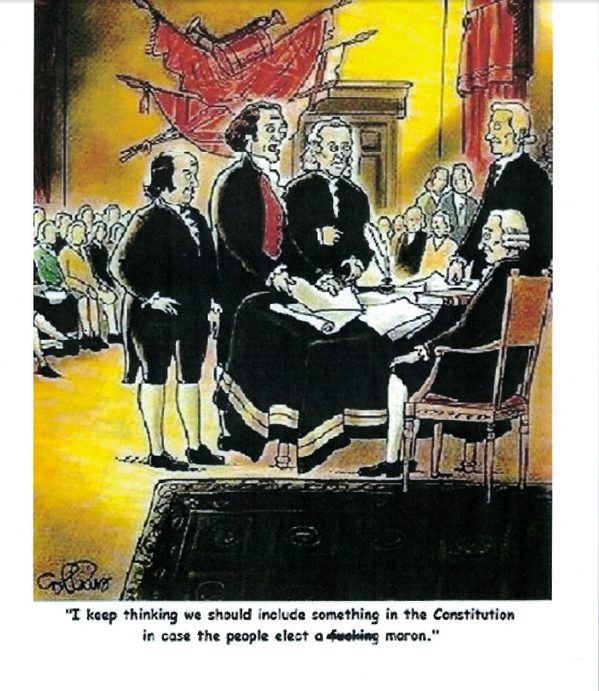
Tweeted by Trump? Seems so!
Share this:

A moron?

On some great and glorious day the plain folks of the land will reach their heart’s desire at last, and the White House will be adorned by a downright moron. H. L. Mencken
Read more at: https://www.brainyquote.com/quotes/h_l_mencken_490503
Share this:

In no strange land
“The angels keep their ancient places;—
Turn but a stone and start a wing!
’Tis ye, ’tis your estrangèd faces,
That miss the many-splendoured thing.”
“William Blake’s visionary transformations of London form the poem’s most important literary ancestry. In Thompson’s work more generally there’s also an occasional, probably coincidental, resemblance to Gerard Manley Hopkins (1844-1889), going beyond the shared faith to sometimes tortuous grammatical structures, vivid word-coinings, and unconventional rhythm. While Thompson’s achievements may be more modest than those of Blake or Hopkins, In No Strange Land is a poem I imagine either would have been happy to have written. A “many-splendoured” hymn, it catches more light than any of the Choruses from “The Rock”.”

