“Virtue gone mad”

14993566_806119116194635_415228818101331918_n.jpg

https://www.newcriterion.com/issues/1997/9/virtue-gone-mad

Extract

Rousseau is mentioned here because, acknowledged or not, he is the intellectual godfather of so much that happened in the cultural revolution of the 1960s. His narcissism and megalomania, his fantastic political ideas and sense of absolute entitlement, his sentimentalizing nature-worship, even his twisted, hypertrophied eroticism: all reappeared updated in the tumult of the 1960s. And so did the underlying totalitarian impulse that informs Rousseau’s notion of freedom.

Writing in 1969, the sociologist Edward Shils summarized the chief components of the revolution he saw unfolding around him in his essay “Dreams of Plenitude, Nightmares of Scarcity.” “The moral revolution,” Shils wrote,

consists in a demand for a total transformation—a transformation from a totality of undifferentiated evil to a totality of undifferentiated perfection. Evil consists in the deadening of sentiment through institutions and more particularly through the exercise of and subordination to authority. Perfection consists in the freedom of feeling and the fulfillment of desires… . A good community is like Rousseau’s; the common will harmonizes individual wills… . The common will is not the resultant of the rationally arrived at assent of its members; it is not actually a shared decision making; … It is the transformation of sentiment and desire into reality in a community in which all realize their wills simultaneously. Anything less is repressive.

Two decades later, in an essay called “Totalitarians and Antinomians: Remembering the 30s and 60s,” Shils elaborated on the theme of absolute fulfillment in his description of the “antinomian temptation.” At the center of that temptation was the fantasy of absolute freedom. “The highest ideal of antinomianism,” Shils wrote, “is a life of complete self-determination, free of the burden of tradition and conventions, free of the constraints imposed by institutional rules and laws and of the stipulations of authority operating within the setting of institutions.” “Free,” in other words, from the very things that underwrite freedom, that give it content, that prevent it from collapsing into that merely rhetorical freedom which always turns out to be another name for servitude.

The glorification of such spurious freedom is closely connected with another misuse of language—one of the most destructive: the description of irresponsible political naïveté as a form of “idealism.” Nor is it only naïveté that gets the extenuating absolution of “idealism.” So do all manner of crimes, blunders, and instances of brutality: all can be morally sanitized by the simple expedient of being rebaptized as examples of (perhaps misguided) “idealism.” The one essential qualification is that the perpetrator be identified with the political Left. In her book On Revolution, Hannah Arendt—who was certainly no enemy of the Left herself —cannily observed that

one has often been struck by the peculiar selflessness of the revolutionists, which should not be confused with “idealism” or heroism. Virtue has indeed been equated with selflessness ever since Robespierre preached a virtue that was borrowed from Rousseau, and it is the equation which has put, as it were, its indelible stamp upon the revolutionary man and his innermost conviction that the value of a policy may be gauged by the extent to which it will contradict all particular interests, and that the value of a man may be judged by the extent to which he acts against his own interest and against his own will.

In fact, the “peculiar selflessness” that Arendt describes often turns out to be little more than an abdication of individual responsibility abetted by utter self-absorption. It is a phenomenon that, among other things, helps to explain the queasy-making spectacle of left-wing Western intellectuals falling over themselves in a vain effort to excuse, mitigate, or sometimes simply deny the crimes of the Soviet Union and other murderous left-wing regimes throughout the Cold War and beyond. Yes, Stalin (or Mao or Pol Pot or Fidel or whoever) was repressive (or maybe that is an ugly rumor propagated by the United States); perhaps he “went too far”; maybe some measures were “extreme”; this or that policy was “misjudged”; … but what a glorious idea is equality, community, the brotherhood of man, etc. The odor of piety that attends these rituals of exculpation is one of their most disagreeable features.

One sees the same thing in another key in the left-wing response to America’s cultural revolution. Whatever criticisms might be made, they are quickly neutralized by invoking the totem of “idealism”: for example, the “passionate belief” (the beliefs of radicals are never less than “passionate”) in a “better world,” in a “more humane society,” in “equality.” The assumption that “passion” redeems fatuousness, rendering it noble or at least exempting it from censure, is part of the Romantic background of the counterculture. It is a profoundly mistaken and destructive idea. As T. S. Eliot observed in After Strange Gods: A Primer of Modern Heresy (1934), the belief that there is “something admirable in violent emotion for its own sake, whatever the emotion or whatever the object,” is “a cardinal point of faith in a romantic age.” It is also, he noted, “a symptom of decadence.” For it is “by no means self-evident,” Eliot wrote,

that human beings are most real when they are most violently excited; violent physical passions do not in themselves differentiate men from each other, but rather tend to reduce them to the same state; and the passion has significance only in relation to the character and behavior of the man at other moments of his life and in other contexts. Furthermore, strong passion is only interesting or significant in strong men, those who abandon themselves without resistance to excitements which tend to deprive them of reason, become merely instruments of feeling and lose their humanity; and unless there is moral resistance and conflict there is no meaning.

“Passion,” like “idealism,” is a nostrum that the Left prescribes to itself in order to relieve the burdens of responsibility.

G. K. Chesterton once observed that in the modern world “the virtues have gone mad because they have been isolated from each other and are wandering alone. Thus some scientists care for truth; and their truth is pitiless. Thus some humanitarians only care for pity; and their pity … is often untruthful.” Something similar can be said about the virtues of freedom and idealism. Freedom is an important virtue. But it is not the only virtue. And apart from other virtues —apart from prudence, say, and duty and responsibility, all of which define and limit freedom—freedom becomes a parody of itself. It becomes, in a word, unfree. And so it is with idealism. Idealism remains a virtue only to the extent that the causes to which it devotes itself are worthy of the devotion they attract. The more abstract the cause, the more vacuous the idealism.

In a subtle essay called “Countercultures,” first published in 1994, the political commentator Irving Kristol noted that the counterculture of the 1960s was in part a reaction against a society that had become increasingly secular, routinized, and crassly materialistic. In this respect, too, the counterculture can be understood as part of our Romantic inheritance, a plea for freedom and transcendence in a society increasingly dominated by the secular forces of Enlightenment rationality. Indeed, revolts of this tenor have been a staple of Romanticism since the nineteenth century: Dostoyevsky’s “underground man,” who seeks refuge from the imperatives of reason in willful arbitrariness, is only one example (a rather grim one) among countless others.

The danger, Mr. Kristol notes, is that the counterculture, in its attack on secular materialism, “will bring down—will discredit —human things that are of permanent importance. A spiritual rebellion against the constrictions of secular humanism could end up … in a celebration of irrationalism and a derogation of reason itself.”

At a time when the radical tenets of the counterculture have become so thoroughly established and institutionalized in cultural life—when they have, in fact, come more and more to define the dominant culture— unmasking illegitimate claims to “liberation” and bogus feats of idealism emerges as a prime critical task. Accordingly, a large part of these reflections on America’s cultural revolution will be given over to the task of critical deconstruction. For over two hundred years, the Left has had an effective but unearned monopoly on the rhetoric of virtue. What is needed is a comprehensive assault on that monopoly. This is obviously not something that can be achieved all at once. Such rhetorical habits reflect a long-standing emotional investment, one not easily assailed by argument. But a start can be made by exposing the baselessness of so many radical claims to liberation and by demystifying the rancid “idealism” of a movement whose primary effect has been to debase the intellectual and moral currency of contemporary culture.

Books and other commentary about the 1960s and the “culture wars” have been appearing almost as fast as one can turn their pages. Many have been critical. Some are celebrations. In December 1994—to take just one example—The New York Times, obviously chastened by the recent Republican sweep in the 1994 congressional race, published an editorial “In Praise of the Counterculture.” Challenging the “pejorative” use of the term “counterculture”—it was Newt Gingrich’s description of Bill and Hillary Clinton as “counterculture McGoverniks” that really set the Times off—the editorialist castigated the “puritans” who criticized the “summery, hedonistic ethos” of the 1960s. Connoisseurs of cant will find much to savor in this brief document, beginning with the proposition that the 1960s “produced a renewal of the Thoreauvian ideal of the clear, defiant voice of the dissenting citizen.” “Only a few periods in American history,” the Times informed its readers, “have seen such a rich fulfillment of the informing ideals of personal freedom and creativity that lie at the heart of the American intellectual tradition… . The 60’s spawned a new morality-based politics that emphasized the individual’s responsibility to speak out against injustice and corruption.”

In the coming months, we shall have occasion to examine some of the chief works and events that constituted this “rich fulfillment,” these triumphs of “individual responsibility” and a “new morality-based politics.” At the moment, it is enough to note the tenor of the Times’s encomium, its invocation of freedom and creativity, its assumption of a superior virtue that is barely distinguishable from a knowing if “summery” hedonism.

Critics of the counterculture have not been slow to attack the phenomena that the Times praises. Many palpable hits have been scored, and by now there exists a rich literature tabulating the excesses and absurdities of 1960s radicalism. Useful though much of that literature is, however, there has been no attempt to trace the overall course of America’s cultural revolution, detailing its roots in the Beat sensibility of the 1950s, analyzing the primary issues and personalities that defined it, assessing the damage it has done to America’s intellectual, moral, and artistic life. “What was its true significance, its real nature, and what were the permanent effects of this strange and terrifying revolution? What exactly did it destroy, and what did it create?” The questions with which Tocqueville began his book about the ancien régime and the French Revolution are also the questions that will guide these reflections on America’s cultural revolution.

No account of America’s cultural revolution would be complete without some discussion of the Vietnam War. More than any other event, it legitimated anti-Americanism and helped insinuate radical feeling into the mainstream of cultural life. What we will focus on in these reflections is not the history of the war itself or even the protest against it—those stories have been often told—but some central examples of how reaction to the war helped to “normalize” a spectrum of radical sentiments. The early history of The New York Review of Books (which began publishing in 1963) belongs here, in part for its reporting on the Vietnam War, in part for its increasingly enthusiastic embrace of other items in the menu of cultural radicalism. The disastrous effect of the war—or, more precisely, of the protests against the war—on our institutions of higher education also deserves attention. What we will be interested in here is not so much a history of student activism against the war: that, too, is an oft-told story. Our focus will be on a handful of exemplary case studies that show how the capitulation of certain key university presidents helped to sanction (and therefore recommend to the society at large) a whole set of radical attitudes, not only about the war and America’s role in it, but also about art, education, and morality.

One prominent part of that radicalism concerns race. The destructive effects of America’s cultural revolution on race relations in this country cannot be overestimated. In the transformation of the civil-rights movement into an agitation for black power, we see not only a new segregationism but also a blueprint for the “victim politics” and demands for political correctness that have so disfigured American culture in the 1980s and 1990s. The unhappy metamorphosis of James Baldwin—from a novelist who insisted that he was “not a black writer but an American one” to one who embraced the racialist politics of the black power movement—epitomized this trend. We will focus here not only on Baldwin but also on the celebration of violent black radicals like Eldridge Cleaver, whose assertion in his book Soul on Icethat rape is “an insurrectionary act” “trampling upon the white man’s law” won abject praise from any number of bien pensant white radicals.

It has been in the life of art and the life of the mind, however, that the counterculture has had its most devastating effects. To an extent that would have been difficult to imagine thirty years ago, art and education have become handmaidens of political radicalism. Standards in both have plummeted. The art world has more and more jettisoned any concern with beauty and has become a playground for bogus “transgressive” gestures, while colleges and universities, aping this exhausted radicalism, have given themselves up to an uneasy mixture of politically correct causes and the rebarbative rhetoric of deconstruction, poststructuralism, and “cultural studies.” The story of what has happened to our institutions of high culture since the Sixties is a story of almost uninterrupted degradation and capitulation to forces inimical to culture. We will outline this chronicle of decline, focusing particularly on the destruction of the humanities in higher education and the surrender of art to the perverting imperatives of politics.

The politicization of art and education represents one large part of the counterculture’s legacy. The coarsening of feeling and sensibility is another.

Solving a problem by moving to a different level of thinking.

16105763_850061121800434_1233443427841306240_nIf you  think you have low self esteem you can buy a self help book  which claims to help you raise your self esteem.There are a number of ways like uttering affirmations
I am as good as anybody else
I’m brilliant at meditaion
I am the best artist ever

There are no doubt lots of other ways but the best way is to leap to another level
I am not concerned about my so called “self esteem and I do not wish to rate myself or compare myself to  others”
Stop trying to evaluate your self worth


And stop evaluating other people as inferior or superior to you.This does not mean that everything  you do is wonderful.You still need to look at what you create or  how you treat people to see if it is what you want.But you don’t keep measuring your self worth.

Judgement is mine,says the Lord

Trust in God or the  dark Unknown aspect of life.Jesus preferred the humble

Photo0319.jpgJudgement is mine,says the Lord

Poetry and truth

DZlPLqXW4AE0RHp.jpghttps://www.newcriterion.com/issues/2015/4/poetry-truth

Extract

“I’d like to offer a few thoughts about truth not from the point of view of the philosopher but from that of the poet (receiving thereby a significant demotion in Socrates’ rankings in the Phaedrus, from first place to sixth out of nine. Poets follow such types as household managers, financiers, doctors, and prophets, and outstrip only manual laborers, sophists, and tyrants). The tension between poetry and truth gave Goethe the title of his autobiography, Aus meinem Leben: Dichtung und Wahrheit (“From My Life: Poetry and Truth”), written between 1811 and 1833. W. H. Auden borrowed Goethe’s title in 1959 for a prose sequence on love, and, in 1977, the poet Anthony Hecht (a great admirer of both poets) took the same title for a poem in which he considers, among other things, Goethe, the Second World War, and the thorny relationship between truth and art. Hecht conveyed the truth of his war experience as a poet not as a journalist or historian.

That poetry greatly enriches our experience is not a hard case to make: the Iliad, the Aeneid, BeowulfThe Divine Comedy, Shakespeare’s sonnets and plays, and Paradise Lost. It’s impossible to imagine our lives—our language—without them. When we say, “His voice was stentorian,” or “He is to the manner born,” or “It was sheer pandemonium,” we employ just a smattering of the countless words and idioms derived from these works, which are woven into the fabric of our daily talk. And, of course, these works routinely speak to one another, like cousins sharing news of distant relations at a holiday dinner. One work allusively gossips about another work, a practice to which T. S. Eliot—with his footnote-bedizened Waste Land and its references to Dante, Shakespeare, Kyd, Nerval, Baudelaire, the Upanishads, etc.—was rather a latecomer.

So keen is Shakespeare on the story of Dido, the Queen of Carthage, for example, that he mentions her four times in The Tempest, twice in Titus Andronicus, and once each in The Merchant of Venice2 Henry VI,Antony and CleopatraHamlet, and Romeo and Juliet. Now it is likely that Shakespeare borrowed these references to the “widow Dido” in The Tempest not from the Aeneid but from Montaigne’s essay “Of Diverting and Diversions,” in John Florio’s translation of 1603, but this is just a further example of how such references are cross-pollinated and propagated.

In fact, as Eliot knew, allusion itself is a great propagator of culture.The story of Dido for Shakespeare is a liquid bit of cultural currency, known to all, a story that plays equally well in the upper stalls and down among the oyster shells. Hamlet himself enacts a similar bit of cultural recuperation, recalling for the players Aeneas’s tale to Dido: “The rugged Pyrrhus, he whose sable arms,/ Black as his purpose, did the night resemble/ When he lay couchèd in the ominous horse . . .” From Timaeus to Virgil to Montaigne to Shakespeare: as stories and references find their way through successive generations of writers, they are revised and revitalized. Allusion is one of the ways that poems mean.

We love these great poems for the stories they tell and for the history they contain. They give important information about who we are as a people, the roots of our customs, our words, our values, and our beliefs. They are roadmaps of our humanity. James Joyce once said about his novel Ulysses, to Frank Budgen, as they were walking together along the Universitätstrasse in Zurich in 1918: “I want to give a picture of Dublin so complete that if the city one day suddenly disappeared from the earth it could be reconstructed out of my book.” And indeed the novel follows the Blooms and Dedalus from street to street, and from beach to bar to bedroom. But clearly this kind of information is not all that is being communicated by a work of fiction or poetry. Indeed, it could be argued that this sort of knowledge—the kind regularly imparted by a newspaper column or a search engine—is almost incidental to the real work of the poem, whose ultimate object is the education of the emotions.

The poet Mark Strand, who died this past November, once told Wallace Shawn in a Paris Review interview that “You don’t read poetry for the kind of truth that passes for truth in the workaday world. You don’t read a poem to find out how you get to Twenty-fourth Street.” In other words, poetic truth does not inhere ultimately in the denotative language of the poem. For facts, we have much more effective means of communication: the instruction manual, the brochure, the travel guide, or the public lecture. When Goethe takes “Poetry and Truth” as the title of his autobiography, what he is suggesting in part, I think, is that experience, in a work of art, may be rendered most clearly, and in a sense most truthfully, by attending to something beyond the verifiable facts. Fine, you might say, but doesn’t art, then, become, as Jacques Maritain wrote, “a world apart, closed, limited, absolute”—not the apprehension of reality but a replacement for reality, an illusion? This was a mote to trouble the mind’s eye of Plato.

Adefinition of poetry put forward by the poet Yvor Winters in his book Primitivism and Decadence (1937) sheds light on the question. A poem, Winters wrote, is a statement in words about a human experience—so far, so good, no?—a statement, he was quick to add, that pays particular attention to the connotative or emotional charge of language. Now, we all know where to find the denotative meaning of a word: we go to the dictionary. The connotative shades of a word, however, are harder to locate precisely. Take, for example, the word prison. The OED reports: “Originally: the condition of being kept in captivity or confinement; forcible deprivation of personal liberty; imprisonment. Hence (now the usual sense): a place of incarceration.” Clear, certainly, but a little dry. One could not say that this definition contains the complete meaningof the word.

Connotation communicates the emotions associated with a human experience. When we attend to the connotative or associative charge of prison, we think of, say, Edgar Allan Poe’s “The Pit and the Pendulum”: “A suffocating odour pervaded the prison! . . . I panted! I gasped for breath!” Or of Richard II in Pomfret Castle, only moments before his death: “I have been studying how I may compare/ This prison where I live unto the world. . . .” Or take Dante’s Ugolino, who, after his children have succumbed one by one to starvation in their shared prison, gives into his unspeakable hunger: “Then fasting,” he confesses, “had more power than grief.” Isolation, deprivation, dankness, threat. Connotation comprises all of the associations—visual, emotional, sonic—that have accrued to a word in all of its uses. The job of the poet is to manage or marshal these emotional charges of language as aptly as possible with regard to a specific experience.

For Winters, poetry—and, in its concision, lyric poetry, especially—is the highest linguistic form because, taken together, connotation and denotation compose the “total content” of language. It’s true that the two exist together in other kinds of writing, a novel, say, but poetry, by dint of its meters, lines, and highly wrought rhythms, modulates feeling with the greatest control. Connotation in poetry, then, acquires what Winters thinks of as a “moral” dimension. In order to render human experience truthfully, connotation or “feeling” must be precisely managed:

The artistic process is one of moral evaluation of human experience, by means of a technique which renders possible an evaluation more precise than any other. The poet tries to understand his experience in rational terms, to state his understanding, and simultaneously to state, by means of the feelings we attach to words, the kind and degree of emotion that should properly be motivated by this understanding.

The term “moral,” then, refers—at least in this instance—to a fairly technical process of selecting the best words in the best order for a given subject. “In so far as the rational statement is understandable and acceptable, and in so far as the feeling is properly motivated by the rational statement, the poem will be good,” he tells us.

Winters’s detractors—who feel that he, in his adherence to reason, quashes emotion in poetry—miss the point, I think. For Winters, emotion, expressed in the proper degree, is the whole ballgame. But this question of degree is crucial; if the feeling in a poem is either overstated or understated, the poem falls down. Excessive emotion, a form of sentimentality, obscures the experience under consideration, while the opposite of sentimentality—a kind of cold reportage—can also be a failure of evaluation. Understatement of the emotion robs experience of its humanity. The statement “Three prisoners were publicly executed in a detention center” crisply relates the facts, but in “The Shield of Achilles” Auden affords the reader some inkling of the feelings involved:

Barbed wire enclosed an arbitrary spot

     Where bored officials lounged (one cracked a joke)

And sentries sweated for the day was hot:

     A crowd of ordinary decent folk

     Watched from without and neither moved nor spoke

As three pale figures were led forth and bound

To three posts driven upright in the ground.

The mass and majesty of this world, all

     That carries weight and always weighs the same

Lay in the hands of others; they were small

     And could not hope for help and no help came:

     What their foes liked to do was done, their shame

Was all the worst could wish; they lost their pride

And died as men before their bodies died.

We would not expect this sort of account from Anderson Cooper, but we should not accept anything less from our poets. As William Carlos Williams wrote famously, if somewhat blowzily, in “Asphodel, That Greeny Flower”:

        It is difficult

to get the news from poems

     yet men die miserably every day

        for lack

of what is found there.

But what, exactly, is found there? And could one possibly die from the lack of it?

One thing found there is song. From ancient times, poetry and music were a single expression. The Greek word mousikedenotes a combined expression of words, music, and dance. The critic H. T. Kirby-Smith tells us that, in the Greek rites, “Dance movements were coordinated with the audible part of the performance by the lifting and clumping down of an enlarged shoe worn by a leader, or by the raising and lowering of a staff.” Poetry and song—or incantation, or chant—often worked together as the basis of religious worship in ancient languages such as Sanskrit, Hebrew, Egyptian, and Greek.

Poetry without music is a relatively recent development. A pronounced separation came around 1550, before which, Kirby-Smith notes, “the concept of a unified performance combining melody, words, and dance had never completely faded out.” The songlike cadence of poetry, in fact all of prosody, is in itself semantic and carries an emotional charge. Every syllable, every phoneme, is highly ordered in such a way as to communicate feeling.

What we most fear

How like a monster is my fear of pain
Expanding to fill all my heart and mind
Swelling like a  giant sponge   in the rain,
This fear begets  new  feelings more unkind.

For humans being chased by lions fierce,
Fear gives us the strength to  dash away.
But when by inner turmoil we are pierced
We cannot run  yet need  not be its prey.

Most strange ,we need to do   what we most fear;
Walk towards the pain with curious calm.
As else we may be maddened like King Lear
With no Cordelia to bring us balm.

To  feel in proper ratio to our   pain.
We need perception,grace and all their gains

20th Century Literature

17457990_887675204705692_8137749729555764088_n.jpg

https://www.bl.uk/20th-century-literature/articles/an-introduction-to-a-room-of-ones-own


“Professor Rachel Bowlby examines A Room of One’s Own as a key work of feminist criticism, revealing how Virginia Woolf ranges beyond the essay’s official topic of women and fiction to question issues around education, sexuality, and gendered values.

What kind of a book is Woolf’s A Room of One’s Own? Opening it first at the description of meals at two Oxbridge colleges, you might think this was some sort of eccentric TripAdvisor review: men’s college dining, halfway to heaven; women’s college dining, one star. At other points, you could take it for an extended list of recommendations for future research, on topics never mooted before for serious study: the everyday lives of middle-class women in other times, or the history of men’s opposition to women’s emancipation, or the value that men place on female virginity. Sometimes Woolf’s suggestions for study sound like a preliminary report on these and other subjects, with information (and exasperation) gleaned from a morning’s reading of works by men on the subject of women. (This reading takes place at the British Library, in its earlier location at the British Museum.)

There is a lot in A Room of One’s Own about literature – about what it says about women (when it’s written by men), about what kind of writing women writers have done or have not been able to do, and about whether writing is helped or hindered by an author’s conscious sense, when writing, of being either a he or she. At the same time – and this ties in with all the suggestions for research – there’s an emphasis on how writers of any sex, but women in particular, need a solid minimum of material support in order to do their job (or create their creation): in order to think, that is, without interference (or ‘impediments’, to use Woolf’s preferred word). Woolf sets this material requirement quite high. Every woman, ideally, should have an annual income of £500 (which was a comfortable middle-class man’s salary at the time). And she should also have that now famous space, a room of one’s own.”

While I washed the pots the cat saw red

I poured detergent over my own head
Surcare Sensitive for dishes I recall
I rinsed it off before I went to bed

I often recall  these words my mother said
The King will not dismount for  one or all
I rinsed it off before I went to bed

While I washed the pots the cat saw red
He wanted me to throw a woollen ball
I played with him before I went to bed

I look like I’ve had chemo,it’s incred!
The hairdresser has trimmed it, till it’s mauled
I rinsed it well before I went to bed

When inside a Salon,sense has fled
Don’t ask for a trim, you’ll be appalled
I  toyed with men, they knew my hair was dead

Over me a sense of doom had crawled
As my mother said,she won’t be told
I poured detergent over my own head
I rinsed it off with brandy,so well bred!

Do not fear, with bitterness, the cracks

Life is woven daily , warp and  weft
We    make the threads and colours as we act
As we age our hands become more deft

I like  almost  everything  that’s Left
The NHS. the OU , what a knack
Good is woven daily , warp and  weft

When we see the butterfly. we kiss
Creating joy and love with gracious tact
As we age our  hearts become more soft

One by one our loved ones turn to dust
Yet on this life we will not turn our back
We  still make  our good daily , warp and  weft

On Jacob’s ladder held by angels fast
We see the Heavens open to our lack
As we age our  hearts relearn to trust

Do not fear with bitterness the cracks
The light shines in  and darkness is pushed back
Life is woven daily now and past
As we age, we  make truth  our repast

What does “eerie” mean?

Photo0313.jpg
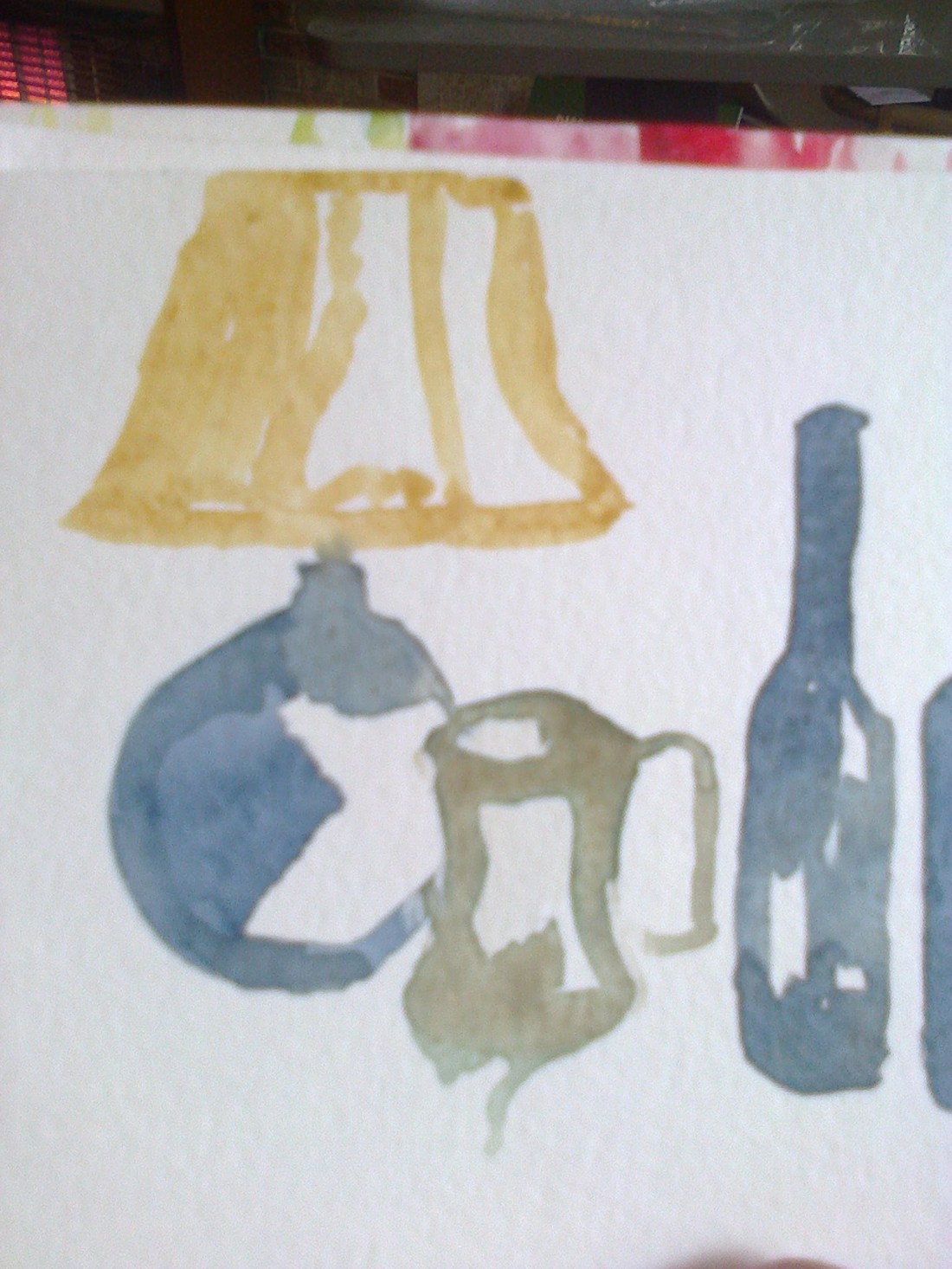
 From my watercolour class
eerie
ˈɪəri/
adjective
adjective: eerie; comparative adjective: eerier; superlative adjective: eeriest
  1. strange and frightening.
    “an eerie green glow in the sky”
    synonyms: uncanny, sinisterghostlyspectral, unnaturalunearthlypreternaturalsupernaturalother-worldlyunrealmysteriousstrangeabnormaloddcuriousqueerweirdbizarrefreakish;

    antonyms: normal, reassuring
Origin
Middle English (originally northern English and Scots in the sense ‘fearful’): probably from Old English earg ‘cowardly’, of Germanic origin; related to German arg .

And today I shall be nineteen ninety four

In answer to your question I declare
That I must die seems totally bizarre
Yet since you ask  which burial I prefer
Cremation seems to be  the least unfair

I’d like to hear the sound of Joan of Arc
Jennifer and Leonard sing in parts
And as the Maiden burns up in the pyre
I shall be consumed by controlled fire

I’d like to  be more useful while alive
I am not a husband nor a wife
But I might be a friend to those I love
And pray the sun will shine ,below, above

I think I made a Will,but why d’you ask?
Do you think you’ll benefit at last?
I plan to leave it all to Charity
One that gives old folk  meringues for tea.

You never phone without your wise advice
About  how housework should fulfil my life
But my mind  is as good as yours, I find.
I keep it oiled  and covered in red wine.

Joan of Arc will be my friend and saint
September Cohen will become my mate
He’ll sing an anthem while I sail away
And give me courage  when it hurts to pray.

It’s time to laugh and cry over our lives
As to the  young we dictate our archives
Though few people  listen the Word
At least we can assure God  that we have tried

I  wonder why you never rang before
And today I shall be nineteen ninety four
I will ring you when your birthday comes
To ask you if you’d like pickling in rum.

Aphorism and poetry

Photo0324.jpghttps://www.poets.org/poetsorg/text/making-space-aphorism-exploring-intersection-between-aphorism-and-poetry


¨What drew me to aphorisms was my reading of a new compilation of Kafka’s Zürau Aphorisms, translated by Michael Hofmann. This collection contracts and expands the notion of what an aphorism can be. Some are merely observations: “Like a path in autumn: no sooner is it cleared than it is once again littered with fallen leaves.” Others strike me as snapshots—fragments—of the personal: “To let one’s hate-and disgust-filled head slump onto one’s chest.” And of course, some grapple with such large concepts as Evil, God, Humility, Babel: “Once we have taken evil into ourselves, it no longer insists that we believe in it.” Finally, there are the aphorisms that, rather than delimiting something small, seem capable of offering a Weltanschauung, a world view, as in the justly famous aphorism that ends the Kafka collection:

It isn’t necessary that you leave home. Sit at your
desk and listen.
Don’t even listen, just wait. Don’t wait, be still and
alone.
The whole world will offer itself to you to be
unmasked, it can
do no other, it will writhe before you in ecstasy.

This aphorism verges on being a parable: a small story that teaches. It strikes me that this is a self-portrait of the artist as a receptacle of, versus creator of, reality. Or, as the Moody Blues sang aphoristically many years ago, “Thinking is the best way to travel.”

I am proud and gleam like gold

I am a gleaming aubergine
in an oval dish
My purple skin is polished
Like BBC English.

I await my fate for I am ripe
My seeds fulfil my wish
Soon,soon the knife will cut me up
As corn in fields is threshed.

I’d rather lie in Egypt’s soil
By birds and insects bit
But here I am in England
Where irony is wit.

After cutting comes the salt
As in a bowl I sit
For I am moist like lady’s parts
As poets have much writ.

Moussaka is my destiny
And as you bite and chew
I shall be what Jesus was
And give my grace to you

I am fried in olive oil
To give me flavour ripe.
Dried in cloth and placed in pot
Atop the meat I ride.

My colour brings all eyes to me
As I lie in a heap.
Some like carrot heads so bright
Royal purple is my state.

So better than a lamb I am
For a sacrifice.
I am proud and gleam like gold
As Caesar-like I’m knifed.

My seeds through sewers deep shall pass
And somewhere come to grief.
I shall grow again and be
Portrayed by a leaf.

“I shall not hate” Izzeldin-Abuelaish.

1 dark handn2.jpg
https://www.telegraph.co.uk/culture/books/bookreviews/8300930/I-Shall-Not-Hate-A-Gaza-Doctors-Journey-on-the-Road-to-Peace-and-Human-Dignity-by-Izzeldin-Abuelaish.html


“This amazing book tells the life story of Dr Izzeldin Abuelaish, a Palestinian who has lived through half a century of horror and destruction in Gaza. Abuelaish, like so many Palestinians, has endured loss, privation and suffering on a scale that is unimaginable. His response is not hatred and violence, which would be all too understandable. Instead he has produced a great work of insight and compassion that tries to point the way towards peace and reconciliation.

He grew up in the shadow of al-Nakba (“the Catastrophe”), the division of Palestine after the creation of the Israeli state in 1948. He came from an established land-owning family based in the south of the country. Overnight they were dispossessed, and his childhood was spent in the Jabalia refugee camp in Gaza.

His family, which had been prosperous, were now in deep poverty. There were 11 of them and he records how they “lived in one room which measured about 10 feet by 10 feet. There was no electricity, no running water; there were no toilets in the house.”

When he was 10, they found a new house to live in. Five years later it was bulldozed by one of Ariel Sharon’s tanks. His brother Noor fell into Israeli hands, went to prison, and later vanished. The book suggests his mother, a stoical woman to whom he acknowledges a huge debt, never fully recovered.

Education, and some inspirational teachers, were his redemption. Eventually he won a scholarship to study medicine in Cairo, and then gynaecology at the University of London.”

Read more by clicking the link.A  truly astonishing goodness.Photo0316.jpgWho is the Light of the world now?

Sorry,I am unable to answer the phone.

  • 17457990_887675204705692_8137749729555764088_n.jpg
    My voice is on strike.
    My husband has to keep his eye on the clock today.
    My sister’s glued to the television.
    While my brothers have been at loggerheads for a very long time.

    My daughter has to keep a weather eye on her fiancee,
    And my granddaughter has been entranced by “The Magic Flute.”
    The cat is having kittens.
    The dog is chasing his tail.
    I’ve got my finger on the button
    And my hand in the till.

    My feet have gone to sleep.
    My head is coming unscrewed,
    And my mind is on higher things.
    Where my brain is is under investigation
    And I hope to be reunited with it soon
    But they can’t be absolutely certain it will reconnect.

    My spirits have been in the doldrums
    But I have some whiskey in the cupboard.
    My career spanned the heights and the depths,
    Though not of love
    as God would recognize it,
    In a very real sense.
    You must rest assured I care about you
    Though I do not feel able to converse, owing to invasion by viruses.
    Now there’s just a few minutes before I go for broke again
    Please leave a message after the pips squeek

Stan and Mary……..the Anniversary

  • Photo0321Photo0320

    Stan was wearing his best suit,topped by a denim apron, and wad polishing the big windows with a microfibre cloth ,as
    he waited breathlessly for his stunning wife.Mary entered the room wearing a long purple and mauve dress which clung somewhat tightly to the curvaceous contours of her beautifully rounded body.
    On her feet she had some smart pewter ballet slippers and in her elegant hand she carried a huge pewter clutch bag which contained some of her many medications.She addressed Stan,
    “I think I can leave my handbag behind if I put my mouth spray into my bra.”
    “That somehow detracts from the romance of the evening.” Stan pronounced openly.
    “Well,you know,I never had a cleavage until lately and I fell I ought to make the most of it.”
    “Surely I should be the one make the most of it,” he riposted jocosely.
    “Of course you may,my angel,but not in the restaurant,”she answered back sweetly
    “I’ll put your spray in my pocket then,shall I?”Suddenly the doorbell rang.”Who’s this?”It was Annie,their next door neighbour.
    She was wearing a coral velvet track suit with matching Reeboks and sun hat.
    “Hi,I just came in with a little prezzie,”She declaimed.In
    her hand was a huge box of chocolates.
    “Gosh,Mary you look lovely in that beautiful long dress but you’re not
    going on your bike,are you?”
    “No,we are having a cab,but it’s not come as yet.”
    “Well,never mind.I’ll ring 999 and get them to send an emergency ambulance for you!”
    Fortunately,as luck would have it the minicab appeared and it was only as they were entering the restaurant that Stan realised he was still wearing his old denim apron.
    “Shall I take it off?” he pondered.
    On the pro side I will look smarter on the con side I might spill some soup down my front.I wish I’d done more logic at college.
    So he kept it on.Mary didn’t seem to notice.She just took him for granted.If he stood on his head and sang”Jerusalem” she probably wouldn’t pay any attention.
    Then he noticed that Mary was wearing an apron too.It was the same colour as her dress.What a brilliant idea,he thought.
    “There may be money in this.” He could start a small business,
    “Aprons R You” selling lovely aprons in all colours of the rainbow.
    Suddenly he heard noises;he awoke and heard Mary shouting
    “How can you go to sleep when you are out with me?”
    “Would you prefer me to recite the Periodic Table?” he snapped gently.
    “I’d prefer a poem,” she cried…All right,Petal,I’ll think of one soon.In the meantime would you like a fool?”
    “No.I’ve got you,” she responded handsomely.
    “I mean for a pudding?”
    “Oh,yes please.A Rubik fool would be lovely.It will pass the time.You know I get so bored.”
    “Well,I do my best but it’s hard keeping up with you.would you like to read a few truth tables whilst I finish?
    my meat.”
    He put his hand in his pocket and pulled out a small leather bound book.
    “Truth tables and levitation for geniuses,” by Bertha Russell.
    “Oh,Stan,this looks interesting.I’ve always wanted to fly like an angel or an owl.”
    “It’s never too late to say never.” he responded.
    “Whatever do you mean?”
    “I don’t know.Just because a sentence is grammatically correct doesn’t imply that it means something.”
    “Yes,quite right.And conversely a sentence can mean something even when it’s not grammatically correct.”

    “Isn’t thinking exciting!”
    “Yes,indeed.I was thinking how exciting it will be to go to bed with you.”
    “Wow,good grammar and full of meaning.I am yours.I am like a ripe plum ready to drop off the tree.I am a cat ready to mate.I am a song waiting to be sung.”
    “Gosh,are metaphors your bete noir?”
    “Je ne parle pas Francais.”
    “Aimez vous ein Nederlander?”
    “Sprechen sie Deutsche?”
    Ist sein mutter immer krank?”

Writing like an Asian


Photo0302.jpghttp://writinglikeanasian.blogspot.co.uk/2016/11/feature-five-qs-with-ploi-pirapokin.html


Feature: Five Qs with Ploi Pirapokin

Ploi Pirapokin was born in Thailand and raised in Hong Kong. Her work is forthcoming and featured in Apogee Journal, Tor.com, the Bellingham Review, Fiction International, the Griffith Review and more. She has received fellowships from the Radgale Foundation, the Anderson Center, the Brush Creek Foundation, Willapa Bay AIR, Kundiman and others. She holds an MFA in Fiction from San Francisco State University and has taught there in the creative writing department and at the Emerging Writers Institute at Brown University.

(Q1) In your nonfiction piece, “An Equation To Tell Your Mother Your Boyfriend Is Black,” the list begins and ends somewhat elliptically. Did the equation for telling result in the correct solution? What was the mother’s response? Or will this response come in a different story?
Initially, this excerpt began as a way for me to respond to my mother and to seek answers to her racism. I blamed the media for portraying stereotypes on black men as influencing her way of thinking and criticized her experiences for raising me the way she did, only to discover that I hadn’t excavated all that I could about the subject. I return to the page to figure out why her opinion matters so much to me, and it’s painful to admit that I’ve always felt like I’ve had to earn my mother’s love. Yet this playful method has led me to explore the constraints that have been placed on me as an Asian woman from Asia in America as well as a daughter who is choosing to immigrate to a country where the culture is completely different to the one she was raised in.


Read more by clicking the link above or this one below
pexels-photo-226615.jpeg

The powerful plants can do just what they want.

The tulips pushed the primroses away
They snatched the pot from these innocuous plants
Nature’s  never kind in such display
The powerful plants can do just what they want.

However, I admire their flowers of red
The shape is elegant, the colour clear.
And had they been in a much bigger bed
Both flowers would give us pleasure without fear.

Magnolias pink my eyes still do adore
Two of them I see from off the bus.
A visual parable, a story for
The short sweet life of all, including us.

We deceive ourselves in order to survive.
But shallowness makes trivia of our lives

It looks and speaks just as a sonnet would

This poem is written in the sonnet form,
And yet I have my doubts about its shape
Though nearly to that structure it conforms
There may be holes where nightmare faces gape.

It looks and speaks just as a sonnet would
And talks of metaphysical concerns.
Do we conclude, as poets and readers should,
That in our schizoid age we cannot learn?

For humans may be decked in clothes of wolves;
And lambs be dressed in lion’s fearsome furs.
Thus, sense is tricked and problems are unsolved.
Landscapes etched, yet details seem quite blurred.

It looks like one,it feels like one,it speaks;
Yet from these words, does human feeling leak?

“Your hair looks nice”

Photo0271.jpg

I found a video I made 3 years ago  in which I tried to talk with my original Northern accent about two people I had met and  interacted with in the town.One was a man with whom I extemporised a mini play
I found it quite  amusing so I sent it to my sister thinking the story was  interesting
After about 3 hours she replied:
Your hair looks nice!

Work needed

Chiloschista-parishii_2018-2Goethe

It used to happen, and still happens, to me to take no pleasure in a work of art at the first sight of it, because it is too much for me; but if I suspect any merit in it, I try to get at it; and then I never fail to make the most gratifying discoveries, — to find new qualities in the work itself and new faculties in myself.

Beware the charmers, make friends with the dour

I didn’t know there was a second row
Those three dots  when clicked on give us more
Visual signs and symbols can be shown

With much help this website is endowed
If we know the  way to open doors
I didn’t know there was a second row

To all inventors let us give a bow
we like learning, yet  ego´s are  sore
Visual signs and symbols can be shown


I could not type nor space my words just so
And then  I learned my IQ´s sixty four
Je suis un moron  avec  digi-score


My mother was a virgin till she bore
Me, like Jesus Christ,  unstable,poor
He´ś my Saviour and I share his lore

By

Beware the charmers, make friends with the dour
Yet always stand up straight and  never cower
I didn’t know there was a second row
Visual signs and symbols can be shown


http://englishchamber.blogspot.co.uk/2005/09/idiots-morons-imbeciles-cretins.html