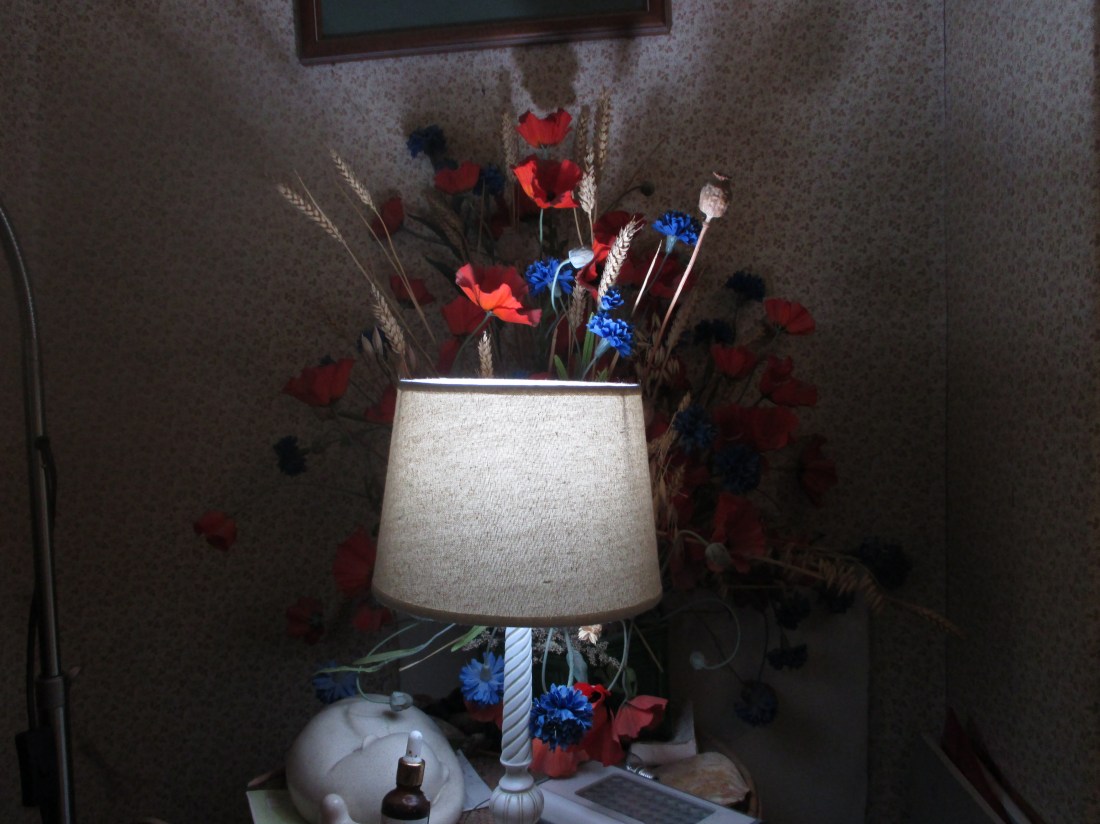
Honouring Paul Tillich

Paul Tillich gave our spirit proper place.

He showed us courage as a  space to dwell.

He wrote for us and left us with   his  grace

With hope he might speak and he might tell.

So many people ignored Fascist speech

And lived with mind cut off from  their own soul

With pen in hand he wrote to reach

And touch us as we strive towards the whole.

Expelled from his own country, he wrote on

Continuing during  tortuous war long years

He lived, he loved ,he wrote, he died and then

His books continue to dispatch our fears.

For many men have lived and have destroyed.

Yet Tillich showed  us how to face the  void

The courage to be

Written March 2015


You know this experience, sometimes when you are browsing in a bookshop you come across a book with a wonderful title. This happened to me as  student when I saw a book with this title:

“The courage to be ”

by Paul Tillich

I was going through a  very hard time indeed and just the title alone helped me as no one I knew had ever said it takes courage to live well.So I bought this book and dipped in. I found it interesting and thoughtful.Sometimes I would just look at the front cover and repeat the title.I had discovered mantra meditation.in a sense.

This morning I was listening to a radio programme  about poetry in England and tidying up. Suddenly my old battered copy fell out of a shelf and into my hand.And I said, thank you. Because I had  lost this companion and now it’s restored to me when I need again to say the words to help me in a personal crisis.

The Courage to Be

And to recognise the power of words on the human mind and thus to take care of  self and others and what we say to them for they too are struggling humans as we ourselves are.

And to discover virtue is not faux piety which suddenly reminded me that Tillich had a weakness for women. He was no plaster saint. I am not saying. I approve.

Had he stayed in Germany he would no doubt have been imprisoned even killed like Dietrich Bonhoeffer.He would not have been silent

Books… they save lives. I was so grateful and still am for education, books, people who talk to me .Had I lived a few years earlier it would have been different.

http://www.britannica.com/EBchecked/topic/595850/Paul-Tillich/7266/Development-of-his-philosophy

Tillich was expelled from Germany in 1933,the first non-Jewish theologian to have this honor bestowed on him.I never saw him but I love him for his writing.

Loneliness expresses the pain of being alone and solitude expresses the glory of being alone.
Paul Tillich
Read more at http://www.brainyquote.com/quotes/authors/p/paul_tillich.html#y15kkZigwdviBd76.99

Walking through the poppy fields again

If you take a selfie of your hair
Do not try to stand beside a bear
A man was killed,I saw it on the News
The bear was injured but he got some views.

Prepare yourself,your face may be a shock
Your eyelids droop  and lines run like a flock
Your lips are thinner than a matchstick now
But with some  aid, you’ll find a lipstick new

But if you’re loved  and loving,be polite
Men can be unfaithful in  the night
He can dream of loving Sarah Jane
Her hair is silk and gold,does that explain?


And we women dream of other men
Walking through the poppy fields again


To my cat

Oh, Alfred, my beloved, do not go
Do  not leave, but warmth to me bestow,
Lie beside me in my bed all night
Succour me when stormy dreams affright.

Oh , Alfred, tis your eyes  that turn me on
The green and golden light is never gone.
Affection constant,  touch and feeling shared.
I am not embarrassed when you stare.

For you , the  gallant male, have ever  seen
My naked form well lit by  Jove’s sunbeams
And if I wear a gown of winceyette
You love it ,as it’s made for paws of cat.

Alfred  ,we can’t marry   yet I fear.
Cats can’t read the Book of Common Prayer.

Vanity or humiliation

Photo1452.jpg2016

My sister and I had a lot to talk about but when she got home she rang  sounding  mor animated to say she and her daughter in law loved my new hairstyle.Unfortunately the main difference is that it is shorter at the back  and longer on top and in front which does not show in a photograph.When we had major things ro discuss it’s good  they could think about my hair!I had been about to buy a wig.To satisfy my family who may be reading I shall take a selfie of the back of my head later on


coral


tiff infomation

9f0be6286e0d1b4aff19447d4509a522_400x400

Myself  someyears ago,carefully hiding my hair which stopped growing owing to underactive thyroid gland.,Unfortunately after treatment I became  extravagent.So if your wife’s habits alter it may not be lack of will power it may be her glands…even my glasses were more upmarket.Lord knows why when I have not been able to have a social life and my cat does not mind what I look like.My husband did like me in bright colours.Sometimes I even wore clothes.

Why do I feel like this?

2apples1.jpghttps://youarenotsosmart.com/2011/07/07/misattribution-of-arousal/

Interesting and strange

“Misattribution of arousal falls under the self-perception theory. This theory goes back as far as William James, one of the founders of psychology. It posits your attitudes are shaped by observing your own behavior and trying to make sense of it. For instance, James would say if you saw a cricket on your arm and then flailed about rubbing your body up and down while screaming incoherently, you would later assume you had experienced fear and might then believe you were afraid of crickets. Self-perception theory says you look back on a situation like this as if in an audience trying to understand your own motivations. Sometimes, you jump to conclusions without all the facts. As with many theories, there is much research left to be done and plenty of debate, but in many ways James was right. You often do act as observer of your actions, a witness to your thoughts, and you form beliefs about your self based on those observations. Psychologist Fritz Strack devised a simple experiment in 1988 in which he had subjects hold a pen straight out between their incisors and bare their teeth as they read cartoon strips. The subjects tended to find the cartoons funnier than when they held the pen between their lips instead. Between the teeth, some of the muscles used for smiling were contracted, and between the lips they contracted some of the muscles used for frowning. He concluded the subjects felt themselves smiling and decided somewhere deep in their minds they must be enjoying the comics. When they felt themselves frowning, they assumed they thought the comics were dull. In a similar experiment in 1980 by Gary Wells and Richard Petty at the University of Alberta subjects were asked to test out headphones by either nodding or shaking their heads while listening to a pundit delivering an editorial. Sure enough, when questioned later the nodders tended to agree with the opinion of the speaker more than the shakers. In 2003, Jens Förster at International University Bremen asked volunteers to rate food items as they moved across a large screen. Sometimes the food names moved up and down, and sometimes side to side, thus producing unconscious nodding or head shaking. As in the pundit study, people tended to say they preferred the foods which made them nod unless they were gross. In Förster’s and other similar studies, positive and negative opinions became stronger, but if a person hated broccoli, for example, no amount of head nodding would change their mind.

Arousal can fill up the spaces in your brain when you least expect it. It could be a rousing movie trailer or a plea for mercy from a distant person reaching out over YouTube. Like a coterie of prairie dogs standing alert as if living periscopes, your ancestors were built to pay attention when it mattered, but with cognition comes pattern recognition and all the silly ways you misinterpret your inputs. The source of your emotional states is often difficult or impossible to detect. The time to pay attention can pass, or the details become lodged in a place underneath consciousness. In those instances you feel, but you know not why. When you find yourself in this situation you tend to lock onto a target, especially if there is another person who fits with the narrative you are about to spin. It feels good to assume you’ve discovered what is “

We will choose to be wrong if it keeps us in good standing with our peers.”

“As you will learn, the latest evidence coming out of social science is clear: Humans value being good members of their tribes much more than they value being correct, so much so that we will choose to be wrong if it keeps us in good standing with our peers.”


YANSS 122 – How our unchecked tribal psychology pollutes politics, science, and just about everything else


Asymmetric insight

STA_0025.jpghttps://youarenotsosmart.com/2011/08/21/the-illusion-of-asymmetric-insight/


Part of the article:

” People in new situations instinctively form groups. Those groups develop their own language quirks, in-jokes, norms, values and so on. You’ve probably suspected zombies, or bombs, or economic collapse would lead to a battle over who runs Bartertown. In this study, all they had to do was introduce competition for resources and summer camp became Lord of the Flies.

What you may not have noticed though is how much of this behavior is gurgling right below the surface of your consciousness day-to-day. You aren’t sharpening spears, but at some level you are contemplating your place in society, contemplating your allegiances and your opponents. You see yourself as part of some groups and not others, and like those boys you spend a lot of time defining outsiders. The way you see others is deeply affected by something psychologists call the illusion of asymmetric insight, but to understand it let’s first consider how groups, like people, have identities – and like people, those identities aren’t exactly real.

Source: “The Breakfast Club,” 1985, Universal

Hopefully by now you’ve had one of those late-night conversations fueled by exhaustion, elation, fear or drugs in which you and your friends finally admit you are all bullshitting each other. If you haven’t, go watch The Breakfast Club and come back. The idea is this: You put on a mask and uniform before leaving for work. You put on another set for school. You have costume for friends of different persuasions and one just for family. Who you are alone is not who you are with a lover or a friend. You quick-change like Superman in a phone booth when you bump into old friends from high school at the grocery store, or the ex in line for the movie. When you part, you quick-change back and tell the person you are with why you appeared so strange for a moment. They understand, after all, they are also in disguise. It’s not a new or novel concept, the idea of multiple identities for multiple occasions, but it’s also not something you talk about often. The idea is old enough that the word person derives from persona – a Latin word for the masks Greek actors sometimes wore so people in the back rows of a performance could see who was on stage. This concept – actors and performance, persona and masks – has been intertwined and adopted throughout history. Shakespeare said, “all the world’s a stage, and all the men and women merely players.” William James said a person “has as many social selves as there are individuals who recognize him.” Carl Jung was particularly fond of the concept of the persona saying it was “that which in reality one is not, but which oneself as well as others think one is.” It’s an old idea, but you and everyone else seems to stumble onto it anew in adolescence, forget about it for a while, and suddenly remember again from time to time when you feel like an impostor or a fraud. It’s ok, that’s a natural feeling, and if you don’t step back occasionally and feel funky about how you are wearing a socially constructed mask and uniform you are probably a psychopath.

Social media confounds the issue. You are a public relations masterpiece. Not only are you free to create alternate selves for forums, websites and digital watering holes, but from one social media service to the next you control the output of your persona. The clever tweets, the photos of your delectable triumphs with the oven and mixing bowl, the funny meme you send out into the firmament that you check back on for comments, the new thing you own, the new place you visited – they tell a story of who you want to be, who you ought to be. They satisfy something. Is anyone clicking on all these links? Is anyone smirking at this video? Are my responses being scoured for grammatical infractions? You ask these questions and others, even if they don’t rise to the surface.

Source: http://www.ravenwoodmasks.com

The recent fuss over the over-sharing, over the loss of privacy is just noisy ignorance. You know, as a citizen of the Internet, you obfuscate the truth of your character. You hide your fears and transgressions and vulnerable yearnings for meaning, for purpose, for connection. In a world where you can control everything presented to an audience both domestic or imaginary, what is laid bare depends on who you believe is on the other side of the screen. You fret over your father or your aunt asking to be your Facebook friend. What will they think of that version of you? In flesh or photons, it seems built-in, this desire to conceal some aspects of yourself in one group while exposing them in others. You can be vulnerable in many different ways but not all at once it seems.

So, you don social masks just like every human going back to the first campfires. You seem rather confident in them, in their ability to communicate and conceal that which you want on display and that which you wish was not. Groups too don these masks. Political parties establish platforms, companies give employees handbooks, countries write out constitutions, tree houses post club rules. Every human gathering and institution from the Gay Pride Parade to the KKK works to remain connected by developing a set a norms and values which signals to members when they are dealing with members of the in-group and help identify others as part of the out-group. The peculiar thing though is that once you feel this, once you feel included in a human institution or ideology, you can’t help but see outsiders through a warped lens called the illusion of asymmetric insight.

How well do you know your friends? Pick one out of the bunch, someone you interact with often. Do you see the little ways she lies to herself and others? Do you secretly know what is holding him back, but also recognize the beautiful talents he doesn’t appreciate? Do you know what she wants, what she is likely to do in most situations, what she will argue about and what she will let slide? Do you notice when he is posturing and when he is vulnerable? Do you know the perfect gift? Do you wish she had never went out with so-and-so? Do you sometimes say with confidence, “You should have been there. You would have loved it,” about things you enjoyed for them, by proxy? Research shows you probably feel all these things and more. You see your friends, your family, your coworkers and peers as semipermeable beings. You label them with ease. You see them as the artist, the grouch, the slacker and the overachiever. “He did what? Oh, that’s no surprise.” You know who will watch the meteor shower with you and who will pass. You know who to ask about spark plugs and who to ask about planting a vegetable garden. You can, you believe, put yourself in his or her shoes and predict his or her behavior in just about any situation. You believe every person not you is an open book. Of course, the research shows they believe the same thing about you.

In 2001, Emily Pronin and Lee Ross at Stanford along with Justin Kruger at the University of Illinois and Kenneth Savitsky at Williams College conducted a series of experiments exploring why you see people this way.

In the first experiment they had people fill out a questionnaire asking them to think of a best friend and rate how well they believed they knew him or her. They showed the subjects a series of photos showing an iceberg submerged in varying levels of water and asked them to circle the one which corresponded to how much of the “essential nature” they felt they could see of their friends. How much, they asked, of your friend’s true self is visible and much is hidden below the surface? They then had the subjects take a second questionnaire which turned the questions around asking them to put themselves in the minds of their friends. How much of their own iceberg did they think their friends could see? Most people rated their insight into their best friend as keen. They saw more of the iceberg floating above the water line. In the other direction they felt the insight their friend’s possessed of them was lacking, most of their own self was submerged.

This and many other studies show you believe you see more of other people’s icebergs than they see of yours; meanwhile, they think the same thing about you.

The same researchers asked people to describe a time when they feel most like themselves. Most subjects, 78 percent, described something internal and unobservable like the feeling of seeing their child excel or the rush of applause after playing for an audience. When asked to describe when they believed friends or relatives were most illustrative of their personalities, they described internal feelings only 28 percent of the time. Instead, they tended to describe actions. Tom is most like Tom when he is telling a dirty joke. Jill is most like Jill when she is rock climbing. You can’t see internal states of others, so you generally don’t use those states to describe their personalities.”

We were alone together

We were alone together
In this  long  thin sitting room.
I would draw on my laptop,
While he  stared  out at the moon.


We were alone together
Now I’m alone, alone.
I am  studying poetry
His number's not  on my new phone.


We were alone together
As I sat by his hospital bed.
He still didn’t speak but then he winked
As I laid my cool hand on his head.


I wish I could be  there now beside you
Together and never alone
I wish I could there  be with you quietly
And you were not cold as this stone.

In your guts,you know he’s nuts… the Goldwater rule?

pexels-photo-129112.jpeghttps://appliedpsychoanalysis.wordpress.com/2017/11/14/in-your-guts-you-know-hes-nuts-trumping-the-goldwater-rule/

EXTRACT

What is so frightening, and why I think we keep talking around the red herring of Trump’s putative insanity, is the possibility that it might not exist. I keep coming back to the slogan with which Lyndon Johnson brilliantly capitalized on Goldwater’s public humiliation: “In your guts, you know he’s nuts”. Do we, though? Before he became president, did anyone think Trump was nuts? I’m trying to remember what I thought of him before all of this and I can’t. Because alongside the terrifying possibility that a man with a serious uncontrolled mental disorder has the nuclear football, is the equally terrifying possibility that a perfectly sane but petty, stupid, tyrannical, and evil man has the nuclear football and might very well use it in a fit of pique. Not because he’s ill and “can’t help it”, but because he just doesn’t care enough not to. What if the evil of Trump isn’t madness at all, but something innate in humanity that no psychiatric diagnosis or psychoanalytic interpretation can remove?

This is the thing I can’t accept, the gaping hole that opens up beneath me when I try to think through how someone like this could wind up in power. It’s not just that Trump is awful, but that he’s a mirror to our own – my own – awfulness. This is unbearable to think of, so to get around it it’s tempting to think of Trump as some kind of anomaly, an aberration who doesn’t count as the normal stream of humanity, rather than a figure who appears over and over and over in human history –  the stupid, nasty demagogue who wants nothing but power and attention and doesn’t care how they get it.”

Confusion in maths

pexels-photo-732499.jpegAt the end of our first year  at University we had to sit Exams.When revising with another girl I realised she had confused the symbols for alpha and for infinity.So most of what she  heard in lectures must have seemed like nonsense to her.I was so dumbfounded I just stared at her.Life might be even worse than we know, listening to mumbo jumbo for 3 years then sitting an exam!

THAT SEEMS MEAN.

I’ve got a bad back
How come?
My wife liked aural sex.
I don’t get it.
She has made me put  our bed next to the party wall so  she can hear the  neighbours. better
And does it work?
I don’t know.I have to sleep on a board in the living room
That seems mean.
Please don’t mention statistics.I feel bad enough already.
What is enough?

Edward Lear

P1000003.jpghttps://www.poetryfoundation.org/poets/edward-lear


“Vivien Noakes fittingly subtitled her biography of Edward Lear The Life of a Wanderer. On a literal level the phrase refers to Lear’s constant traveling as a self-proclaimed “dirty landscape painter” from 1837 until he finally settled at his Villa Tennyson on the San Remo coast of Italy in 1880. But wandering, in that it suggests rootlessness, aimlessness, loneliness, and uncertainty, is also a metaphor for Lear’s emotional life and for the sense of melancholy that so often peeps through the playfully absurd surface of his nonsense verse.

The uncertainty began with his birth. Born 12 May 1812 in the London suburb of Holloway, Lear was the twentieth of twenty-one children (and youngest to survive) of Ann Skerrett Lear and Jeremiah Lear, a stockbroker. Many of the Lear offspring did not live beyond infancy, so Edward’s very survival had something of the fortuitous about it. Even though he lived to be seventy-five, his health was always delicate; he had poor eyesight and suffered from chronic respiratory problems. At the age of five he experienced his first epileptic seizure. For Lear this “Demon,” as he dubbed his affliction, was a mark of shame. Much of his self-imposed isolation from those he loved derived from his need to hide his condition from them.

The year before the onset of the disease had brought trauma of another sort. Jeremiah Lear underwent severe financial reverses—in later years Lear repeatedly told friends his father had gone to debtors’ prison, but no evidence substantiates this claim—and the family had to rent out their home, Bowman’s Lodge, for a time. Mrs. Lear entrusted Edward to the care of his eldest sister, twenty-five-year-old Ann, and when financial stability returned, she did not resume her maternal duties. Ann never married and devotedly acted the mother’s part to Lear as long as she lived; yet he never recovered from the hurt of his real mother’s rejection, as the ambivalence about mother figures in many of his poems indicates.

Lear received little, if any, formal education. Ann tutored him at home and encouraged a talent for drawing and painting that he had early exhibited. When Jeremiah Lear retired and moved south of London in 1828, Edward and Ann remained in the city, taking up lodgings off the Gray’s Inn Road. The sixteen-year-old Lear supported them by selling miscellaneous sketches; he soon moved on to anatomical drawings and then to illustrations for natural history books. His skill in this latter capacity led to the publication in 1832 of a volume of twelve folio lithographic prints of parrots, Illustrations of the Family of Psittacidae. This volume brought him to the attention of Edward Stanley, later thirteenth earl of Derby, who wanted an artist to draw the animals in his menagerie at Knowsley, the Derby estate in Lancashire. Lear accepted Stanley’s offer of residency at Knowsley Hall while the work was in progress; he stayed there off and on from 1832 to 1837.

The Knowsley days shaped the course of Lear’s entire subsequent career. In addition to gaining the unflagging patronage of the earl of Derby, he met and charmed many aristocrats who would later buy his paintings and provide entrée to a level of society usually unbreachable by a man of Lear’s impecunious middle-class origins. In 1837, when failing eyesight and lungs forced Lear to abandon the detailed work of natural history draftsmanship and the English winters, the earl provided funds and introductions to establish him in Rome to pursue a vocation as a painter of topographical landscapes. He remained in Rome for ten years, during which time he first established himself as a nonsense poet and formed several of the deepest of his many intimate friendships.

Lear had initially produced poems, drawings, alphabets, and menus for the entertainment of the children at Knowsley; these “nonsenses”—and Lear’s charming conversation and piano improvisations—had soon ingratiated him with the adults as well. In 1846 he gathered together some of his limericks, a verse form he had first encountered in the joke book Anecdotes and Adventures of Fifteen Gentlemen (circa 1822), and had them published with his own illustrations in A Book of Nonsenseunder the pseudonym Derry down Derry.

The Learian limerick focuses on the singular individual, an old or young “Person,” “Man,” or “Lady,” who is distinguished by unusual appearance, behavior, talents, diet, or dress. In its most typical form it announces the existence of the eccentric, notes his dwelling place, and describes his distinctive features; then it explains the consequences of his peculiarity and concludes with an apostrophe:


There was a Young Lady of Norway,

Who casually sat in a doorway;

When the door squeezed her flat, she exclaimed “What of that?”

This courageous Young Lady of Norway.

The limerick generally has a closed structure, repeating the final word of the first line at the end of the last rather than utilizing the unexpected, punch-line rhyme that characterizes the successful modern limerick.”

A great number of Lear’s limericks set the eccentric in conflict with “they,” the faceless, conformist, officious members of society at large. Many times “they” unfairly persecute the individual; at other times he provokes and deserves their hostility. But the primary theme of the limericks remains the problems anyone with the slightest idiosyncrasy has in feeling comfortable among the mass of men. Since these eccentrics often have the oversized noses and long legs Lear gave himself in deprecatory self-caricatures, as well as his affinity for all animals except dogs, the poet probably saw himself as a sharer of their misfit status.”

On a less subjective level, the limerick protagonists provided for the didactically surfeited Victorian child examples of bizarre, misbehaving adults, with no blatant moralizing attached. What intrinsic morality the verses contain is conveyed largely in terms of eating habits. Food is often a symbol in Lear’s poetry: the sharing of food indicates affection and selflessness, while gluttony denotes egotism and lack of concern for others. Gluttony also receives harsh punishment:


There was an Old Man of the South,

Who had an immoderate mouth;

But in swallowing a dish, that was quite full of fish,

He was choked, that Old Man of the South.

The year before the publication of the Book of Nonsense, Lear formed with Chichester Fortescue, later to become Lord Carlingford, one of the firmest of his many lifelong friendships. Their delightful correspondence, compiled in two volumes by Lady Strachey, is the largest collection of Lear letters published to date. Also in Italy, in 1848, Lear was befriended by another future peer, Thomas Baring, later Lord Northbrook. (Later, in 1873 and 1874, Lear journeyed to India and Ceylon as Northbrook’s guest.) Returning to England in 1849, Lear met Alfred and Emily Tennyson. Lear admired Tennyson’s poetry, setting several pieces to music and leaving a projected volume of illustrations of the laureate’s works unfinished at his death; Tennyson addressed an admiring poem “To E. L., on His Travels in Greece.” Their personal relations were nevertheless rarely more than cordial. Lear, however, adored Emily, and she gradually superseded Ann (who died in 1861) as his confidante and surrogate mother. He also formed a close friendship in 1852 with Holman Hunt, the Pre-Raphaelite painter.”

Lear’s most fervent and most painful friendship involved Franklin Lushington. He met the young barrister in Malta in 1849 and then toured southern Greece with him. Lear developed an undoubtedly homosexual passion for him that Lushington did not reciprocate. Although they remained friends for almost forty years, until Lear’s death, the disparity of their feelings for one another constantly tormented Lear.”

In 1850 Lear decided to remain in England to take the ten-year painting course at the Royal Academy Schools in order to improve his untrained technique in oils and figure drawing. He also had the first two of three illustrated journals of his travels published. But his low resistance to the English climate curtailed his stay. After three and a half years he abandoned England for the sunny Mediterranean, and in 1855 he resolved that he would never return to Britain permanently. In October of that year he established a home on Corfu, where Lushington’s government position had stationed him.”

The next years were the most hectic and unsettled of Lear’s life. He traveled incessantly throughout the Mediterranean and Near East, moved from Corfu to Rome to Corfu again and then to Cannes, and visited England eight times. He came close to marrying the one eligible woman with whom he ever maintained a long-term friendship, the Honorable Augusta “Gussie” Bethell of London, whom he had met in the early 1840s, when she was a child. But in 1866 he unwisely consulted her sister Emma about the advisability of a proposal. Emma firmly discouraged him, and he never approached Gussie, who by all accounts would have accepted. Despite his many long-distance friendships, Lear was doomed to a solitary life. His only constant companions were his manservant Giorgio Kokali from 1856 to 1883, and his cat Foss from 1871 to 1887.”

Lear did not have any new nonsense published for fifteen years following the appearance of A Book of Nonsense. In 1861, however, a new, expanded edition was brought out under his own name. Its enthusiastic reception gratified but also perplexed Lear, who always hoped to gain fame as a painter and regarded nonsense only as a source of fun and money. His success as a poet did encourage him to compose more complex nonsenses, which appeared in three volumes during the 1870s after he had settled in San Remo, Italy.”

The first, Nonsense Songs (1870), contained longer poems in which characterization is more realistic and emotions are less distanced than in the limericks. The characters are nonhuman, and the central actions frequently involve a pair or group taking off on a journey. The Owl and the Pussy-cat go to sea in a beautiful pea-green boat; the Jumblies depart in a sieve; the Duck and Kangaroo hop around the world; and even a nutcracker and some tongs, a table and a chair, go out to take the air. These first lyrics seem clearly to constitute Lear’s reflections on his own life as a wanderer. At their happiest they also describe a joyful togetherness that he never attained. The elements of this Learian epiphany–song, dance, food, the shore in the moonlight–are established in “The Owl and the Pussy-cat” and recur frequently in later poems:


They dined on mince, and slices of quince,

Which they ate with a runcible spoon;

And hand in hand, on the edge of the sand,

They danced by the light of the moon.

More Nonsense (1872) contained additional limericks of the earlier kind but no new songs. Several songs did appear in his last volume of verse, Laughable Lyrics (1877). The volume is misnamed, for the tone is melancholy; a majority of the poems deal with some sort of loss. The Pobble loses his toes; the pelicans lose their daughter. Most poignant are those lyrics dealing with the loss of love: “The Dong with a Luminous Nose” and “The Courtship of the Yonghy-Bonghy-Bò.” Laughable Lyrics also contains the bulk of Lear’s invented nonsense creatures such as the Dong, the Bò, the Pobble, the octopod Discobboloses, and the Quangle Wangle. Lear frequently sets these poems in his nonsense landscapes on the Hills of the Chankly Bore or the Great Gromboolian Plain. It was only by creating such unreal beings and settings that Lear could write with unrepressed emotion about his own unhappiness and sense of isolation.”

In 1886 Lear contracted a severe case of bronchitis, from which he never fully recovered. In that same year he wrote his last nonsense poem, “Incidents in the Life of My Uncle Arly.” Transparently autobiographical, it sums up in a few brief lines the essence of his life:


Close beside a leafy thicket:–

On his nose there was a Cricket,–

In his hat a Railway-Ticket,–

(But his shoes were far too tight.)

Lear was a wandering nonsense minstrel, never completely free of physical and emotional pain. His health steadily deteriorated until he died, alone except for a servant, on 29 January 1888. His last words expressed gratitude for the kindnesses of all his absent friends.”

Lear’s poetry shares many elements with the nonsense verse of Lewis CarrollThomas Hood, W. S. Gilbert, and other Victorians, particularly in the use of verbal play and other distancing devices to derive humor from cruelty, pain, and death. Like nonsense verse as a whole, it influenced such twentieth-century aesthetic movements as surrealism and the theater of the absurd. It also, however, contains themes unique to Lear’s personal experience. It is above all an expression of the inmost longings, frustrations, and wish-fulfillment dreams of a lovable and intensely loving man who, despite the fond affection of numerous relatives, friends, and readers–children and adults–was never beloved in the intimate, exclusive, constant manner he so fervently desired.

Missing you

Some days I’m missing,missing you.
Oh, dear,love, I don’t know what to do.
The air is soft,the trees are green
Oh,tell me ,tell me where’ve you gone?

Some days are slow yet full of peace.
Some days are slow with tears and grief.
I look up at the books you wrote,
I see your scarf and overcoat.
The sky’s soft blue folds gently round.
Oh,won’t you tell me where you’ve gone?

These days,I miss your tender touch.
These days I know you meant so much.
I hear the birds sing in the trees.
I hear the humming honey bees.
The strawberries ripen in your pot,
I think I hear you,I forgot.
The air is mild,the rain falls now,
Life is going on somehow.

Some days I’m missing you so much,
I miss your glances and your loving touch.
The cat sits by your old black shoes,
As he washes his front paws.
The air glows with reflected light
I see you at the edge of sight.

Some days,some days,I feel I can’t go on.
Some days I want just your person.
Our trees are waving in the breeze,
I wish the whole wide world would freeze.
No-one else can fill this gap…..
You’ve strayed right off my lifetime map.

Goodbye,goodbye I sing your song.
Goodbye,goodbye,love’s never wrong.
The sun is high in this June sky
I wish that lovers never died.
I wish that you were by my side.
I’ll sit and grieve by these new leaves
How golden sunlit days deceive.

It was a wig so it fell off and Emile bit it!

Cats on the hillMary had made a Christmas cake with marzipan but no white icing.Stan was diabetic so she had opted for a middle way.Like some Zen Buddhists.You don’t either cut it completely nor have a 6-inch layer of icing.No, you find a middle way.Like 5 inches of icing!
Mary like almonds so she went for marzipan with her home ground almonds and some sugar.The raw egg part was worrying but so far nobody had died after eating her cakeStil,l if you are dying , enjoy the cake while you can!
Annie arrived for a cup of coffee.
Wow, that cake is large.You will get fat if you eat it
I am not planning to eat it all myself, Mary said merrily.
In fact, if I could find a way of cutting an infinitesimally small piece I could have on every day forever.
Would the cake not shrink ?asked Annie with a puzzled smile
No, because a real number times an infinitesimal is itself infinitesimal Mary answered.
So it must be zero, Annie decided.
No , said Mary.All of the  calculus is based on the idea that they are not zero.Then, at the end, we pretend they are zero and cross them out.It’s like magic or sleight of hand
I thought maths was logic, Annie said in an angry voice, tossing her purple hair over her shoulder.Alas it was a wig so it fell off and Emile bit it!
Gosh, Annie why are you wearing a wig? Mary asked.
I am involved with a Jewish man so he won’t make love unless I wear a wig.
Surely if he is  Orthodox he should not sleep with you unless you get married.
We can’t get married, Annie said boldly.
Why not?
He is already married….Annie muttered
Well, that seems wrong.
What, being married?
No having an affair.I know Stan is old.Can’t  you find a  single man?
Women can’t go running after men.Men enjoy the chase.They despise  women who run after them.
Well, can’t you ask them if they are married?
No, it seems too cheeky, Annie smiledAnyway in fuzzy logic you are not either married or single.You are  married to the extent  of some decimal number in between 0  and 1
Some folk are 0.999 married and some are 0.34 married.
But who measures it? God? It’s not much use.
You have to guess , said Annie.I like Jewish men
How many do you know, Mary asked.
Three said Annie triumphantly.
You can’t generalize from three, Mary said.
If I test a larger sample I shall never get to find one till I am 99, Annie wept.
Think of the fun, though, Mary said teasingly.And you’d have to travel a  lot as many live in the USA, France and other places including Israel.How do you fancy Bibi Netanyahu?
Annie was silent, then burst out: life is not science nor technology.It’s an art like watercolor painting.Why do you call him Bibi? Do you know him?
Not biblically, Mary said humorously.I’ve never even met him.He’s just   been in the News because of Trumpelstiltschein
Does Bibi know Donald is half German?
No, but the Queen is too.More than half,maybe.
Where does that take us logically?
Off to Boots to buy some expensive makeup and then to have a manicure and tea in a cafe
If only politicians did this life would be much easier and kinder/
And so say all of us!


CHOOSING - MORE COMPLICATED THAN IT SEEMS - Godschool

And that was the end of the world tonight.

Hello,Mrs Blogge.What can I do for you this nice morning?
Oh,I’ve got a nasty  odd pain in my conundrum,doctor.
Are you being careful in  your speech?
I’m always careful.
No,I mean, are you using a euphemism?
No,I am on the pill.Is a euphemism better for preventing babies?
Look here, tell me what is really wrong with you?
It’s  a complete conundrum to me and my family
Well,it will be so for me as well  unless you tell me where and what it is.
It’s a pain in my testicle.
But you are a lady.
That’s what people think.
Well,surely somebody would have seen before now.
It’s only just dropped.
That’s  very odd.
Yes,it is as usually testicles come in pairs.
I don’t know what to say.
Well,it’s  just a conundrum.
Maybe I should examine you.
I am in a hurry and you need a chaperone.
No,I can use gloves.
What,put a glove on my testicle!
Well,let’s just wait and see whether it progresses.Come back if you feel worried about it.
Is it wrong to be a hermaphrodite?
What a stupid question.How can it be wrong when you can’t control it.You didn’t make the testicle grow.
Yes ,being a hermaphrodite does give one stronger sexual desires as like with a worm there’s more possibilities.
I really don’t fancy sex with a worm myself
But if you loved it the worm then you might cuddle it
They have no faces so they all look the same.
They used to say all black people looked the same to the whites even though they have eyes and faces and expressions.
Do we need faces to love
We need them to kiss.
And what is life without a kiss?
Ask a worm.They seem to have a good life with no wars and worries.
No,they can’t use guns,can they?
Well,not to shoot with.
So the answer is to get rid of people and just have worms. and beetles.
The way the world is going this may happen quite soon.
It’s a terrible conundrum..
Well,I am very euphemistic.
Do you mean optimistic?
Bang
And that was the end of the world tonight.

Creative alternatives

Peace is not the absence of conflict but the presence of creative alternatives for responding to conflict – alternatives to passive or aggressive responses, alternatives to violence. Dorothy Thompson
Read more at: https://www.brainyquote.com/quotes/dorothy_thompson_135066?src=t_passive

Queen save our God

The word God evokes many different feelings;

not just in a cross section of the world’s people

but in me.

From fear and hate to  indifference

To Love

That sacrifices itself for humanity.

What shall we make of it?

How shall we live with it

Oh,Queen,save our God.

Indifference is the death of hope

Indifference is the death of hope
Some  will say it’s hate
To me indifference still connotes
Lost desire  and witless  notes
Without the will to read or write
Hate has fire and will burn  strong
Destroying all in its red might
Curdling  love,  with blackness hung
Its sarcasm bites

I solved the key problem

IMG_0018.jpgThe problem was that my bus pass kept falling out of the key case.Luckily it usually happened on the doorstep/The postman finds it and puts it through the letterbox.
But after much thought I reexamined the key case and found there is another pocket with a zip on it.So if I use that I hope it will be safer.I think some of is don#t remember to fasten these zips.
I think in my case the bus driver would let me on anyway as  they see I am hobbling along

It must be self help day

Robin_2018-1.jpg

God helps those who help themselves

https://www.taramohr.com/8-ways-women-undermine-themselves-with-their-words/

Drop the “just:” “I’m just wondering …” “I just think …” “I just want to add …” “Just” demeans what you have to say. “Just” shrinks your power. It’s time to say goodbye to the justs.

. While you are at it, drop the “actually.” “I actually have a question.” ” I actually want to add something.” “Actually” communicates a sense of surprise that you have something to say. Of course you want to add something. Of course you have questions. There’s nothing surprising about it.

Finding misplaced keys and other small items.

duck drawing 001https://gretchenrubin.com/2014/04/lost-your-keys-again-8-tips-for-finding-misplaced-objects

My ideas

Never lock your doors so you won’t need keys
Buy an old car without electronics.Do not lock the door.Nobody wants it
Never wear lipstick ,nail varnish, or eye cream
Carry a toothbrush in your bag.
Never use expensive pens.Buy a bag of cheap ones.
When menstruating ,use large leaves from the nearest tree.
Keep one  drawer for s much loved cards,letters and ? bills
Buy a  very large red phone and keep it charged with a portable battery when out  all day
But 24 combs   on offer and keep them in the drawer with the screwdrivers.
Where  to put your oyster card?? I am thinking

The fire, the smoke

We’ve seen the tear gas for five weeks
We saw the smoke
If might could let the  people speak
Although the issue’s intricate
They would not choke
If  Solomon would bring his  knife,
And cut the land so cold, so broke,
Would he end the cruel strife
The fire, the smoke?

Can one catch paranoia  like a bug ?

Epimedium-Pink-Champagne_18-1.jpg

Can one catch paranoia  like a bug
Feeling insecure and ill at ease
Noone near to offer you a hug?

Being skinless  makes   it hard to love
The heart unwrapped can never take a tease
Can we catch paranoia   from above?

The nerves exposed, the shoulders cannot shrug
Nothing seems like fun or  a mere wheeze
Neighbours will  not let you walk their dog

Is it a disease, is there a drug,
That makes your skin like rubber in the breeze,
Repelling  paranoia, that old bug?

Sensitive to  danger, the heart tugs
Signals fight or flight or final freeze
Noone near  allowed to give that hug

Can one   learn to trust when panic leers
See through the futile fantasies of fear
Can one kill paranoia  like a bug?
Resolve to live with  fear and make it good