From despair

When marriage was a sacrament and life was  lived as prayer
We lived inside a structure; we knew  anatomy
The living hands of  God were there to hold us from despair

Each event had its rituals when ritual was pure.
Birth was baptism, death expected, Royal poverty.
Marriage was a sacrament and life was  lived as prayer

Meaning leaked  like ink runs down the page that is no cure
For those who cannot read the word  must live in gravity
Yet feel the living hands of  God  to hold them from despair

When angels dwell in gold serene and stars look far and bare
There may be cruel reckonings  as boats cross the dark sea
Yet marriage was a sacrament and life was  lived as prayer

But now it is the government who hear no poor man’s plea
Thus  hell is made by laziness, ignited  is  the Tree
If marriage were a sacrament and life a piercing prayer
The living hands of  God would  come to hold us from despair


They said she was too hot to hold

They said she was too hot to hold
She was on fire, all night
But her ashes now have gone so  cold

Her  plastic dress was  a sight to behold
Yeah, she looked so good, so right
They said she was too hot to hold

They were waiting for the  night to unfold
She  wore a coat of imitation gelignite
All their ashes now have gone so  cold

She was big, she was dashing in silver and gold
They said they didn’t expect her to ignite that night
They knew she was too hot to hold

She was poor but she pretended to be bold
She had little self-esteem but the governor thought she might
All their ashes now have gone so  cold

They don’t need the Crem since they burned so bright
It reminded me of Poland and the Jewish night
They said she was too hot to hold.
But her ashes fell  to earth and we all felt so cold

A strange cloud over England

_96499334_3ac96b8a-1268-42ee-9ed1-a17341023e2c

“Keep your friends close and your enemies closer.”

If you have an enemy, pretend to be friends with them instead of openly fighting with them. That way you can watch them carefully and figure out what they’re plan

Muslims in Tudor England

BBC magazine

The first Muslims in England

  • 20 March 2016
  • From the sectionMagazine
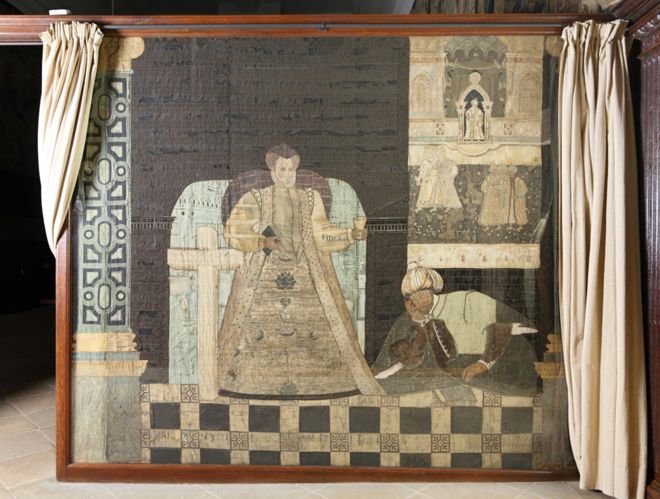
True Faith and Mahomet (silk), English School, (16th century) / Hardwick Hall, Derbyshire, UKImage copyrightBRIDGEMAN IMAGES
Image caption“True Faith and Mahomet” a needlework hanging at Hardwick Hall in Derbyshire

Sixteenth-century Elizabethan England has always had a special place in the nation’s understanding of itself. But few realise that it was also the first time that Muslims began openly living, working and practising their faith in England, writes Jerry Brotton.

From as far away as North Africa, the Middle East and Central Asia, Muslims from various walks of life found themselves in London in the 16th Century working as diplomats, merchants, translators, musicians, servants and even prostitutes.

The reason for the Muslim presence in England stemmed from Queen Elizabeth’s isolation from Catholic Europe. Her official excommunication by Pope Pius V in 1570 allowed her to act outside the papal edicts forbidding Christian trade with Muslims and create commercial and political alliances with various Islamic states, including the Moroccan Sa’adian dynasty, the Ottoman Empire and the Shi’a Persian Empire.

She sent her diplomats and merchants into the Muslim world to exploit this theological loophole, and in return Muslims began arriving in London, variously described as “Moors”, “Indians”, “Negroes” and “Turks”.

Before Elizabeth’s reign, England – like the rest of Christendom – understood a garbled version of Islam mainly through the bloody and polarised experiences of the Crusades.