Stan wants a chamber pot for Xmas

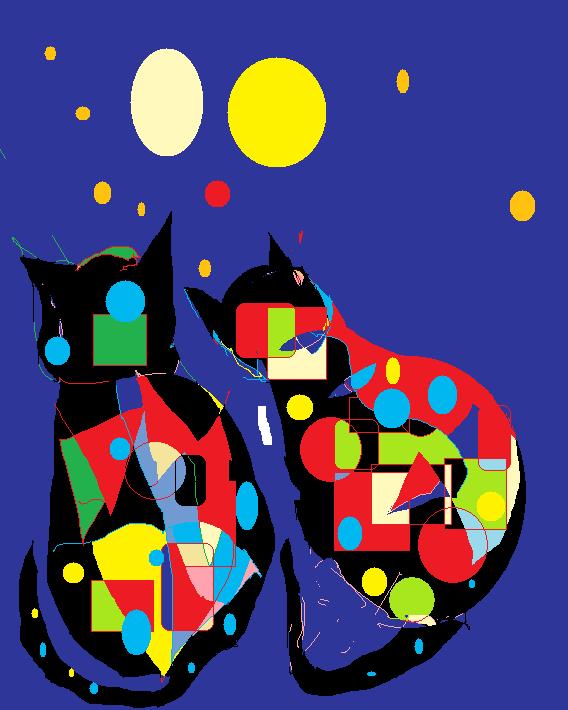
New cats today

Cats by Katherine

Stan was recovering from his long feverish cold and cough.He had Emile standing on his desk under the window
cleaning it with a microfibre cloth fastened to his right front paw
Very good,Emile,he said in a husky voice.I think I’ll get up and make a hot drink.I feel better now than I did and I
enjoyed the Reith lecture on the radio.Mary came into the room wearing a long dressing gown with a zip front.
Where did you get that,Stan enquired jocosely.
It was hanging behind the door, she said.I must have bought it in a sale.I get almost all my stuff in sales.It makes it more of an achievement.
Buit are they really want you want,Stan enquired.
I am happy with them because I like bright colors but most folk don’t so they end up in the sale.I just bought
some pewter shoes for £29.99 when in black they were £79.99.
Will pewter shoes not be too heavy?Stan joked.
It’s the colour dearest.It’s a good colour for when we are going out in the evening to a do.
But we never do go out nowadays .he told her sadly.
I live in my imagination,Mary responded, and so I get clothes and shoes for any possible event funerals.weddings,evening balls.
The only b*lls you see in the evening are at home ,he murmured vulgarly.
I don’t think that’s very funny,Stan,she told him.I am a woman of gentle birth even if I was born in a coal mine.
I am sorry, dearest,my mind is not right since I fell out of bed and banged my head on that heavy tin chamber pot.
That’s a flower vase,she told him honestly and directly.We no longer use chamber pots now we have an en-suite here and a cloakroom downstairs plus an outside lav tooWell,I do.Stan said.I was brought up with one and I always use one at night
That’s strange Mary told him.Where do you find them?I have never bought any,not even in the Sales.
In the kitchen,Stan said.In the cupboard
Those are my baking bowls, she said crossly.
I forbid you to use them to wee into.
Well,will you buy me one? he asked her tenderly as he stroked her curly light blonde hair just washed in Boots
Dandruff and Acne shampoo. with Rosemary and Rose Essence
Of course,darling,if it wil; make you happy.I’ll go online.I am sure they are still made though originally they were used when people had outside loos.
That can be my Xmas present,he joked,if you pay for express delivery but don’t have it gift wrapped.
Adulterous Annie their neighbour came in.She wore a grass green trouser suit and pink calf high boots.Underneath she had spanx hip and thigh control pantees and a blue lace bra which peeped out as she forgotten to put a blouse or jumper on despite the cold weather.
What is that, in your hand,Annie ? Stan asked thoughtfully.
It’s a pewter chamber pot that we inheritied from my granny she said
Gosh,how amazing,it’s just what Stan needs,Mary informed her.He’s been using a vase..
That is very naughty,Annie told him.You should know better
NaughtyThat’s strange word to use.I am a man.I can do what I want.You’ll see.
But can you want what you do,Mary asked like an Oxford don on low dose speed.
I can if I choose to ,he said.
So do you believe in will power? Annie asked curiously.Sometimes I do and sometimes I don’t, he replied ambiguously which was one of his defense mechanisms when he was with very clever women.
I see,you twist the world around your little finger.
That’s a strange parallel,Stan told her.But parallel lines on the earth’s surface do meet at the Poles which proves
that Euclidean geometry is not the only sort possible.
Why is that?Annie asked,though she had no idea what he was talking about
Because one of Euclid’s axioms is that parallel lines never meet .
It sounds a bit like men and women nowadays,Stan said thoughtfully.We will only meet if we go up the pole
I wonder what the origin of that phrase is,Mary said curiously.It’s a strange world.
Meanwhile Emile finished the window and was polishing the dressing table mirror.What luck for Mary and Stan
that Emile loves microfibre and Windolene.Next they are hoping to buy him tiny vacuum cleaner… that would
help to gather up all the dust from the floor and let Mary get on with her book
Mirrors and the development of the child’s theory of integers and meta-language as hypothesised by
Jack Lacant. Part 2z

How like a winter by Wm Shakespeare

How like a winter hath my absence been
From thee, the pleasure of the fleeting year!
What freezings have I felt, what dark days seen!
What old December’s bareness everywhere!
And yet this time remov’d was summer’s time,
The teeming autumn, big with rich increase,
Bearing the wanton burthen of the prime,
Like widow’d wombs after their lords’ decease:
Yet this abundant issue seem’d to me
But hope of orphans and unfather’d fruit;
For summer and his pleasures wait on thee,
And thou away, the very birds are mute;
Or if they sing, ’tis with so dull a cheer
That leaves look pale, dreading the winter’s near.
  • Related

Xmas food– don’t buy a pie

nrm_1428488377-rbk-blender-food-peanut-butter-chocolate-chip-mini-blender-muffins.jpg
Pies from  a cheaper supermarket labelled chicken have got fish in.Pies from  another labelled chicken have small pieces of plastic in.Don’t end up in A and E trying to explain why you have plastic coming out of your bum or even worse, you may be dead from choking before the plastic enters your digestive system.
If you still eat pastry, make your own pies.It makes me wonder who makes the pies and where.Is it a protest by underpaid wage slaves in some Asian country?

A winter day describe

Grey, damp, dark, a winter day describe,

Though sunshine comes  with  white and wintry frost.
While on my paper, curving shapes inscribe
The alphabet I learned at childhood’s cost.

Humankind can’t bear too much of night
Hallucinations,dreams, symbols confused.
We like the sunny sky where birds take flight.
In warmth soft air, our tension are defused.

Accepting night is one of our sad tasks
Light and dark need balance in this world
In the light of sun. our sorrow’s masked
We feel false ecstasy as colours swirl.

God created light and darkness first
Their divided unity is blessed

Another way, a place,another mind

Photo0294 2.jpg
From time and place and season I am lost,
Disorientated ,missing tracks well worn.
Do not suppose I’m unaware of cost,
Nor label me with epithets of scorn.
For usual paths lead to the usual place.
The safest way to live and perhaps to die,
But wandering through the woods I find new space
and in wild grasses with the fox I lie.
Through distant trees, I see a way to go
As narrow as a slit in  pale limestone.
I pass in silence as if in deep,deep snow.
My courage rises even as I groan.
Remember when we’re lost ,we may then find
Another way,a place,another mind.

In the space

In the space where you are not, I am.
I, the symbol of your love and  hate
Closer to your soul  than a wing-span
Closer than the time  our lives began
I the woman you the other, man
This our destiny or common fate
In the space where you are no more than
I, the object in your love’s estate

rr

In the mystery

I miss his warmth and lying in his arms
I miss the conversation we enjoyed
Hidden in the mystery of demise
Wondering if he had a different choice
The truth will help us more than clever lines
I miss the animation in his voice
I miss his warmth,my dwelling in his arms
I loved the silences we both enjoyed

About faux Xmases, who can belong?

About our Xmas, we are always wrong
Old resentments rise like mist on moss
Yet we may enjoy the Xmas songs

On the Northern hills my heart belongs
There is too much space for me to cross
About this season, we are often wrong

See the family bare their human fangs
Anger is a stand in for our loss
Yet we may enjoy the Xmas songs

On the wall, the Xmas cards all hang
On the pathm we see the patterned frost
About this season, admit we are wrong

“Stille Nacht” the warring armies sang
What remains is less than what was lost
We are saddened by such carolled songs

On we eat,regardless of the cost
And the tons of paper and of waste
About a Xmas, we are sometimes wrong
Yet we must enjoy the Xmas songs

What to consider when writing a poem

Oxford2017-3
Oxford

7 Ingredients You Need to Consider When Writing Poetry

“What are you trying to say?

The message of your poem is the most important part.

The message of your poem is the most important part. CLICK TO TWEET
It could be something as simple as your love of cupcakes, or it could be something more complex, like a relationship. Whatever it is, your message should be clear without stating the obvious or patronising the reader.

You can use visual language in your poem to explain to the reader what’s happening without making it blindingly obvious.

The layout of your poem can reinforce this message further…

2. Form/Structure
The structure of your poem can be as influential as the grammar, punctuation and language.

What will your poem look like on the page?

Will it be a concrete poem? Will the length/shape of each stanza enhance the poem in any way?

Think carefully about how the poem looks on the page. A poem—particularly a concrete one—can be as visual as a piece of art.

If you’re not sure how to lay your poem out, experiment with different forms. What you’ve written may work better as a concrete poem, or it may fit a more structured layout, like a sonnet. A strictly structured poem looks very neat and tidy, but if you’re writing about things falling apart, it may not be the best layout to choose (unless you’re being ironic).

Some poets have their preferences for particular structures, others prefer to write with a lack of structure.

Write to whatever form fits your poem and writing style the best. It may take you several drafts of a poem to find the right form for it, but that’s ok! “

Every day ritual

Oxford2017-2

http://www.coffeeshopsermons.com/blog/everyday-ritual-grieving-creativity-and-poetry


“Poetry and Grief

“Poetry is spontaneous overflow of powerful feelings: it takes its origin from emotion recollected in tranquility.” –William Wordsworth, Lyrical Ballads

There are not many emotions that can overflow as spontaneously and powerfully as grief. Often, grief will linger with us. Other times, it catches us off guard. The poet William Wordsworth knew this, losing three of his children when they were still young, and much of his poetry grappled with issues over loss and grief. Through poetry, Wordsworth found a medium to express his feelings, becoming one of the most celebrated poets of his time. We, too, can find creative ways to express our grief. Poetry is an effective form of artistic expression for grief and loss; it allows us to put our feelings into words, words that are not as necessarily contained by sentences and grammar but free flowing.

Poetry comes in many forms—from the sonnet to the epic poem. Some poems focus on having a particular meter or rhythm to how the words flow, some poems focus on rhyming words. The three forms suggested here are free verse, rhyming couplets, and the haiku; however, feel free to experiment with forms that come naturally and flowing for you.

A good resource on the different forms of poetry and how to write them can be found on the internet (see poets.org’s article on poetic forms–the website has a menu you can select from with over thirty different forms of poems and examples of each).

Free Verse

Free verse poetry is just what it sounds like. It is free from the constraints of any kind of meter or rhyming scheme. Instead, one is free to just let their thoughts and feelings flow out in written form. The free verse poems tend to follow a natural rhythm of human speech, with line breaks often appearing at natural pauses (like where a comma might normally appear in prose text). Especially for beginning poets, the free verse form may be helpful in just getting one’s thoughts from their mind to the page without having to worry too much about form. The ultimate goal of a poem is up to the poet, but many poems seek to express feelings or thoughts in unique ways, using metaphors or comparisons. Others try to capture a moment or a memory in words. The free verse is an ideal form to capture

How to write a free verse poem:
There are many ways to begin writing a poem. Some begin with a technique called “free writing,” where they just start writing without any plan or purpose and see what comes of it. If you are having difficulty trying to think of what to write about, perhaps try some free writing—clear your mind, put the pencil or pen to paper, and just write. Don’t be concerned about spelling, grammar, or sentences, don’t erase or cross out, just write until the well of words is empty. Then you can go back to what you wrote and pull words, phrases, or ideas out of what you have written to create a poem. Others will start with an image, memory, emotion, or thought in mind and work towards a poem that way, by focusing on that particular idea as they write the whole way through. Some might write a poem to eulogize a loved one, listing their loved one’s attributes, accomplishments, or their memories of that loved one. Know this: there is no right or wrong way to write a free verse poem, no set length or anything else. Give yourself permission to write whatever comes to mind. After all, you can always go back and edit it later.

My favorite example is Ysaye M Barnwell’s “Wanting Memories,” which you can find here.

Rhyming Couplets

Poems with rhyming couplets are perhaps the most widely known form of poetry, and I would argue is what most people think of when they think of a poem. Poems with rhyming couplets do not necessarily have a set rhythm or meter. The focus instead is on the rhyming of the last words of every two lines. These lines are always rhymed in a pair. For example, William Shakespeare ends the play Romeo and Juliet with a rhyming couplet: “For never was a story more of woe, / Than this of Juliet, and her Romeo.”  Similar to a free verse poem, the lines can be as long or as short as you like. You can choose to have a meter to your poems or not, the important part of this form is making the lines of the poem rhyme in pairs. Rhyming poems help give the poem a memorable lilt as each line rhymes with the one directly before it or after it—think of many songs that rhyme.

How to write a poem with rhyming couplets: 
You can start just like before—by doing a freewriting exercise to help center your thoughts. You can also begin by thinking about the subject of your poem and go from there. When you start writing the lines of your poem, be very intentional of the word you want to end your line with, noting if it is easy to rhyme with other words, and if there is a word that it rhymes with that will help continue to move the poem forward.”

Time

Do we wait for hints from other Realms?
Though hints can be  confusing to the dead
Oh, let life run  like seas that overwhelm

We first look after those who are  becalmed
As hints can  be a nuisance when unfed
Do we care for hints from other Realms?

Spiritual  rules become embalmed
And hints fill shyer people with deep dread
As does life  with seas that overwhelm

Was our life an accident designed?
Do we want our hints  to be unread?
Do we share our hints from other times?

What is compassion  worth when  life’s unkind?
Where are the arms that opened when we bled?
What is life  that seas  should overwhelm?

What is life  for those who have no bed?
Sacred are all children  underfed
Do not wait for hints   and special signs
The  little voice  beneath the noise calls time

e


Love Bade Me Welcome – from Love (III) by George Herbert

 Love bade me welcome: yet my soul drew back.
Guiltie of dust and sinne.
But quick-ey’d Love, observing me grow slack
From my first entrance in,
Drew nearer to me, sweetly questioning
If I lack’d anything.

A guest, I answer’d, worthy to be here:
Love said, You shall be he.
I the unkinde, ungrateful? Ah, my deare,
I cannot look on thee.
Love took my hand, and smiling did reply,
Who made the eyes but I?

Truth Lord, but I have marr’d them: let my shame
Go where it doth deserve.
And know you not, sayes Love, who bore the blame?
My deare, then I will serve.
You must sit down, sayes Love, and taste my meat:
So I did sit and eat.

Posted in Thinkings and poems | Leave a comment | Edit

Behind glass… a defense

caught-red-handed-2

Have you ever felt you were behind a pane of glass? I did once many years ago after a friend committed  suicide.It must be a protective  condition but it is painful and odd.Everyone else seems ok ,you imagine,but you are not a part
.In reality many people may be feeling like you do and putting on a performance while out at work or socialising.We are probably wiser as we grow older as we know more people better and see we are not  unique in our suffering and pain; we know that feelings pass,even the worst ones and we may have become better at judging others and knowing if friends die  by suicide it’s probably not our fault

When one feels that way it has to be accepted for the time being, like all feelings,I found reading poetry helped me and also being with others in a group where I could sit and listen without pressure to speak.I like this poem from then.It was a favorite  of Simone Weil,the mystic.

LOVE BADE ME WELCOME  by George Herbert


 Love Bade Me Welcome – from Love (III)

Love bade me welcome: yet my soul drew back.
Guiltie of dust and sinne.
But quick-ey’d Love, observing me grow slack
From my first entrance in,
Drew nearer to me, sweetly questioning
If I lack’d anything.

A guest, I answer’d, worthy to be here:
Love said, You shall be he.
I the unkinde, ungrateful? Ah, my deare,
I cannot look on thee.
Love took my hand, and smiling did reply,
Who made the eyes but I?

Truth Lord, but I have marr’d them: let my shame
Go where it doth deserve.
And know you not, sayes Love, who bore the blame?
My deare, then I will serve.
You must sit down, sayes Love, and taste my meat:
So I did sit and eat.

Sin,does it still exist?

30002.jpgI have been  wondering why the term sin has almost died out in our language and I think  for many of us who were brought up in a very strict version of Christianity it became too painful  for us to think about it.
We were made to feel ashamed  of our failures so much so that we abandon the whole idea of sin.
We don’t know as children that it is very difficult to live without making mistakes and our emotions run away with us so that we hurt other children….
But now looking at the world as it is,maybe it would be better of more adults admitted making dreadful mistakes.And we know  free will may not be as free as we think.But if we accept we do sin then it makes us more tolerant of others around us…If we were perfect it might make us self righteous and judgemental which to me seems a perversion of religion.Yet this is happening  in the world today.
I have read that it is very hard for Catholics,even lapsed one,to be able to  have a successful psychoanalysis because the conscience is so harsh.We cannot easily alter it.
So it is not surprising we don’t like the word sin.
It is interesting that being thought of as sinners means we are quite powerful,If our errors are caused by human weakness it is more painful to see ourselves as weak and vulnerable yet we are.We all need others.

Grace may enter here

We used to learn from talking to our friends
Our neighbours in communities now gone
Gone too are the preachers and the saints
And there’s gap to fill but how’s that done?

Oh,  buy a tabloid like the  Daily Wail
It’s full of gossip lies , crude images
Like  the words we swapped by village wells
Lies and truth and problems that enraged

Now the people we live by are  who?
We know not of their work,religion,place
We see their faces as they pass at speed
We see no smiles, no love, just a strained face.

There is a gap  but we must keep it clear;
For sometimes grace will  enter, conquering fear


We

Yet  our humanity they desecrate.

The anger of the trapped bull  made to fight
In ring enclosed with no way to escape
Full of useless  strength and less insight

Even with intelligence and light
His self respect and being are both raped
The anger of the trapped bull  made to fight

Like our nuclear weapons and their might
If we use them we destroy all hope
So full of useless  strength and no insight

In discussions , all sides  play polite.
Yet  our humanity they desecrate.
The anger of the trapped ones  made to fight.

Most leaders are   giant infants with the gripes
Not thoughtful people willed to dedicate
Full of useless  strength and no insight

The theatres of new wars, of blood,of hate
Are where the moment leads,ill consecrates.
The torment of the  huge  bull  made to fight
Full of useless  strength and less insight

Post-truth, post-God, post meaning, post remorse

Who should speak, which people have a voice?
Can we trust the ones who’ve told such lies
Post-truth, post-God, post meaning, post remorse?

If we’re wounded, who shall give recourse?
Does it matter to them what we’re tortured by?
Who should speak, which people own their voice?

If we hear bad news, what is its source?
See the bodies  hear the babies cry,
Post-truth, post-God, post meaning, post remorse?

Can we spread democracy by force?
Is it still democracy post-war?
Who should speak, which people own their voice?

Which of all the methods is the choice?
What is politics the reason for,
Post-truth, post-God, post meaning, post remorse?

If I speak, will you believe I lie?
The tongues of angels whisper, what of Troy
Who should speak, which people have a voice?
Post-truth, post-God, post meaning, post remorse


Poetry can convey what prose cannot

Photo0124.jpghttps://www.theguardian.com/education/2000/feb/23/tefl2


“Given these difficulties, is poetry worth the effort? What can a good poem offer the language learner that a good newspaper article or authentic dialogue can’t?

The answer has to do with things such as richness of meaning, diversity and ambiguity. In ELT textbooks students are usually presented with oral and written texts whose meaning can be fairly confidently ascertained: these texts have a meaning and you, the learner, can discover it. Poetry is different. The reader is a much more active participant in working out the meaning – or rather the range of meanings – of the text. The reader brings his or her own experience to the poem. The idea that the meaning of a text can vary according to the person reading it will be a new and refreshing one for many students.

A well-chosen poem encourages teachers to ask questions such as, “What do you think this means?” When students realise that “I’m not sure” is an acceptable answer to such questions, a whole new way of thinking about meaning is opened up.

So using poems in class encourages a diversity of views and a healthy debate about meaning. What else? Well, good poems deal with issues and concerns that are important to students – growing up, love and loss, the animal world and our relationship to it, perhaps even (sadly) war and peace.

The key phrase here is “well-chosen”. You’ve got to find poems that are at the right level for your students, both linguistically and in terms of content. This isn’t easy. On the other hand, there’s no point in feeding students an unrelieved diet of whimsy.”

Singing in the sun, we seem to be

We are little leaves upon the tree
We never did control our tiny worlds
The tree of life; what power, what mystery

With metaphor, it’s easier to see
Life is tender, see each leaf unfurl
We are only leaves upon the tree

Singing in the sun we seem to be
Full of joy until the storm winds swirl
The tree of life; what power, what mystery

Extinguished candles smoke at Tenebrae
We are blown to death however bold
We are little leaves upon the tree

Thus we sacrifice to God uncertainly
Yet as the wars continue, we grow cold
The tree of life; what power, what mystery

Who has dropped us from the hands that hold?
Who has stolen certainty untold?
We are little leaves upon the tree
The tree of life; what power, what mystery

A history of silence

https://www.poetryfoundation.org/poetrymagazine/poems/144823/a-short-history-of-silence?utm_source=Poetry+Foundation&utm_campaign=4d5329c06e-PMAG_DEC_19_2017&utm_medium=email&utm_term=0_ff7136981c-4d5329c06e-185545637

A Short History of Silence

BY JANE YEH

In our house, all the clocks are turned off and the mirrors
Don’t work. We sit like bread in a stay-fresh wrapper,
Keep ourselves to our selves. Sometimes the speeches
Are so beautiful it hurts. On the porch where we can’t be

Seen to smile, the honeysuckle meshes with silent
Weeds. We rock back and forth, back and forth in our long
Black dresses. Mosquitoes taste our blood and find it good.

Inside, candles are lit every night and keep going
Until they burn themselves down. We kiss our fingers
To our lips like Italians, promise we’ll never look back.
Whip-poor-will. When the doorbell rings we don’t answer.

In winter, the fur grows long on the horses and the ice
Grows long on the eaves. We sleep in the same bed
Like good animals, braid our hair together, tailor
Our limbs to fit. Conspiracy of wood.

Source: Poetry (December 2017)

To His Coy Mistress 

BY ANDREW MARVELL


Had we but world enough and time,
This coyness, lady, were no crime.
We would sit down, and think which way
To walk, and pass our long love’s day.
Thou by the Indian Ganges’ side
Shouldst rubies find; I by the tide
Of Humber would complain. I would
Love you ten years before the flood,
And you should, if you please, refuse
Till the conversion of the Jews.
My vegetable love should grow
Vaster than empires and more slow;
An hundred years should go to praise
Thine eyes, and on thy forehead gaze;
Two hundred to adore each breast,
But thirty thousand to the rest;
An age at least to every part,
And the last age should show your heart.
For, lady, you deserve this state,
Nor would I love at lower rate.
       But at my back I always hear
Time’s wingèd chariot hurrying near;
And yonder all before us lie
Deserts of vast eternity.
Thy beauty shall no more be found;
Nor, in thy marble vault, shall sound
My echoing song; then worms shall try
That long-preserved virginity,
And your quaint honour turn to dust,
And into ashes all my lust;
The grave’s a fine and private place,
But none, I think, do there embrace.
       Now therefore, while the youthful hue
Sits on thy skin like morning dew,
And while thy willing soul transpires
At every pore with instant fires,
Now let us sport us while we may,
And now, like amorous birds of prey,
Rather at once our time devour
Than languish in his slow-chapped power.
Let us roll all our strength and all
Our sweetness up into one ball,
And tear our pleasures with rough strife
Through the iron gates of life:
Thus, though we cannot make our sun
Stand still, yet we will make him run.

A bad poem is better than a black hole

1.Use a cliche in every line
[You can find more cliches by googling£ cliche list”]
2 Try to write in form but fail.
3.Completely ignore the music of the poem
4 Write about something vague and general
5 Make out  you have  a very high opinion of your work
6.Use  out of date  words/phrases like ’twas
7.Use complicated words especially ones you don’t  understand

To his boy mistress:

You are the most  consecutive lover in the world
The sun  has never  gloamed as much as you do
When Cassius and his kin their daggers hurled
You were out of town meeting customers  I once knew

Oh,God, not another cliche attack on Advertising
That  line has more than five beats in it but never mind
Even a Samaritan  might be suicidal
If all their customers were so unkind

And when I dream of you, you are wearing all white clothing
Which  shall boil for you in my slow cooker
Then we shall go roaming in the gloaming.
Maybe we’ ll have a drink with a  few hookers


Iambic pentameter sucks as does the honey bee
This is the  possibly worst poem anyone could ever see

That is  supposed to be the end of verse
But I could invent one a  great deal worse.

Eggs never boil unseen

Photo0156.jpg
To write a bad poem you could write a good one and then make changes to the metre or put in the wrong word here and there.But it seems like work.Maybe some of us can write bad poetry without really trying

You were the centre of my universe
[What is a universe,by the way?]
You were the light in my life
[What about the sun?
You were perfect in every way
{ Name a few definite ones]
So why did you choose me?
[Why, what’s wrong with you?]
Now, you have thrown me away
Seems as  if I am trash
But some folk save the wrong things
Or put them in the wrong wash
[That might be a metaphor]
My washing machine  only works on the rapidest wash
[Good grief, that sounds positive]
Since it’s only 14 minutes,I do it twice
[Why would people want to know this?]
Sometimes I just do rinse and spin
‘But I didn’t realise that was an option at first
[Who cares?]
I am trying to save money so in future I shall just do one
{ why wash them at all, just steam them!]
I love elecricity
{ Is that a metaphor?]
I love gas
[Maybe it’s not]
I’ll cook my angel a roast
{ Do  angels eat?]
A roasted prayer of thanksgiving
{Sounds more  like a threat than a promise]
God will smell the odour
[Not if he doesn’t want to]
God will be happy
[Are you crackers?]
God is neither happy nor unhappy
[Make your mind up.This is  not logic class BTW}
God looks divine
[How can we compare the two?]
I have seen him
[Are you high?]
I don’t know what will happen next but I accept it all
[Very gracious!]
I wish Father Xmas would come tonight
{ Don’t we all?]
And to use a cliche,I love the entire universe.What ever that is!
Is that a bad poem?
Do cows eat grass
Do  sheep have woollen rugs  glued to their heads ?
I am finished
[At last!]

And play

erichfromm.jpg
Erich Fromm

I wander through the lonely streets to find
A shop where I can buy another mind
This mind I have I must have well abused
For I wrote mathematics with no clues.
Now I cannot understand my books
I want to see but I can only look
Why did I go wrong so  fast so soon
I ask the stars to watch me and resume
I wonder why there’s no door in our heads
So minds could be replaced while we’re abed.
But dreaming would be altered and undone
As soon as we sensed dawn had overrun
Soon it is he shortest day  of light
And winter  aggravates  with frost the longest night
Yet I have found wrist warmers are superb
Made of tin foil, boiled in dark green curds
My fingernails have grown again,how gay!
I’ll ask a man to dine with me and play

Poetry and language

Photo0157

Click to access poetry-language.pdf

Short extract

POETRY’S LANGUAGE
Poetry uses language in many different ways. By noticing the techniques poets use with
language, it becomes easier to understand and talk about a poem. If you are a writer, consider
using some of these language techniques to emphasize certain ideas, themes or images.
Imagery
Plain and simple, imagery is the word used to describe the types of images a poet uses
throughout the poem. Images are references to a single mental creation; they are the verbal
representation of a sense impression. However, there are many different types of imagery that
can be used.
Visual Images (sight)
 Example: “The look-out man will see some lakes of milk-color light on the sea’s
night-purple”
“The Purse-Seine”
Robinson Jeffers
Tactile Images (touch)
 Example: “The only things moving are swirls of snow.
As I lift the mailbox door, I feel its cold iron.”
“Driving to Town Late to Mail a Letter”
Robert Bly
Auditory Images (sounds)
 Example: “she quietly rolled
flour tortillasthe
‘papas’
cracking in the hot lard
would wake me”
“My Grandmother Would Rock Quietly and Hum”
Leonard Adamé
Gustatory Images (tastes)
 Example: “Take out a three-pound leg of lamb,

Simple recipes for one or two

Simple recipes for one or two
Cheese on toast accompanied by glue
What will this old cook book do for me?
Shall I make an omelette for my tea.

When I reached the age of 65
I blessed the Lord for I was still alive
But I put away the cordon bleu cook book
I am going simple.Write me books.

How to mash potatoes with your shoe
How to fill the freezer till you’re blue
How to boil an egg within a stew
An omelette in the kettle is a clue.

So do not be alarmed for all is well
They just have many cook books that won’t sell

Good and bad poetry and the in between

Photo0154

https://www.poetryfoundation.org/articles/69448/the-good-the-bad-and-the-good-bad


“Our ongoing fascination with terrible poetry.

Introduction

“Yet just as cheese sometimes gets too moldy—to plunge forward with my metaphor in the blithe manner of James McIntyre—so can bad poetry rot beyond possible appreciation. Charles Lee and D.B. Wyndham Lewis discussed this problem in their famed anthology The Stuffed Owl (1930), a collection of bad poetry that has served as a model for many such volumes to follow. They outlined distinctions between ‘good Bad Verse,’ which they sought for their book, and “bad Bad Verse,” which they avoided.”—Abigail Deutsch examines the good, the bad, and the good bad.

Read the entire article.

Follow us on TwitterFacebook.

Bad Poetry. Original Illustrations by Paul Killebrew.Original illustrations by Paul Killebrew.

What are we to do with lines like these?

We have seen thee, queen of cheese,
Lying quietly at your ease,
Gently fanned by evening breeze,
Thy fair form no flies dare seize.

All gaily dressed soon you’ll go
To the great Provincial show,
To be admired by many a beau
In the city of Toronto.

We might grow slightly nauseated. We might (who knows?) get hungry. We might gleefully illuminate the poetic palsies that weaken the frame of this work, James McIntyre’s “Ode on the Mammoth Cheese”: the clanging rhymes, the collapsing meter, the misguided coronation of a Canadian dairy queen.

Alternatively—as we reread in delight, as we probably just did—we might note the workings of a mysterious alchemy. Just as milk ferments into cheese, so can bad poetry, in this and other cases, transform into something rather enjoyable. Like a pungent Roquefort, bad poetry can stink in marvelously complex ways.

Yet just as cheese sometimes gets too moldy—to plunge forward with my metaphor in the blithe manner of James McIntyre—so can bad poetry rot beyond possible appreciation. Charles Lee and D.B. Wyndham Lewis discussed this problem in their famed anthology The Stuffed Owl (1930), a collection of bad poetry that has served as a model for many such volumes to follow. They outlined distinctions between “good Bad Verse,” which they sought for their book, and “bad Bad Verse,” which they avoided. “The field of bad Bad Verse is vast, and confusing in its tropical luxuriance,” they opined, before launching into a description of its authors (“the illiterate, the semi-literate, the Babu, the nature-loving contributor to the county newspaper, the retired station-master, the spinster lady coyly attuned to Life and Spring”). When it came to explaining their preference for the elusive “good Bad” variety, however, Lewis and Lee grew cagey:

It would, indeed, be a permissible exercise in dialectic to prove here conclusively and inclusively, if we had the time, that good Bad Verse has an eerie, supernal beauty comparable in its accidents with the beauty of Good Verse. . . . We will merely assert here that good Bad verse . . . is devilish pleasing.

To what do we owe the devilish pleasure—and how has it grown powerful enough to prompt the succession of bad-poetry anthologies that followed The Stuffed Owl? These works include, but are not limited to, The Worst English Poets (1958), Pegasus Descending: A Book of the Best Bad Verse (1971), The Joy of Bad Verse (1988), In Search of the World’s Worst Writers (2000), and Very Bad Poetry (1997), edited by a brother-and-sister team who also published The 776 Stupidest Things Ever Said (1993) and The 776 Even Stupider Things Ever Said(1994). In 2009, according to Nielsen BookScan, Very Bad Poetry has sold as many copies as Richard Ellmann’s Oxford Book of Verse, suggesting that the anthology-worshiping public values the good Bad as much as the good Good. But why?

Is it because lovers of bad verse are bad people?”


Dawn

The sun  delivers late   like  morning post
I’m waiting for the first sign of the dawn
See it hiding like a pink flushed ghost

In two short days  ,it will be at its  lowest
Before we note, it’s been and swift has run.
The sun  delivers late just  like the  post

I wish I were on Norfolk’s Northern coast
There the sun will rise  and on strands fawn
See it waving like a scarlet ghost.

Pale gold sands  edge   seas that Norsemen rode
How daring were these Danes,where have they gone?
The sun  delivers late just  like the  post

Here love lives and here will love abide
Seeds of  wild flowers , cliffs behind Weybourne
See the sun  waste till it is a ghost

These natural happenings fill my mind with awe
Symbols are created from light raw
The sun  delivers late  and does not boast
See it skitter like a winter ghost