I’ll hum like him all day,

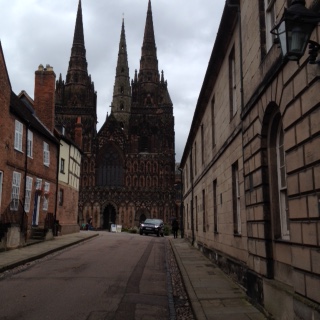
I look up our small street,
To see if you are coming.
I don’t know what time it is,
But I think I hear you humming.

You sang sweet songs for us,
And you could whistle well .
You wore an old tweed jacket
You loved us,I could tell.

I look out there each day,
But I can’t see your tall, thin shape.
I saved your Woodbine packet,
It made me feel some hope.

What does death’s door mean?
Where has Daddy gone?
When will be the welcome day,
When we hear his songs again?

I’ll hum like him all day,
I’ll dream of him all night.
I hope he won’t be angry,
If his cigarettes won’t light!

He can’t write his own songs now.
He went too far away,too soon.
I’ll write down what I think he sang,
And I’ll invent the tune.

I hear him singing now,
He dwells inside my heart.
And though I still can’t see his face,
I recognise his Art.

Electric Cheetah

Was this Earth designed for life or death,
When wired up cheetahs surf the desert sands
Seeking prey to stave off hunger’s wrath?
This hunt’s repeated over all our lands.
And in deep seas of green we find the curse
Of being pursuer or of becoming prey.
Blood in water looks to me much worse
Yet God requires that we should kneel and pray
Rare flowers can snatch and eat the striped bee
Programmed by genes to fertilize and feed.
I grieve a violent God exacts a fee.
He loves to see his creatures as they bleed.
Nature soothes our souls when life’s all green.
Yet tigers springs and care not when we scream

I feel you near


The pattern of your speech is in my ear
Although I do not hear you speak out loud
Shall I say ear or is it heart that bears
The form that made your speech have its right sound?

Wherever in myself I find your trace,
I long to keep it even when I grieve.
As though, because I do not see your face,
I never wish by sound to be deceived.

And at the end, you did not speak at all
Like the bird rests soft inside its nest.
But with your eyes, you gave me a sweet smile
As happy as a baby at the breast.

And so you went, but left your patterns here.
Thus by prosody, I feel you near

How to appear comme il faut

IMG_3812.jpg
Tell people you can’t log onto Amazon
Never order eggs online especially human ones
Do not wear a watch, look at your phone
Don’t wear socks with sandals
Roll up a newspaper and pretend to hit people with it.
Smile and look faraway.
Do not  order pizza on the phone
Don’t eat Weetabix banana flavoured
Use full fat milk
Use butter
Drink cream
Keep saying,  je suis ici, madame/monsieur.
I like faux creme caramel.

How to look un-European for men

14925476_803616533111560_4983467094003038409_n.jpg
Wear a kilt,collar and tie under a very old tweed jacket
Don’t keep your nails clean
Don’t express interest in Albert Camus ; who?
Polish your shoes nightly
Wear  old  nasty socks with  those weird short trousers
Don”t wear trench coats especially in bed or if dead or in the Army
Take a  talking cat out on your shoulder.
When out with friends do not ask what hermeutics is.And don’t ask in bed.Ask your Rabbi as Christianity is a  heresy of Judaisn so we are all entitled to speak to  the nearest Rabbi unless they have fled from anti-Semitisim
Wear a fake fur dressing  gown all day
Don’t appear intelligent
Walk round  square parks screaming Pi.? och aye
Talk about cricket and snooker as much as you can
Never tell your partner you adore them.
Always get married before sexual activity including to yourself.
What this old rubbish,? Be  off

The editor

Race: what and where?

erichfromm.jpg
Erich Fromm

http://www.dictionary.com/browse/race


“Usage note
Genetic evidence has undermined the idea of racial divisions of the human species and erendered  race obsolete as a biological system of classification.Race, therefore, should no longer be considered as an objective category, as the term formerly was in
expressions like the Caucasian race, the Asian race, the Hispanic race.Instead, if the
reference is to a particular inherited physical trait, as skin colour or eye shape, that
 salient feature should be mentioned specifically: discrimination based on colour.Rather than using race to generalize about national or geographic origin or even religious affiliation, it is better to be specific: South Korean, of Polish descent.
References to cultural affiliation may refer to ethnicity or ethnic group: Kurdish ethnicity, Hispanic ethnicity
.
Though race is no longerconsidered a viable scientific categorization of humans, it continues to beused by the U.S. Census to refer to current prevalent categories of self-identification that include some physical traits, some historical affiliations, and some national origins: black, white, American Indian, Chinese, Samoan,etc. The
current version of the census also asks whether or not Americans are of Hispanic origin, which is not considered a raceThere are times when it is still accurate to talk about race in society. Though race has lost its biological basis, the sociological consequences of
historical racial categories persist. For example, it may be appropriate to invoke race to
discuss social or historical events shaped by racial categorizations, asslavery, segregation, integration, discrimination, equal employment policy.Often in these cases, the adjective “racial” is more appropriate than thenoun “race.” While the scientific foundation for
 race is now disputed, racial factors in sociological and historical contexts
continue to be relevant.

The vulnerable,the trembling heart inside

Once I saw the face within your face
Vulnerable and lower than an ant
An image that fits many of our race
The human  seeing that forever haunts

The face within your face is  on my mind
As I think of Christmas and choose  gifts
I recollect the cruelty of our lives
When too much fighting did create deep rifts.

Often masks are fixed with superglue
The psychic rival sees no other view
We may have no one else to show them to
The pain of lying pierces us right through.

Yet we can’t live  now with no mask to hide
The vulnerable, the trembling heart inside

Forward: what does it mean?

Photo0163
forward
adverb
adverb: forward; adverb: forwards
  1. 1.
    in the direction that one is facing or travelling; towards the front.
    “he started up the engine and the car moved forward”
    synonyms: ahead, forwards, onwards, onwardonfurther

    “the traffic moved slowly forward”
    • in or towards the bow or nose of a ship or aircraft.
    • in the normal order or sequence.
      “the number was the same backwards as forwards”
  2. 2.
    onward so as to make progress.
    “the signing of the treaty is a big step forward”
    synonyms: moving forwards, moving ahead, onward, advancing, progressing, progressive

    “in a forward direction”
    antonyms: backward
    • into a position of prominence or notice.
      “he is pushing forward a political ally”
  3. 3.
    towards the future.
    “looking forward, earnings are expected to hit £7.2 billion”
    synonyms: onward, onwards, onforth, forwards; More

    • to an earlier time.
      “the special issue has been moved forward to November”
adjective
adjective: forward
  1. 1.
    directed or facing towards the front or the direction that one is facing or travelling.
    “forward flight”
    • positioned near the enemy lines.
      “troops moved to the forward areas”
      synonyms: frontadvanceforemostheadleadingfrontal

      “the fortress served as the Austrian army’s forward base against the Russians”
      antonyms: rear
    • situated in or towards the bow or nose of a ship or aircraft.
      “the forward cargo doors”
    • ELECTRONICS
      (of a voltage applied to a semiconductor junction) in the direction which allows significant current to flow.
  2. 2.
    relating to the future.
    “a twelve-month forward forecast”
    synonyms: futureforward-looking, for the future, prospective

    “forward planning”
  3. 3.
    progressing towards a successful conclusion.
    “the decision is a forward step”
    • further advanced than expected or required.
      “an alarmingly forward yet painfully vulnerable child”
      synonyms: advanced, well advanced, earlypremature;

      precocious
      “I never saw the trees so forward as they are this year”
      antonyms: late
  4. 4.
    (of a person) bold or overfamiliar in manner.
    “I am not usually a forward sort of person”
    synonyms: boldbrazenbrazen-facedbarefacedbrashshamelessimmodestaudaciousdaringpresumptuouspresumingassumingfamiliaroverfamiliarMore

    antonyms: shy
noun
noun: forward; plural noun: forwards
  1. 1.
    an attacking player in football, hockey, or other sports.
  2. 2.
    FINANCE
    agreements to trade specified assets, typically currency, at a specified price at a certain future date.
verb
verb: forward; 3rd person present: forwards; past tense: forwarded; past participle: forwarded; gerund or present participle: forwarding
  1. 1.
    send (a letter or email) on to a further destination.
    “my emails were forwarded to a friend”
    synonyms: send on, post on, redirectreaddress, pass on

    “my mother forwarded me your letter the day she received it”
    • dispatch or send (a document or goods).
      “apply by forwarding a CV”
      synonyms: senddispatchtransmitcarryconveydeliverremitpostmailshipfreight

      “the goods were forwarded by sea”
  2. 2.
    help to advance (something); promote.
    “the scientists are forwarding the development of biotechnology”
    synonyms: advancefurtherhasten, hurry along, expediteaccelerate, speed up, step up, aidassisthelpfosterencourage, contribute to, promotefavoursupportback, give backing to, facilitate

    “my five months in England were used to forward my plans”
Origin
Old English forweard (in the sense ‘towards the future’, as in from this day forward ), variant of forthweard (see forth-ward).

Spiritual poetry

photo0016.jpg

https://www.poetryfoundation.org/articles/68606/spiritual-poetry


“The root of “spirit” is the Latin spirare, to breathe. Whatever lives on the breath, then, must have its spiritual dimension— including all poems, even the most unlikely. Philip LarkinSylvia PlathWilliam Carlos Williams: all poets of spiritual life. A useful exercise of soul would be to open any doorstop-sized anthology at random a dozen times and find in each of the resulting pages its spiritual dimension. If the poems are worth the cost of their ink, it can be done.

But, no, I’ve been asked to choose, to recommend. The poems I suggest here are this moment’s choices, not “the best spiritual poems” (a phrase weighing nothing in so intimate and personal a context). The “gates” are an equally personal selection of entrance points into spiritual life. Some of the poems are well known, others less so. Each stands representative of many others. Each also, for me, plunges into the heart of the matter at hand, bearing witness in some essential way.


GATE 1. PERMEABILITY
Although the wind
blows terribly here,
the moonlight also leaks
between the roof planks
of this ruined house.

Izumi Shikibu (Japan, 974?-1034?) [translated by Jane Hirshfield with Mariko Aratani]
The moon in Japanese poetry is always the moon; often it is also the image of Buddhist awakening. This poem reminds that if a house is walled so tightly that it lets in no wind or rain, if a life is walled so tightly that it lets in no pain, grief, anger, or longing, it will also be closed to the entrance of what is most wanted.

The poem, by the greatest woman poet of classical-era Japan, is one I first encountered in 1986 while working with Mariko Aratani, my co-translator for The Ink Dark Moon. At first, I had the poem’s words, I had the poem’s grammar, but its meaning eluded. Once it clarified, this became for me a life-altering poem, transforming my relationship to safety, permeability, awakening, and the mouth of the lion.

GATE 2. THE GREAT YES

Che Fece… Il Gran Refiuto

For some people the day comes
when they have to declare the great Yes
or the great No. It’s clear at once who has the Yes
ready within him; and saying it,

he goes from honor to honor, strong in his conviction.
He who refuses does not repent. Asked again,
he’d still say no. Yet that no—the right no—
drags him down all his life.

C.P. Cavafy (Alexandria, 1863-1933) [translated by Edmund Keeley and Philip Sherrard]
Cavafy is not generally thought of as a spiritual poet. This early poem’s precipitating title comes from a story about a pope, as told by Dante, but that is not the reason it is here. Nor can I say I even fully understand the poem—the phrase “the right no” has been, for me, a decades-long riddle and harvest. But Cavafy’s basic proposal, that a person carries within himself or herself a great Yes or great No, requiring declaration—this surely is one gate to the spiritual dimension.

Sensitive to what is merely faked

You let me see the face within your face
So vulnerable, so touching. eyes of pain
No posturing no masking, no mistake.

You did not wish to share a kind embrace
As trauma may revisit you again
You let me see the face within your face

Inside us is our heart, which others break
With their false love, when truth is what they feign
No posturing no masking, no mistake

Sensitive to what is merely faked
Agony is etched into your brain
You let me see the face within your face

Having been insulted’s no disgrace
Yet all alone, we ‘re victims of our brains
No posturing no masking, no mistake

For  humans there’s an insult set in train
When, powerless, we struggle but in vain
You let me see the face within your face
No posturing no bluster, I was graced.