I did not bear him any grudge

fkower-abstract
I won’t go on the North Circular again
There are so many cars, it’s mayhem
My husband drove well
But this road is hell
You might as well turn  a sheep  to a hen.

When he was  more young he drove fast
If I wanted to pee, he was pissed
Then he got older
And his prostate was bolder
So he was sorry  he’d hurt me, at last!

I did not bear him any grudge
For his face was a sight much beloved
His voice caused much fear
When the doctor was here
She looked like she’d swallowed a smudge.

I know this may never make sense
But my feelings are always intense
I pray for  some news
But God is amused
So he wants my old man to stay hence.

He looked like a Peer of the Realm
So a barman said,overwhelmed
His grandad was a blacksmith
So he  covered up  his  nuts with
A piece of  old iron at the helm

On the tiger’s cage she leant, now she ‘s went

There was a young lady from Kent
In whom wisdom was somewhat absent
She went to a zoo
She knew what to do
On the tiger’s cage she leant, now she ‘s went

My husband  lived near ICI
The air was so bad  they’d no  sky
They said, kill or cure
Or repent and be pure
So he just goes,”why, will I die?”

My husband was a very strange man
He  once fried an egg  on a pin
I said,I bought that in York
Why not use a fork?
He said,I pinked and so therefore I am.

He was on this diuretic for  a while
He had to pee into a vase or a pail
He had no desire
To eat or perspire
Nor did he break into a wail

I didn’t know he was going to die
He leaned over and smiled with his eye.
He winked at me laughing,
I  had a premonition
Before I could speak, he had sighed

I still think he’ll come back to me
So I put out a cup for his tea.
I see from the edge of my eye
He is there till I turn to espy
Well,at least up above, they don’t pee!


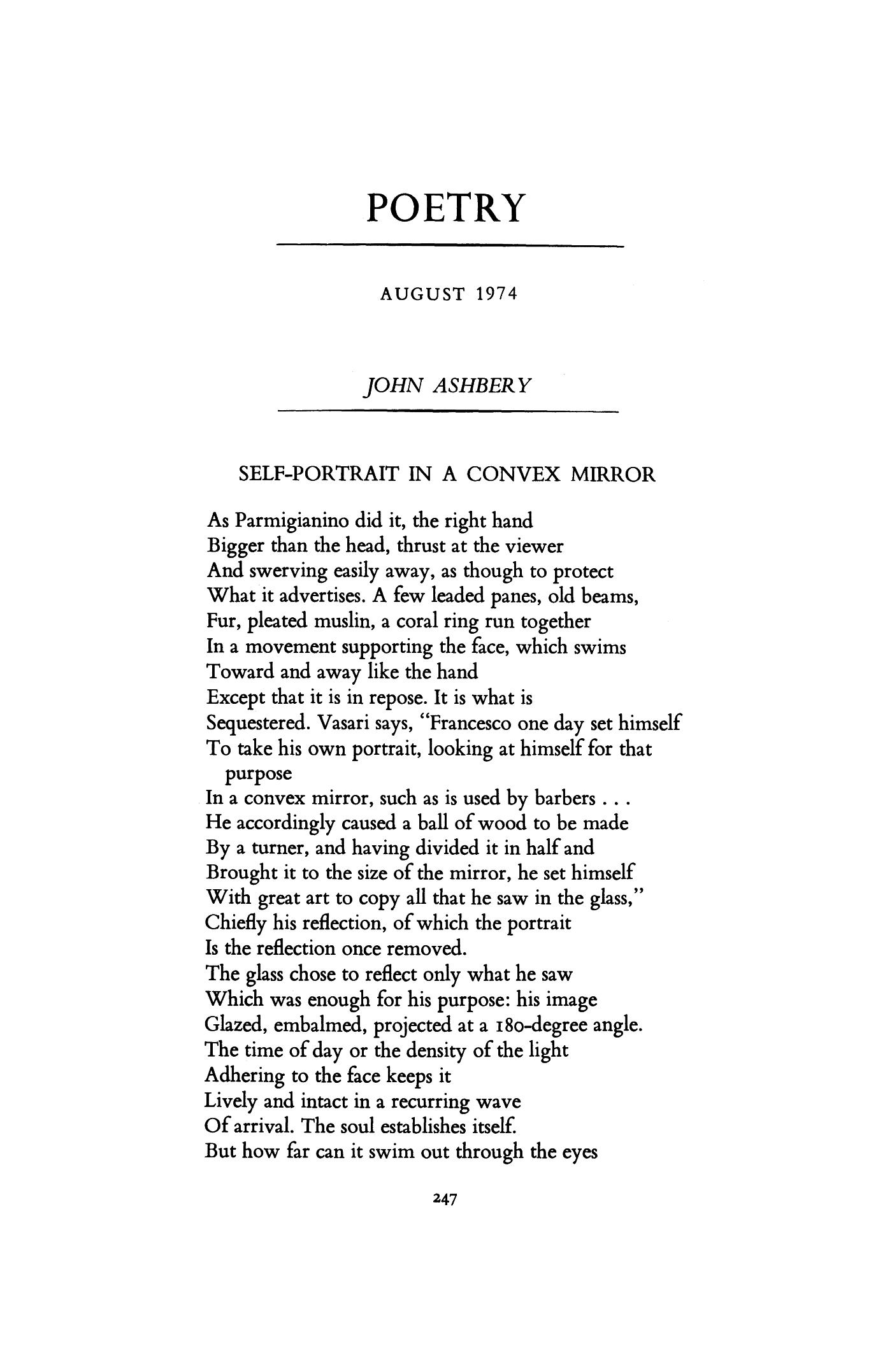
Self portrait in a convex mirror by John Ashbery

11998867_613825758757306_6080048193100925661_n

https://www.poetryfoundation.org/poetrymagazine/browse?contentId=32944&utm_source=Poetry+Foundation&utm_campaign=abbd14820e-PMAG_SEP_05_2017&utm_medium=email&utm_term=0_ff7136981c-abbd14820e-185545637

August 1974

I’ll eat my Canon Powershot if I’m bored.


Come live with me and be my helpmeet now
I’ll share my bed  if you can see I’m true
If you let me love you
I’ll darn your old gloves 4 you..
If you come and meet me brow to brow.

Come live with me and teach me all you know
About poetic licence and Soho
I’ll mend your vacuum cleaner
And learn expressions meaner.
How cheerfully the hours to come will go,

Come live with me and be my lover true
Without one,how will we ever do?
I’ll fire up model railways
Learn the Arab weekdays
Come live with me and I will clean your flue.

Come live with me in Norway on a fjord
I’ll eat my Canon Powershot if I’m bored.
I’ll watch the ice flowers growing
And then we must be sowing.
How happy Wittgenstein d’ve been if he’d have knowen

If singing was  their way to eminence

Poetry is images in words
And sentences that coil around the heart
Poetry, like love, is  called absurd
Yet  does not pierce our being like a dart.

Our first  language was song and not  bare speech
A melody  can move us and entrance
The  politicians would be other beasts
If singing was  their way to eminence.

In Westminster, the clock would chant, Amen
As silently the day’s work  was undone
In the morning,it would sing, Begin
Penelope would weave her soul again.

The image may strike deep into our soul;
Make live the voice that sings us into whole

An interesting idea— removing smartphones from pictures

https://qz.com/523746/a-photographer-edits-out-our-smartphones-to-show-our-strange-and-lonely-new-world/

Eric Pickersgill has created a set of photos to show our lonely world.I find it really interesting that he thought of this

I need your touch as well

when words are not enough
to give our feelings form
music is the language
which many find gives calm

when words are too clumsy
touch may be enough
a glance of compassion
may pull us from the Slough

when words don’t come easy
when music fails to charm
then come to me and tell me
and I’ll enclose you in my arms

gestures,touch and glances
are a language in themselves
words are not enough for me
I need your touch as well.

Enjoy the alternations of your breath    

First mew phome pics 005I love to read your poems in the night
And see each sentence frame a new born thought.
I often am in darkness not in light,
Like yours my memories are hardly caught.

The cat sits in patient joy upon her chair
The fire glows golden red, I watch the smoke.
Some days I’m here and sometimes there.
My mind from trouble wishes to elope.

The washing gurgles in the old machine
When special christmas garments meet the soap.
Is this true life or am I but a dream?
In someone’s mind perhaps my image floats.

For nothing is so sure in life as death
Enjoy the alternations of your breath

What are creative people like?

http://talentdevelop.com/articles/TCPTPT.html


10. Creative people’s openness and sensitivity often exposes them to suffering and pain, yet also to a great deal of enjoyment.

Most would agree with Rabinow’s words: “Inventors have a low threshold of pain. Things bother them.” A badly designed machine causes pain to an inventive engineer, just as the creative writer is hurt when reading bad prose.

Being alone at the forefront of a discipline also leaves you exposed and vulnerable. Eminence invites criticism and often vicious attacks. When an artist has invested years in making a sculpture, or a scientist in developing a theory, it is devastating if nobody cares.

Deep interest and involvement in obscure subjects often goes unrewarded, or even brings on ridicule. Divergent thinking is often perceived as deviant by the majority, and so the creative person may feel isolated and misunderstood.

Perhaps the most difficult thing for creative individuals to bear is the sense of loss and emptiness they experience when, for some reason, they cannot work. This is especially painful when a person feels his or her creativity drying out.

Yet when a person is working in the area of his of her expertise, worries and cares fall away, replaced by a sense of bliss.

Perhaps the most important quality, the one that is most consistently present in all creative individuals, is the ability to enjoy the process of creation for its own sake.

Without this trait, poets would give up striving for perfection and would write commercial jingles, economists would work for banks where they would earn at least twice as much as they do at universities, and physicists would stop doing basic research and join industrial laboratories where the conditions are better and the expectations more predictable.

The technology of poetry

Photo0702
https://www.theatlantic.com/magazine/archive/1999/03/what-makes-poetry-poetic/377508/

“What Pinsky has produced is in essence a handbook on prosody — though, significantly, he nowhere alludes to that technical term for the study of versification and its expressive effects. Yet in saving his readers from what another scholar has called “the beast of terminology,” Pinsky is not simply making an egalitarian concession to accessibility but taking a stand on principle. Pinsky insists that all of us already have “finely developed powers” for discerning the shades and nuances of language: that “hearing-knowledge” is part of the standard cognitive equipment we acquire from infancy and employ instinctively in routine banter and chitchat. “It is almost as if we sing to one another all day,” Pinsky submits on the first page with typically sly charm.

Are we all unwitting prosodists, then? Well, no; and therein hangs the gist of Pinsky’s engaging approach to shedding light on the mastery of poetic craft. On the one hand, his point is that the rhythmic patterns of accent and pitch that form the basis of English metric occur naturally in the modulation of the speaking voice; without them we could hardly make ourselves understood. On the other hand, when Robert Frost composes lines such as

I had the swirl and ache
From sprays of honeysuckle
That when they’re gathered shake
Dew on the knuckle.

those familiar verbal tones and inflections take on a charged resonance missing from workaday locutions. What makes the difference is the versification: the casting of phrases into distinct vocal cadences that enable a listener, Pinsky writes, to “detect their presence without a printed version of the poem.” Taken by itself, this may sound suspiciously like a truism — and indeed, there is nothing especially startling about the touchstone concepts that inform Pinsky’s account of poetry’s inner workings. The great virtue of his treatment lies in his demonstration that paying closer attention to how poems like Frost’s work — how the flow of language is measured, how the length of a line builds expectation and tension, how the interplay within patterns of sounds produces audible dynamics that are pleasing and stirring — is a technical concern of the most profound kind, instrumental in appreciating the full import of what Pinsky likes to call the “technology of poetry.”

On the face of it, that turn of phrase may seem faintly heretical. In the event, however, it is indicative of Pinsky’s finely developed powers as a demystifier that his analogy turns out to be uplifting instead of unsettling, emblematic of poetry’s “special intimacy” as an ancient oral medium conceived for the purpose of committing ideas and feelings to memory. It also proves to be the rationale for his focus on the acoustics of poems and his emphasis on recitation. “When I say to myself a poem by Emily Dickinson or George Herbert,” he writes, “the artist’s medium is my breath. The reader’s breath and hearing embody the poet’s words. This makes the art physical, intimate, vocal, and individual.”

This is about as close as The Sounds of Poetry comes to advancing a theory of poetics, and it is only by way of brisk introduction to what emerges as an invigorating session of talking shop. Why are poems written in lines, and why do the lines break where they do? How do the mechanics of English meter operate, and why is it that artful verse measure is seldom strictly regular? How can a reader acquire a reliable feel for the qualities of rhythm, tempo, and cadence that give a memorable poem its visceral appeal and expressive resonance? Is “free verse” really free — and if so, what has it been liberated from? Pinsky’s sensible answers to these questions — for instance, that lines of poetry need to be understood as notations for the voice, and that rhythm is the “sound of an actual line” while meter is the “abstract pattern” that stands behind it — are never doctrinaire, nor do they appeal to abstruse expertise. The prevailing atmosphere is less that of a solemn classroom lecture than that of a spirited audio tour, with Pinsky offering up various devices and motifs for inspection and providing a lively running commentary on how to fine-tune the ear to respond to the distinctive verbal energies that make poetry “poetic.”

I now think, Love is rather
deaf than blind,
For else it could not be
That she
Whom I adore so much
should so slight me,
And cast my love behind.

And here is part of what Pinsky has to say about the “appealing show-off quality” of the poem’s sense of line:

The run-over lines and pauses, the varying line lengths, the varying way the unit of syntax (that is, the grammatical phrases) coincides with the unit of rhythm (that is, the lines) or does not coincide — all of these create an expressive, flamboyant whole. The poem speeds up and slows down many different ways in the course of these five lines. Though the lines are all made of iambic feet, the variation in pace and emphasis is great — greater than could be easily attained in a comparable thirty-one words of prose.

Pinsky is equally attentive to poems with no fixed meter or rhyme scheme. Thus, shortly after sizing up the “flamboyant” Jonson snippet, he turns to poems by Robert Frost and William Carlos Williams, American contemporaries with polar aesthetic sensibilities, making a persuasive case for how the sinuous structure of Frost’s “To Earthward” (quoted above) and of the following stanza from a decidedly unadorned poem by Williams (“To a Poor Old Woman”) have much in common.

They taste good to her
They taste good
to her. They taste
good to her

Both poems dramatize the relation of “vocal alertness to sensory alertness” by “the angling of syntax into line and stanza at interesting tilts.” For Pinsky any diligent reading of poetry must take account of the structural elements of sound that are inherent in the language itself.

Considered as a contribution to the line of edifying essays on metrics and poetics, a genre with a history nearly as long as English poetry itself, Pinsky’s slim primer can hardly be said to break new ground. But that is not its ambition. With any luck the book will find its way into the hands not only of apprentice poets in graduate creative-writing programs but also of lapsed poetry lovers and prodigal English majors — so many of whom, hearsay evidence strongly suggests, have been conditioned to question their instinctual belief that poems should be sources of delight rather than calls to duty. For them, The Sounds of Poetry contains an implicit message — even, one might go so far as to say, a moral: hearing is believing.


David Barber is the assistant poetry editor of The Atlantic. He is the author of (1995), which won the Terrence Des Pres prize for poetry.


The Atlantic Monthly; March 1999; What Makes Poetry “Poetic”?; Volume 283, No. 3; pages 114-116.

ABOUT THE AUTHOR


What makes someone a poet?

16106018_849379001868646_2003027143428679842_n

http://www.newstalk.com/What-makes-a-poet


“Today there are no guidelines for what is poetic and what is not, what constitutes a poem and what does not. Poetry is simply letters on a page which make us go ‘that is a poem’. The only certainty we can have is that a great many people through the ages have been hailed as poets and it tends to be by these marking posts that we define what poetry is. Our small island of saints and scholars has proven a fertile ground for the growing of poets and that is as true today as ever before. One of those at the fore of Irish poetry today is Eavan Boland who has proven her worth as a chronicler of Ireland and the Irish time and time again.

Born to a career diplomat and a post-impressionist painter in 1944 Boland’s life was assured to be an interesting one. Following her father’s appointment as ambassador to the UK in 1951 Boland experienced how the Irish were viewed from the outside. The anti-Irish sentiment she felt in London would help to form Boland’s artistic identity and mission as she went on to tell the extraordinary story of ordinary Ireland and the ordinary Irish. With her combination of poetic skill and simple language Eavan Boland has proven that the existential exuberance, angst, and apathy of the everyman is as perfect fuel for poetic verse as the deeds of Odysseus or Beowulf.

Listen back as Susan talks with Eavan Boland about her life as a poet and find out what she thinks the difference is between a poet and someone who writes good poems.