Alfred,cat ,both black and white
Do not be afraid
Alfred dearest, that was News
Before the Trump arrived
Alfred how I miss you now
I hope you’re still alive
You look quite puzzled or afraid
I’m sorry I was sad
In this world of madness now
We search for tidings glad
If you have another home
I don’t mind now you’re gone
I hope you find a warm bed place
And sleep until you’re done
Accelerating into madness

Who owns the weapons of mass extinction?
The Queen has been raining since 1954 at least
Brtain is a mock-democracy.
We sell instruments of torture to keep the Economy entranced
Across the globe people are locked up without trial but has it made the world safer?
You can kill one Osama but there are others.Why not use the power
of reason? Why not think? Why not wonder?
It’s madmen playing games to make their names
Grieving Someone You Didn’t Like (Because It Happens!) – Whats your Grief
https://whatsyourgrief.com/grieving-someone-you-didnt-like/

This is a rarely mentioned topic.
We may be feeling distressed because we hoped that our relationship would get better but if they’re die before that happens that can be very sad.
This sort of relationship seems more common in siblings and other family connections it can be extremely painful
Perhaps you dud once h
ave have a good relationship
Sins we had never heard of.
It’s interesting that when something is sinful according to Christian teachings then it’s written down in various places. When I used a missal a Catholic prayer book there was a section on the sacrament of confession which contained the list of sins. I never ever wondered how this was put together It was quite a long list I had discovered later that some people were just looking through and picking out a couple of sins and then confess their sins when they went into the confessional with the priest!
Obviously they didn’t know that we were all sinners for whom Jesus died on the cross and therefore we had to confess our real sins that we really done to the priest.
I wonder how many Catholics misinterpreted this but I do know my sister confessed to adultery when she was 12 years old. Told me that she had got the word from that list but she didn’t know what it was and I didn’t tell her.
Why should I cause my sister distress? It was s very long list of sins and it was quite a good education;it was almost as good as finding a list of swear words and 4-letter words that you must never say when you never would have seen them previously because you didn’t know of their existence and you never heard anyone say them.
If you you are 7 or 8 when you make your first Communion have you ever wondered what the children knew because some of them couldn’t read!!
It is even more strange that the average reading age of adults in this country is between 9 and 10 that means that 50% of the population had a reading age below 10 which means that they could only read a limited number of words when to read a newspaper like the Times or the Guardian you need a reading age of 14 so it would appear that three quarters of the population of Britain cannot read a proper newspaper at all with any degree of success. And they probably could not afford to buy those expensive papers
Since the reading age is declining even further it’s possible that is a connection to the weak politicians we now have. Only idiots would vote for some of the people who are in office or who will hope to get into office at the next general election so in one sense it is not in the interests or the political class to raise the reading age of our children in schools. It’s possible that using computers and other screens might mean that the vocabulary the children meet at different ages may be reduced from what it used to be when we are all read books paper books. I’m sure that information must exist. Conversation is a place where we learn language and increase our vocabulary but is conversation as common now but it used to be by? Writing texting and emailing language comes across a little bit differently and again it may be a language with fewer words that the full number in the English language and literature which used to be named by a proportion of people let’s say the ones who went to college or of the ones who did GCSE level subjects at school.
Returning to the subject of sin we can increase our vocabulary by reading some of the list of sins in prayer books especially Catholic ones. I wonder if some theologians like to think about sins for reasons that are not entirely honourable,
If my sister reached the age of 12 without having anything said about being bad or committing sins and believed that the list was put there for our convenience to save us thinking about what we had actually done then why would see loads of them just wanting to tell her that she might suffer from
irregular motions of the flesh ?If she got married she added adultery to her behaviour so that she could confess to it when she went to church.

how could you convince your child the telling lies was wrong has madewhen when Boris Johnson that’s very clear but it’s not wrong for him to tell lies?
What about irregular motions of the brain brought on by using iPads and laptops not to mention smartphones.
Such words “not to mention” could have been used in the present to say you know this sinful to steal people’s food and I don’t want to mention all the other things like adultery theft selfishness greed calling someone nasty names murder anti-semitism; and several thousand more.
Mary sees the rheumatologist

First posted on July 29, 2019
Mary went to the hospital to see the rheumatologist.The entire hospital had been re-built and half the site wasnow full of so called “Executive Homes”
She and Annie took a cab as it was raining hard.Although Mary was wearing her new green raincoat, she did not like to get it wet.
Where did you buy your mac,Annie enquired jauntily?
Cotton Traders,Mary admitted nervously.It looked lighter than it is and Stan liked me in green
You already have two trenchoats and a nylon mac,Annie told her.
And Stan is no longer here
What’s it to you? you want me to give all my money to the poor?
Well, some of it,Annie responded anxiously.You need to pay your utilities.

My utilities!That sounds like something sexual that cannot be openly named,Mary cried
You are confusing it with urethra, Annie laughed
What is my ethra? whispered Mary
No, the urethra is a little tube for the bladder to empty itself through
Isn’t the human body amazing? Mary acknowledged using a cliche for better effect
Definitely, said Annie and I love wearing beautiful clothes like velvet
Where do we draw the line though, between looking good and giving money to the poor, tortured or victimised,Mary pondered
It is hard now because we can see what the rich have and we want it.Annie shouted calmly
Or in your case you can see all those philosophy books on Amazon and buy them with one click she continued.
Mary could see in her mind’s eye her living room piled high with books but if she were rich like Michael Frayn she could have a huge house full of shelves and desks.
Adam Phillips,’ room looked more full than Mary’s and he must want it like that as he is well off.
In the waiting room Mary looked at Wittgenstein’s biography by Ray Monk on her kindle while Annie read The Sun.
Soon Mary was called in
Hello, said Doctor Morse.How are you?
In the pink , she cried shyly.
I don’t understand that, he said in his kindly way
It’s an old English saying.It means I feel fine, but I don’t really that’s why I am here
He looked at her left hand. and said there was no cartilege between the the thumb and wrist.
Where has it gone,Mary asked but he remained silent
Then he said,I think steroid injections will help.Would you turn your chair round by 180 degrees so you can put your arm on my desk?
Mary turned round and felt a bit dizzy
It’s hard getting older isn’t it, the doctor said in a tone rather artificially kind like a bad actor on stage and afraid of forgetting his lines or whether he was in King Lear or a Comedy
Mary burst out laughing, to her surprise.
You are a weird person, the told her thoughtfully with his green eyes shining like the sun over Lake Windermere in October.
Well, we can’t all be exactly the same ,she told him logically
Then she had to turn her chair round again. despite her poor hands
Why don’t you have swivelling chairs ,she asked pointedly
They won’t give me enough money, they doctor said, even though I a Consultant and I have published lots of papers
Can’t you buy a second hand chair? Mary wondered
No, it has to pass Health and Safety,Dr Morse whispered cautiously
I see.Well don’t blame it all on the EU.
I love the EU, he told her.I hope Brexit evaporates
Me too she croaked sweetly
They sat in companionable silence for a few minutes until his next patient arrived
I will see you in September, he told her optimistically his smile making her giggle inside so her body shivered with suppressed laughter or terror.
Miaow, cried Emile from Mary’s designer handbag
What in Gd’s name is that, the doctor asked nervously
Don’t worry doctor.I forgot to leave Emile in the Waiting Room
Emile stuck out his head and smiled at Dr Morse
Good morning, he said graciously.Is Dave the paramedic here?
No, they are not here they have their own Ambulance Station down the road
Emile began to sob as he liked to get his own way by any means he could
Mary apologised as she shook hands with the doctor.
Thank you for helping me, she murmured.I feel better already
And so say all of
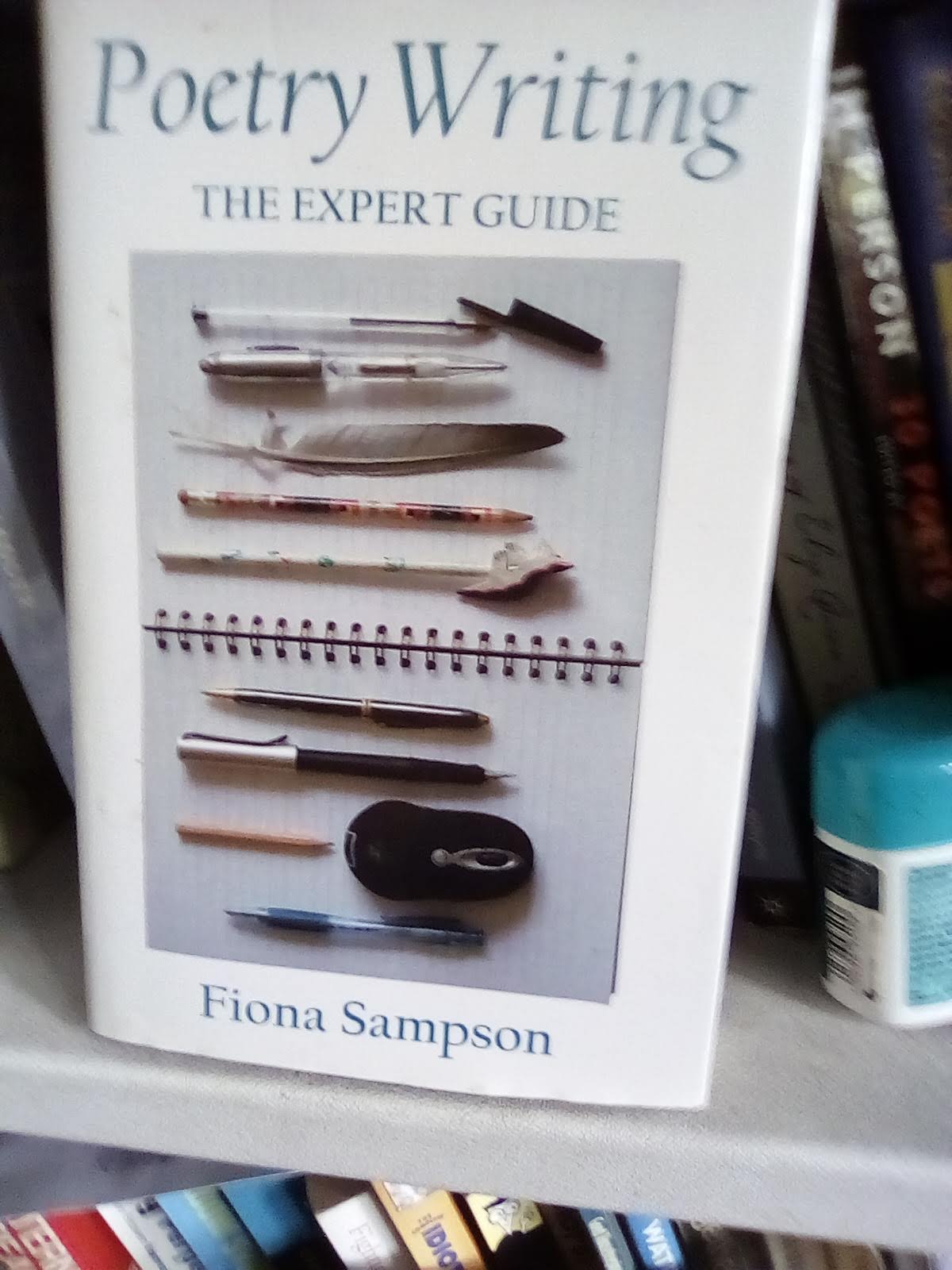
Helpful ideas about poetry writing

Th is my goodbye and thank you after almost two years of writing my Times poetry column. I have loved reading the piles of poetry books – thank you to all the publishers who sent them; I have also loved reading your e-mails and letters. You demonstrated how a poem in the column could go off and have another life; comments, discussions and readers’ poems abounded. And I have loved writing about the poems, trying to relate them to our hopes and anxieties as human beings in my belief that there is a poem for everyone – even a trucker on the M1 who reads nothing more challenging than his sat-nav. Because to say “I don’t like poetry” is like saying “I don’t like music”. It’s a case
Is the pen mightier than the keyboard?

https://www.theguardian.com/science/2014/dec/16/cognitive-benefits-handwriting-decline-typing
Handwriting is the result of a singular movement of the body, typing is not.”
Furthermore pens and keyboards use very different media. “Word-processing is a normative, standardised tool,” says Claire Bustarret, a specialist on codex manuscripts at the Maurice Halbwachs research centre in Paris. “Obviously you can change the page layout and switch fonts, but you cannot invent a form not foreseen by the software. Paper allows much greater graphic freedom: you can write on either side, keep to set margins or not, superimpose lines or distort them. There is nothing to make you follow a set pattern. It has three dimensions too, so it can be folded, cut out, stapled or glued.”
An electronic text does not leave the same mark as its handwritten counterpart either. “When you draft a text on the screen, you can change it as much as you like but there is no record of your editing,” Bustarret adds. “The software does keep track of the changes somewhere, but users cannot access them. With a pen and paper, it’s all there. Words crossed out or corrected, bits scribbled in the margin and later additions are there for good, leaving a visual and tactile record of your work and its creative stages.”
But does all this really change our relation to reading and writing? The advocates of digital documents are convinced it makes no difference. “What we want from writing – and what the Sumerians wanted – is cognitive automaticity, the ability to think as fast as possible, freed as much as can be from the strictures of whichever technology we must use to record our thoughts,” Anne Trubek, associate professor of rhetoric and composition at Oberlin College in Ohio, wrote some years ago. “This is what typing does for millions. It allows us to go faster, not because we want everything faster in our hyped-up age, but for the opposite reason: we want more time to think.”
Some neuroscientists are not so sure. They think that giving up handwriting will affect how future generations learn to read. “Drawing each letter by hand substantially improves subsequent recognition,” Gentaz explains.
Marieke Longchamp and Jean-Luc Velay, two researchers at the cognitive neuroscience laboratory at Aix-Marseille University, have carried out a study of 76 children, aged three to five. The group that learned to write letters by hand were better at recognising them than the group that learned to type them on a computer. They repeated the experiment on adults, teaching them Bengali or Tamil characters. The results were much the same as with the children.
Drawing each letter by hand improves our grasp of the alphabet because we really have a “body memory”, Gentaz adds. “Some people have difficulty reading again after a stroke. To help them remember the alphabet again, we ask them to trace the letters with their finger. Often it works, the gesture restoring the memory.”
Although learning to write by hand does seem to play an important part in reading, no one can say whether the tool alters the quality of the text itself. Do we express ourselves more freely and clearly with a pen than with a keyboard? Does it make any difference to the way the brain works? Some studies suggest this may indeed be the case. In a paper published in April in the journal Psychological Science, two US researchers, Pam Mueller and Daniel Oppenheimer, claim that note-taking with a pen, rather than a laptop, gives students a better grasp of the subject.
The study focused on more than 300 students at Princeton and the University of California, Los Angeles. It suggested that students who took longhand notes were better able to answer questions on the lecture than those using a laptop. For the scientists, the reason is clear: those working on paper rephrased information as they took notes, which required them to carry out a preliminary process of summarising and comprehension; in contrast, those working on a keyboard tended to take a lot of notes, sometimes even making a literal transcript, but avoided what is known as “desirable difficulty”.
On the basic issue of handwriting France has chosen to take the opposite course from the US. In the early 2000s the ministry of education instructed schools to start teaching cursive writing when pupils entered primary school [aged six]. “For a long time we attached little importance to handwriting, which was seen as a fairly routine exercise,” says school inspector Viviane Bouysse. “But in 2000, drawing on work in the neurosciences, we realised that this learning process was a key step in cognitive development.”
“With joined-up writing children learn words as blocks of letters, which helps with spelling,” Bouysse explains. “It’s important in a country where spelling is so complex! However, the ornamental capitals in the patterns published in the 2013 exercise books have been simplified, with fewer loops and scrolls […] They are important, though, because they distinguish proper names or the start of a sentence.”
Some handwriting advocates regret the disappearance of these ornamental effects. “It’s not just a question of writing a letter: it also involves drawing, acquiring a sense of harmony and balance, with rounded forms,” Jouvent asserts. “There is an element of dancing when we write, a melody in the message, which adds emotion to the text. After all that’s why emoticons were invented, to restore a little emotion to text messages.”
Writing has always been seen as expressing our personality. In his books the historian Philippe Artières explained how doctors and detectives, in the late 19th and early 20th century, found signs of deviance among lunatics and delinquents, simply by examining the way they formed their letters. “With handwriting we come closer to the intimacy of the author,” Jouvent explains. “That’s why we are more powerfully moved by the manuscript of a poem by Verlaine than by the same work simply printed in a book. Each person’s hand is different: the gesture is charged with emotion, lending it a special charm.”
Which no doubt explains the narcissistic relationship we often entertain with our own scrawl.
Despite omnipresent IT, Gentaz believes handwriting will persist. “Touchscreens and styluses are taking us back to handwriting. Our love affair with keyboards may not last,” he says.
“It still plays an important part in everyday life,” Bustarret adds. “We write by hand more often than we think, if only to fill in forms or make a label for a jam jar. Writing is still very much alive in our surroundings – in advertising, signing, graffiti and street demonstrations.” Certainly the graphic arts and calligraphy are thriving.
Perhaps, in their way, they compensate for our soulless keyboards.
This article appeared in Guardian Weekly, which incorporates material from Le Monde
… we have a small favour to ask. Tens of millions have placed their trust in the Guardian’s fearless journalism since we started publishing 200 years ago, turning to us in moments of crisis, uncertainty, solidarity and hope. More than 1.5 million supporters, from 180 countries, now power us financially – keeping us open to all, and fiercely independent.
Unlike many others, the Guardian has no shareholders and no billionaire owner. Just the determination and passion to deliver high-impact global reporting, always free from commercial or political influence. Reporting like this is vital for democracy, for fairness and to demand better from the powerful.
And we provide all this for free, for everyone to read. We do this because we believe in information equality. Greater numbers of people can keep track of the global events shaping our world, understand their impact on people and communities, and become inspired to take meaningful action. Millions can benefit from open access to quality, truthful news, regardless of their ability to pay for it.
If there were ever a time to join us, it is now. Every contribution, however big or small, powers our journalism and sustains our future. Support the Guardian from as little as £1 – it only takes a minute.
SingleMonthlyAnnual£5 per month£10 per monthOther
ContinueRemind me in January

Topics
Handwriting is the result of a singular movement of the body, typing is not.”
Furthermore pens and keyboards use very different media. “Word-processing is a normative, standardised tool,” says Claire Bustarret, a specialist on codex manuscripts at the Maurice Halbwachs research centre in Paris. “Obviously you can change the page layout and switch fonts, but you cannot invent a form not foreseen by the software. Paper allows much greater graphic freedom: you can write on either side, keep to set margins or not, superimpose lines or distort them. There is nothing to make you follow a set pattern. It has three dimensions too, so it can be folded, cut out, stapled or glued.”
An electronic text does not leave the same mark as its handwritten counterpart either. “When you draft a text on the screen, you can change it as much as you like but there is no record of your editing,” Bustarret adds. “The software does keep track of the changes somewhere, but users cannot access them. With a pen and paper, it’s all there. Words crossed out or corrected, bits scribbled in the margin and later additions are there for good, leaving a visual and tactile record of your work and its creative stages.”
But does all this really change our relation to reading and writing? The advocates of digital documents are convinced it makes no difference. “What we want from writing – and what the Sumerians wanted – is cognitive automaticity, the ability to think as fast as possible, freed as much as can be from the strictures of whichever technology we must use to record our thoughts,” Anne Trubek, associate professor of rhetoric and composition at Oberlin College in Ohio, wrote some years ago. “This is what typing does for millions. It allows us to go faster, not because we want everything faster in our hyped-up age, but for the opposite reason: we want more time to think.”
Some neuroscientists are not so sure. They think that giving up handwriting will affect how future generations learn to read. “Drawing each letter by hand substantially improves subsequent recognition,” Gentaz explains.
Marieke Longchamp and Jean-Luc Velay, two researchers at the cognitive neuroscience laboratory at Aix-Marseille University, have carried out a study of 76 children, aged three to five. The group that learned to write letters by hand were better at recognising them than the group that learned to type them on a computer. They repeated the experiment on adults, teaching them Bengali or Tamil characters. The results were much the same as with the children.
Drawing each letter by hand improves our grasp of the alphabet because we really have a “body memory”, Gentaz adds. “Some people have difficulty reading again after a stroke. To help them remember the alphabet again, we ask them to trace the letters with their finger. Often it works, the gesture restoring the memory.”
Although learning to write by hand does seem to play an important part in reading, no one can say whether the tool alters the quality of the text itself. Do we express ourselves more freely and clearly with a pen than with a keyboard? Does it make any difference to the way the brain works? Some studies suggest this may indeed be the case. In a paper published in April in the journal Psychological Science, two US researchers, Pam Mueller and Daniel Oppenheimer, claim that note-taking with a pen, rather than a laptop, gives students a better grasp of the subject.
The study focused on more than 300 students at Princeton and the University of California, Los Angeles. It suggested that students who took longhand notes were better able to answer questions on the lecture than those using a laptop. For the scientists, the reason is clear: those working on paper rephrased information as they took notes, which required them to carry out a preliminary process of summarising and comprehension; in contrast, those working on a keyboard tended to take a lot of notes, sometimes even making a literal transcript, but avoided what is known as “desirable difficulty”.
On the basic issue of handwriting France has chosen to take the opposite course from the US. In the early 2000s the ministry of education instructed schools to start teaching cursive writing when pupils entered primary school [aged six]. “For a long time we attached little importance to handwriting, which was seen as a fairly routine exercise,” says school inspector Viviane Bouysse. “But in 2000, drawing on work in the neurosciences, we realised that this learning process was a key step in cognitive development.”
“With joined-up writing children learn words as blocks of letters, which helps with spelling,” Bouysse explains. “It’s important in a country where spelling is so complex! However, the ornamental capitals in the patterns published in the 2013 exercise books have been simplified, with fewer loops and scrolls […] They are important, though, because they distinguish proper names or the start of a sentence.”
Some handwriting advocates regret the disappearance of these ornamental effects. “It’s not just a question of writing a letter: it also involves drawing, acquiring a sense of harmony and balance, with rounded forms,” Jouvent asserts. “There is an element of dancing when we write, a melody in the message, which adds emotion to the text. After all that’s why emoticons were invented, to restore a little emotion to text messages.”
Writing has always been seen as expressing our personality. In his books the historian Philippe Artières explained how doctors and detectives, in the late 19th and early 20th century, found signs of deviance among lunatics and delinquents, simply by examining the way they formed their letters. “With handwriting we come closer to the intimacy of the author,” Jouvent explains. “That’s why we are more powerfully moved by the manuscript of a poem by Verlaine than by the same work simply printed in a book. Each person’s hand is different: the gesture is charged with emotion, lending it a special charm.”
Which no doubt explains the narcissistic relationship we often entertain with our own scrawl.
Despite omnipresent IT, Gentaz believes handwriting will persist. “Touchscreens and styluses are taking us back to handwriting. Our love affair with keyboards may not last,” he says.
“It still plays an important part in everyday life,” Bustarret adds. “We write by hand more often than we think, if only to fill in forms or make a label for a jam jar. Writing is still very much alive in our surroundings – in advertising, signing, graffiti and street demonstrations.” Certainly the graphic arts and calligraphy are thriving.
Perhaps, in their way, they compensate for our soulless keyboards.
This article appeared in Guardian Weekly, which incorporates material from Le Monde
… we have a small favour to ask. Tens of millions have placed their trust in the Guardian’s fearless journalism since we started publishing 200 years ago, turning to us in moments of crisis, uncertainty, solidarity and hope. More than 1.5 million supporters, from 180 countries, now power us financially – keeping us open to all, and fiercely independent.
Unlike many others, the Guardian has no shareholders and no billionaire owner. Just the determination and passion to deliver high-impact global reporting, always free from commercial or political influence. Reporting like this is vital for democracy, for fairness and to demand better from the powerful.
And we provide all this for free, for everyone to read. We do this because we believe in information equality. Greater numbers of people can keep track of the global events shaping our world, understand their impact on people and communities, and become inspired to take meaningful action. Millions can benefit from open access to quality, truthful news, regardless of their ability to pay for it.
If there were ever a time to join us, it is now. Every contribution, however big or small, powers our journalism and sustains our future. Support the Guardian from as little as £1 – it only takes a minute.
SingleMonthlyAnnual£5 per month£10 per monthOther
ContinueRemind me in January

Topics
Handwriting is the result of a singular movement of the body, typing is not.”
Furthermore pens and keyboards use very different media. “Word-processing is a normative, standardised tool,” says Claire Bustarret, a specialist on codex manuscripts at the Maurice Halbwachs research centre in Paris. “Obviously you can change the page layout and switch fonts, but you cannot invent a form not foreseen by the software. Paper allows much greater graphic freedom: you can write on either side, keep to set margins or not, superimpose lines or distort them. There is nothing to make you follow a set pattern. It has three dimensions too, so it can be folded, cut out, stapled or glued.”
An electronic text does not leave the same mark as its handwritten counterpart either. “When you draft a text on the screen, you can change it as much as you like but there is no record of your editing,” Bustarret adds. “The software does keep track of the changes somewhere, but users cannot access them. With a pen and paper, it’s all there. Words crossed out or corrected, bits scribbled in the margin and later additions are there for good, leaving a visual and tactile record of your work and its creative stages.”
But does all this really change our relation to reading and writing? The advocates of digital documents are convinced it makes no difference. “What we want from writing – and what the Sumerians wanted – is cognitive automaticity, the ability to think as fast as possible, freed as much as can be from the strictures of whichever technology we must use to record our thoughts,” Anne Trubek, associate professor of rhetoric and composition at Oberlin College in Ohio, wrote some years ago. “This is what typing does for millions. It allows us to go faster, not because we want everything faster in our hyped-up age, but for the opposite reason: we want more time to think.”
Some neuroscientists are not so sure. They think that giving up handwriting will affect how future generations learn to read. “Drawing each letter by hand substantially improves subsequent recognition,” Gentaz explains.
Marieke Longchamp and Jean-Luc Velay, two researchers at the cognitive neuroscience laboratory at Aix-Marseille University, have carried out a study of 76 children, aged three to five. The group that learned to write letters by hand were better at recognising them than the group that learned to type them on a computer. They repeated the experiment on adults, teaching them Bengali or Tamil characters. The results were much the same as with the children.
Drawing each letter by hand improves our grasp of the alphabet because we really have a “body memory”, Gentaz adds. “Some people have difficulty reading again after a stroke. To help them remember the alphabet again, we ask them to trace the letters with their finger. Often it works, the gesture restoring the memory.”
Although learning to write by hand does seem to play an important part in reading, no one can say whether the tool alters the quality of the text itself. Do we express ourselves more freely and clearly with a pen than with a keyboard? Does it make any difference to the way the brain works? Some studies suggest this may indeed be the case. In a paper published in April in the journal Psychological Science, two US researchers, Pam Mueller and Daniel Oppenheimer, claim that note-taking with a pen, rather than a laptop, gives students a better grasp of the subject.
The study focused on more than 300 students at Princeton and the University of California, Los Angeles. It suggested that students who took longhand notes were better able to answer questions on the lecture than those using a laptop. For the scientists, the reason is clear: those working on paper rephrased information as they took notes, which required them to carry out a preliminary process of summarising and comprehension; in contrast, those working on a keyboard tended to take a lot of notes, sometimes even making a literal transcript, but avoided what is known as “desirable difficulty”.
On the basic issue of handwriting France has chosen to take the opposite course from the US. In the early 2000s the ministry of education instructed schools to start teaching cursive writing when pupils entered primary school [aged six]. “For a long time we attached little importance to handwriting, which was seen as a fairly routine exercise,” says school inspector Viviane Bouysse. “But in 2000, drawing on work in the neurosciences, we realised that this learning process was a key step in cognitive development.”
“With joined-up writing children learn words as blocks of letters, which helps with spelling,” Bouysse explains. “It’s important in a country where spelling is so complex! However, the ornamental capitals in the patterns published in the 2013 exercise books have been simplified, with fewer loops and scrolls […] They are important, though, because they distinguish proper names or the start of a sentence.”
Some handwriting advocates regret the disappearance of these ornamental effects. “It’s not just a question of writing a letter: it also involves drawing, acquiring a sense of harmony and balance, with rounded forms,” Jouvent asserts. “There is an element of dancing when we write, a melody in the message, which adds emotion to the text. After all that’s why emoticons were invented, to restore a little emotion to text messages.”
Writing has always been seen as expressing our personality. In his books the historian Philippe Artières explained how doctors and detectives, in the late 19th and early 20th century, found signs of deviance among lunatics and delinquents, simply by examining the way they formed their letters. “With handwriting we come closer to the intimacy of the author,” Jouvent explains. “That’s why we are more powerfully moved by the manuscript of a poem by Verlaine than by the same work simply printed in a book. Each person’s hand is different: the gesture is charged with emotion, lending it a special charm.”
Which no doubt explains the narcissistic relationship we often entertain with our own scrawl.
Despite omnipresent IT, Gentaz believes handwriting will persist. “Touchscreens and styluses are taking us back to handwriting. Our love affair with keyboards may not last,” he says.
“It still plays an important part in everyday life,” Bustarret adds. “We write by hand more often than we think, if only to fill in forms or make a label for a jam jar. Writing is still very much alive in our surroundings – in advertising, signing, graffiti and street demonstrations.” Certainly the graphic arts and calligraphy are thriving.
Perhaps, in their way, they compensate for our soulless keyboards.
This article appeared in Guardian Weekly, which incorporates material from Le Monde
… we have a small favour to ask. Tens of millions have placed their trust in the Guardian’s fearless journalism since we started publishing 200 years ago, turning to us in moments of crisis, uncertainty, solidarity and hope. More than 1.5 million supporters, from 180 countries, now power us financially – keeping us open to all, and fiercely independent.
Unlike many others, the Guardian has no shareholders and no billionaire owner. Just the determination and passion to deliver high-impact global reporting, always free from commercial or political influence. Reporting like this is vital for democracy, for fairness and to demand better from the powerful.
And we provide all this for free, for everyone to read. We do this because we believe in information equality. Greater numbers of people can keep track of the global events shaping our world, understand their impact on people and communities, and become inspired to take meaningful action. Millions can benefit from open access to quality, truthful news, regardless of their ability to pay for it.
If there were ever a time to join us, it is now. Every contribution, however big or small, powers our journalism and sustains our future. Support the Guardian from as little as £1 – it only takes a minute.
SingleMonthlyAnnual£5 per month£10 per monthOther
ContinueRemind me in January

Topics
Claire Marin: ‘We can make room for the other without giving up our own selves’
More from Keats’ letter


“It has been an old comparison for our urging on – the Beehive; however, it seems to me that we should rather be the flower than the Bee – for it is a false notion that more is gained by receiving more than giving – no, the receiver and the giver are equal in their benefits. The flower, I doubt not, receives a fair guerdon from the Bee – its leaves blush deeper in the next spring – and who shall say between man and woman which is the most delighted”
Learn to love peace
I breath as softly as a little bird
Like the robin in the glade in Arnside Wood
Quick yet calm, who for some food would dare.
The view from Arnside Knot is broad and fair
The atmosphere is pure, we see trains chug
The Estuary of the Kent will never bore
Further South the Lune runs like tapped tears
Morecambe Bay endangers, how it floods
Behind the Pennines rise, the edges fierce
Dent is sacredmmobile phones won’t dare
To penetrate the music of its blood
Nor bring their tones to hurt the mad March hare
Hutton Roof , cathedral, how we stared
A gentle hand caressed my heart to good
Meek flowers grew in the cracks as safe,as pure
How my heart expands and I am glad
For mourning heals and I am no more sad
I breath as softly as a little bird
I tiptoe on the path the peace is shared
Call for psychosis treatment overhaul after evidence of autoimmune trigger
Simon Armitage: Poets can fight climate crisis by making us spellbound by nature | Simon Armitage | The Guardian
Missing the chair

Many years ago we bought a pine chair for the kitchen.
It was larger and taller than the average dining chair and reminded me of the chair in van Gogh’s painting. My husband like to sit in the kitchen with the door open to look at birds also listen to the radio and that is why I decided we should get this special chair
After he died I didn’t think about the chair very much and I rarely sat on it. So a couple of weeks ago I decided to move it out of the kitchen where it was taking up space.
The next day as I was walking into the kitchen my hand reached out to hold the chair back but it wasn’t there.
I nearly fell over. That kept happening for several days and even now I have to be careful. I’m missing it. It takes a long time for the brain to adjust when you move the furniture so imagine how long it takes to adjust when you lose a beloved person
No matter how many times you tell yourself they are not here you still reach out for them or pick up the phone to phone them before you get the pain of grief. They are not there:they are missing
A smile played long
A smile played long upon her face
As I held her in close embrace.
There was no bed on which to lie
Nor yet a bed on which to die
A little death, a little grace.
I could not stare enough to feast
My wanton eyes upon her breast.
My hands tormented me with lust
As they played and on her fussed.
A smile played long.
And so it was, we made our bed
And at our table friends were fed.
She sang and murmured like a bird.
And I was hypnotized by words
A smile played long
‘I’m a CBE, I’m poet laureate so I’m clearly not a republican am I?’: Simon Armitage on his radical roots and rock star dreams | Simon Armitage | The Guardian
Writing makes me breathe differently
I can feel the silence settle around me,
Like a prayer shawl.
i accept it gratefully.
There’s a thin feeling to the day
As if the sun might have tried harder
to come through
But it had a blue feeling
And the clouds were greedy,
Wanting too much to melt
And shed their moisture.
Some perfume please.I think it was £27.99
Yes,I like that one even more than jasmine oil.
Pour it down over London
Like a blessing.
A black woman laughed and patted my arm,
You’re so funny, she cried.
And I smiled coyly
As if someone hidden was taking my photograph.
Sometimes life’s too sweet
And needs a little pepper.
The chair creaks as I lean forward
Trying to see everything at once
As if it all happened now, not yesterday.
Tempting path

A change of heart?
A change of climate shocked my soul and heart
Foul moods unstable blew me off the chart
I had no map, how should I plot my course.?
I called for help until my voice was hoarse.
Cold winds blew rain clouds over us each day
The weather fluctuated gold to grey
And in my heart I feel the same odd change
.My soul is not my own to rearrange
I cannot see a pattern, feel a rhythm
Between me and the world there is a chasm
My feelings are in chaos,like wild beasts
I fear the devils hoping for a feast.
What can we do when w have lost the way?
Where is the light, where is the will to pray?
If you can’t be happy

If you can’t be happy then be sad
In joy and sorrow human souls are clad
When they were soaked in jam
Dr Adams was a very kind man
He never fried sprats when they were soaked in jam
He apologised to the loaf when he cut the bread
And he wept many tears when his ants were found half dead..
He was enamoured of spiders because he liked their webs
And even let them build one between his middle ribs.
He loved his wife anheed allowed her to be free
So she met a jolly sailor and they went out to sea.
Suddenly he realised, altruism’s bad
Unless it’s given to those who really are quite sad.
So he made a resolution to be a bit more stern
And gave up putting dinner out for the lost earthworms.
He met a kind fair lady and he began to hope
She would marry him and raise some antelopes.
He said she must be free but not quite totally;
Loving other men was not permitted,don’t you see?
Some folk can live with a marriage and affairs
Some men even keep many concubines and bears.
But he and his new lady decided to be chaste
As loving any other folk was a sorry waste..
They had many off spring of whom I am one
I look like the pussy cat when all is said and done..
And I like being groomed and sitting on folks’ knees
Think whate’er you like but it’s fun running up trees.
My father was black and my mother is white
So I am rather grey ,except in a good light.
I have many patches in different shades of grey
I only wish my whiskers didn’t look like hay.
I am hoping to marry when the corn and barley’s ripe
Oh,what fun we’ll have in the middle of the night.
Because it was so hard

Why did Jesus walk on the water?
Because it was really hard.
Why did Jesus feed the 5,000?
That was the biggest number they could think of when writing the New Testament
Why did Jesus cross the road?
Because the other side was flatter.
Why do we learn arithmetic in school?
Because it would be boring in school with nothing to do
Why do we have to learn to read in school?
So you can go on the internet on your phone and get into trouble arguing on political forums.
Who could have been the first person who learned to read?
It must have been the first person who invented writing because until there was writing there couldn’t be any reading
Did Adam and Eve have a library?
Nobody could read what God had written.
Did Cain and Abel go to a comprehensive school?
Well it didn’t teach morals did it?
What would God think of VAT on private school fees?
Jesus didn’t need to go to school.
Why are rich people averse to paying more tax?
Because they don’t want to get through the eye of the needle.
If you are forced to give money to the poor it’s not an act of virtue.
Well it still helps the poor.
My husband has a rubber face
- My husband has a rubber face,
A subspecies of the human race.
Some men have faces fixed and set;
My husband’s face is not like that. - He imitates our politicians,
Just like Rory Bremner can.
Though he has no wig or hair piece,
He can look like anyone - .Some nights I waken for I’m laughing
While I am quite sound asleep.
I am dreaming of his mobile features,
Contorted to a different shape - .He is skilled at telling jokes.
And he loves a good cartoon.
If I am feeling flu type blueness
he can get me up again - .He has a rather noble visage.
He gets attention he abhors.
In the bar on King’s Cross Station—
I was asked was he a Lord! - He’s a Lord of Fun and Humour.
He’s a Lord at Listening Well.
He’s unique, but so are you,
And all creatures that on earth do dwell
Surrender to the otherness of all
Tact and subtle actions create life
Assertive force destroys another’s soul
To the High and Holy One, we’re wife.
The way we go seems but a throw of dice
Yet destiny will beckon, though we crawl
Tact and subtle actions make a life
Into every heart, there comes the knife.
Surrender to the otherness of all
To the High and Holy One be wife.
In his shadow, we look down, we cry.
We listen to that voice, so still, so small
Tact and subtle actions shape good lives.
As a mother births her child, she sighs
All lives and coming suffering must appal.
To the High and Holy One, we’re wife.
Here we seem like prisoners on bail
May we live with love in this, our world
Tact and subtle actions create life
Surrender humble to God and his wiles.
My heart was in my mouth all day which made it difficult to eat

My heart was in my mouth [so I had to eat suck it all day which gave my thumb a rest]
My heart sank [ to the bottom of the pond in Barrow Bridge]
I fell head over heels in love with a cat.[That’s why I had no children as inter-species marriage is not yet allowed but soon it will be here]
I could not swallow his excuse as my mouth was full of chocolate buttons I had torn off my uniform..well they looked like chocolate]
That is hard to digest.[So may I please spit it out?]
I spat him out [but he came back as he was on an elastic rope]
I was wondering if new phrases come into existence now and I don’t recall any.Is it because we are no longer so involved in creating our language or because there are experts in academia who study it.At one time ordinary people made buildings etc and m ust have developed skills in geometry etc from a practical point of view.And it was they who invented writing and numbers etc not people in Universities who do not create but analayse and criticise and study signs and connections.
So has the rise of experts made us stupider than people were in the past?Is it poets who invent new idioms?
My eyes nearly leaped out of my head when he passed by…
Luckily I had put superglue down the sides of them at breakfast time.
My hands grasped the nettle and I almost threw the flowers at his head.Then he said:
You are the hoover of my soul.
Walls have fears,you know.
A rolling brick gathers no floss.
I patted him on the wreck and we parted with no acrimony and no real money either.What is acrimony?
I’m a pharisee and ‘i’m ok.Jewish by right and a whirling prayer.
I can’t live without hue or colour
Tint me this day.oh Lord.
Does God sell salt on the internet.He has a Lot.Sorry Lot’s wife.Does it clatter?
Neither fall nor winter
The sky is distant,cold
Neither Fall not Winter
Colour light mauvey yellow
No birds àbout, full silence
hangs like a dead bell
No thoughts,no emotion stir my
mind
This does not flatter
Death hides in the shrubs
Chased out by a cat,it floats
away like a coat someone hung
there for a moment
To smhug on the dead leaves
Leaving mistletoe weeping in old
jealousy
We will have to kiss

Post naviga
Logged in as Katherine. Log out?
Comment
I apologise for loving you too much
We never learned to balance the see-saw
In modern times the lovers should go Dutch
Two lonely lovers with a single crutch
Each one having many curious flaws
I apologise for loving you too much
What ever did I do to merit touch?
Then I was too careless with the salt
In modern times the lovers should go Dutch
We should measure what we speak at lunch
Then we weigh the sentences that spilt
I apologise for loving you too much
Maths and stats are useful in the lurch
Equality of signs and numbers,bills
In modern times the lovers should go Dutch
,
Let the mouth be silent, keep quite still
Love is rarely used when writing Wills
I apologise for loving you so much
In modern times we lovers cannot touch
A is not aggression

A is for the axioms we use
B for Brownian motion in a glass
C is for the circle that found pi
D is for the dots that we combine
E is the ellipse that I adore
F is for the fraction I deplore
G is for geometry and art
H is for the hidden and unknown
I was once for inkwells filled each day
J is a close relation here of G
K is my own name, I do declare
L is for the loops that string can make
M is mathematics as an art
N is for the numbers that transcend
O might be for zero or the mind
P is for the problems we all meet
Q is for the quality of life
R is for the random numbers here
S must be statistics, I declare,
T is for topology, that’s clear
U is understanding what we read
V is for the vacuum in the heart~
W is the will power to succeed
X is still unknown but we’ll give in
Y is Yes we understand the game
Z I’ll leave to you to make or maim
Lies and statistics
“5 per cent of the people in the study died or were treated for suicide.”
How? Resurrected?
Independent Newspaper 15 June 2019
How to become a better poet | BBC Maestro

https://www.bbcmaestro.com/blog/how-to-become-a-better-poet
All the advice I’ve read so is that you must read a lot and in particular read a lot of poetry.
If you write poetry even if it’s not very good it makes it easier to read other people’s poetry and when reading a novel I am much more aware of how they describe people nature etc the kind of language that they use. P d James seems to have a poetic gift though as far as I know she did not write poetry as such.
My heart is like a rowing boat adrift
Whose occupant has fallen overboard
The empty vessel drifts through deep sea mist.
And in those pearl filled ears the deep sea roars.
Just as the boat drifts mapless,so do I.
My maps were drawn for quite another sea
My captain’s taken leave and now I cry
As if that drowned soul might just be me.
Yet on the sea bed mysteries abound;
Such wonders and such magic there displayed.
I wonder if it is my lot drown
And to a memory then quickly fade.
Maps are no more certainties than hints.
Between the lines hides gold from other mints.
Why bother?
How short a time we mould our universe
We learn to walk, to talk and then to curse.
We pass exams,or fail l,and get a life
Any one must work and have mate
Then we age and one day we are late
We must submit though often we deny.
The time we are a boss is very short.
Then then things slip away, and in gods net we’re caugh
But while we are alive we can’t despair
For always there is nature.love and fear
In the end we fade away to death
Happy to be childish as God laughs