The place where you learn to practise having fractures
The hip replacement clinic
You go here when you’ve lost your hip.
Please know which one it is left or right before you arrive at the clinic
A hat trick
You can wear a hat so that you can keep something under it
If you are on the verge of a nervous breakdown go to the psychiatric clinic where you can have a complete one under the psychiatrist
If you don’t know how to use a commode go to the geriatric ward. They’ll teach you how to be incontinent by refusing to take you to the toilet in a wheelchair when you have broken your leg
Happenstance
When something perfect happens seemingly by charice
A consultant
The head doctor in a unit not just not to be confused with s psychiatrist.
Psychiatrist
Used to be someone who dealt with the psyche but now we don’t believe in the psyche anymore but we still go crazy anyway
In fact it’s normal to go crazy from time to time. It’s just a total relaxation and refusal to bear any tension
Now just pay attention. It’s easy once you know what currency is used in Attention.
“I will say this quite plainly, what truly human is -and don’t be afraid of this word- love. And I mean it even with everything that burdens love or, i could say it better, responsibility is actually love, as Pascal said: ‘without concupiscence’ [without lust]… love exists without worrying about being loved.”
― Emmanuel Lévinas, Of God Who Comes to Mind
In her Philosophy in a New Key (1942) her intent was to authenticate a new notion of the “rational,” but how she does it is of fundamental importance. The classical tradition, Langer claimed, generally identified the rational with the “logical,” with discursive thought and objectivity. It then had the difficult task of explaining, or explaining away, such important human concerns as art, ritual, myth, and religion. Langer showed that these forms of meaning-making were embodied in vast sets of symbols and symbolic practices with their own distinctive “logic,” a non-discursive logic, quite different from the discursive logic of language and mathematics. They belonged to the domain of “presentational forms,” not “discursive forms,” a key distinction of her work. Presentational forms, Langer showed by an examination of their logic, are not mere effusions of an irrational subjectivity but articulations of the felt sense of things to which they give us unique access. They orient us in the world in the deepest existential manner, effecting participation in vital values and giving us visions, embodied in symbolic images, of our place in the cosmos. Langer, prior to extensive developments in semiotics, showed that they are worthy of philosophical study in their own right. Her work compares favourably in heuristic power with, and complements, C S Peirce’s great attempt to avoid logocentrism. We are a symbolic species at every level and not just language-endowed animals, although Langer held discursive symbols in the highest regard, as did her intellectual companion, Ernst Cassirer.
Langer was a devoted lover and practitioner of the arts, especially music, which she had studied in detail in Philosophy in a New Key. In 1953 she published Feeling and Form, a masterful generalisation and application to all the arts of the theory of music elaborated in that book. Its key idea was that feeling had a distinctive “morphology” that is exemplified in different ways in the different genres of art. Art works, she claimed, give us knowledge of or insight into ways of feeling the world in every shade of its expressiveness. They articulate feeling and are not mere expressions of personal feeling. They are presentational symbols and their meaning-contents are the “primary illusions” peculiar to each art form: virtual space in the pictorial and visual arts, virtual powers in dance, virtual experience and virtual memory in literature, virtual time in music, the ethnic domain in architecture, and so on. Langer showed art to be an authentic symbolic form and her notion of a “morphology of feeling” exhibited in the artwork is a permanent contribution to aesthetics.
In the last twenty-five years of her working life Langer attempted to develop the notion of feeling as a term to cover all the manifestations of minding. The result was Mind (1967-1982), published in three volumes over a fifteen year period, and which remained incomplete, due to her advancing age. It anticipated many of the current concerns in neuroscience, cognitive psychology, and philosophy of mind. Its central idea is that feeling is an emergent property of natural processes but that its paradigmatic manifestation is the rise of symbolisation and the proliferation of cultural forms and their attendant conflicts and permutations. Central chapters in this book carry out and reformulate Langer’s central insight and claim: symbolisation and the power of abstraction are the keys to what it means to be human. In a return to and deepening of her initial proposals in her first philosophical work, Langer distinguished between generalising abstraction and presentational abstraction, the two fountainheads of all those frames of meaning in which we live out our lives. It was the working out of the implications of this distinction, present at the beginning of her intellectual journey, that forms the connecting link of her whole remarkable philosophical career.
Robert E Innis is professor emeritus of philosophy at the University of Massachusetts Lowell and author of Susanne Langer in Focus: The Symbolic Mind (Indiana University Press).
I’m really sorry to hear that your sister has died again. Will it ever stop,? Someone needs to get to the bottom of this before it becomes an infinitely repairing decibel. I know I’ve always preferred fractions myself but not everybody is as rational as I am.
Please accept our deepest infinity for your cross
Please be aware of our deepest symphony when we hear sure sad news.
I am sorry your sister is enjoying eternal pests. I pray it will be soon be over. Who else is there in purgatory?
I couldn’t wait to write to you when I heard your sister lied. I hope she makes a good recovery when she gets to heaven if you guess what I scream. I only wish I was illiterate I know you both went to Oxford. What for? I never like the railway station there myself and the Marks and Spencer store is far too small there I suppose Oxford Cons do not shop there.
I hope your mourning goes well. Sending our bugging timpani
When you said your sister spied I wondered if you were on the spectrum. But we don’t have a chemistry lab over here. Should you ask professor Fearrack
What did you say was the spectrum of the Duraglit operator. Did this affect your sister’s health and ultimately her life? I know you were worried about nuclear plumbers at Oxford. We lost contact so I never got to have that explosion that we were all waiting for in 1969
More likely it was a rest in eternity.
I really don’t know what I’m talking about but I am very sad on your behalf because you’ve had too many deaths in your life so far so I hope that you will have no more for the rest of eternity or should that be we will have arrested eternity? In any case eternity is inconceivable
William Blake could see eternity in a grain of sand
How did it feel on the beach when you were with him?
overlook, for instance, that Keats spent six years studying medicine, successfully earning a license to practice in London from the Society of Apothecaries—hence Lockhart’s insult about the “plasters, pills, and ointment boxes.” To think that he was “snuffed out by an article” trivializes the intense pain he experienced as his lungs were slowly consumed by tuberculosis, robbing him of his work, his love, and his life at the age of twenty-five.
The myth of the frail genius is attractive, even to contemporary readers, because of its quintessential Romanticism. But the truth is that Keats’s writings—especially when they seem fanciful or escapist—are grounded in real-world concerns. And nowhere is this more evident than in the letters and poems of his that deal with feverish suffering.
During the early nineteenth century, London had fallen into the grip of fever mania. The city was working to combat a host of diseases associated with the colonies: yellow fever, typhus, influenza, smallpox, child-bed fevers, agues, and St. Anthony’s fire, among many others. With almost a million people living in the city in the early 1800s, including more than ten thousand prostitutes, disease spread quickly, inducing public panic. Between 1816 and 1817, the number of admissions to the Fever Hospital spiked from 124 to 781, and the fever epidemic remained a major news story for the duration of Keats’s life. Whereas some historians have viewed the fever as a foreign invader, striking from the colonies upon the homeland, Keats would have recognized it as a recurrent, intimate presence that followed him throughout his life.
The patients whom he attended at Guy’s Hospital haunted him, as did the memory of his mother’s fatal consumptive fever, which he would relive as he nursed his brother, Tom, throughout 1818. Because of his family’s history of illness, his own medical training, and the epidemic of fever that spread throughout London, Keats was intimately familiar with feverish suffering; he used his writing to make sense of a pain for which there was no reasonable explanation. Two letters—one written before Tom’s death and one after—outline Keats’s philosophy of suffering as a creative force.
* * *
On May 3, 1818, Keats wrote a letter to his friend, John Hamilton Reynolds, comparing a human lifespan to “a large Mansion of Many Apartments.” He imagined two rooms in a mansion through which one must pass before confronting a vast number of potential third rooms. For an unspecified length of time, one remains unthinkingly in the first apartment, in spite of the fact that the doors leading to the second are wide open. Eventually, the impetus to think moves one from the first chamber into this second, called the “Chamber of Maiden-Thought,” which is full of intoxicating delights and thus initially very pleasing. But time spent within it leads to a “sharpening [of] one’s vision into the heart and nature of Man … convincing ones nerves that the World is full of Misery and Heartbreak, Pain, Sickness and oppression.”
One becomes aware of one’s own fever and the suffering that afflicts humanity—which were present all the while, even amid the delights. Keats thought he’d only made it to the end of this second room. He saw nothing but darkness and mist in the hallway beyond it. He told Reynolds that he wished to explore the dark passages to seek out some form of salvation by way of his poetry, though he offered no compelling evidence that any of the unexplored rooms might contain something redemptive, or even pleasant.
Surrounding this philosophical discussion are the details of Tom’s illness. The letter begins with what appears to be good news: “After a Night without a Wink of sleep, and overburdened with fever, [Tom] has got up after a refreshing day sleep and is better than he has been for a long time,” and ends with restrained melancholy: “Tom has spit a leetle [for little] blood this afternoon, and that is rather a damper.” But insofar as Keats was hoping to justify the purpose of suffering to himself, both of these statements are heartbreaking. Because of his extensive experience with ill patients, Keats surely knew that his brother’s condition was grim, even in May 1818. His reactions hint at a kind of denial—an insistence that there be an identifiable purpose to justify the trauma he continued to witness and endure. And once he has convinced himself that there is a purpose to suffering, it is only another small leap to start thinking of the fever as something constructive. Indeed, as odd as it may seem, it was his brother’s grim condition that prompted, even forced, Keats to expand his philosophy of suffering to embrace fever as beneficial. The search for the third room, undertaken in the midst of suffering, had to lead to the creation of something meaningful and redemptive, as Keats would try to convince himself after Tom’s death in December 1818.
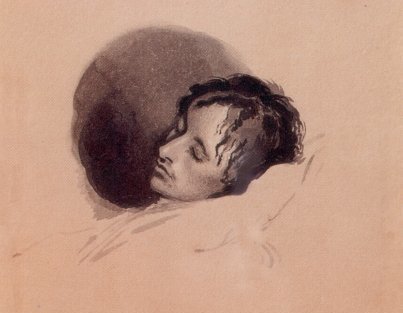
Joseph Severn’s drawing of Keats on his deathbed.
* * *
In the spring of 1819, Keats was at the height of his genius; within the next few months he would write his finest poems. In a letter from April 21, 1819 to his other brother, George, who had emigrated to America, Keats revisited his philosophy, unveiling the “system of Spirit-creation” that he’d been designing and testing for more than a year: the world as the “vale of Soul-making.”
Keats argued that any attempts to improve one’s life still end in death—a fate that he acknowledged as unbearable without some notion of redemption. And yet he rejected the idea of the afterlife or religious salvation—those, in his view, devalue the act of suffering, because they serve no creative purpose and teach nothing to the human individual.
Instead, he referred to the raw material of a soul as an “intelligence.” All humans have (or are) an intelligence, but they’re not considered souls until they develop an individual identity. Soul creation takes place over the span of many years and requires two components—the human heart and the world of feverish suffering—comprising a process that Keats likens to an education:
I will call the world a School instituted for the purpose of teaching little children to read—I will call the human heart the horn Book used in that School—and I will call the Child able to read, the Soul made from that school and its hornbook. Do you not see how necessary a World of Pains and troubles is to school an Intelligence and make it a soul? A Place where the heart must feel and suffer in a thousand diverse ways!
The “vale of Soul-making” celebrated the fever that had followed him through his life. And yet what Keats could not, or refused to, see is that the irrationality he perceived in religious salvation is present in his own system, too. There’s no ultimate purpose to the suffering that he, his family, and his patients have had to endure; it’s not as if the fever of tuberculosis consciously, benevolently struck Keats’s mother and brother to help them shape their souls. But Keats went to great lengths to convince himself of just that.
While the fever had surrounded him for most of his life, it consumed Keats during the months following Tom’s death, insisting that he find some way to rationalize its irrational effects. In fact, compared with other medical terms, Keats uses the word fever sparingly in his poems: blood is explicitly referenced forty-seven times (and implicitly in at least a dozen other instances), and there are 157 variations of heart, but only twenty-three instances of fever appear across the body of Keats’s poetry.
This shouldn’t mislead us into thinking that it’s a less potent image for him. His prudent use of the term demonstrates its importance—it’s loaded with personal significance. All but five of these uses of “fever” occur after Tom became ill, the most poignant of which comes in “Ode to a Nightingale,” written only a few days after the “vale of Soul-making” letter.
The feverish heart overwhelms the speaker of the “Ode to a Nightingale,” who suffers a heartache as he listens to the nightingale’s song, hoping to mirror the bird’s ability to transcend real-world circumstances. The speaker describes the world as
The weariness, the fever, and the fret Here, where men sit and hear each other groan; Where palsy shakes a few, sad, last gray hairs, Where youth grows pale, and spectre-thin, and dies; Where but to think is to be full of sorrow And leaden-eyed despairs.
Keats must have had Tom’s death in mind when he composed these lines; every phrase is loaded with the common suffering of humanity from which the nightingale’s song seems to escape.
Less than two years later, Keats died of tuberculosis in Italy, where he’d traveled in the hope of recovering, accompanied by the artist Joseph Severn. Even as he grew shorter and shorter of breath in early 1821, Keats repeatedly rejected his dear friend Severn’s belief in the afterlife, suggesting that he was committed to his philosophy of Soul-making until the end. Severn wrote in mid-January: “this noble fellow lying on the bed—is dying in horror—no kind hope smoothing down his suffering—no philosophy—no religion to support him.”
When the end came, it was the fever, and not an article with obvious political motivations, that killed Keats. The pleasures of his life—beauty, love, poetry—had always been bundled up with suffering and death, and we may empathize with him in his desire to articulate a purpose to it all. He was not too frail for the world: his devotion to making the most of his mortality drove his creative process. He was a man who had a deep need to create meaning where there was none.
Jeffrey C. Johnson is a writer living in California. His writing can be found on his website, and he is on Twitter.
The average retirement income in 2014 was £15,800 but unlike earned incomes which have remained steady or increased slightly in the past few years average retirement incomes have been declining. For example it is 11 per cent down on 2009’s £17,779 and 15% down on 2008’s £18,663. This worrying trend is likely to continue as occupation pension schemes close, annuity rates go lower and the squeeze continues on disposable incomes, which means that most people have less money to save for their future. The state pension will account for 35 per cent of average retirement income for those planning to retire in 2014, but one in seven people will retire without a pension, and women are nearly three times more likely than men to be entirely reliant upon the state pension, because they made no provisions of their own. (Statistics source: Prudential)
I saw your soul like that of a wild bird Someone other guided me to act Deep inside my voice had been unlocked I sang the psalms and then a lullaby Not aware in thought that you would die. I fed you with a teaspoon the mashed fish From a plate as good as one might wish Like a little child you tried your best You smiled at me and gazed like one who’s blessed You sat up with a brighter face at last Then lay back and God knows all the rest
Oh, don’t go yet ,my darling,I am here The floor of heaven came down among my tears Made of sumptuous satin, golden,dear. For a little moment it hung low Then it rose and took you in its glow I saw your soul like that of a wild bird Taken by the Power who spoke the Word A sheet of tears fell down from my closed eyes It’s hard ,so hard when those you love must die
I was unready for anything, with no charms, like a bee. Each fresh day is torture.. When you don’t hate me.
I was as tame as a mango, I was outright in my mind. Each night was a daydream Where you were so kind.
I was harmed by your molars. They were sharper than whales. Each claw brought the moon out. As you cut your nails.
Rolling stones gather…. Your heart is not mine. I’ll give you what you wish for. It ‘s a true new design . . As long as the clock speaks As long as the rose. As long as the bike pumps.. I’ll remember your nose.
As long as my patterns; As brief as they are; As long as my brain’s dead… I shall parse on a star.
I love a good proverb. I love no cliche. When you find some Wisdom Do not never pay.
Justice long as a ruler, Sharpened to a screw. When you are more kind,then I may leak what I brew . As long as the flat Earth As wise as it’s broad. The moon in the water
“Mental illness is, however, more often a matter of degree, not kind, and a great many people who suffer it are gentle and compassionate. And by many measures, including injustice, insatiable greed, and ecological destruction, madness, like meanness, is central to our society, not simply at its edges.
In a fascinating op-ed piece last year, T.M. Luhrmann noted that when schizophrenics hear voices in India, they’re more likely to be told to clean the house, while Americans are more likely to be told to become violent. Culture matters. Or as my friend, the criminal-defense investigator who knows insanity and violence intimately, put it, “When one begins to lose touch with reality, the ill brain latches obsessively and delusionally onto whatever it’s immersed in—the surrounding culture’s illness.””
I saw a phrase which interested me which is the following
Deconstruct eternity
Philosophical stereo called deconstruction which I think was invented by Jacques Derrida
On the face of it deconstructing eternity sounds very peculiar since eternity is so enormous, in a sense. Could you breaj it down?
Well insight it comes from a book about post traumatic stress disorder and it seems to mean the following
If you have a flashback and our reliving the trauma that caused your problems, apparently you will feel as if it’s going to last forever or that it’s going to keep coming back to you forever and.
Apparently this is not true so that’s what they mean that even if you feel something terrible is happening and it’s going to last forever don’t believe it because it won’t. At least it’s never happened to anybody
The term is used in a misleading way in my opinion because it’s not eternity that you’re deconstructing it’s your own thoughts.
And it’s very good idea not to believe all of your own thoughts as with an article in the Guardian about this poor woman who feels she’s very ugly.
It’s not because he looks at Navara and think she’s ugly it’s because she has what are called intrusive thoughts. These intrusive thoughts are all like a voice nagging her that she’s ugly and eventually she’s come to believe it but why should you believe it just because either something in your own self or even another person keeps telling you that you’re ugly. Don’t believe what people say necessarily because they may have ulterior motives like you break up with your boyfriend and he says
Well I didn’t really want to stay with you permanently because you’re so ugly.
That sounds as if he is upset by you deserting him or throwing him out and he tries to make himself feel better by saying that you are ugly
to have these thoughts that you’re ugly coming from somewhere inside you again it seems like you’re dissatisfied with yourself but you didn’t make yourself you grew from the Union of two cells
Nature has created you and even frogs and toads are thought to be beautiful by their mates
So why should you feel you’re ugly just because you’re not like some famous film star because most of us are not lack of famous film star and it’s probably fortunate because if you want to pursue a career in a serious manner being very beautiful can be a handicap. Let’s face it how many people are really really beautiful? Well it’s all dependence isn’t it if I love my friend to me she is beautiful regardless of conventional wisdom about the subject
Some black people think that white people are more beautiful and on the other hand many white people feel that black people are more beautiful more graceful more adept it running and other bodily activities but can you compare on to another? Not really but if you are looking for a mate, you find someone who’s beautiful to you not to the general public at large. If you see what I mean
Someone who has inherited a house in Rhyl when she already owns a house herself and therefore now has two houses it’s complaining about having to pay the increased council tax at the government imposed. It is not as if she bought the house!
Well one and one often makes two.
The Sunday Times is really getting terrible now putting in these stories just to get a lot of comments. Just like the daily mail I suppose
Because nobody went running in the Holy Land. That’s why it took them 40 years to cross the desert. And to think there was no bathroom anywhere in sight
Is God a pacifist?
Do zebras have stripes?
Why did Jesus walk on the water?
To escape from the quicksands
Why did Jesus feed the 5,000?
That was the biggest number they could think of when writing the New Testament
Why did Jesus cross the road?
Because the other side was lower.
Why do we learn arithmetic in school?
Because it would be boring in school with nothing to do
Why do we have to learn to read in school?
So you can go on the internet on your phone and get into trouble arguing on political forums. And you can also look at pornography.
Who could have been the first person who learned to read?
It must have been the first person who invented writing because until there was writing there couldn’t be any reading
Did Adam and Eve have a library?
Nobody could read what God had written.
Did Cain and Abel go to a comprehensive school?
Well it didn’t teach comprehensive morals did it?
What would God think of VAT on private school fees?
Jesus didn’t need to go to school.
What would God think about double council tax on second homes?
God only has one home.
Why are rich people averse to paying more tax?
Because they don’t want to get through the eye of the needle.
If you are forced to give money to the poor it’s not an act of virtue.
Mary was admiring the rowan tree outside her window when she saw Annie running down the street
Well Annie I didn’t know that you could still run so fast:why are you coming here in such a breathless state?
Oh it’s my New Year resolution: don’t you know that running is very good for you?
Wlell in theory that might be true but when you’re over 80 is it a good time to start?
I have no choice because I didn’t start when I was younger and time doesn’t go backwards.
Would you like some breakfast? I have some very nice bread here from the bakery and some lovely honey from Devon.
They at down at the kitchen table.
Where did you get your running shoes from, Mary asked her friend?
Oh I think they belonged to my husband. They were in the wardrobe and as I like the colour blue I thought what’s the point of buying new ones?
Well,stone the crows I am amazed you never needed an excuse to buy new shoes before even though you have 78 pairs already.
How do you know tl I have got 78 ,,?
Well I like the number 78 because it’s divisible by 13. So I counted your shoes to see if they would fit the pattern as I have got 65 pears.
And did Stan have 52 pairs ?
Of course not he was a man: men don’t have so many shoes. It dates back to when shoes had to be polished. No man would like to polish 52 pairs of shoes nor come to that would have liked to polish 13 If you have 13 pairs of shoes that will be one pair each for the 12 disciples of Jesus and Jesus himself at the Last Supper although if there were any folk serving the food there would not be enough for them. Why am I saying all these ridiculous things?
And any way how does being divisible by 13 help you or the world or in particular Sir Keir Starmer?
It’s hard to explain it but it just pleases me somehow maybe it’s a distraction from reality.
What is reality anyway Annie asked her rudely
Why it’s just like being back at Oxford with iris Murdoch as our tutor
You seem to forget that I did not go to Oxford; well I have been to the station of course but I never was matriculated there nor anywhere else for that matter. I did go into Marks and Spencer’s there though
Well you’re in good company because 99.99% of the world did not matriculate at Oxford. Most of them don’t even speak English and would not know what matriculation means. But they would all love to go into Marks and Spencers
Words are very interesting because sometimes we read words that we’ve never heard anyone say and we are likely to misspeak
Well I don’t know what anything means, to be honest.
Do you put a comma after means; it’s because if you don’t it’s a completely different sentence?
I see that you don’t know what it means to be honest Is that what you’re trying to tell me?
As long as you don’t use the term fake news I will be quite content with whatever you say whether or not I’ve ever heard the words before.
Give me some examples please
Mishap and awry
You have to see them written down and imagine you’ve never seen them before nor have you heard anyone say them and then you realize the problem unless you are very stupid in which case you won’t know if and your life will go on like a wide river flowing down slowly and gently into the sea with no great waves to drown any animals or people who are not being careful
Now I feel sleepy I wonder if I am awake or asleep. Am I really writing the story or am I just imagining it
How could I know?
How would you know that you know or that you knew,?
Do you know something Annie I think I’ll get married again because when you’re married to a man you don’t have conversations like this do you?
You are so right Mary.
I am so sorry that I am not a man. Evening by try to pretend to be a man I don’t think now my mind would change sufficiently to please you by a totally different kind of conversations not to mention other things that men and women might get up to in private.
Well I think it’s getting a bit late now so why don’t we stop here and then tomorrow we will make a new start
Can we make some new year resolutions ?
Well we can but we should think very carefully first and then we should think even more carefully afterwards.
Oh this is getting on my nerves why do we have to keep thinking all the time?
Do cats think;do eagle think?
Isn’t it wonderful that there are so many questions that don’t have any answers in the system in which we are enmeshed?
Now just stop that We’ve already had one Wittgenstein. I’m not sure if the world can take another one.
The best thing I’m going to do tomorrow is making a cake from a very old recipe that was handed down to me from my grandmother. And it’s got lots of ground almonds in it which are very nutritious as well as being delicious
That’s the best idea you’ve had tonight
My New Year resolution is to start to make cakes again at home and then to invite our friends around on Sunday afternoon to eat them
Daddy, how we missed you when you died I had not been told when I was five Come back,Daddy,miss your smiling eyes
We were told that we must never cry When the cancer took your earthly life Daddy, how you suffered ,then you died
When you wanted company, I tried I was too articulate to thrive Come back,Daddy,miss my Daddy’s eyes
By the flower beds, you wanted a guide You wanted me to talk.I really tried. Daddy we fell down a black hole, why d’y die?
You slept all alone, the pain arrived We slept with our mammy, on your side Come back,Daddy, don’t you miss my eyes?
I always hum like you did though I’m shy You are singing through me, close and wise Daddy, we still miss you and your pride Come back,Daddy, teach me how to cry.
While Mary sat in the kitchen on a large pine chair looking at Hotter’s latest shoe catalogue,Annie was creeping up the garden path in a pair of turquoise suede elegantly heeled shoes matching her teal tencel culottes and blouse.Round her neck was a large lump of amber on a gold chain handy for beating off muggers or lustful men and women Despite the heat she was in full splendour with golden beige tinted moisturiser from Langone of Lyons on her lovely complexion,pink eyeshadow from Yves St Current and dark brown boot polish as her mascara had run out and she’d not been out for a while to buy more Annie ran the last few yards and darted like an eel into Mary’s 1970’s orange kitchen. What on earth are you doing,dear? Mary asked her.Those shoes look unsuitable for leading anyone up the garden path.Mind you,I do like them Oh,I’ll explain,Annie said huskily. I told that psychotherapist across the road I was living with you. What exactly do you mean by living,Mary asked anxiously. Well,he said yesterday that anyone who lives alone must be lacking in some way.Except for him of course as he had full analysis with Alfred Zion. You mean Wilfred Bion,Mary told her. Zion,Bion,what’s the difference? It shows your lack of education,Mary told her.Not that education nowadays makes much difference when almost anyone can get a 2.2 .After all would you pay £90,000 for a fourth class degree in Aeronautical Engineering? And Zion is in the Bible That’s not quite what I would have done, said Annie.A degree in flirtation and pleasing men would be more up my street.And cooking of course although I once did have an interest in Hebrew and Aramaic. It’s not a way to progress in a neo-liberal economy,although reading the Hebrew Bible is always interesting.Personally I prefer that to the New Vex-a man.The stories,the love songs,the action.Mary’s round eyes gleamed with intellectual life and a bit of languorous lust How about God? Annie asked her. He seems to have changed as he related to his people.But he was a friend despite being an abstract concept.Though one could hardly call him a concept as he is inconceivable. Mary’s voice faltered as she was stunned by her own articulacy and wondered what she might say next that could offend millions around the globe with modern technology beinf so widespread You should write a book,Annie said kindly. I think I am ill-equipped to write about God.And ,also ,I am saddened to see how his own people have been treated.I can’t dwell on it over much as I already feel weak and weepy. Why what have you been doing,asked Annie. I have been sorting out clothes to give to the hospice shop. I’ve got a big bag full already and 2 bags of newspapers and rubbish of various kinds which somehow creeps into my bedroom… tissues,cotton wool, old hairbrushes.I am hoping to get it nice and neat before my sister comes to see me in August.And no doubt she will not be happy even then.She’d like me to buy a small new flat with a lovely bathroom and kitchen. But I don’t want to leave my neighbours behind.If I won the lottery I could get the neighbours to move as well.Love thy neighbour etc And now I realise I have far too many pans despite burning several.But it’s a big decision for a woman who was famed for entertaining friends with scorching Beef Vindaloo and lemon mousse that looked like yellow rubber.Giving that up is a big wrench. Why can’t you carry on, asked Annie. Carrying on is precisely why I can’t do it.Now I am a widow the wives of my former colleagues and my own women friends are afraid I will steal their husbands. Emile miaowed in ecstasy as any talk about the love lives of his family were always intriguing.He was hiding as usual behind the stone flour bin. Don’t you see,said Annie.If we pretend we are living together then you can mingle with men without suspicion. This is beginning to sound like a spy story,Mary told her.And do not drag me into a character part in the play based on your romantic love for that psychoanalyst. He looks ugly and boring to me. Oh,that’s just a projection,Annie told her.You are defending yourself against acknowledging how much you long to lie in his arms and let him smother you in kisses. Well,said Mary,I see you have been reading Freud for beginners again. Or is it Freud for Dummies? Mary recalled how nice her dummy used to taste when it was dipped into a jar of malt and codliver oil.Maybe that is the answer,she thought. I’m going to Mothercare,she called as she ran out of the house in her green trainers and denim trouser suit.See you later. Annie sat in the kitchen wondering how soon she could see the psychoanalyst again without being accused of sexual harassment.Even old age has not deterred her from seeking a replacement for dear old Stan.A few tears ran down her cheek and Emile jumped out and sat on her knee.