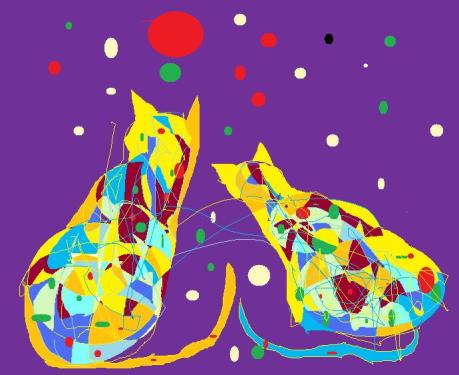
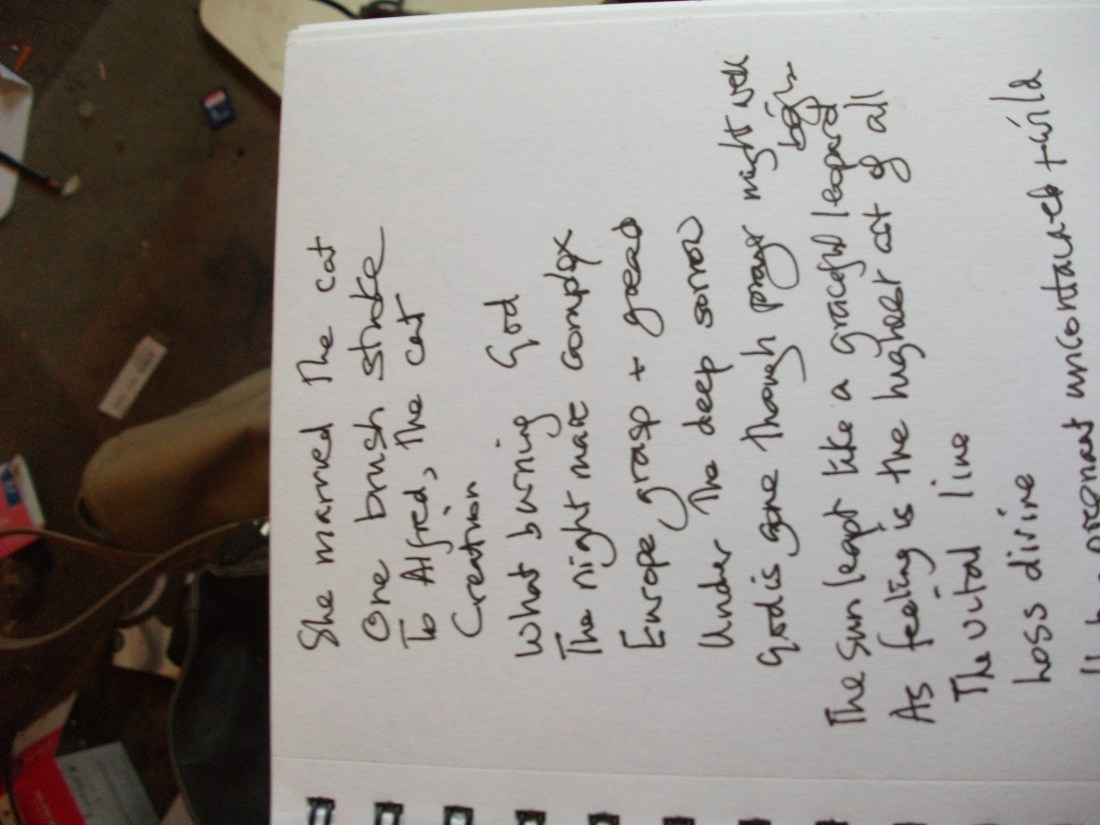
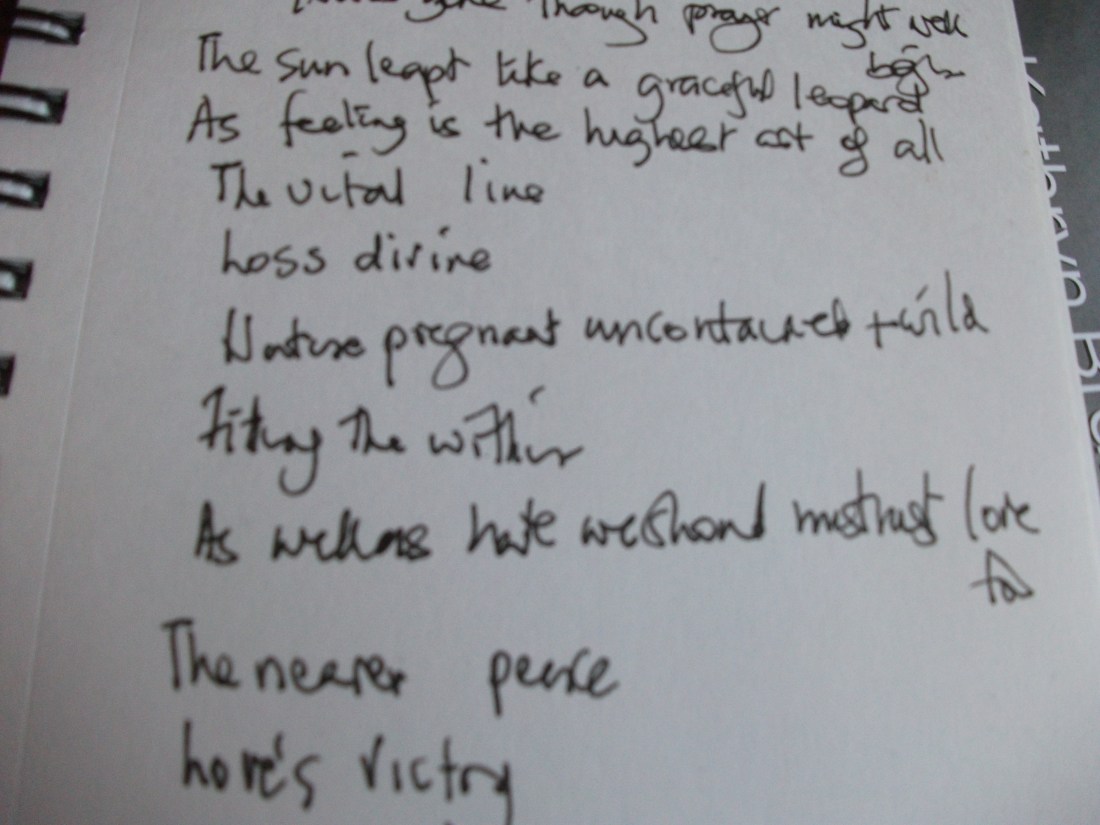
The cat that bit, the black dog and its bark

The unconscious is  the home of image stark
The faces of our  love and of our hate
The holy, the important  and the dark


The cat that bit, the black dog with wild barks,
The bills ,the charge, the  passive, irritate
The unconscious is  the cave of image stark


The Northern moors the heather and the lark
Old letters torn up when they came  too late
The holy, the important , the deep dark


The marvelled fire, the glowing light, the spark
The holy place immune from every State
The unconscious ,oh  the home of image stark

Here  too dwell envy and   malicious hearts
Yet in that space we  must a soul create
The holy and its candles light the dark

Time has gone, there is no day or date
We are never early or too late
The unconscious lives,  the home of image stark
The holy, the  divided , glossy dark


Shyness is egotism?

DSCF0115“Shyness is just egotism out of its depth,” Penelope Keith once told an interviewer – a line the writer Sadie Stein credits with curing her own shyness. “For some reason, the unequivocal harshness of that quote was what I needed,” Stein wrote. “OK, I thought… No one is looking at you; to think they are is the worst form of solipsism.”


The later poems of Auden

https://archive.nytimes.com/www.nytimes.com/books/first/m/mendelson-auden.html?scp=28&sq=father%2527s+day+gift&st=cse


This is  an extract

Demon or Gift

In his first days in New York Auden felt a new sense of liberation and power. He arrived in the harbor with Christopher Isherwood on 26 January 1939, in the dead of winter, while a light snow disfigured the public statues. During their voyage, he and Isherwood had spoken aloud for the first time of their disaffection with the mass political movements they had hoped to serve with their poetry and plays. Three days after their arrival, the news came that W. B. Yeats had died at seventy-three. Auden, who was not yet thirty-two, had left England with the half-formed resolution that he would begin his career anew in a new country. He now wrote a memorable and audacious poem on the death of Yeats in which he proclaimed the rebirth of poetry and foresaw in the heroic labors of a living poet the renewal of the world.

Two ideas of poetry contend against each other in “In Memory of W. B. Yeats.” The opening section, with its solemn, meditative, unrhymed verse paragraphs, acknowledges that the most a poet can achieve in the world is to be remembered by his admirers. The closing section, with its drumbeat stanzas and soaring visionary rhetoric, celebrates poetic language as a force more powerful than time or death, and glorifies the poet as a source of sustenance, healing, and rejoicing. The closing argument wins this debate, but the ironies and doubts insinuated by the opening one remain unanswered.

The first published version of the poem drew an absolute contrast between the dying impotence of the poet and the reviving power of verse. This version—it appeared in The New Republic, 8 March 1939—was not yet the poem familiar from Auden’s books: the opening and closing sections had almost reached their final form, but the quietly discursive middle section, where “poetry makes nothing happen” and “Ireland has her madness and her weather still,” had not yet been written.

The opening section transforms traditional elegy into a bleak new mode:

He disappeared in the dead of winter:
The brooks were frozen, the air-ports almost deserted,
And snow disfigured the public statues;
The mercury sank in the mouth of the dying day.

The metaphors point to a world where facts may be counted or measured or reported in news bulletins, where neither poetry nor metaphor is any use. In English elegies, until Auden wrote this one, nature itself mourned the dead while an exclamatory “O” announced the personal grief of the elegist. In Milton’s “Lycidas,” for example:”

Stan smacks his lips:an every day story of masochism and married life


S
Source

I have written many stories about Stan.Time goes backwards and forwards.Ages fluctuate.But the main characters always come in somewhere.”Double entendre” and exaggeration are some of the humor tools which I use.I chose the name “Stan” for the main character as a tribute to our English novelist,Stanley Middleton

Sometimes I give a little instruction about e.g. when to call out the Emergency Services and when not to such as when the cat scratches you or you break a chair leg.You’d be astounded to know what trivial reasons cause people to phone Emergency….. then again,perhaps you are one of the culprits!

My art and photographs

I take my photos mainly with a mobile phone,sometimes with a Fuji camera.I use Artweaver Free3.1 software,Paint.net and Microsoft Paint.Also Google Pixir.These are all free software available on the Internet.Why not try?I find it fascinating.A crack in the pavement or a gnat bite on your leg can make a great image!

My imagination

Source
Source
Source
K 

A strange world

While Mary boiled the kettle in the new greenish blue painted kitchen,Stan smacked his thick red lips.
“I thought we said, we’d have no more corporal punishment,” she murmured loudly.”Why did you smack your lips just now?”
“Well,I can hardly smack yours” he said politely
“But we said no more smacking at all yesterday”
“I just like the noise” he confessed, turning as red as a stalk of ripe rhubarb.
“Sado-masochism may be fun, but after reading,Fifty Glades of Fray,I thought we said we’d abandon it”
“Well,why don’t we abandon ourselves to our bodies or divine providence?” he answered curiously.
“I am unsure if one can do that on purpose or if it just happens whilst doing something else.”
“Elser than what?”
“I dunno” the Oxgrudge educated woman replied sheepishly .
“The Government didn’t give you a three year research grant so you’d say,I dunno” Stan told his slender and silver haired wife and lover.
“Well,that’s their problem.Three years studying Searat’s equation did nothing for my spoken English” the brilliantly brained brown haired and eyed bonny bosomed  beauty told him shrewdly.
“Well,are there rats in the sea?
“I dunno”
“So who wrote the equation?” Stan asked her.Immediately in a peevish tone
The door bell rang.
“Hello,Mary,It’s me” cried Annie their naughty neighbor and man magnet
“No,it’s not”
“What do you mean?”
“You never invented Searat’s equation”
“Pardon me for living,”Annie answered rudely.”I prefer peeling potatoes to this noisy argument.”
“I never knew potatoes pealed”
“Yes,it’s like little bells ringing” Mary informed her kindly
Oh,for God’s sake,”Stan shouted quietly,”that’s Emile’s bell ringing so the birds can escape from him”
The women went red all over with shame.Annie ran into the kitchen and poured a bucket of cold water over her head.
It’s this hot weather;it’s too much.I need a man now!I am mad with desire.
No,it’s just that mid life madness coming too late,she told herself gently
It’s too hot to make love anyway.
Why you must be getting old,she remarked to herself confidently
Heat never turned you off before.Why you once said you’d lie down in the road and sleep with the next man who passed by.
Unfortunately he passed by on the other side,just like in the Bible.
But in my case no Samaritan came to my aid.
“Am I having a mental breakdown/” she shouted pensively
“No,it’s me” Stan told her,I am trying to stop Mary smacking her lips but it is hard work. and it has create a bad atmosphere.”
“Is it wrong to smack your own lips?Can you morally smack someone else’s?” Annie said wonderingly
“Why do you ask me that?”
“Well,it seems lots of things are wrong if one does them alone but are moral if you do it with someone else or to someone one else”
“I just have no idea what you are talking about,”Mary called valiantly.
“Make me some tea.My lips are parched!”she continued
“No wonder,”said Stan vivaciously
Well,thought Emile,I am glad cats have no lips.That’s one thing less to worry about.He sat up and drank some tea from his china saucer
Stan and the ladies sat quietly on the patio watching the birds flying about.
“Do birds ever get obese?”Mary asked.But answer came there none.
Night fell and they all went to bed together,Emile says there is safety in numbers and I find thirty is a safe number to share my bed.I write 30 on a postcard and pop it under my pillow.With my dentures and my hanky and four mobile phones
I seem to manage the night.

And so shout all of us

I’d love a snail

Sometimes when bereft I’d love a snail

Though it might wet my bed with silvery trails

Would snails be lonely living in my house?

Shall I be but fit to love one louse?

I hugged a rowan tree but now it’s dead

The council said they’ll give me oak instead

It stood upon the pavement by the gate

But now it is what McCall Smith calls “late”

I wonder if self massage is the thing

Some perfumed lotion stolen on the wing.

I stroked my arms with Cream E45

Now they say I’m not allowed to drive!

I was sad but now I am at peace

All I needed was a plate of eggs and grease.

Who are we to know what is the best?

To fulminate against the hands of fate
To vent our anger on  beloved friends
Will not repair our ills and our mistakes
But may bring friendships to  a bitter end.

For who are we to know what is the best?
Who are we to choose when loved ones die?
And  do not think this is a needed test.
As if on us God wastes his time to spy.

Once  we were a joining of two cells
The lively sperm, a salmon riding high.
The egg awaiting without  need for bells
Is fertilised and grows that which  shall die.

Astonishing that we should live at all.
Unsurprising, that a loved one falls.

Against sadness

Against  sadness:no new creator weeps
Nor lounges  in  black melancholy deep
Was Van Gogh senseless to permit  his muse.
For  even genius  ,was the price too steep?
We see the yellow chair  but not his views
Nor his  mind where  learning made strange leaps.
Nor was his journey broadcast on the news.
Against sadness.

Happiness  or joy is hard to find
When we rest, the News  lies  on our minds
Yet men are  cold  towards the slaughtered priest
His nose a beak of bone  in old  face   lined
Now Muslims go to Mass and join Christ’s feast
Against sadness.

What rages in the mind make men  kill thus?
In Syrian wars  the  innocents fare worse.
But these are our near neighbours so we weep
And wonder how to end the  frightening curse
The sins we once committed hold us deep
We  hold our hands out, thinking we’ll  be nursed
Against sadness

My neighbours are so kind, they share their dogs

portrait of a dog
Photo by Pixabay on Pexels.com

My neighbours are so kind they share their dogs
They let them run quite free into my house
They blame me when  the dogs escape
Or when they swim in dirty lakes
Or frighten cows

The neighbour on the other side is cute
He cuts bits of my trees and throws them out
He threw a big pile over t’ fence
I can see through one eye lens
Fly tipping lout!

So here I am   trapped in between these saints
I am grateful for the topics  they  have lent
I shall not hate them nor despise
But neither will I close my eyes
It takes all sorts

What’s already here

We only see what is already there
What grabs attention ,what we ought to fear
In our minds and hearts own  common ware

We see  the beauty or  what makes us scared
We see the  horror like it is right here
We mostly see what is already there

Men see woman and pick out the fair
Some will ever wink and send a leer
From their mind and heart’s own  common ware

But who can  see the gifted one  and care
Helping them develop in  their sphere
We  try to see just what’s already there


We suffer   till we feel a mute despair
There’s music  playing nobody can hear
With the mind and heart’s own well used ware

Who has hands and eyes well fit to steer
At autumnal turnings of these years?
We only see what we  ourselves put there
In our minds and hearts own  common ware

Trees overhanging your garden

new treeshttps://www.saga.co.uk/magazine/home-garden/gardening/advice-tips/what-to-do-about-a-neighbours-overhanging-tree

uit.

What should I do with the trimmed branches?

Ironically, even though the branches belong to your neighbour, you cannot simply throw them back over his fence. That could be deemed to be fly tipping of garden waste. Advise your neighbour that you intend to burn them or take them to a recycling centre.

How far can I trim the branches back?

You can cut branches and/or roots back up to the limit of your property, your garden fence, say. There you should stop.

You are not allowed to go into a neighbour’s garden without permission to cut a tree back. Nor can you lean over into his garden to cut back the ‘offending’ branch – you will be trespassing. If you cut the branch back beyond the limit of your property, into the very trunk itself, say, you could be liable for damage or trespass.

Pedantic

I wonder what rhymes with pedantic
Without being excessively frantic?
I thought of crazed wasps
Whose teeth I would floss
Yet that is  not really romantic

Pedantic seems related  to feet
In poetry that might be neat
Pedes obscuro
Might made a detouro
In search of a very fine beat

Is poetry dying?

h

aerial view of body of water
Photo by Pok Rie on Pexels.com

https://www.washingtonpost.com/news/wonk/wp/2015/04/24/poetry-is-going-extinct-government-data-show/?noredirect=on&utm_term=.2bac34a719fd


“The survey finds that the decline in poetry readership is unique among the arts — particularly the literary arts. “Since 2002, the share of poetry-readers has contracted by 45 percent—resulting in the steepest decline in participation in any literary genre,” the study concludes. Over the past 20 years, the downward trend is nearly perfectly linear — and doesn’t show signs of abating.

According to the latest numbers, poetry is less popular than jazz. It’s less popular than dance, and only about half as popular as knitting. The only major arts category with a narrower audience than poetry is opera — not exactly surprising, given the contemporary state of that art.

Of course the arts aren’t a zero-sum game, and they’re not a popularity contest either. But in general the arts community gets uncomfortable when you talk about declining numbers. I asked Bonnie Nichols, a researcher with the National Endowment for the Arts, who co-authored the latest SPPA, what she made of the poetry readership rate. She was less interested in talking numbers, and more interested in the things arts organizations are doing to counteract them.”


Politics and the English Language by Orwell


http://www.orwell.ru/library/essays/politics/english/e_polit


“MEANINGLESS WORDS. In certain kinds of writing, particularly in art criticism and literary criticism, it is normal to come across long passages which are almost completely lacking in meaning(2). Words like romantic, plastic, values, human, dead, sentimental, natural, vitality, as used in art criticism, are strictly meaningless, in the sense that they not only do not point to any discoverable object, but are hardly ever expected to do so by the reader. When one critic writes, ‘The outstanding feature of Mr. X’s work is its living quality’, while another writes, ‘The immediately striking thing about Mr. X’s work is its peculiar deadness’, the reader accepts this as a simple difference opinion. If words like black and white were involved, instead of the jargon words dead and living, he would see at once that language was being used in an improper way. Many political words are similarly abused. The word Fascism has now no meaning except in so far as it signifies ‘something not desirable’. The words democracy, socialism, freedom, patriotic, realistic, justice have each of them several different meanings which cannot be reconciled with one another. In the case of a word like democracy, not only is there no agreed definition, but the attempt to make one is resisted from all sides. It is almost universally felt that when we call a country democratic we are praising it: consequently the defenders of every kind of regime claim that it is a democracy, and fear that they might have to stop using that word if it were tied down to any one meaning. Words of this kind are often used in a consciously dishonest way. That is, the person who uses them has his own private definition, but allows his hearer to think he means something quite different. Statements like Marshal Petain was a true patriot, The Soviet press is the freest in the world, The Catholic Church is opposed to persecution, are almost always made with intent to deceive. Other words used in variable meanings, in most cases more or less dishonestly, are: class, totalitarian, science, progressive, reactionary, bourgeois, equality.

Now that I have made this catalogue of swindles and perversions, let me give another example of the kind of writing that they lead to. This time it must of its nature be an imaginary one. I am going to translate a passage of good English into modern English of the worst sort. Here is a well-known verse from Ecclesiastes:

I returned and saw under the sun, that the race is not to the swift, nor the battle to the strong, neither yet bread to the wise, nor yet riches to men of understanding, nor yet favour to men of skill; but time and chance happeneth to them all.

Here it is in modern English:

Objective considerations of contemporary phenomena compel the conclusion that success or failure in competitive activities exhibits no tendency to be commensurate with innate capacity, but that a considerable element of the unpredictable must invariably be taken into account.

This is a parody, but not a very gross one. Exhibit (3) above, for instance, contains several patches of the same kind of English. It will be seen that I have not made a full translation. The beginning and ending of the sentence follow the original meaning fairly closely, but in the middle the concrete illustrations — race, battle, bread — dissolve into the vague phrases ‘success or failure in competitive activities’. This had to be so, because no modern writer of the kind I am discussing — no one capable of using phrases like ‘objective considerations of contemporary phenomena’ — would ever tabulate his thoughts in that precise and detailed way. The whole tendency of modern prose is away from concreteness. Now analyze these two sentences a little more closely. The first contains forty-nine words but only sixty syllables, and all its words are those of everyday life. The second contains thirty-eight words of ninety syllables: eighteen of those words are from Latin roots, and one from Greek. The first sentence contains six vivid images, and only one phrase (‘time and chance’) that could be called vague. The second contains not a single fresh, arresting phrase, and in spite of its ninety syllables it gives only a shortened version of the meaning contained in the first. Yet without a doubt it is the second kind of sentence that is gaining ground in modern English. I do not want to exaggerate. This kind of writing is not yet universal, and outcrops of simplicity will occur here and there in the worst-written page. Still, if you or I were told to write a few lines on the uncertainty of human fortunes, we should probably come much nearer to my imaginary sentence than to the one from Ecclesiastes.

As I have tried to show, modern writing at its worst does not consist in picking out words for the sake of their meaning and inventing images in order to make the meaning clearer. It consists in gumming together long strips of words which have already been set in order by someone else, and making the results presentable by sheer humbug. The attraction of this way of writing is that it is easy. It is easier — even quicker, once you have the habit — to say In my opinion it is not an unjustifiable assumption that than to say I think. If you use ready-made phrases, you not only don’t have to hunt about for the words; you also don’t have to bother with the rhythms of your sentences since these phrases are generally so arranged as to be more or less euphonious. When you are composing in a hurry — when you are dictating to a stenographer, for instance, or making a public speech — it is natural to fall into a pretentious, Latinized style. Tags like a consideration which we should do well to bear in mind or a conclusion to which all of us would readily assent will save many a sentence from coming down with a bump. By using stale metaphors, similes, and idioms, you save much mental effort, at the cost of leaving your meaning vague, not only for your reader but for yourself. This is the significance of mixed metaphors. The sole aim of a metaphor is to call up a visual image. When these images clash — as in The Fascist octopus has sung its swan song, the jackboot is thrown into the melting pot — it can be taken as certain that the writer is not seeing a mental image of the objects he is naming; in other words he is not really thinking. Look again at the examples I gave at the beginning of this essay. Professor Laski (1) uses five negatives in fifty three words. One of these is superfluous, making nonsense of the whole passage, and in addition there is the slip — alien for akin — making further nonsense, and several avoidable pieces of clumsiness which increase the general vagueness. Professor Hogben (2) plays ducks and drakes with a battery which is able to write prescriptions, and, while disapproving of the everyday phrase put up with, is unwilling to look egregiousup in the dictionary and see what it means; (3), if one takes an uncharitable attitude towards it, is simply meaningless: probably one could work out its intended meaning by reading the whole of the article in which it occurs. In (4), the writer knows more or less what he wants to say, but an accumulation of stale phrases chokes him like tea leaves blocking a sink. In (5), words and meaning have almost parted company. People who write in this manner usually have a general emotional meaning — they dislike one thing and want to express solidarity with another — but they are not interested in the detail of what they are saying. A scrupulous writer, in every sentence that he writes, will ask himself at least four questions, thus: What am I trying to say? What words will express it? What image or idiom will make it clearer? Is this image fresh enough to have an effect? And he will probably ask himself two more: Could I put it more shortly? Have I said anything that is avoidably ugly? But you are not obliged to go to all this trouble. You can shirk it by simply throwing your mind open and letting the ready-made phrases come crowding in. The will construct your sentences for you — even think your thoughts for you, to a certain extent — and at need they will perform the important service of partially concealing your meaning even from yourself. It is at this point that the special connection between politics and the debasement of language becomes clear.”

Stan and Mary go out looking through other people’s windows

5626469_f260
After dinner Mary and Stan  often went for a longish walk.They liked to go to a road where the richer people  of Britain lived.,where there were some Georgian houses and one Tudor house.
At dusk they would stroll by looking into the lighted windows to see how the rooms were decorated.And if the front garden was large sometimes they crept in to see more
One beautiful  house they liked from the outside was spoiled for Mary by the garish tartan wall paper.
What sort of people would live there, she asked Emile who was in her handbag.with his head peeping out
Well,they have a cat called Percy,he mewed softly.
Why Percy?It is a noble name from the British past of course,she answered…
Earls of Percy were involved in affairs of state.
Well.Percy is a  Chinese cat,Emile said to her wittily.
He ought to be called Hu Ar U then,Mary joked ,or tried to as her sense of humour was somewhat lacking or maybe just odd.Still she looked lovely despite her moth eaten clothes bought in Sales in colors nobody else wanted like purple and lilac and bottle green.
She and Stan crept slowly up the garden path and peered  nervously into the empty sitting room trying to identify the paintings on the walls.
All of a sudden, a woman who was completely naked came into the room and lay modishly on a sofa as if she were a trained  dancer.She was a sight for sore male eyes.
Are they about to have a drawing class,Stan whispered.
She must be a model for a Life Class or an abstract woman ,with cat ,if Percy gets into the frame,Mary mused
Percy might scratch her then.Stan muttered.She could scream.
Suddenly a loud voice was booming at them.
What the  bloody hell are you doing in my garden?
There stood a big man in plus fours and and an oversized red jumper with matching cheeks
We were admiring your wall paper,Mary said.I think it is very unusual.
He smiled in gratification.
I chose it,he cried.All by my self.
But why is there a nude lady on the sofa,Stan enquired.
I am so annoyed, the man told them.My fiancee likes to walk around nude but she forgets to draw the curtains first.
Does she want to make an exhibition of herself,Stan enquired hopefully.
We wondered if it was for a life class, you know,students learning to draw and become artists of note.
Well,that’s a good idea said Arthur thoughtfully.
The woman got up and came over.She opened the wondow.To their astonishment she was Annie,their neighbour and Stan’s mistress too.Stan might have known but he had kept his face immobile after years of practise.
Fancy seeing you here,Annie whispered creatively in her sweet little voice
I am trying to seduce Arthur but with no success so far  except a marriage proposal.
You need to be more discreet and indirect, said Stan.
If you act like this he will think you are an artist’s model and likely to be featured in the Tate Modern Annual Show of Infamy .Now, would a man like this marry or even sleep with such a woman as you appear to be walking around like Eve before she ate the apple?
I don’t know said Annie but my clothes are all in the tumble dryer,anyhow.
Did you wet yourself? Mary asked her kindly.It’s nothing to be ashamed of.We all do it now and then especially since public conveniences were shut down across the UK.And now ,even winter coats are machine washable.
Well,I knocked over some lemon barley water in a big jug and so I decided to wash all my clothes. while I was here as Arthur as a tumble dryer
That’s a  very strange tale Arthur told her.You look ravishing hanging out of the window with your nipples pointing up.Let me take a photo of
you.Say,Cheese
But will you put it on Twitter,Annie asked anxiously.
No,dear.I am not so cruel.Why don’t you get your clothes and make us all some tea .
I can’t make tea,she yelled and without pausing she dialledd 999.
What is it Fire or Ambulance the lady receptionist asked politely.
It’s a kettle.
Is it on fire?
No,it won’t boil.Can you send Dave the paramedic ,please, as he makes good tea.
We are quite busy so it may be  two hours or more she was told.
I thought this was an emergency service,Annie said.
But who defines what an emergency is? the lady asked her philosophically.
I will die without this tea,Annie informed her in a  ringing tone
Ok ,hang up and I will send the ambulance now.
Arthur seemed a little surprised
I have private medical insurance,he cried.But they don’t make tea not even for old people.
Well,in the UK tea has always been   essential to the  National  Health
But it will soon be drying up and we shall get flasks from the dustmen on Sundays instead.
I just don’t believe it,Arthur said and he then passed out on the rug which stood in front of a bookcase full of leather bound volumes of poetry.
Will he  live?Read more tomorrow and pay the price… af ew minutes of fun and gaiety.

My blog, is it suitable for anyone at all?

img_20180912_194342Sure, my blog is suitable for anyone to read,That is if they have actually  learned
Don’t you think you are showing off telling people what words mean?
Well,I didn’t know myself, that’s why I looked tbem up
Still you have managed to live your life without using them
But maybe it would have been a different life!
Like, what idiot put an empty kettle on the fire
Oh, it was me.I was in my mimetic mode trying to convey the pressure I am under in this hothouse place
Well, in future use diogesis
I am too nervous to tell my story so I just drop a few hints
If you don’t take that kettle off the fire your whole life will have been a hint
What do you mean?
Stop thinking and take the damn thing off
Do you mean my dress or the kettle?
I mean both!
It’s not very romantic to talk to me that way
Why don’t we  use the hot kettle to make some make believe tea and I will whisper in your ears while we mimetically drink it
OMG…. are you on the Spectrum.
Not yet but I am trying
You can say that again
Not yet but I am very trying
You can say that again

We seem to me in an infinite loop.Isn’t life wonderful

And that is the end of Women’s Hour for today

Mimesis… what a thesis!

37784126_1187718428034700_8515909718256910336_n

Mimesis is acting out rather than narrating.Is this why Freud wanted people to stop acting out their neurosis but construct a way of narrating it, that is making up your  life story  as a story that conveys better what your life has been and is.Linking together experiences and phantasies in a way that makes one feel it is a truer better  story than what we were partly acting out unconsciously

For a better story read below

From Britannica.com

Mimesis, basic theoretical principle in the creation of art. The word is Greek and means “imitation” (though in the sense of “re-presentation” rather than of “copying”). Platoand Aristotle spoke of mimesis as the re-presentation of nature. According to Plato, all artistic creation is a form  of imitation: that which really exists (in the “world of ideas”) is a type created by God; the concrete things man perceives in his existence are shadowy representations of this ideal type. Therefore, the painter, the tragedian, and the musician are imitators of an imitation, twice removed from the truth. Aristotle, speaking of tragedy, stressed the point that it was an “imitation of an action”—that of a man falling from a higher to a lower estate. Shakespeare, in Hamlet’s speech to the actors, referred to the purpose of playing as being “…to hold, as ’twere, the mirror up to nature.” Thus, an artist, by skillfully selecting and presenting his material, may purposefully seek to “imitate” the action of life.

He sang when high

You make me feel like a handout
Another hand out ? How many hands do you have
We have a food blank right now.Except for snails
Don’t keep me  inflating.I am no saloon

I make the blade gay which was no meaningless feat,I reassure you
If you want to make tracks, hire a wolf or even a pack of wolves on a zero hours contract
To rake waves won’t make anything grow in the sea.
If you make your mind improve ,who is doing the improving?
You must see it through
His eyes pierced me like darts with no handles

He makes my blood oil and sells it to the highest bladder
Making money is hard when you are pissed all day and kissed all night
She is making me go made withf rost
I chose a man for all the right pleasings
A blighter trades on whales

My man’s home is his battle.I am the field
God took out an order on me….I am tagged by daemons
Many hands make light work s; hire all the unemployedright and charge the national grid
He was not only unemployed but unenjoyed by anyone.
Why is self pleasure thought sinful?It is exercise,in a very feel sense
He was a larky sort of man.. he sang when high.

We have a hoover sort of love
Where have all the towers gone,gone to Grenfell,every one
When will we never burn?
A hundred years since the War to end all  laws
Apartheid is not wrong, it’#s just that tigers will eat us.
The country as a Zoo

Too long endured

Surprise is welcome  if we are secure
When happiness with safety is enough
Otherwise it’s  more pain to endure

The cliffs of Howth, a beauty loved  each hour
The harbour and large seabirds  can be rough
Surprise is welcome  if we  feel our power

The grassy upland  welcomes with small flowers
Oh, see large ships  sail seas from Dublin  tossed
In stress our eyes are tight, we sob, endure

The salty wind our city faces scours
No need to buy more products to  feel loved
Surprise is welcome  when we are secure

Innocence in chilhood is no bower
The hymen of the soul so rudely stabbed
With fear our eyes are shut, we  just endure


We read of people who have had enough
Their  life and light extinguished , sadly snuffed
Surprise is welcome   to  one who feels secure
Else it’s   plainly pain  too long endured


Using surprise to make poetry come alive

40046020_1954111211314812_8944128776690728960_nhttps://teachersandwritersmagazine.org/make-it-new-using-surprise-to-make-poetry-come-alive-999.htm


“How do we teach students of poetry to avoid cliché, to use language that allows us (and them) to see things anew? In these four lessons, the poet Michelle Chan Brown offers an array of strategies for using surprise to subvert expectations and create a sense of wonder. Using the work of poets (and one songwriter), Brown walks us through the ways poets use surprise in both form and content, and presents writing exercises to help students incorporate surprise into their own work.


Michelle Chan Brown 

autumngold

The work of poetry is to render things new.  When we use language in ways that surprise we do just that. But what, exactly, is surprise and how do we teach it? Any attempt to define it is a suspect endeavor because spontaneity and unpredictability are an intrinsic part of what makes something “surprising.”

Take a birthday party planned in stealth, or a physical gesture intended to rattle: the tickle-attack, for example. Once the recipient of the planned surprise has any indication of what is about to happen, they begin to strategize how they will receive the (now non-) surprise. They may still experience pleasure or distress, but of a different variety.

Although many claim to hate surprises, I would argue that in life, and especially in art, we crave surprise. Let me clarify that I don’t mean shock, which is surprise’s sweaty, bombastic cousin. The elegant relative of surprise is wonder. And why make art but to enlarge our capacity for wonder?

When we demand that language surprise us we move towards more clarity and fewer clichés, away from what George Orwell, in his famous essay “Politics and the English Language,” calls “the slovenliness of our language [that] makes it easier for us to have foolish thoughts.”

Although many claim to hate surprises, I would argue that in life, and especially in art, we crave surprise. Let me clarify that I don’t mean shock, which is surprise’s sweaty, bombastic cousin. The elegant relative of surprise is wonder. And why make art but to enlarge our capacity for wonder?

Here are four lessons on surprise that I have taught to high school students. The lessons introduce categories of surprise, look at sample poems that take different routes to surprise, and suggest approaches for writing poems that aim to surprise not only the reader but the poet as well.

Following the lessons, I offer several writing assignments that challenge students to explore these strategies for creating surprise.”

Read the rest  by clicking the link


11947749_607677642705451_7462838250476200851_o