Poetry can help with depression

img_0040

My photo

https://www.theguardian.com/global/2016/jun/18/poetry-can-heal-it-helped-me-through-depression

Extract:

For me, poetry is medicine. The poet Les Murray writes: “I’d disapproved of using poetry as personal therapy, but the Black Dog taught me better. Get sick enough, and you’ll use any remedy you’ve got.” In the 19th century, people in asylums were encouraged to write poetry, while William Cowper (1731-1800) wrote that, in his depressions, “I find writing, especially poetry, my best remedy.” Orpheus was both healer and poet and his lyre could vanquish melancholy.

When the mute begin to feel their wrath

When the mute give lectures to the  rest
When gross torturers run the world’s affairs
Ambiguous states of mind are put to death

Then the blind can navigate the best
The bones, the  human parings, the cut hair
Indict the mute and torment all the  rest

No more does spirit send  us holy breath
The foxes and the wolves wait in dark lairs
Indict the mute and torment all the  rest

Send the poisoner out to kill the pests
Do not be concerned if it’s unfair
Hear the mute and silence all the  rest

Who decided loving was unblessed?
Cover up the Gorgon and her stare
Unbind the mute and  let them each confess


Do not any fuehrer war declare
Do not listen to the voice that blares
When the mute begin to feel their wrath
Uneasy states of mind are put to death

Killing scapegoats  brings just grief and woe

Broken  into ruins by Great Wars
Europe’s  choosing suicide seemed  mad
Where is Europe going and what for?

Is there any love left in the core?
Are we  the British people going bad
Hating our opponents in Great Wars?

Did we realise our unlocked, door
Annoyed the   low paid workers  down the road?
Where is Europe going  after all?

But why blame immigration, what’s  the bar?
We get doctors,nurses, they’re no foe
They did not  ruin Europe by Great Wars

The Jews were murdered yet the ill’s still here
Killing scapegoats    brings just grief and woe
Where is Europe going and what for?


As we sink in pathos, anger goads
Paranoia    our  commonsense  erodes
Broken   like an eggshell  in  the war
Is Europe   making  good the world destroyed?


Soul and psychoanalysis


Hellebore_2019-1https://www.lrb.co.uk/v23/n23/adam-phillips/the-soul-of-man-under-psychoanalysis

Extract

When Harold Bloom writes with his useful (and usual) fervour about Eliot that ‘to have been born in 1888, and to have died in 1965, is to have flourished in the Age of Freud, hardly a time when Anglo-Catholic theology, social thought and morality were central to the main movement of mind,’ he is writing with unnecessary triumphalism. The idea of ‘the main movement of mind’ was, after all, as precious to Eliot as it is to Bloom. If in some spurious, putative cultural competition the language of Freud has won out over Eliot’s language of Anglo-Catholic theology; if some of us, or most of us, are now more likely to talk about sexuality and violence and childhood when we talk about people rather than to talk about the soul and original sin and redemption, it is worth remembering just what this transition from the language of sin to the language of unconscious desire entails. It is naive to believe – as both Eliot and Freud showed us in their different ways – that languages could ever be anything other than the traces of their own histories. We would be right to assume that there were also continuities and evolutions where there seemed to be ruptures and revolutions. Both Freud and Eliot write out of a history of descriptions of self-division, of the individual in conflict, riven in one way or another. It is no accident, so to speak, that R.D. Laing took his title The Divided Self from William James’s The Varieties of Religious Experience.

If we take self-division and conflict for granted, as Freud and Eliot clearly do; and if we take seriously the problem, and not merely the progress, of secularising a language; then the question becomes this: does this division, this conflict we experience in ourselves, reveal our sinfulness, and if not what does it reveal? It may just reveal the fact of division; and yet so much depends on the way in which we assign moral status to the combatants. In this agonistic picture of ourselves – by which we are clearly compelled if not actually bewitched – there is an anxiety about the division of the moral spoils. Once we relinquish the reassuring but sparse intelligibility of a world of good and bad we begin to experience the vertigo, the disarray of what is politely called moral complexity. When we don’t understand something – and especially when we have taken understanding to be our currency – we are prone to coerce and oversimplify. ‘It is human,’ Eliot writes, using the difficult word,

when we do not understand another human being, and cannot ignore him, to exert an unconscious pressure on that person to turn him into something that we can understand: many husbands and wives exert this pressure on each other. The effect on the person so influenced is liable to be the repression and distortion, rather than the improvement, of the personality; and no man is good enough to have the right to make another over in his own image.

Of crypto-theological  progress

Of crypto-theological  progress
Of humans rising from the humble worm
Where is Evolution’s  grand success?

Those who are imperfect cause distress
Soon we want to murder the deformed
Oh! crypto-theological  progress

Evolution’s natural life works best
Eugenics led to genocide in turn
Who is Evolution’s  grand success?

Soon  arose the measurements and tests
As if no human being could discern.
Oh! crypto-theological  progress


Is your IQ less than all the rest?
Does testing impede  children’s wish to learn?
Where  is Europe’s  male  evolved  success?

See the Nazis and the books they burned
Did any  of the living feel concern
Re  crypto-theological  progress
Has Europe evolved yet  into success?


What is a poem?

img_20190530_112343518https://www.theatlantic.com/entertainment/archive/2013/11/what-is-a-poem/281835/

Extract:

There is at least one kind of utility that a poem can embody: ambiguity. Ambiguity is not what school or society wants to instill. You don’t want an ambiguous answer as to which side of the road you should drive on, or whether or not pilots should put down the flaps before take-off. That said, day-to-day living—unlike sentence-to-sentence reading—is filled with ambiguity: Does she love me enough to marry? Should I fuck him one more time before I dump him?

But such observations still don’t tell us much about what a poem really is. Try crowd-sourcing for an answer. If you search Wikipedia for “poem,” it redirects to “poetry”: “a form of literary art which uses aesthetic and rhythmic qualities of language—such as phonoaesthetics, sound symbolism, etc.” Fine English-professor speak, but it belies the origins of the word. “Poem” comes from the Greek poíēma, meaning a “thing made,” and a poet is defined in ancient terms as “a maker of things.” So if a poem is a thing made, what kind of thing is it?

Daily Mirror Joke

I’m on a whiskey diet. I’ve lost three days already.
No, that is not funny enough.They must be lacking in knowledge

But then would you write for a like writing for a window…. you can write on my mirror, though,if you want as long as you do mirror writing
ie you start on the right and go left.Then when I see it I will know everything

Build me a mirror at my gate

And call me up on the phone in my house

So I can  slip off

and look at myself….

Maybe better in the bathroom

There is “The Writing on The Wall” but where’s that wall?

And the game is up.

We know what you are after.. but what are you before?

What can we be for?

A little town

A man passed by the cottage with a horse
Leading it around  on a  short rope
The horse was  happy  though its coat was coarse
A man passed by the cottage with a horse
He said  it  will resist  and must be forced
To  go back  home for freedom is its hope
A man passed by the cottage with a horse
Leading it around  on a  short rope

Castleacre built from ruined  choir
The monumental Abbey  wild men  broke
The people built their houses, lit their fires
Castleacre built from ruined  choir
Thomas Cromwell fell into the mire
He was executed not by fire
Beheaded and uncovered without smoke
Castleacre built from ruined  choir
The Abbey  and its beauty strong men  broke

Now the town is peaceful  and remote
A piper played  as  round the ruin we walked
In a  little postcard love I wrote
As the town is peaceful  and remote
In a   river in the valley  float
Bits of paper,billets doux or jokes
The remnants of the castle have no moat
We stood to gether with no need to talk
Now the town is peaceful  and remote
A piper played  as  round the ruin we walked


Thus with this spirit,I my spirit wed

epimedium-domino

As on this foreign shore I stand and stare
Across the green and foaming tidal sea.
I do not wonder whether life is fair
Nor whether what’s to come is what should be
.
The hinterland is not a wishful dream
Whatever I meet there is all itself
So useless are past thoughts and present schemes
My courage,heart and spirit are my wealth.
Although alone,I sense some being close
Whom I accept as guide and friend to me.
To walk with otherness is not my boast.

It’s he who guides and shows me how to see.

Thus with this spirit,I my spirit wed
As close to me as in a marriage be

Online article titles [real]

baking blur breakfast chocolate
Photo by Pixabay on Pexels.com

Why your vagina shrinks at  menopause and what you can do  about it [Don’t ask ]

How to handle things.[what sort ?}

Why  or how your finger length  reveals your gender [Surely easier just to look at the bosom/ chest?}

Which microwave to buy
[Making  unstated assumptions;some of us either have none or may have stolen one]

Why you need both metal and silicon whisks
[I thought it was breasts just for a moment; now there’s an idea]

Why you need to keep  lots of frozen pasta in your kitchen
[Try turning off the radiator first and checking the ovens]

Which  six cookery books are the best?
[Look up restaurants on your smartphone  instead] I wonder how many this person has checked.I find ones written for catering colleges are better and cheaper.

Why you should never take  a bath

[I find a handbag is quite sufficient].

How to  entertain at home. [Fall out of bed?]

How to keep your husband happy [Freeze him?]

Why you should never forget your wedding anniversary
[Am I married?]

How to have the best number of children
[ Yes, it’s all under our total control]

How to keep your teeth  super clean [Stop eating and die?]

Are you bored of sex?
[No,I’m bored of London]

How to cure loneliness.
[Buy a microwave and some cookery books]

How to get your bounce back
[Buy a dunlopillo mattress?]

Should you take vitamins?
[Where to?]

How Julie Myerson writes


https://www.theguardian.com/books/2017/dec/30/julie-myerson-my-writing-day


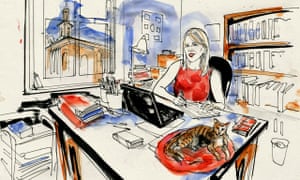
“The author and columnist on her powers of concentration, the importance of Pilates and the trials of co-existing with an inquisitive tabby cat

Julie Myerson … I need to be able to lose myself when I am writing.
 Julie Myerson … ‘I need to be able to lose myself when I am writing.’ Illustration: Alan Vest

Iwrote my first novel at evenings and weekends, with an office job, two babies and another one on the way. I also had debilitating back pain and often had to lie down on the floor between paragraphs. I now wonder how I did it (a husband untroubled by childcare is the honest answer). These days it’s all very different but it still feels like the biggest luxury, to be allowed to think, write and work exactly when and how I want to. The only non-negotiable is twice weekly Pilates: if I didn’t stretch my body seriously and regularly, I don’t think I’d be able to sit and write.

Otherwise, my requirements are straightforward: a desk, a good chair, a screen and a door that shuts. I do need quiet (right now the bell ringers are rehearsing at the church next door and it’s not ideal). I also need it to be daytime – I’ve never been able to write a coherent word after about 6.45pm.”

Read it all by clicking the link

Not a clerihew

I went to university to study mathematics
The performance of my teachers was  boring not ecstatic
So then I   went to London to earn a little money
While living with my husband who as usual smelled of honey
Then we went to Portland Bill to study rocks and seaside forms
I took to writing poetry because I love the sound of rhymes
I would have preferred lyrics  of  the Leonard Cohen Anthem type
But  when he died  I grieved and wept, too late for us to meet on Skype
What a sad old life it is  when Donald Trump  builds up more walls
So sound the trumpet and ram’s horn, like Jericho  the walls will fall.
Oh,Lord.

Attention must be paid to each small thing

The air feel still and cool and nothing moves
The birds  have disappeared and do not sing.
Life  feels distant, love’s in interlude

As we age  when health  and wit we lose
What new  learning may our own life  bring?
The air feel still and cool and nothing moves

Are we present to  the life we choose?
Attention must be paid to each small thing
Life  feels distant,  heart feels un-renewed

Like the dough we must be left to rise
The hidden power of yeast the flour shall wring
Minute yet powerful,  how the grains collide

Hidden in the dark ,what myriad eyes
Insects scurry, wasps to nettles cling
Life  feels distant, lovers lost are rued

Now  we feel the breath of a small wind
A whispering voice, the holy dove descends
The air feel still and cool and nothing moves
Consoled by  darkness, we await its clues.

Seeing visions,hearing  that small voice

Were we created for the Shopping Malls
Or to ponder over weight and belly bold?
If  God approached would humans hear his call
As prophets did  in mystic days of old?

Seeing visions,hearing  that small voice
May be possible no longer while we spend.
 We look for  good advice on  what is choice
Not rosaries but money  fills the hand?

Instead of tenderness, below, above
We hope to find love handcuffed on the rug.
And  promises are lost as well as vows.
Vibrating dildos  surround us  like black  bugs.

The sacred has been hidden, we are  half disgraced.
We ignore our lowness and ignore the holy face

Visions serve us well

Depending on our power, we may be blessed
Hallucinations entertained and self confessed
Fill our world with wonder and delight
Unless our mind is filled with hateful spite

Seeing  the  Golden Light  may give us hope
Unless we are in Blackpool full of dope
Feeling warmth may comfort us at night
Unless a cigarette set us alight

Hearing soft sweet voices is  a change
When one is alone but not deranged
Love your spirits and you will be safe
Hatred cultivated   ruins hope

If we are kind and wish no-one ill
We live  well within the sacred will

Conative?

michelangelo-pieta-590x615https://dictionary.cambridge.org/dictionary/english/conative

Extract:

conative

adjective

UK ​ /ˈkɒn.ə.tɪv/ US ​ /ˈkɑː.nə.t̬ɪv/ specialized

connected with a wish, intention, or effort to do something:

There is a long-established distinction in psychology between cognitive and conative aspects of behaviour.
If we wish to describe the whole person, conative aspects must be included.

Leaves dry and crack, the acers seem to burn.

The season alters imperceptibly;
No  point  exact which demonstrates  the turn.
Yet soon come changes which our eyes can see
Leaves dry and crack, the acers seem to burn.

And so it is with human beings too.
Each day our loved one looks the same to us
And yet their body alters like leaves do.
Small changes made with neither noise nor  fuss.

We change into  transparent ghosts of self
Thus totter down the avenue of life
Soon death approaches with  its common stealth.
And separates  the husband  and the wife.

In winter all is black and we despair
Yet  deep in earth,worms  silently repair

Tulip fever

https://bulletin.hds.harvard.edu/articles/springsummer2019/tulip-fever


Tulip Fever

Adrie Kusserow
Each spring, when the sun finally dragged its paw
across the mangy, battered meadows, I’d wander,
light starved into the 1,000 tulips my Dutch
father planted, just as they opened their gaping
red and purple jaws. What an indulgence,
the farmers said, as they bitterly whacked the caked
manure off their black rubber boots. Still,
how I loved the tulips with such desperate hunger. In their presence,
my brain began its frantic hunt, ravenous
pounce, an almost violent pecking of metaphors,
similes flocking in like a murder of crows. For it
was in the ritual of perfect description I thought
I could be closest to them: Burning Hearts, lipstick streaked,
brazenly splaying their thighs. Queens of the Night,
standing aloof, regal rococo ruffles the color of eggplant.
Orange flames of the Fire Parrot black-beaked and wild,
guzzling wells of ink down their necks. Double
fringed white Angeliques, like a whole squawk of geese
flapping and nipping toward sky. The giant red Darwins,
shiny clawed lobsters, underbellies bulging and blue veined. 

And yet it was a kind of torture to be separate from the tulips.
Hoping to swallow their beauty whole, I sucked on a petal, a mammoth
white lobe bringing nothing but a gagging fake communion.
Meanwhile, the squawking in the birdcage of my mind continued.
The shame and lunacy of it all. Didn’t I have
enough? Think of the farmers, forced to sell
their land, watching TV in the stuffy heat
of their trailers where I sheepishly delivered bouquets (on orders
from my father). As if this could make up for our glaring wealth,
I yelled at him one day. I didn’t know
that something mute and elemental would open,
as I sat throat deep in that field, and let the tulips
be, a kind of quiet softening in the bed
of my mind, that I would come to cherish for even
five or six seconds, when all the crows stopped pecking
and all the tender beauty of my father’s
last crop, by now pockmarked with such
desperate description, finally stopped bleeding.

Adrie Kusserow, MTS ’90, is Professor of Cultural Anthropology at St. Michael’s College in Vermont. She has had two books of poetry (Hunting Down the Monk and REFUGE) published by BOA Editions as part of their New American Poets Series. Her poems have been published in Best American Poetry, The Kenyon Review, Prairie Schooner, The SUN, and elsewhere.

Pieta

To the mother holding her own son
His body dehydrated ,drained and dead
Who can imagine her emotion?

I feel  in my own depths , vibration  stuns
Though I lost the one I had once wed
Grieving with  the mother and her son

On this night ,the ambulance had gone
Woe had pierced me , drawn my blood
I  could never have imagined  what  began

Forgive my  hubris, my comparison
Mary’s pain eluded me till led
To mourn like she’d already done

The Passions wild and painful   were all done
Whether in the Garden or the Bed
I had not dreamed of such emotion

I heard the still small voice  and what it said
Despite  the hollows of my heart were filled with dread
With the mother weeping  on her son
Help us hold  our loss  until we’re done