I decided to live without him

I was so kind I let sharks bite my legs
I let the swordfish cut my skin
I  let my  cats hunt for clothes pegs

I gave help to all who  had begged
But one of them sat down in my bin
I was so kind I let sharks bite my legs.

I made myself walk over eggs
And paid children to bring me old tin
I  let my cats play with clothes pegs.

A man  told me he wished I were dead
I decided to live without him
I was so kind I let sharks bite my legs.

My heart felt like a  pellet of lead
So I kicked this man on both his shins
I  let my cats play with clothes pegs.

I will put out the cruel in my bin
And let God decide if they sinned
I was so kind I gave sharks scrambled eggs
I  let my  cats dance with clothes pegs


Reflecting on a leaf

Reflecting on  a leaf that lies alone,
Cut off the shrub or tree by wilful wind,
May touch a heart which now feels like a stone.

Beneath our generous flesh there lie our bones
Within a skeleton, a heart we find,
Reflecting on  a leaf that lies alone

From our lungs, we hear pathetic groans
As all the certainties once strong become untied
Then our hearts will feel like cold,  cold stones.

Yet on a kinder wind, red  leaves are borne
And left renewed in places more than kind
Food for ants, no more to lie alone

Inside my heart, an emptiness now yawns
But  like a womb, with rich velvet it’s lined
In truth, a heart is no kin to a stone.

To the dust and ash leaves are consigned
For a former neighbour do they pine?
Reflecting on  a leaf that lies alone
Will touch a heart no longer a cold stone.

A pink coat

My coloured cats show
Emile woke Mary up at 7am.It was a  Sunday in October, grey and damp.
Go away, she told him.The clock has changed.It’s not 8 am yet.I have to wash my hair as well.Get the Observer out.
I can’t read. the dear animal replied.And why don’t you rebel and stick to Summer Time
I know Stan wanted to send you to Eton but we couldn’t afford it.Yet you understand days and calenders, Mary joked
I can make myself some hot toast, Emile remarked boastfully.
You’ve never eaten it, she murmured fondly
Well, I want to.Let me try it!With butter.
Mary got up and found her fleece dressing gown; it was  brown and covered in coloured spots.She went downstairs and gave Emile a whole kipper.Then she made some tea and took it upstairs so she could drink it while she came round from her dreams
Suddenly Annie ran into  the room wearing a  long black vinyl coat and  red knee-high boots
You never locked the back door, she howled like a wild  leopard which has had no breakfast
I don’t suppose anyone wants my old TV as it is only 19 inches.And my Chromebook is not something worth re-selling.I do have a new coat.
How about Ray Monk’s life of Wittgenstein, Annie asked her defiantly, her apricot lips pouting childishly as the Riemann of Paris lipstick glittered uncannily
The people who might enjoy reading it are by virtue of that , not the sort to steal or buy it on the black market.
That is very racist, Annie told her.You should say. the beige market!
Then nobody would know what I meant, Mary said lovingly
Anyway, do you want to come to Marks with me?They have some lovely coats in
I’d like a pink wool coat, said Mary.
Quite right ,said Annie.Bring back feminine colours
Actually, gay men might like pink coats, she continued.But if they go on the bus they might get dirty.Come to think of it,so will women’s coats
They will have to buy pink puffa jackets and we can wash them at 30 deg.Mary whispered
Using a special detergent, Annie asked?
I have never seen a detergent for washing gay men.I don’t think they will fit into the washing machine.On the other hand, you are small so you will fit in
Shall I get undressed first, Annie asked furtively.
Yes, I’ll try to put you on a rapid wash for 15 minutes but it is your choice.Maybe a bath would be safer?
No problem, said Annie intellectually.Are you having one with me?
You#d better be careful, Mary ad-libbed.It might be sexual harassment.
Well, I am not gay , said Annie.
You never know till you try, Mary giggled ,like a child behind the school canteen
Why, we might become gender fluid and then who knows?
And so say all of us
Miaow,

Remember life is sacred and too brief

When we are made so lonely  by our grief
When we lose the loved one of our years
Remember life is sacred and too brief

Some may gain their comfort from a priest
Other by the emptying of their tears
Can we be too careless in our grief?

Blown away like one dried autumn leaf
Disconnected with our hearts so seared
Remember life is sacred and too brief

Death is more forgiving to the least
We must share the anguish and the fear
When we are made  lonely  by our grief

When we feel we’re falling piece by piece
We wonder how to dignify by prayer
Remembering life is sacred and too brief

Just as the sun will rise up in the East
Despite it  dying daily everywhere
We  may one day rise up from our grief

Life is hard and often it’s unfair
We may feel so much we cannot bear
When we are made   lonely  by our grief
We remember life is sacred and so brief

Being nothing, nothing can do harm

When the pain of grief is wakened up
And sorrow falls  down like a winter storm
Avoid another’s careless talk and lip.

As we struggle to control our ship
Fearing to be injured, suffer harm
Alas, the pain of grief can waken up.

With endurance, we must be equipped.
And  we must take in both love and balm
Avoid the others’ careless talk and lip.

In our deepest souls, a  wound is ripped
Most soothing  is the singing of the psalms
When the pain of grief is wakened up

By a  rock, an avalanche is tipped
Destroying those who’re trapped within its arms
Avoid the other’s wicked open lips.

By humility, our pain’s disarmed
Being nothing, nothing can do harm
When the pain of grief is wakened up
Do not drink the bitter final cup.


Absent sun

We speak in cliches yet we do not know.
The clock change makes us grumble every year,
We say we hate dark nights and   winter snow

If we were original, what show!
The unacknowledged boredom makes us swear,
We speak in cliches but we do not know.

Oh, lovers and strength lost deal many blows.
And life itself will at frail bodies tear
Then we say we hate dark nights and snow

While we’re  living, we will undergo
The changes of the seasons and the years
We speak in cliches; we’re afraid to know.

We have gifts  yet we each suffer blows
Like all  creation, we might live with flair
Though we hate dark nights, the ice, the snow

Inside dwells our soul both frail and bare
Despite its lack, with it we love, revere
We speak in cliches, still afraid to know.
We  reproach the low down sun and snow


I am by shapes and colours now bewitched?

I thought my wardrobe adequate or rich
A coat or two, some boots and woollen skirts
But now the shapes have changed, the colours mixed

Am I by shapes and colours quite bewitched?
Will my being out of fashion hurt?
I thought my wardrobe colourful  and rich

The country’s gloomy, nothing remains fixed
Yet with a little fun, we like to flirt
The shapes have changed the colours different mix.

I like to take a wander, see the pitch
But I need coats that do not show the dirt
I thought my wardrobe ample, even rich

Some  may say the advertising works
Like an image pistol, adverts squirt
So now by  colours brilliant I’m bewitched

How about I steal a lover’s shirt
And wear his golden tie around my throat?
I am by shapes and colours now bewitched?
I thought my  wardrobe interesting and rich


Poems about Nature

IMG_3820
http://www.bbc.co.uk/poetryseason/poems/nature.shtml


Binsey Poplars by Gerard Manley Hopkins

(Felled 1879)

My aspens dear, whose airy cages quelled,
Quelled or quenched in leaves the leaping sun,
All felled, felled, are all felled;
Of a fresh and following folded rank
Not spared, not one
That dandled a sandalled
Shadow that swam or sank
On meadow and river and wind-wandering
weed-winding bank.

O if we but knew what we do
When we delve or hew –
Hack and rack the growing green!
Since country is so tender
To touch, her being so slender,
That, like this sleek and seeing ball
But a prick will make no eye at all,

Where we, even where we mean
To mend her we end her,
When we hew or delve:
After-comers cannot guess the beauty been.
Ten or twelve, only ten or twelve
Strokes of havoc unselve
The sweet especial scene,
Rural scene, a rural scene,
Sweet especial rural scene.

Related Video

Hopkins' moral maze

Poet insight

Hopkins’ moral maze

You loved us,I could tell

IMG_3820.JPG

I look up our small street,
To see if you are coming.
I don’t know what time it is,
But I think I hear you humming.

You sang sweet songs for us,
And you could whistle well.
You wore an old tweed jacket
You loved us, I could tell.

I look out there each day,
But I can’t see your tall, thin shape.
I saved your Woodbine packet,
It made me feel some hope.

What does death’s door mean?
Where has Daddy gone?
When will be the welcome day,
When we hear his songs again?

I’ll hum like him all day,
I’ll dream of him all night.
I hope he won’t be angry,
If his cigarettes won’t light!

He can’t write his own songs now.
He went too far away, too soon.
I’ll write down what I think he sang,
And I’ll invent the tune.

I hear him singing now,
He dwells inside my heart.
And though I still can’t see his face,
I recognise his Art.

Why poetry must be taught

DSC00024https://www.theatlantic.com/education/archive/2014/04/why-teaching-poetry-is-so-important/360346/


“Students can learn how to utilize grammar in their own writing by studying how poets do—and do not—abide by traditional writing rules in their work. Poetry can teach writing and grammar conventions by showing what happens when poets strip them away or pervert them for effect. Dickinson often capitalizes common nouns and uses dashes instead of commas to note sudden shifts in focus. Agee uses colons to create dramatic, speech-like pauses. Cummings of course rebels completely. He usually eschews capitalization in his proto-text message poetry, wrapping frequent asides in parentheses and leaving last lines dangling on their pages, period-less. In “next to of course god america i,” Cummings strings together, in the first 13 lines, a cavalcade of jingoistic catch-phrases a politician might utter, and the lack of punctuation slowing down and organizing the assault accentuates their unintelligibility and banality and heightens the satire. The abuse of conventions helps make the point. In class, it can help a teacher explain the exhausting effect of run-on sentences—or illustrate how clichés weaken an argument.

Yet, despite all of the benefits poetry brings to the classroom, I have been hesitant to use poems as a mere tool for teaching grammar conventions. Even the in-class disembowelment of a poem’s meaning can diminish the personal, even transcendent, experience of reading a poem. Billy Collins characterizes the latter as a “deadening” act that obscures the poem beneath the puffed-up importance of its interpretation. In his poem “Introduction to Poetry,” he writes:  “all they want to do is tie the poem to a chair with rope/and torture a confession out of it./They begin beating it with a hose/to find out what it really means.””

Charles Simic: why I still write poetry

DSC00026DSC00025DSC00024DSC00022
“There’s something else in my past that I only recently realized contributed to my perseverance in writing poems, and that is my love of chess. I was taught the game in wartime Belgrade by a retired professor of astronomy when I was six years old and over the next few years became good enough to beat not just all the kids my age, but many of the grownups in the neighborhood. My first sleepless nights, I recall, were due to the games I lost and replayed in my head. Chess made me obsessive and tenacious. Already then, I could not forget each wrong move, each humiliating defeat. I adored games in which both sides are reduced to a few figures each and in which every single move is of momentous significance. Even today, when my opponent is a computer program (I call it “God”) that outwits me nine out of ten times, I’m not only in awe of its superior intelligence, but find my losses far more interesting to me than my infrequent wins. The kinds of poems I write—mostly short and requiring endless tinkering—often recall for me games of chess. They depend for their success on word and image being placed in proper order and their endings must have the inevitability and surprise of an elegantly executed checkmate.

Of course, it is easy to say all this now. When I was eighteen years old, I had other worries. My parents had split up and I was on my own, working in an office in Chicago and attending university classes at night. Later on, in 1958, when I moved to New York, I led the same kind of life. I wrote poems and published a few of them in literary magazines, but I didn’t expect that any of that activity would amount to much. People I worked with and befriended had no inkling that I was a poet. I also painted a little and found it easier to confess that interest to a stranger. All I knew with any certainty about my poems is that they were not as good as I wanted them to be and that I was determined, for my own peace of mind, to write something I wouldn’t be embarrassed to show my literary friends. In the meantime, there were other more pressing things to attend to, like getting married, paying the rent, hanging out in bars and jazz clubs, and every night before going to bed baiting the mousetraps in my apartment on East 13th Street with peanut butter.”

Why I Still Write Poetry

For saints do not boast of their might

coloured tree and sshadowI am unsure if I’m suffering from trauma.
Or from eating a dish of beef korma.
I felt shaky all day
As if I were prey,
But the doctor says, Who’d want to harm y’?

I am unsure if I was confused
By a man whose two eyebrows were fused.
He got it in one,
By the beard was undone.
I scratched his face, just to bemuse

I guess mother feared the Old Devil
And the drunken orgies at his revels.
She warned he had hooves
And about how he moves.
Though he can seem quite charming and civil.

But it’s real men who cause us dismay
As on us sweet women ,they prey.
They may fast and pray too,
And cry, How do you do?
Run from “good” ones, don’t delay.

For saints do not boast of their might
And how they have reached to dizzy heights.
They are self-forgetting and plain
Use no-one for their gain.
Mostly they work out of sight

Counting


Photo0065_001
Nine years since my sister died
Eight years since getting a computer

Eight years living with my Father also alive.
Seven years of writing poetry
Seven years in grammar school
Six years in primary school
Five years for GCE study
Four years piano lessons
Three years  doing my degree and three years being at home before entering nursery school
Two years doing A  and S levels and in Nursery school [ not at the same time]
One year plus studying cello
Less than one year of being unable speak in sentences and hence being allowed or able to be a baby.


On nonsense poetry

DSC00056.JPG


http://orwell.ru/library/reviews/nonsense/english/e_nons


“See-saw, Margery Daw,
Sold her bed and lay upon straw.
Wasn’t she a silly slut
To sell her bed and lie upon dirt?

It may be that there was once a real person called Margery Daw, and perhaps there was even a Dobbin who somehow came into the story. When Shakespeare makes Edgar in King Lear quote “Pillicock sat on Pillicock hill”, and similar fragments, he is uttering nonsense, but no doubt these fragments come from forgotten ballads in which they once had a meaning. The typical scrap of folk poetry which one quotes almost unconsciously is not exactly nonsense but a sort of musical comment on some recurring event, such as “One a penny, two a penny, Hot-Cross buns”, or “Polly, put the kettle on, we’ll all have tea”. Some of these seemingly frivolous rhymes actually express a deeply pessimistic view of life, the churchyard wisdom of the peasant. For instance:

Solomon Grundy,
Born on Monday,
Christened on Tuesday,
Married on Wednesday,
Took ill on Thursday,
Worse on Friday,
Died on Saturday,
Buried on Sunday,
And that was the end of Solomon Grundy.

which is a gloomy story, but remarkably similar to yours or mine.

Until Surrealism made a deliberate raid on the unconscious, poetry that aimed at being nonsense, apart from the meaningless refrains of songs, does not seem to have been common. This gives a special position to Edward Lear, whose nonsense rhymes have just been edited by Mr R. L. Megroz, who was also responsible for the Penguin edition a year or two before the war. Lear was one of the first writers to deal in pure fantasy, with imaginary countries and made-up words, without any satirical purpose. His poems are not all of them equally nonsensical; some of them get their effect by a perversion of logic, but they are all alike in that their underlying feeling is sad and not bitter. They express a kind of amiable lunacy, a natural sympathy with whatever is weak and absurd. Lear could fairly be called the originator of the limerick, though verses in almost the same metrical form are to be found in earlier writers, and what is sometimes considered a weakness in his limericks — that is, the fact that the rhyme is the same in the first and last lines — is part of their charm. The very slight change increases the impression of ineffectuality, which might be spoiled if there were some striking surprise. For example:

There was a young lady of Portugal
Whose ideas were excessively nautical;
She climbed up a tree
To examine the sea,
But declared she would never leave Portugal.

It is significant that almost no limericks since Lear’s have been both printable and funny enough to seem worth quoting. But he is really seen at his best in certain longer poems, such as “The Owl and the Pussy-Cat” or “The Courtship of the Yonghy-Bonghy-Bт”:

On the Coast of Coromandel,
Where the early pumpkins blow,
In the middle of the woods
Lived the Yonghy-Bonghy-Bт.
Two old chairs, and half a candle
One old jug without a handle
These were all his worldly goods:
In the middle of the woods,
These were all the worldly goods
Of the Yonghy-Bonghy-Bт,
Of the Yonghy-Bonghy-Bт.

The cat’s mother

Photo0292 3

After Mass on Sunday Mary decided to visit Stan, her elderly, gentle and frail husband in the Rehabilitation Unit where he had been sent recently by a strange physiotherapist…He was unhappy as the diuretics made him pee even more often than he used to do and he got very worried about it because his bad heart made it extremely hard for him to walk.
When she went into the small four bed ward she saw Stan sitting on his chair without any pyjama trousers on even though it was visiting time from 3 to 8 pm.
Why has he no trousers on? Mary asked a nurse angrily, her singularly blue eyes full of unshed glistening tears which almost washed off her turquoise mascara and made runnels in her honey beige foundation by Rimmel of London and Paris
He keeps wanting to go to the toilet so it’s easier for us all if he has no pants on, the nurse told her haughtily.He’s on diuretics, you see as he has water in his lungs and other inner organs and the water has to be removed from his body, Sheila ,the nurse announced in a cold voice
What about the lack of dignity in baring him to the world, Mary enquired softly yet piercingly her eyes dripping tears again.
Dignity ,what’s that? the nurse said insolently.He is just a pest. And old men don’t deserve any attention.We are tired of them.They should all die now.That’s government policy it appears
Emile who had hidden in Mary’s old, but good olive green Radley leather handbag let out a sound like a banshee in Cork or a demon in a nightmare.
The nurse looked quite frightened
What’s that? she whispered to Mary behind her hand.
It’s probably Satan coming to say ” hello” to you as you seem very wicked to me.Mary informed her politely yet honestly in her Northern way.
Oh my,what shall I do? the nurse asked in a trembling voice.I am so upset now.
You could try reading the Ten Commandments, Mary riposted jocosely… if it’s not too late.
Or recalling the Golden Rule………
I’ve never heard of the golden rule, said the nurse.Is it a measuring instrument of some unusual type?
Yes,in a sense it is, Mary said.It measures us by our compassion towards others.And you seem to have none for Stan.Can you not imagine what it’s like being a man sitting half naked in a public room with no recourse?
What’s a recourse, Sheila, the nurse, asked her thoughtfully,Is it a garment like a dressing gown?
No,it’s a a source of help in a difficult situation.It’s a remedy or an option
I have a higher degree in nursing,Sheila boasted stupidly.
I don’t care if you have a doctorate in nursing and philosophy,Mary cried.It’s what you do and say to the patients that counts.And going to an evening class in English would do you no harm.Your vocabulary is limited,to say the least.And words are useful whatever job you do.Or even if you are unemployed it helps you deal with bureaucrats
Oh,dear,said the nurse,I am sorry for being so thoughtless.I am always thinking about sex,love and clothes instead of the patients.I see now I have fallen into evil ways and hope I can improve a little.
You have been cruel, said Mary.And seeing my aged husband like this is breaking my heart.
She went over to Stan and sat by him.He fell against her bosom hungrily.Alas it was not for erotic reasons.His blood sugar was only 2 and his BP was 60/40.He was dying there with no trousers on and with no-one but Mary to help him… and Emile, their small intelligent black cat ,of course.Unfortunately Emile’s trousers were too small for Stan

.Mary wrapped a bath towel around Stan and held him in her arms.
Stan tried to speak but Mary could not make out what he was saying.Tears ran down her beautiful lined and wrinkled face and dripped onto Stan’s head.I suppose one might say it was a kind of baptism by love.Now Stan will soon be entering a new dimension and will be given a new and better name by One who cannot be named here.But you catch my drift?

Judgement is mine says the Lord.

Stan collapsed, his face went black.Only then was he sent to a real hospital with full equipment.He died, looking happy, the next day.His last words
“So many lovely friends”
Emile was crying on Mary’s lap.
Don’t worry Emile.He was very unhappy.
So am I, Emile wept
Then Mary wept herself.What a pity Emile is a cat and so cannot embrace the person he calls “Mother”

I don’t need drugs, hallucinations gawp!

My head is reeling and my nails all broke
To rip the backs off phones is not for blokes.
If this goes on, my ears will start to smoke

I see a man  I fancy, by the oak
I’m jiggered so I wonder, will he cope?
My hair is looking wild, my nails all broke.

It might be an ash, don’t worry folks
I’ll tie myself to this one with a rope
If this keeps on, my ears will burn and smoke

When I was younger, no-one sold  me coke
I don’t need drugs, hallucinations gawp!
My hair is looking wild, my nails all broke.

Cats may mew and frogs might want to croak
All I want are books  or I shall mope
If life keeps up, my ears will start to smoke

How much is the rail fair up to Stoke?
How much does one pay for Chanel soap?
My hair is looking  golden  in this light

I think this villanelle was unprovoked
As a tactic, it may be mistake
My head is reeling and my nails all broke
If this goes on, my I will want to  smoke


Metaphors are dead, yet telling lies.

Scientists tell us what the wise might think
That frosty chill makes poor old people die
See, it’s in the Guardian in ink.

I wonder if it harms the eyes to wink?
Do fluorescent light tubes injure flies
Scientists tell us what the odd might think.

Why do women dress their lips in pink?
What do genes do when their bearer dies?
See, it’s in the Daily Groat in ink

Do you know in daydreams we can’t blink?
Metaphors are dead, yet telling lies.
Scientists tell us what the wireless think!

Re open minds, the light gets through the chinks
If my mind is closed, I’m sterilised
I’ll put it in a Telegraph in ink.

Wittgenstein said  our metaphors aren’t lies
Concrete thinking is no use in life
Scientists tell us what we cannot think!
Ye Gods, it’s in the Oxford mag in mink.


Too proud to live

I met a man who boasted of his prayers
And of the great good works that he would do
He wrote to someone dying  in despair
Who are you that I should pray for you?

This puts him on a level with the Lord
He  will not pray for us, he bears contempt
He  will not let the free flow of his words
Add to the songs of love all  heaven sent

But who is going to be the Judge of all?
Who can ask us rightly, who are you?
No human being  is too low, too small
For God to use them in his retinue.

The man who judges others, his self harms
Fascinated by the image of his charms.

Fear not ignorance

The scientific approach to the phenomenon of human nature enables us to be ignorant without being frightened, and without, therefore, having to invent all sorts of weird theories to explain away our gaps in knowledge.

How like a song unsung, unmusical

I cannot write a serious poem without some part of me wanting to make it funny.

Photo0065_001

How like a prison is my cubicle
Within four walls, I know I am entrapped.
How like a song unsung, unmusical,
My state of mind so far has not been mapped.

Inside my heart, I used to have a room
Where space and grace and nature all did dwell.
But then a false man led me to my doom
The details I will never ever  tell.

My walls fell down like Jericho of old.
My love became my enemy, my hate.
With rubble my heart filled, alas, not gold.
My enemy was once my warmest mate

What seems to be the truth is but a lie
Take me to the woods and let me  die
Photo1815
Take me to the pub to eat pork pie
Give me cardboard wings for I can fly

Primrose way

Thprimroses-fairhaven

https://plantscientist.wordpress.com/2013/04/27/organism-of-the-week-primrose-primula-vulgaris/

Very lovely blog about primroses


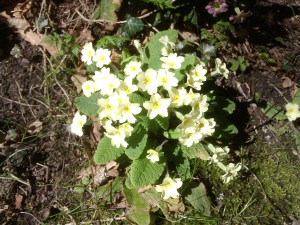
“During a field trip in Pembrokeshire as an undergraduate student I spent a couple of days studying primrose flowers. Wild primrose flowers are typically a pale yellow colour like those pictured above but white and pink forms are also seen. There are two forms of flowers, which look almost identical apart from the position of the stigma (female part) and the anthers (male part holding the pollen) in the flower tube in the centre. In “pin” flowers the stigma is positioned at the top of the tube with the anthers positioned halfway down. In “thrum” flowers the stigma is instead positioned halfway down the tube with the anthers at the top.

"Thrum" flower type. The anthers are visible at the top of the flower tube with the stigma underneath about halfway down (not visible).

Pin form. The stigma is at the top of the tube above the anthers (not visible).

The two flower types were first described by Charles Darwin in 1862 (1) and he also observed that the pollen produced by the pin flowers was smaller than that of the thrum flowers. He performed a number of crosses (where he took pollen from one flower and placed it on the stigma of another)  between pin-to-pin, thrum-to-thrum, pin-to-thrum, and thrum-to-pin flowers and found that the crosses between the different flower types were more fertile than those between flowers of the same type.”

Guilt and more

8282959_f520http://www.skylightto.com/interviews/dr-donald-carveth-guilt/


Do you identify a difference between guilt and shame? 

Yes I do. There are two main types of guilt: The first is punitive guilt, in which “I’m whipping myself”, and that’s almost indistinguishable from shame, which is a narcissistic emotion. In shame, my mind is entirely on myself. We often think of selfishness or narcissism as focusing on “how great I am” but it’s equally narcissistic to be going on all the time about how terrible you are. Shame is self-persecution. It’s a horrible feeling. You beat yourself up, and once in a while, in order to stop beating yourself up, you beat somebody else up- that’s the scapegoat mechanism. When I’m depressed, my superego has me in its crosshairs, but if I can shift someone else into its crosshairs: “That guy over there is the sinner, let’s attack him instead of attacking me.” People can get relief from depression by targeting somebody else. All of this is destructive guilt.

But there’s another kind of guilt altogether, which is reparative guilt: your mind is not on yourself, it’s on the person you’ve injured. The move into reparative guilt is a move out of narcissism. We get our minds off ourselves long enough to actually see the harm we’ve done to others, and to be concerned about them, and to want to do something to make it right.

The example I use is, “I’ve injured someone, and he’s bleeding in the corner. With persecutory guilt or shame, I’m flagellating, I’m such a terrible person.” But that’s useless to the guy who’s bleeding. If I put down the cat-o-nine tails, go get the first aid kit, and start bandaging- that’s reparative guilt.

So guilt can lead to better behaviour. 

Yes. Now I make a distinction between the conscience and the superego. The superego is the inner, moralistic, hanging-judge torturer. Superego is about aggression turned on the self and sometimes on scapegoats.

Conscience is quite separate. Conscience is grounded in love, is grounded in concern. You give love, because you were cared for, and you know you have an obligation to give care back. When you’re out of sync with your conscience, or doing something wrong, Conscience bothers you. By contrast, the superego tortures you- the superego’s attitude is, “OK I caught you in wrongdoing, good. Now I can do what I like to do, which is beat the shit out you.” Conscience doesn’t react that way. The conscience is saddened by the fact that you’re doing wrong. It encourages you to turn around and do right, it calls you to contrition and pulls you to apology and to reparative action, and that is useful guilt.

I like that. Let’s talk about Skylight.

As background: Kyra worked in Tom’s restaurant, and they had an affair while Tom was married to Alice. Kyra was very close to the family, including Alice and Tom’s son, Edward. After six years, Alice discovered the affair, and Kyra abruptly removed herself from their lives. Tom’s relationship with Alice never recovered; Alice became ill and died. Kyra has now moved to a low-income neighbourhood and taken a job teaching very difficult students. Skylight shows us Tom’s and Kyra’s first meeting, 3 years after the end of their affair.

What do you observe in the characters?

My reactions to the play deepened every time I read it. On the first read, you’re very aware of what a bombastic narcissistic character Tom is; and he’s also a symbol, and a critique, of Thatcher’s neoliberal market fundamentalism nonsense. He’s likeable, intelligent, charming, energetic, but he’s easy to identify as a narcissist and a coward. When the wife he’s been unfaithful to is dying, his act of reparation is to throw money, which is nothing to him; he builds her a house, but he can’t face her.

My initial tendency was to see Kyra as a bit of a victim of this narcissistic male, but I think she’s pretty guilty in her own way. She felt fine sleeping with her friend Alice’s husband as long as Alice didn’t know. So now, Kyra’s freezing in this tiny, shoddy apartment, a little bit like she’s sent herself to jail– Tom calls it Siberia. But she would not have to continue in this bread-and-water prison if she came consciously to terms with her guilt. If she did that, she could get over it. So she’s paying a big price for her failure to acknowledge her guilt. And now she’s unconsciously making reparation for her sins by becoming a devoted teacher.

And yet, after Alice discovered the affair, Kyra had 3 years to make true reparations before Alice’s death, but instead, she vanished.

And now, her first words to Tom after a 3-year separation– she doesn’t even say hello- she says, “I’m not guilty.” 

Exactly! She’s making a joke, but as you say, it’s the first thing that comes out of her mouth, which indicates how guilty she really is.

photo1815_001_001


Oh– I wanted to mention this quotation from a Yeats poem at the beginning of the play:

“We had fed the heart on fantasies; the heart’s grown brutal from the fare.”

So here, Kyra and Tom had the illusion that they could help themselves to this fantasy of pleasure and that it wouldn’t hurt anyone as long as they kept it secret. Well that is a total illusion, because ultimately there are no secrets. Even in physics, scientists say everything connects. A butterfly flaps its wings in the Amazon; it affects the weather in Toronto. People have this illusion that there is a hiding place, but it all comes out, and it affects us. Tom and Kyra are maintaining this illusion that their affair is not hurtful, and so…

…the heart has grown brutal as a result.

Repressed guilt and shame are toxic. It’s not the guilt and shame themselves that have a toxic effect, it’s the repression of them, the avoidance of them. So I think it’s a perfect epigraph for the play. Illusions are hard to see through– that’s why we need other people who see us better than we can see ourselves.

(laughing) You should know.

(laughing) Well, it works both ways! One of the great things about doing this work is that the patient sees me as well. When you work with patients intensively for a long period of time, they get to see your weak spots, biases, blind spots… and they tell you about it!

Oh! Can you tell me some of the things they’ve called out?

Sure! One said, “You know, Don, when they called it a Talking Cure, they meant the patient talks!” (laughing)

(laughing) How does that feel?

Well, sometimes… (laughs). But really, I like it, because they’re teaching me something. You know, sometimes I’m clumsy, sometimes I’m arrogant, sometimes I’m wrong, sometimes I’m sleepy, and the patient is going to tell me the ways in which I’m not perfect!

But I’m also getting real gratitude. Sometimes people will thank me with tears in their eyes, and this makes me feel very good. And you don’t get the good without the other side of it. It’s a very deep kind of connectedness with other people, and it’s very gratifying work.

Why did you become an analyst?

When I was younger, I was unhappy, I was self-punishing by getting depressed, by not letting myself be as successful as I otherwise could- and by not being able to write my doctoral dissertation! So I started analysis, because I knew that there was something wrong with me. I had done all of the trendy therapies- this was the sixties- but it was useless. And so, my very first psychiatrist—when I fired him—said, “Consider psychoanalysis.” And I said, “What, they still do that thing with the couch?” But within a matter of weeks I knew this was the therapy for me. I started to change, overcame the writer’s block, wrote the PhD, got the PhD and a tenure-track position, and I started publishing. And as soon as I got tenure, I applied to train as an analyst, and I’ve been practicing ever since. But it started out with a need to deal with my own personal issues, and only then did it turn into a career.

As someone who’s read the play several times, and as someone who has professional insights about its themes- what do you think audiences will take away from Skylight?

I think the audience will be quite moved, and they’ll be shaken. But also entertained. The dialogue is incredibly amusing; some of Tom’s diatribes are hilarious, and Kyra has such a dry, acerbic wit- this is a play that should really be enjoyed. But it’s going to shake people as well.

Our average reading age is 9

colouredlove1http://www.see-a-voice.org/marketing-ad/effective-communication/readability/


Readability

The average reading age of the UK population is 9 years – that is, they have achieved the reading ability normally expected of a 9 year old.
The Guardian has a reading age of 14 and the Sun has a reading age of 8.

Considering the readability of your copy will benefit many people, including blind and partially sighted people.

This is an example of a possible paragraph written for the access page of a brochure:

At every performance where audio description is provided, there is also an opportunity for a touch tour of the stage and set. Touch tours give visually impaired patrons an opportunity to familiarise themselves with the set and costumes before the show to enhance their enjoyment of the production.

This sample has a reading age of 24 and, therefore, it excludes the vast majority of its intended readers.

Here is an alternate version of the copy:

There will be a touch tour before every audio described performance. This gives you the chance get to know the set and costumes. Patrons tell us this means they enjoy the show more.

It now has a reading age of 10. All we’ve done is use shorter sentences and shorter, everyday words.

On the DOWNLOADS page you can print out instructions on how to calculate the reading age of a piece of text using the FOG INDEX or a tool within Microsoft WORD.

Scannable copy

One way of improving readability for everyone is to create scannable copy. This makes it easy for people to go quickly to the information they are interested in.

Take a look at the extracts overleaf from The Sun and The Guardian on 25 August 2008. Which one is easiest to scan and why?

Two newspaper scans. On the left a clipping from The Sun, and on the right The Guardian. Both feature the same new item about David Cameron's stolen bicycle.

What you can do …

• Use bold to take the reader to key words.

• Use meaningful subheadings (explain what’s in it for them).

Deja woo…I already fell out of love

Deja mew…. the cat’s upset already
Deja new…. a logical impossibility
Deja you….I met you before
Deja true… an axiom
Deja due……..your payment is late
Deja slew… he was dead before I shot him, sir.
Deja new…second hand
Deja blue….. inborn sadness
Deja vile….original sin
Deja bile————-I   had indigestion earlier
Deja smile……I won’t laugh again
Deja flew……I love you no more/I have gone
Deja dew—————-will it drop off?
Deja who…..I know you but not your name
Deja new………old
Deja phew….. that was hard

I found your diary

I found your diary with  a date to meet
A friend  you loved and cherished all these years
But life itself made that a  raw, cold cheat
For when it came you were no longer here.

I admired your life force and your wit
The act, illusion, call it what we must.
You did not hurry into death’s cold pit
Nor where you eager to  break down into dust

Yet you did not fight  the coming freeze
Like a cat that senses its own end
No longer could  you speak, yet  lay at ease
Until the curtain’s calm and kind descent

On New Year’s  Day two thousand and fifteen
We  did not know that this was our last scene


Tenderly you stroked my crooked feet

Shall I miss the journeys that we made
Up sheer cliffs and through deep muddy yards
Chased by  geese and then in heather laid?
I cannot catch you now, it is too far.

You cleaned my boots back in the cottage sweet
On the bed, you covered  me in  coats
Tenderly you stroked my crooked feet
And hot and sugared tea you once more brought

A dog stopped by and held out its clean paw
It shook your hand and gazed with amber eyes
Remote and cold, the Hartland Cliffs we saw
Where have you got to now, my love, disguised?

Danger and delight then drew us on
I cannot find your face, where have you gone?

The journey by Thomas Hardy

Hereto I come to view a voiceless ghost;
Whither, O whither will its whim now draw me?
Up the cliff, down, till I’m lonely, lost,
And the unseen waters’ ejaculations awe me. the sound of the sea
Where you will next be there’s no knowing,
Facing round about me everywhere,
With your nut-coloured hair,
And gray eyes, and rose-flush coming and going. Emma’s rose pink cheeks
Yes: I have re-entered your olden haunts at last; the places where you often used to go
Through the years, through the dead scenes I have tracked you;
What have you now found to say of our past –
Viewed across the dark space wherein I have lacked you?
Summer gave us sweets, but autumn wrought division?
Things were not lastly as firstly well
With us twain, you tell? twain – two
But all’s closed now, despite Time’s derision. derision – mocking
I see what you are doing: you are leading me on
To the spots we knew when we haunted here together, often used to go
The waterfall, above which the mist-bow shone
At the then fair hour in the then fair weather,
And the cave just under, with a voice still so hollow
That it seems to call out to me from forty years ago,
When you were all aglow,
And not the thin ghost that I now frailly follow!
Ignorant of what there is flitting here to see, flitting – moving quickly from place to place
The waked birds preen and the seals flop lazily, preen – clean themselves, arrange their feathers
Soon you will have, Dear, to vanish from me, ghosts are said to vanish at daybreak
For the stars close their shutters and the dawn whitens hazily.
Trust me, I mind not, though Life lours, lours – looks gloomy
The bringing me here; nay, bring me here again!
I am just the same as when
Our days were a joy, and our paths through flowers.

Dannie Abse’s best poems


Spring 2012 049

From Valediction:

“In this exile called old age
I live between nostalgia and rage.
This is the land of fools and fear.
Thanks be. I’m lucky to be here.”


http://www.telegraph.co.uk/culture/books/11127571/Dannie-Abse-his-greatest-poems.html