Charles Dickens,the great novelist of Victorian England http://en.wikipedia.org/wiki/Charles_Dickens
Fiction is invented,of course, by novelists and writers.And we also have lies which are slightly different.The truth of fiction when well done comes from the use of the true imagination based on genuine interactions with what is other than ourselves and is a way of depicting the truths of the heart.
The true imagination can only be effective when it is not fantasy based on mere wish fulfillment.To me that is what Buddhism is about.We desire nothing in order to get everything and more.
Lies,on the other hand ,may be for purposes of manipulating other people or may be the product of fantasy which is common in children who “make believe” they are having a birthday party because they want one so much. http://en.wikipedia.org/wiki/List_of_best-selling_fiction_authors
I might say fictional writing in novels or poetry using the true imagination helps us to understand complex reality better..Lies can be very destructive.And we have the kind of language used in the novel 1984 by George Orwell where black can mean white and death merely.termination of life…. we have begun to hear a lot of this and it does have an utterly bad and even destructive effect on personal and political life.The most famous example is when some politician was lying but it was referred to as being “Economy with the truth”.It’s our intentions which count to in making us moral agents.We may lie so smoothly we feel it will have no illl effect.
Imagining what it is like to be another person as in Dicken’s great novels about the poor is very powerful and can change government policy via changing people’s hearts and minds.
I feel imagination does have this purpose of making us feel for others and bring us closer even to murderers and criminals when the writer makes their world something we can comprehend.
Reality is very complex which is one reason we have all the arts,science,mysticism,religion as they all look at or relate to different aspects of life.
Plain lying is a selfish activity for our personal benefit or to avoid trouble when we have misbehaved.And we weave a web of destruction
Religion as Poetic Truth
A lightly edited transcript of an impromptu talk by Mark F. Sharlow
How much truth is there in the religions of the world? How many of their beliefs are true? Before trying to answer that question, I’d like to mention an example that shows how intricate the question of truth can sometimes be. Think about poetry. The poet Carl Sandburg once wrote a poem titled “Fog,” in which he used these lines: The fog comes on little cat feet. Now, is Sandburg’s statement true or not? When you think about the fog coming in over a coastline, as in Sandburg’s poem, do you find those lines true? The answer to that question could be “no,” because there are no cat feet on the fog – no matter how hard you look under the fog, you won’t find cat feet. Or the answer could be “yes,” because those lines describe exquisitely a certain experience of what it feels like when you’re in a place where the fog is coming in. You know what I mean, if you’ve ever been there – that strange hushing, that strange softness that your surroundings develop. It’s a subjective experience, but it’s a real part of your awareness. So, are Sandburg’s lines true? The answer is yes or no, depending on whether what you mean is 1 literal truth – truth of the kind that a scientist would consider true – or poetic truth. If you mean literal truth, then the lines are not true (of course). But if you think of the lines as possibly describing an experience, as being poetically true in that sense, then they are true. Those lines do describe something real – a real subjective feature of your awareness and of your surroundings – even though there really aren’t any feet under the fog. I’d like to propose that we think of most of the beliefs of the major religions of the world in this way. These beliefs might not be literally true, but at least in some cases – at least for the central beliefs shared by most religions – they might be true in some other way. They might point to a significant truth, even though they aren’t literally true. The prime belief of this sort would be belief in God. Now, some people think of God as a being who created the universe and who created everything in the universe, including living species, by supernatural means, by just bringing them into being (boom! there they are), instead of natural causes creating the things in the universe. If this is exactly how you define God, then there is no God. Why? Because things have natural causes. Many things have been found to have natural causes, and biological species, as one prime example, have been found to have natural causes through evolution. So if that’s what you mean by “God,” then there is no God. But the answer is different if what you mean by “God” is a divine presence in the world, some entity or feature of reality that can be regarded as divine – which means, at a minimum, that it’s worthy of our highest admiration and love, and somehow represents and embodies all that is good. If that’s what you mean by God, then there could well be a God. I’ve argued in some of my writings that there is a being like that. It’s what philosophers would call an “abstract entity” – not a ghostly spiritual substance, but an entity that can be known to us as a feature of the world and of things in the world. This entity is a suitable focus for our highest love, because it is shown or manifested in all that is beautiful and good, including the people we love. It is not just some force or some object devoid of spiritual qualities. Instead, it has enough mindlike features that we can regard it as a “someone” instead of a mere “something.” However, it is not what we usually think of as a “person.” I know I’m being rather vague and sketchy here, but I’ve spelled it all out before, in my writings on the subject of God.
Poetry, for Wallace Stevens, was “the supreme fiction”. Poets invent things that aren’t there – or, at least, weren’t there before the poem brought them into being. Scientists, by contrast, are said to tell the truth. They discover things – things that are already there. The structure of DNA, Newton’s inverse square law, the speed of light are pre-existent features of the universe, waiting to be revealed. Some lucky scientist or other will get there first. On this model nothing could be simpler: poets are inventors, scientists are discoverers. The model is simple. It is also wrong.
We may not value poems for factual truth, but that is not to say that we value them either as merely spinning magnificent lies. A poem may well encompass or enact an important truth even if its facts are wrong or invented. Robert Graves was famously dismissive about Matthew Arnold’s “Dover Beach” which, amongst other heinous errors, has Sophocles hearing the sound of pebbles flung up by the retreating tide – which, as Graves points out, is impossible, given that the Aegean, unlike the North Sea, is not tidal. But whatever truth-value is in the poem is there despite the poet’s careless way with facts. The facts in a poem are to be understood in advance as being in inverted commas. What is important is the truth that the poet brings to expression – or invents.
Is it possible, however, to invent the truth as opposed to discovering it? Some inventions work, after all, others do not. You can’t invent a perpetual motion machine, because such a machine would contravene the laws of physics: it wouldn’t work. All you can invent is the idea of such a machine. Similarly, if a poetic or other literary invention works, it is helpful to know why it works. Why have Hamlet, Werther, Jekyll and Hyde, Godot all become modern archetypes, part of the furniture of our minds – regardless of whether we have read the works in which they are instantiated?
It is true that, after Shakespeare, after Goethe, there were many more Hamlets and Werthers in daily life than there had been before. The poets, to that extent, had invented them, and changed things. But they couldn’t invent what had no basis in a possible reality. They named, they developed what existed already as potentialities in human psychology. Their invention, to that degree, is therefore, just as much discovery.
Indeed, there is a continuum rather than a disjunction between the two. Where poets like Hardy, Edward Thomas, Larkin are to a large extent discoverers, others, such as Wallace Stevens, Paul Celan, John Ashbery, J.H. Prynne, working at the limits of language, are primarily inventors. Where the poet of the first type fails, it is in telling us something we know already: where the poet of the second type fails, it is in an inability to tell us anything at all. To the extent that the poem of an inventer works, however, it makes a new use of language permanently available in which to explore truths – and perhaps lies – which it was not previously possible to express, rather in the same way that the invention of new concepts in a language makes it possible to think, and ultimately, to live differently than before.
Poets, of course, are not alone in this. Scientists too invent with greater or lesser success. They invented the ether, for example, which must count, in the end, as an unsuccessful invention, since it isn’t there, though it continues to haunt our language as an incoherent idea. But to discover what is there you must also have a theory as to what is likely to be there. Observation in itself counts for little. You must invent in advance. Who has ever seen a quark? What kind of a beast is natural selection?
(2)
We are told sometimes that poetry is its own world, that poets explore the potentialities of language – as if language could somehow be separated from the world out of which it has arisen. As if there could be a pure poetry (or, for that matter, a pure science). Fine poets can be slaves of a deficient aesthetic, just as scientists may make obeisance to a flawed philosophy of science and succeed
Mary was feeling very unwell when the phone rang. It was a former colleague of hers who asked her how she was. But she didn’t want to tell anyone she was ill with covid-19
Oh I am grieving for my sister, Mary told her untruthfully but firmly.
You have never mentioned your sister before.Were you close to her?
Oh no. I wasn’t close to her I just like grieving for people that I’m not close to, don’t you?
Mary I think you are being sardonic. I’ve never heard you speak like that before. What has come over you?
Am I really being sardonicJust think that you can be sardonic without even knowing it.
I don’t believe you Mary You know what it is I am sure you do.
Well you can know something and practice it without necessarily knowing the name or knowing that there is a name for it
Suddenly she realized that everything that has a name now must have been experienced by human beings before the name was given to it and it was they who had invented a name for it
We don’t know what it will be in another language like Italian or German either
Annie came running in lb into the kitchen wearing some green trousers and a purple top. She had no makeup on at all which is very unusual for this dear lady.What was wrong with her? Could you be about to change gender?
Mary are you feeling better? Who are you talking to? Anything exciting?
Oh it’s Leonora do you remember her? She used to teach in Huddersfield polytechnic where I took a course in algebraic mythology.
Don’t be ridiculous if you wanted to learn algebraic mythology you would have gone to East Barnet University. How Annie got this idea is a mystery since she is a very uneducated and thoughtless person but who knows? Some people become more intelligent as they get older especially if they wear a lot of makeup filled with dangerous chemicals.
Well never mind I can’t remember where I met her but she is very clever and she’s just come back to this country from Australia
Well she must be short of company if she’s phoning you now after 20 or 30 years of absence. Was she in fact a colleague of yours?
How can you say something so rude to me? I am stunned
Oh I’m sorry Mary. I am feeling depressed at the moment and sometimes that can make me cruel.
I forgive you because I’ve known you for many years al. I know chronic pain can make people behave badly as well in fact there’s a higher risk of suicide for those people. But in the current political climate we’re all at a higher risk of suicide or murder.
Why are you feeling so depressed, do you know? Of course that is the thing we often don’t know why we are depressed and that is what is so horrible about it because we don’t know what to do.
Is it just a chemical reaction that’s gone wrong in the brain or is it some indication that we are locking for a deep meaning to our lives or maybe we just hate the society we’re living in especially the newspapers.
I’m not sure perhaps it’s the spring sunshine that can bring on seasonal ineffective disorder.
Well I will say goodbye to Leonora and I will make you a lovely cup of tea in the kitchen with Emile. He will be thrilled to see you with your purple lipstick and your green eye shadow which had mysteriously appeared by themselves on Annie’s face. Free at the point of contact just like the nhs
Mary I’m so fortunate to have you as my friend.
Some people would never speak to me again if I was rude to them
Well we should never jump to conclusions especially . And this is a very minor offense that you have committed compared to what politicians do every day but even our politicians here are nothing like so bad as Ronald Stump
According to the Times readers we have to become resilient and not let things affect us but unfortunately they don’t say how.
Well we can talk about that while we have our tea
I’d rather talk about fashion really I believe yellow is the color for this year
Oh for God’s sake Emile cried. I hate the colour yellow except on flowers and the sun but I do not like women wearing yellow clothing.
Emil you are just a cat but you are very wise so we will talk about something else altogether namely what we shall have for our supper.
I’d like sardines on toast,the cat purred
Then I will do the washing up for you
I want to wash my fur tonight
Your wish is my command Mary cried
Thus it did transpire
What the two women ate is a total mystery
Send your ideas on a postcard. You might win 10 pounds for the the best suggestion on the other hand you may not win anything at all because I’m too tired to think about it
To be sardonic is to be disdainfully or cynically humorous, or scornfully mocking.[1][2] A form of wit or humour, being sardonic often involves expressing an uncomfortable truth in a clever and not necessarily malicious way, often with a degree of skepticism.[3]
Irony is a term for aaa@A figure of speech.[1] Irony is when something happens that is opposite from what is expected. It can often be funny, but it is also used in tragedies. There are many types of irony, including those listed below:
Socratic irony, when someone (usually a teacher) pretends to be stupid in order to show how stupid his pupils are (while at the same time the reader or audience understand the situation).
Cosmic irony, when something that everyone thinks will happen actually happens very differently.
Situational irony e.g. Mr. Smith gets a parking ticket. This is ironic because Mr. Smith is a traffic warden.
Verbal irony is an absence of expression and intention. Sarcasm may sometimes involve verbal irony.
Irony of fate is the misfortune in the result of fate or chance.
The difference between of things seem to be or reality.
In Shakespeare’s play Romeo and Juliet, Juliet takes a potion that will put her to sleep, making her look dead. She does this in the hopes of being reunited with Romeo. He incorrectly learns of her death, and kills himself. This is an example of dramatic irony, as the reader/viewer knows she is not dead, but Romeo does not.
A common example of cosmic irony could be that a child wants some kind of pudding, and misbehaves to try to get it. The parent withholds it because of the child’s behavior.
Verbal irony can be found in sarcasm, but not just that.
In Sophocles‘ play Oedipus Rex, Oedipus acts out based on the knowledge of his fate which in turn leads to the fulfillment of the tragic fate. This is an example of how fate plays on irony.
You stabbed my heart when I was left alone Telling me my writing was like porn Now you give me nightmares, be my pest We all need one or two,and you confessed
My writing is so bad, you envy not Did I hit you on a painful spot? If others have a gift, that is their call You have yours , get out a net and trawl
Ambivalent in love which turns to hate We wound ourselves in making this our fate Talking overmuch lets such thoughts out As tea will pour down from a tilted spout
The ancient virtues,patience and restraint Shall be our wise protectors when distraught
I’m in deep now,never been this deep before The world’s hollow like a shell and I’m out its door. In so deep, the ocean has its own startled floor. I’m down,down.down.never been so dark , so more
I can’t rightly tell how I got where I am I think I had an accident,fell over, then I swam. Sometimes it’s a loss, be times it’s my man. I guess I only do it cos I know some folk can.
I don’t know if the joy is worth the pain Would I choose to relive if, I was born again? The deep joy is the amazing gain. But the sorrow is damn sad, let’s admit it plain.
I’m in deep and it’s over my head What was I thinking of,when I fell out of that bed? I look up and the sea’s so turquoise like that mist is red When we get good and mad and wish some loon was dead.
At first, it was all just black,black pain But from the bottom of the well, I looked up with awed love again. That’s when I recalled,feelings are deep and sane Joy is much greater when we’re in the deep,deep zone.
I dunno if I’m ever comin’ out. We can’t control it,ain’t that what life’s all about? I’ll never love with innocence again,nor not feel doubt. But I’m no teapot and the devil ain’t got my spout.
I’m swimming and the ocean’s so mysteriously bright Down here we don’t have no day nor no night Fish nudge me with big grins and teeth white Sea flowers fondle me and whisper,turn off that light
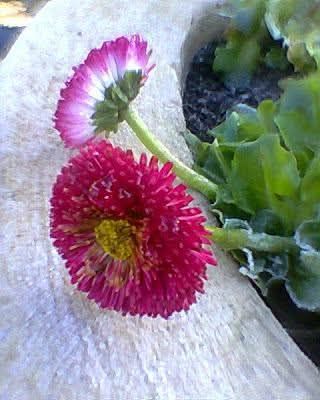
The tulips pushed the primroses away They took the pot from these innocuous plants Nature is not kind in such display The powerful plants can do just what they want.
However, I admire their flowers of red The shape is elegant, the colour clear. And had they been in a much bigger bed Both flowers would give us pleasure without fear.
And now magnolias pink my eyes adore Two of them I see from off the bus. A visual parable, a story for The short sweet life of all including us.
We deceive ourselves in order to survive. But shallowness makes trivia of our lives
London is bewildered by its roads The Circular, the North,the South, th da wase QCodes The Morse and the Enigma, Turing broke So now we have new bicycles with spokes Once we had the A to Z in hand Turn it upside down and you’ll be grand New technology has made great strides Carrying us to Eden ,what a ride The motorways are empty for tonight God decided we had too much Light He taught the bare cheeked Moon on Jesus’ Mount To turn the other side when love’s about I liked to use a compass and a map But now, my dear, most everything’s on tap I crouch beneath my sister as she drives In the dark on the M 25 But if it’s closed, we are completely foxed We left the old Road Atlas in a box Along with all my ex’s underpants And naturally his principles of Kant We may be in Watford or in Bucks I often wonder what will rhyme with luck We may be near St Albans, we can’t see The car ran up the trunk of an oak tree We rang 999 and they are here A fire engine filled up with Kentish beer A ladder for the ladies to climb down Now they are just women on the town London exists no more as a real spot MI 5 are joining all the dots
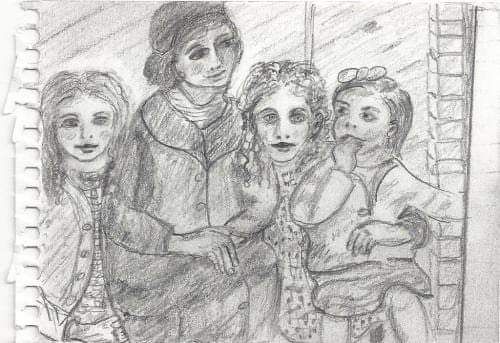
I tried to draw this from a photograph when I had only just begun to learn joy so it’s not at all realistic but there’s something about it that my sister likes and so because of that I have helped her she is the one on the extreme left.
I’m the only one still alive now
It’s the cancer. I’ve not long left
You’ve been a good sister
For several days I was able to send messages to comfort her and help her and once you could no longer speak one of her sons read out one of my poems to her and a little smile came on her face.
She was still a devout Catholic I never believed that I would consider giving anybody some rosary beads or that it might help anybody but in fact she told was she was using her fingertips because she had no beads to pray on and so I sent her some rosaries and she was holding them in her hands when she died.
I asked if I could have them then but they had left them in her hands.
So I have to get some more because it’s a sort of link to her and to my mother and others. I don’t think it’s idolatry. People need something to touch when they had no longer speak properly or at all and she knew when she touched them that I had sent them to her so it was all I could do since she was 160 miles away from me.
In a way hearing the diagnosis was worse than when she actually died because at first she was in a terrible mental state and was suicidal but she lived long enough to see her daughter’s second baby born and the baby was one month old when she died
Now the babys 10 months old and very lively and full of interest but of course she won’t remember my sister that is what is so sad for her mother.
Soul making is a phrase from Keats.{ link to article by Jeffrey C. Johnson in Paris Review]
We saw Wolf Hall on TV recently and it is so wonderful.I am just writing down a few of my thoughts not about that but about Anne Boleyn… I meant it to be funny but I could n’t manage that after seeing the play.
ANNE BOLEYN
Anne Boleyn withheld to win
As Henry lusted in his sin.
Once a virgin,sweet Madonna;
Henry turned in rage on her.
She bore him but one living child,
For her quips,she was reviled.
Henry knew not the fault was his
It seems the king had syphilis.
Or Anne was rhesus negative
then just her first born child would live.
We women make our worst mistake
When power for love we wrongly take
Our strength lasts but till we submit.
We need less love and far more wit.
Whatever lusty men may say,
their “love” dies when they get their way.
And they will take their wife by force
As cannons pound on oaken doors.
As for women,we must not
Promise gold we have not got.
Conception is a game of chance;
We come to be by happenstance.
we sin in pride in promising
What only God or Nature bring.
We deceive and trick and charm
At last our hearts bang in alarm
The man who begged upon his knees
Chops off our heads when we displease.
For Emperors and Kings and Lords
Wield fearful power by the sword.
Yet when for judgement they shall stand
How will point the knowing hand?
And just like us they’ll ashen be
When true majesty they see.
Into dust and crumbled ruin
they will go by their own doings.
Each day create with grace your soul.
Cracked shall be the golden bowl.
Keats wrote this extract below [read all by clicking on soul above[ and he died when aged only 25 years:
I will call the world a School instituted for the purpose of teaching little children to read—I will call the human heart the horn Book used in that School—and I will call the Child able to read, the Soul made from that school and its hornbook. Do you not see how necessary a World of Pains and troubles is to school an Intelligence and make it a soul? A Place where the heart must feel and suffer in a thousand diverse ways!
It seems that our friends are part of our immune system in a very real sense to coin a phrase. If you see what I mean etc
We don’t need an excuse to hug our friends
Find a friend or family member and ask for a hug. That warm squeeze will give you a lift — and could even make conflict less upsetting, according to one study.
Hugging could also help your immune system, another study says.
Don’t put a comments box on your post because if people put comments on you’ll have to reply to them and that will take up your precious time.
Never read blogs written by other people. You have read all the great writers so why bother?
Don’t allow “likes” either because people might “like” things that they’ve not read
Then the only statistics you get will be the number of visitors and their countries. You don’t even need to bother to look at that
So why would you continue to blog once you put all those restrictions on your blog?
Well you just have to try it. You are still writing and someone might read it possibly but you will never know and you’ll certainly won’t know who they are or whether they are interested in the same things as you etc
Maybe you want to show your friends or your family that you have a blog but you don’t want anything negative written on it although as a matter of fact most people are very courteous and dont write really horrible comments like the following
Do you consider yourself to be a poet? You must be very conceited.
These poems are getting worse month by month so this is my duty to tell you that you’re wasting your time here. You’d be better off going for a walk.
Do you consider these to be short stories? Even children wouldn’t bother to read them and they normally like stories are some cartoons as well it might help but I can’t guarantee that unless you improve the quality.
Well if only you would stop writing it would free up 45 minutes of my time every day and I could stay in bed longer in the morning looking at the clouds go past my window.
Of course I could ignore your blog but you might think that was rude
Perhaps you could write an article about why people like to stay in bed longer in the morning. And is it true when you are getting older?
Personally I’m sick and tired of being in bed and I’m in bed because I’m sick and tired.
















 How my heart speaks