
https://poets.org/poem/habit-perfection

Search
The Habit of Perfection


Elected Silence, sing to me
And beat upon my whorlèd ear,
Pipe me to pastures still and be
The music that I care to hear.
Shape nothing, lips; be lovely-dumb:
It is the shut, the curfew sent
From there where all surrenders come
Which only make you eloquent.
Be shellèd, eyes, with double dark
And find the uncreated light:
This ruck and reel which you remark
Coils, keeps, and teases simple sight.
Palate, the hutch of tasty lust,
Desire not to be rinsed with wine:
The can must be so sweet, the crust
So fresh that come in fasts divine!
Nostrils, our careless breath that spend
Upon the stir and keep of pride,
What relish shall the censers send
Along the sanctuary side!
O feel-of-primrose hands, O feet
That want the yield of plushy sward,
But you shall walk the golden street
And you unhouse and house the Lord.
And, Poverty, be thou the bride
And now the marriage feast begun,
And lily-coloured clothes provide
Your spouse not laboured-at nor spun.
This poem is in the public domain. Published in Poem-a-Day on January 14, 2024, by the Academy of American Poets.
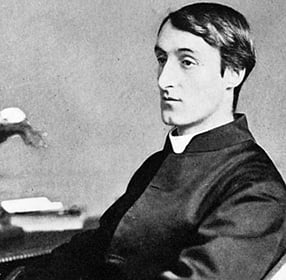
Born at Stratford, Essex, England, on July 28, 1844, Gerard Manley Hopkins
Themes
About this Poem
Originally written in 1866, a fragment from “The Habit of Perfection” was first published in Robert Seymour Bridges’s anthology The Spirit of Man: An Anthology in English & French from the Philosophers & Poets (Longmans Green & Co., 1916). In “Food Metaphors in Gerard Manley Hopkins,” published in Victorian Poetry, vol. 55, no. 3 (Fall 2017), Mariaconcetta Costantini, professor of English at D’Annunzio University of Chieti–Pescara, Italy, writes, “Another struggle against the lure of the senses, including taste, is dramatized in ‘The Habit of Perfection.’ Like other lyrics of Hopkins’s university years, this poem in quatrains exalts the human capacity for renouncing physical pleasures in favor of spiritual ones [. . .]. [T]he poet turns the body and its perceptive organs into vehicles for achieving a condition of bliss that entails the final rejection of corporeality. Such a strategy is evident at the beginning of each quatrain, which opens with a direct reference to man’s sensual powers of perception / communication: hearing, speaking, seeing, tasting, smelling and touching. Stanza four, in particular, focuses on the pleasures of the palate—‘the hutch of tasty lust’—which are visibly evoked before the invitation to transcend them. Despite the use of negation, the speaker gives flesh to the palate’s ‘desire . . . to be rinsed with wine,’ while the other references to drinks and aliments (‘The can . . . so sweet, the crust / So fresh’) attach physical valences to the ‘fasts divine.’”
Sign up for Poem-a-Day
* indicates requiredEmail Address *
More by this poet
Z
The boughs, the boughs are bare enough,
But earth has not yet felt the snow.
Frost-fringed our ivies are, and rough
With spiked rime the brambles show,
The hoarse leaves crawl on hissing ground,
What time the sighing wind is low.
Gerard Manley Hopkins
1863
The Sea and the Skylark
On ear and ear two noises too old to end
Trench—right, the tide that ramps against the shore;
With a flood or a fall, low lull-off or all roar,
Frequenting there while moon shall wear and wend.
Gerard Manley Hopkins
1918
41 [No worst, there is none. Pitched past pitch of grief,]
No worst, there is none. Pitched past pitch of grief,
More pangs will, schooled at forepangs, wilder wring.
Comforter, where, where is your comforting?
Mary, mother of us, where is your relief?
My cries heave, herds-long; huddle in a main, a chief
Woe, world-sorrow; on an age-old anvil wince and sing—
Gerard Manley Hopkins
2018
Related Poems
I Must Be Far
I must be far from men and women
To love their ways.
I must be on a mountain
Breathing greatly like a tree
If my heart would yearn a little
For the peopled, placid valley.
I must be in a bare place
And lonely as a moon
To find the graceless ways of people
Elsa Gidlow
1923
Reflections
I walked along the countryside
At eventide,
And everywhere
The road was fair
With moons of water here and there,
Into whose heart the grasses spied.
And suddenly upon them shone
The light of the City’s eye,
Reflected from a bulb on high.
Ameen Rihani
1921
It is a Beauteous Evening, Calm and Free
It is a beauteous evening, calm and free,
The holy time is quiet as a Nun
Breathless with adoration; the broad sun
Is sinking down in its tranquility;
The gentleness of heaven broods o’er the Sea;
Listen! the mighty Being is awake,
And doth with his eternal motion make
A sound like thunder—everlastingly.
William Wordsworth
1807
Newsletter Sign Up
Email Address
Support Us
Follow Us
Footer
© Academy of American Poets, 75 Maiden Lane, Suite 901, New York, NY 10038

 How my heart speaks