Between you and me, we ought to be able to get this lady pregnant.
• She is numb from her toes down
This man wanted his own bed so I told him he could have it for £100 cash.
By the time he was admitted, his rapid heart had stopped and he was feeling better.
• Patient has chest pain if she lies on her left side for over a year.
• On the second day the knee was better and on the third day it had completely disappeared.
• She has had no rigors or shaking chills, but her husband states she was very hot in bed last night.
• The patient has been depressed ever since she began seeing me in 1983.
• Patient was released to outpatient department without dressing.
• I have suggested that he loosen his pants before standing and then, when he stands with the help of his wife, they should fall to the floor.
• The patient is tearful and crying constantly. She also appears to be depressed.
• Discharge status: Alive but without permission.
• Healthy appearing decrepit 69 year-old male, mentally alert but forgetful.
• The patient refused an autopsy.
• The patient has no past history of suicides.
• Patient has left his white blood cells at another hospital.
• The patient’s past medical history has been remarkably insignificant with only a 40 pound weight gain in the past three days.
• She slipped on the ice and apparently her legs went in separate directions in early December.
• The patient experienced sudden onset of severe shortness of breath with a picture of acute pulmonary oedema at home while having sex, which gradually deteriorated in the emergency room.
• The patient had waffles for breakfast and anorexia for lunch.
• The patient was in his usual state of good health until his aeroplane ran out of gas and crashed.
When she came into the clinic she said,
I want to see Jesus
Unfortunately he is not a doctor.
But then God created the world and he’s not a doctor!
Marry now,pray later.
Buy two coffees,get two pees
Work hard,pray hard and love softly.
He conquered but never felt at home.He had blundered into the outside lav
Buy today,cry tomorrow.
Why not rent a husband by the month? August,December and January… and maybe April
No use locking the door if the window is open.
Miaow now,purr later.
A cat at play keeps the doctor away.
Cats are good for the sole.
I cleaned up Renee with a fine tooth comb… nits,what a pain they can be.
If you are lonely, do listen to others.
If you have no others ,listen to the radio and /or God. and any holy people around
It’s better to meditate only if you are well grounded in reality.Do good works instead and be merciful to old fools
Fantasy wastes the time that we don’t have.
Daydreams are better when you are asleep.
Acting selfishly is unhealthily practically.
Far gone are my grammer and my spilling.
I never was no good at English except at speaking it.
He said,you are not a native of London.I said, no they were nearly all killed by the Romans 2,000 years but we don’t like to complain now.They all died en passant as the Germans might say.Fechen gee hoitch?
I dyed my hair white as I wanted a Freedom Pass.But who else is free?
the answers she gave to a New Zealand journalist recently about the effects of loneliness and the “beautiful benefits” of solitude. And here’s her blog about how desperately important connection and communication can be in a time of pandemic.
“I know how distracting it can be if you are having an interesting conversation and have to eat and order as well,” she says. “Although I won’t be eating much. But you must order something that you would really like, perhaps duck or prawns; that would make me feel a lot better.” I tell her that I am happy with her vegetarian choices of golden tofu (which she says “sounds lovely”), crispy dumplings and pad Thai.
Infuzions Thai in Cammeray is our venue because of its proximity to a studio where the Balmain-based Dowrick has been recording the audio book for Intimacy and Solitude.As it happens, recording has been completed, so there is plenty of time to move around the largely empty restaurant in search of the best spot for recording and photography.
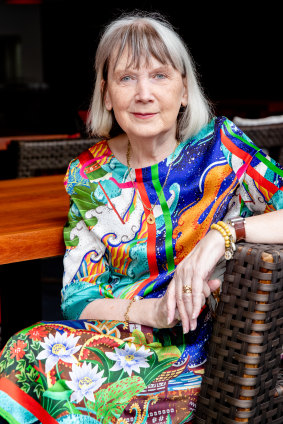
Stephanie DowrickCREDIT:EDWINA PICKLES
Dowrick’s vibrantly patterned dress, in what interior designers would call “jewel” colours, blends well with the richly coloured Thai cushions and warm woods. “Lead, Kindly Light,” she jokes, quoting a famous hymn, as we search for the most flattering spot. In addition to being a versatile author of almost 20 fiction and non-fiction books, and a psychotherapist, Dowrick is an interfaith minister who was based at Pitt Street Uniting Church from 2006 to 2017. More recently she has been co-leading “sacred gatherings” at the InnerSpace Centre in Five Dock.
Advertisement
null
It quickly becomes clear that the meal is secondary to Dowrick, who I have met several times over the years through her publishing work and journalism. She wrote a popular Inner Life column for Good Weekend between 2001 and 2010, and was a regular guest of both Geraldine Doogue and Tony Delroy on ABC radio. These days she contributes opinion pieces to newspapers, primarily on social justice, human rights and ethical issues. And as she is my friend on Facebook, I am also aware of the joy she reaps as a mother and grandparent – and of her “later life” marriage in 2017 to Darwin-based paediatrician and health activist Paul Bauert. (“Because he lives 4000 kilometres from my home, I can continue to evolve my understanding of intimacy as well as solitude!”)
Today, and perhaps always, conversation and ideas interest her. Dowrick is a woman of intense blue eyes, a direct gaze and gently probing questions; she invites confidence and confidences, and indeed becomes the interviewer as much as the subject. It is fortunate that she arrived with her background dossier.
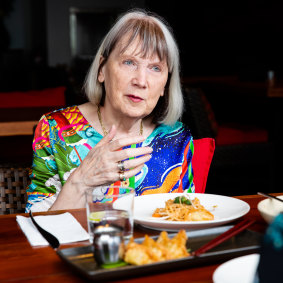
Stephanie Dowrick.CREDIT:EDWINA PICKLES
First published in 1991, Intimacy and Solitude was an international bestseller and has been revised and expanded several times since then. The latest edition was sparked by a recognition that the unpredictable events of 2020 had made the book’s message more relevant than ever. It is an encouragement for readers, a message of hope that blends readable case studies with deeply considered but accessible wisdom. Dowrick is convinced that we all have the potential to respond to both familiar and new situations freshly and creatively, especially if we renew our closeness to ourselves and to other people.
Comedian and author Magda Szubanski, musician Clare Bowditch and politician Kristina Keneally are among her raft of fans.
“If the pandemic taught us anything at all, it is that we are utterly and inevitably connected – and not only with this earth on which we wholly depend in all its brilliance, beauty, fearsomenesss and biodiversity,” Dowrick writes in her new 7000-word introductory essay. “COVID-19 showed us plainly that we protect ourselves best by willingly and generously protecting one another – even when separate or ‘distanced’.
“As powerful as those two potent words are individually – intimacy and solitude – they together describe and evoke a steadiness of inner support and resourcefulness that brings more than resilience and inevitably extends beyond ourselves to other people.”
‘My instinct has been unwavering: that not just I, but most of us, want to do at least somewhat better in our connections with others.’
Dowrick says that in addition to interviewing many people for the book, and “surveying screeds of psychological wisdom for the finest ideas”, she reviewed her own rich catalogue of “missteps” as well as what had made life “most worth living”. “My instinct has been unwavering: that not just I, but most of us, want to do at least somewhat better in our connections with others.
“A relatively healthy sense of self lets you accept what others can give you, even when it isn’t quite what you yearned for … It’s also dependent on trusting that your life matters – whether or not it is lauded by others. And that you deserve to care for yourself as respectfully and supportively as you would a trusted and cared-for friend.”
Golden tofu on crispy wonton with crushed peanuts.CREDIT:EDWINA PICKLES
Dowrick was born in New Zealand and spent some of her formative years in isolated Maori and Pacific Island communities, where her parents were teaching. Her mother, Mary, died in her late 30s, when Dowrick was eight. It was, of course, a truly terrible experience and not one that she wishes to dwell on overly in an interview.
However, in her book she writes of the loss, which has affected the rest of her life: “Unsurprisingly, I was incapable of much self-care, never mind what ‘independence’ adds up to. I had gained immeasurably from the years of unstinting love my mother could give me when she lived. She was also, in her moral and emotional intelligence, in her creativity and pride in her profession as a gifted teacher and her commitment to service to others, an exceptional example to me.”
In the late 1960s, a lack of career opportunities in New Zealand for a clever and determined young woman led Dowrick to head for London where, with delight, she fell into book publishing (where senior women were still a rarity and her colleagues, mostly men from public schools, addressed each other by their surnames).
Crispy dumplings with leek, mushroom and ginger.CREDIT:EDWINA PICKLES
Her star rose. At the height of “second wave” feminism, in 1977, she convinced British publishing entrepreneur Naim Attallah to back a groundbreaking feminist imprint, The Women’s Press, and became its first managing director. Writers Janet Frame, Andrea Dworkin, Michele Roberts and Lisa Alther were among those who joined the list and, in 1983, with the Commonwealth publication of Alice Walker’s Pulitzer Prize-winning The Color Purple, commercial success was added to its cult status.
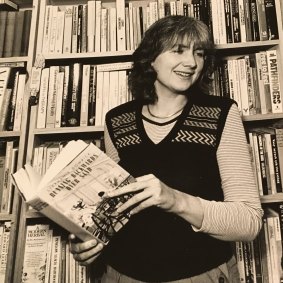
Stephanie Dowrick in 1985 after the publication of her first novel ‘Running Backwards Over Sand’.
Shortly afterwards, Dowrick moved to Sydney and had two children, Kezia and Gabriel, in quick succession; her first novel, Running Backwards over Sand, which tells of a journey of self-exploration by a young woman who has lost her mother, was published in 1985. Subsequently, she worked part-time as a publisher at Allen & Unwin and broadened her writing to focus on self-development and further explored spirituality, most particularly through the work of German poet Rainer Maria Rilke (on whom she wrote a PhD thesis that evolved into a book, In the Company of Rilke).
On learning to live with isolation, the author, an “impatient patient” who fell ill for four months and was in hospital for 10 weeks before the pandemic hit, says that while the lockdown was a crisis of communication for social beings it could also offer “an opportunity to consider with fresh interest how we can more thoughtfully support others – receiving with grace and gratitude what they may have to give”.
Pad Thai with tofu.CREDIT:EDWINA PICKLES
While many have been feeling “flat”, she says it is important to be more consciously open to receiving, even when what’s coming your way doesn’t quite fit your expectations of how things should be. Like any change, some detachment is needed to see things anew, as is stillness, which is best achieved by not being constantly busy. (“Being busy is for me a psychological defence.”)
“In illness, our world shrinks. In social isolation, our world shrinks. Yet it’s precisely now that our vision must enlarge. Choosing to be the smallest bit more generous, perhaps more tolerant in both directions (giving and receiving), is itself an act of empowerment, an act of self-respect and even love – for ourselves and for all with whom we share this planet.
The bill please.CREDIT:SYDNEY MORNING HERALD
“When we’re down, our thoughts leap into a future that’s frightening. When we slow down, by contrast, we can experience this moment and – when we can – infuse it with greater vitality and hope. We can surround people and situations with the energies of loving-kindness and care, rather than anxiety or raw terror. And when we do this, we ourselves will benefit.”
The afternoon is slipping away, but Dowrick proposes we move on to coffee and pavlova. She wants to ask me some more questions.
Infuzions Cammeray
439 Miller St, Cammeray
(02) 9957 1122
Daily, 11.30am-9.30pm
Intimacy and Solitude by Stephanie Dowrick is out now from Allen & Unwin.Save
Shona Martyn is Spectrum Editor at The Sydney Morning Herald. She was previously the Publishing Director of HarperCollins, the founding editor of HQ magazine and an editor of Good Weekend.Connect via email.
Levinas’s philosophy is clearly governed by a deep-seated pacifism. In fact, it is one of Levinas’s central contentions that Western philosophy is wedded to a counter-ethical process of conflict. It is this radical idea that underpins Levinas’s first magnum opus, Totality and Infinity (1961).
This treatise opens with a discussion of war – an all-encompassing, as well as literal term for conflict. Levinas states that it is the Western preoccupation with the truth that generates this conflict. In short, if one is able to apprehend the truth, one is essentially self-sufficient or “total”.
For Levinas, this reassuring sense of totality is disastrous for it harbours an underlying antagonism towards others who are liable to challenge one’s authority.
Levinas traces this conception of totality back to the teachings of Socrates and Plato. According to classical authority, the self is literally self-contained – it is able to contain the truth. For Levinas, this spirit of autonomy was perpetuated in the work of philosophers as diverse as Plotinus, Bishop Berkeley and Hegel. In addition, Levinas also detected a return to this spirit of self-sufficiency in the phenomenological work of his former tutors, Husserl and Heidegger.
In an attempt to evade this tide of thought, Levinas turned his attention to the constitution of subjectivity. For Levinas, far from being self-sufficient or total, the self can only exist through reference to the non-self. In short, self-knowledge presupposes the existence of a power infinitely greater than oneself. Echoing the famous Cartesian cosmological argument, Levinas thus suggests that the subject is indebted to the idea of infinity. In direct opposition to contemporary continental thought, Levinas thus reinstates the subject – a subject that encounters itself through the mediation of an-Other. According to Levinas’s intricate argument, such an encounter precedes the disastrous desire for truth.
Crucially, Levinas argues that the encounter between the self and the Other is always passive. In slightly different terms, one welcomes the Other as the measure of one’s own being. It would seem to follow that one’s subjectivity depends upon a non-aggressive or non-violent interface. Given its passive nature, Levinas concludes that this interface is a proto-ethical moment that precedes all other ethical discourse. In this way Levinas undercuts traditional ethical debate.
Today, Levinas’s ethical thought is frequently discussed in relation to diverse academic fields beyond the traditional boundaries of philosophy. Disparate fields such as sociology, literary theory, historiography and anthropology have all benefited from the priority Levinas accorded to “the Other”. This ubiquity stands as testimony to both Levinas’s profundity and growing contemporary relevance.
At the time of writing, Lawrence R Harvey was teaching and completing his doctoral thesis on Levinas and the ethics of representation.
He wanted some companion during the night but nobody was able to be with him.
I’m sure that some of us have had a similar experience.
So would a helper have said to Jesus
Why don’t you listen to some music
I know the radio has not been invented yet but you are God…. So make yourself a radio and listen to music
Why don’t you turn your mind away from fear of death
I’m thinking about signing up for an art class,myself.
I know that Jews can’t worship images but there’s no harm in making some images was paint or pastels.
It might lift your mood..
Now Jesus, have you drunk enough water today? Have you had a proper meal?
(Well they had the last supper I believe.)
Don’t you think we should all go home and go to bed and have a good rest and forget about this event that’s going to happen?
Now Jesus what you need is a good holiday.
You know it’s not so far to Cyprus and it would be a break from living in this occupied territory.
The Romans have a lot to answer for.
And would Jesus have lost his temper and called out to the disciples
Satan get thee hence.
Then somebody will just say, if you feel bad at three o’clock in the morning it’s often a sign of depression and I believe there are some new antidepressants on the market now.
Why don’t you see the doctor tomorrow and ask him can you have a free sample because there is no NHS in the holy land.
And that’s why Jesus stayed in the Garden of Gethsemane by himself because he did not like what his followers were saying to him.
And it was all because they didn’t want to actually know how he was feeling: that he was sweating blood that he was afraid that he was terrified but he was going to continue on the path that he believed God had set him on.
And after all he was the son of God. So he believed and there is some evidence to favour that view.

























 How my heart speaks