

Day: Dec 30, 2023

The return of psychoanalysis


Never say logic again.


My foreign students said I was too warm to be British,so turn off your heating now or face execution as a traitor.
What people forget is we Brits are a mixed race… then we have the nerve to call people,wogs,dagos and foreigners.we are all foreigners here apart from the Welsh.
Some students told me their dreams;s,anything to avoid algebra!
I personally found quantum theory helps to avoid emotional overspill…
and topology is useful for dressmakers
Dreams and love are all very well… if you are a millionaire.Till then keep on with figures,asymmetry and words.
Friends are no use unless you are a real person.Whatever she is.
Schizophrenia is to some extent cowardliness………….keep your feet on the ground and say straight out what you mean without entering into wordplay,fey ways,being a seer and seeing how life veers.It’s all absolute bullshit.Only not all bulls are male.
Some bulls are e-male.
Depression is mainly the result of being driven.So give up the chauffeur and take your time.
Some loose women are fast and vice versa.Isn’t logic trying?
I was so thin when I began lecturing I got half fare on the bus and I was 25.So studying keeps you young.Never say,Dirac,again.
I was so thin then I bought children’s clothes but now I am twice the size.Then they said I might have TB,now they say I could get diabetes.Take your pick……there’s something in me that will never take the middle way.My middle gets in the way.
We all eat too much considering how little we do.Bring back the scrubbing board,brush and hard green soap.But if I eat less I faint…. what an ‘orrible feeling as your vision shrinks to a pinpoint and you sweat all over but more on the top of the head…. and you throw yourself onto the floor… or the ceiling.
Once we were having a meal with another couple…with one of those heated plate things on the table.I passed out and for years they talked about it.They divorced later and blamed me!Still,I gave them something to talk about so maybe I helped.
If you get disturbed stop introspecting and sweep the floor or the pavement.Do useful things with your hands and help others.Be polite even if you think they are the Devil
Related articles
- Feels like home! – helps foreign students to settle in Vienna (lifeinviennaa.wordpress.com)
- Universities urged to open doors to foreigners (universityworldnews.com)
- Living in courage and creative utilization (sxmead13.wordpress.com)
- Courage (selfinthemaking.wordpress.com)
Share this:

Mary and Cameron

Mary goes to the clinic and meets David Cameron
Mary was sitting down feeling quite lonely in the waiting room outside the doctor’s office when she saw Emile hiding under a chair..
What are you doing,she whispered.I’m glad of your company though.
I jumped into your cab, the cheeky cat informed her proudly
I want to be there when he examines you in case he makes vulgar remarks
Don’t worry,she answered,they always have a chaperone nowadays.
Just then a pretty young black nurse took Mary into a room and said to her
Take off your underpants!
I don’t wear underpants,said Mary,but I can go home and get my husband’s if you want me to.
We use underpants as a generic term,the nurse informed her in a kindly yet menacing voice.
Wow,they are so intelligent nowadays,I don’t think I knew what generic meant till recently Mary told herself stupidly
I have no underpants,Emile meowed. crossly
No and I am not making you any.I have quite enough washing to do already.Mary responded like a mother.
It’s not fair, said Emile.All my friends have underpants and T shirts too.
Soon the doctor came in and looked nervously at Mary and then at her female parts.
Mary was used to this but all of a sudden she got a nasty pain
Ow,ow,ow,she shrieked,what is that?
It’s ok,said the nurse,just older ladies are not used to this sort of thing.
I’ll have you know many older ladies are very used to it but not when they are unaroused.Besides men’s organs are kinder than metal or plastic if the lady is willing.Can’t you put more lubricant on the damned thing
The doctor tried to remove the speculum but was clearly somewhat agitated.
Ouch,cried Mary.Ouch.
Thank goodness I didn’t know it would hurt.Do you think we should be shown a romantic mildly arousing film in the waiting room to make it easier?
We can’t do that,said the nurse.We might be accused of running a brothel.Still ,we could use more money in here.
But the doctor is not paying me,said Mary.I am paying him, in a sense,as a taxpayer.And you too,dear.
You are too clever for me,said the nurse sharply as she admired Mary’s tan leather handbag from TKMaxx stuffed with set squares and cameras
I shall bring a vibrator next time,Mary told her,though she had never even seen a vibrator except in a picture.Still.she had to say something.And why should she not benefit from modern science?Boots sell them,she seemed to recall…
You can’t bring a vibrator in here or the doctor will be angry ,as he might be accused of misconduct if you enjoyed yourself, the nurse whispered, though why should you not enjoy it,she said in a puzzled tone ;as if she had never thought like this before.
I thought it was only misconduct if the doctor enjoyed himself,Mary cried loudly.
He has seen so many ladies, it is just like seeing into a mouth for him,said the nurse churlishly thus taking away Mary’s pride in her unique anatomy.
I expect one gets used to anything in time,Mary murmured,but I hope he will not need to do that again to me.
No, you seem ok,the doctor said,but I seem to imagine I can see a cat under the table.What is he doing?
I am just keeping an eye on you,mewed Emile.I live with Mary.
No animals are allowed in here ,the doctor shouted in a paranoid manner.
A bit late now,meowed the cat.Are you sending for the cat police?
Dr.Grey picked up a very large speculum and threatened to strike Emile with it
Now then,said the nurse, he might scratch my legs.Leave him alone.He’s just protecting her.And I had just sterilised that.
Fat lot of good Emile was,Mary thought to herself.
The doctor approached Mary and told her she would be seeing a consultant soon… in the meantime should she do anything to prepare… she asked.
Well, do try to relax if you can, he told her gently.It is trying for ladies of riper years to attend hospitals but we only want to help you.
I’ll have to help myself,Mary thought wryly, laughing inside, as she got down off the table and put on her red and purple knickers or “underpants” as they are now referred to by health professionals
.Thank God,that is over,she whispered to Emile.Let’s run out and get a cab.
She hobbled to the door and phoned the taxi firm with her mobile.I just want to get home she told the driver.
Don’t we all, he said in an Eton accent.Surely it’s not David Cameron in disguise canvassing patients?Thank God he’s not conducting pelvic exams on them!That would lose him the election whether he was any good or not… in my view,but then what do I know about the British electorate?It might be the key to our future as a nation.Think about it!No,stop!
Share this:

Mary,Annie and Dave

Watercolour by E.Limbrey 2019 copyright
When Mary woke up, it was very sunny and bright. Then, she realised, she had forgotten to turn off the light over her bed, when she went to sleep. So, it was not sunny at all; in fact, it was the middle of the night!
“Oh dear,” said Mary to herself. “Shall I make a cup of tea or, since the landing light is not working, maybe I should stay here.” She closed her eyes and began to think about whether there was any space in the house to store the hundreds of chargers and USB cords that she seemed to have acquired over the last 20 years.
Soon, she was thinking about what she was going to wear, because Annie and she were going to a poetry reading in the Civic Centre at 4 p.m. and, before that, she had to do some shopping. It was much easier in the 1960s and 70s, when everybody wore denim all the time, whatever they were doing, except of course in bed. “We don’t actually know whether anybody did wear denim in bed but I would not recommend it, because denim is very stiff when you are in bed.” Mary mused.
Before long, Mary fell asleep again and started dreaming about Stan, her dear husband. They were in the kitchen, scrubbing the gas cooker with Brillo pads. Stan did not speak to her, nor did she ask him why he had never cleaned the cooker during the many years of their marriage. There was no point in dwelling or ruminating over what has gone.
On the other hand, it would have been nice if she had dreamed that they were staying in a hotel overlooking Poole Harbour and, from there, were magically transported to Corfe Castle, to have lunch in a beautiful restaurant. Stan and Mary had been for a walk along the top of a hill overlooking Poole Harbour, when they were younger, and it is one of the most beautiful places she had ever seen; certainly, more beautiful than Torremolinos.
When Mary woke up again, it was 8 o’clock and Emile was mewing on the landing, as he wanted his breakfast. Once she was down in the kitchen, eating her Weetabix, Mary heard a noise and, when she turned around, she saw her neighbour, Annie, dressed in purple velvet, standing at the back door
“Why are you up and dressed so early, Annie?” Mary cried “and why are you wearing velvet in January? It doesn’t look very warm to me.”
“Don’t worry,” said Annie “I am feeling very hot.”
“In what sort of manner are you feeling hot?” said Mary, quizzically
“You have got a vulgar mind, Mary!”
“Well, you may be 72 but you look stunning and I am sure that men will be staring at you, as you walk down the street.”
“I don’t want men to stare at me” Annie retorted
“Well, in that case, why are you wearing the foundation cream from Rummel St Quarantine, silver beige, and that purple mascara that you bought in Wigan last summer. By the way, why did you go to Wigan last summer?”
“I was following a man on Facebook.”
“But you don’t literally follow them, do you? I thought you just read what they wrote on Facebook. Did he know that you were following him? He might have reported you to the police and said that you were a stalker.”
“No, he wouldn’t do that; he was very nice. Actually, he introduced me to his wife and she took me shopping in this amazing pharmacy, where they had wonderful make-up: mascara in 20 colours and lipsticks in 40 colours!”
“I see,” said Mary “why did you not send me a postcard?”
Just then, they heard a noise by the front door. It was the post and, there on the door mat, was a big picture postcard of Wigan Pier
“Good heavens!” said Annie “why does it take the whole year for my postcard to arrive”
“Don’t ask me,” said Mary “I could understand differential operators but I cannot understand the so called Royal Mail”
She picked up the postcard when, suddenly, she felt dizzy and fell over, clutching at the banisters with her left hand. Emile was very worried; he sobbed and sobbed.
“I think I’d better ring 999.” he said. “we need some help!”
“I think I’m alright.” said Mary “It’s just my hand is a bit painful but I haven’t broken anything.”
But it was too late, as Emile had already phoned.
The doorbell rang and Annie opened the door. In ran Dave, the trans-sexual paramedic, wearing a purple velvet trouser suit and a green silk scarf.
“Is that your new uniform?” Annie asked him politely
“No, I’m not on duty officially but, when I heard it was you phoning, I thought I would come.”
“Well, you see, Mary fell over in the hall.”
“Why?”
“Well, she had just seen a postcard that I sent to her when I was in Wigan last summer and it’s only just arrived.”
“Did you see the Pier?” Dave asked her.
“You know the Pier’s not real; it is a figment of somebody’s imagination, like George Orwell, for example”
“Well, I’ve often heard people talk about Wigan Pier.” Dave muttered nervously.
“Well, Wigan is not on the coast.” Annie told him.
“Don’t test me! I didn’t even do O-level Geography.”
Mary stood up and said “All you need to do is look at a road atlas.”
“I am afraid you are behind the times. People do not have road atlases, because they use a sat-nav.”
“Well,” said Mary “even if I were to use sat nav on my bicycle, I would still like to see where I’m going before I leave home and then I would know if Wigan was on the coast and whether Southport was at the bottom of the Langdale Pikes, if you see what I mean.”
“Yes, I do see what you mean.” Dave said “Let me take your pulse.”
“Where are you going to take it?” Mary asked him, anxiously.
“I will use your wrist but not the left one, because I know you have just hurt it on the stairs …Your pulse seems quite normal, Mary, so I won’t bother to take your blood pressure, because you might get ‘White Coat’ syndrome.”
“But you are not wearing a white coat.” Mary joked.
”That doesn’t matter. I am a Medical Professional, so you can imagine I am wearing a white coat in your unconscious mind, even though I am not”
“My goodness, Dave, you seem to be getting very clever these days; you sound like a Professor from Oxford.”
“I’ve never had the good fortune to meet a Professor in Oxford,“ Dave replied “but I have seen your Professor here in Knittingham, because there is a University here; actually, there are two Universities here now.”
“Yes, I know.” said Mary. “Let’s all go into the living room and have a cup of tea. My cat needs to have his breakfast.”
.Emile crawled out from under the kitchen table, he was shivering with nerves.
“Oh dear!, Emile, I am sorry that I frightened you when I fell over”
“Oh, mama, I thought that you were going to die!”
“Well, I’m not dead yet.” she replied tersely.
“Thank the lord!” cried Dave.
“You sound like an evangelical Christian,” Annie told him.
“Well, I might be an evangelical Christian.” he said, in a rude tone of voice.
“Don’t be so rude, Jesus would not like it.” said Annie, bluntly.
“How do you know? He lived 2000 years ago; they must have been very rude then. I do know that the Jews are very ‘in your face’ and they like arguments” the paramedic replied.
“But that is not the same as being rude to people.”
“And I don’t like arguing; it makes me get migraine. Thank the Lord I never married a Jew,” Annie cried.
“But the Lord was a Jew, himself.” Dave whispered.
“Very true. They are very clever people, you know, and they have been persecuted so much; it’s a miracle that there are any left at all,” Mary told them, uneasily as it caused her anguish to think of the Holocaust and the Museum in Prague
“Well they enjoy their bodies; they are told that the body is good and that sex is good, both for procreation or for recreation or, hopefully, both at once, now and then.” he lectured her
“You seem to know a lot about Jews.” the women said “Are you Jewish?”
“No, I am not Jewish, although my mother was, I believe, but she died when I was only 3 years old and I never learnt anything about that religion … but I know they can’t eat pork”
“Who brought you up?” said Annie.
“My father and his sister brought me up and I like both of them, and that is why I am a trans-sexual dresser, because I like women’s clothes and men’s clothes, depending on the weather …You have never asked me before about my background.”
“You just seem so British.” Mary told him.
“Well, I am British; I was born in Clapton.”
“What a shame it was not Clacton-on-Sea, because there was a pier there, unlike Wigan, and I am sure that you would have liked to grow up by the sea.”
“Yes, but Clapton was also an interesting place to grow up; there are people from all ethnic groups, including Jews, Muslims, black, brown, white, Irish people, Catholics, Protestants, evangelical missionaries …….”
“For God’s sake, stop!” Annie told him “I have had quite enough. How are you feeling, Mary?”
“I was feeling alright, actually, until you began asking Dave about his background. Mind you, it is very interesting because, if your mother is Jewish you are too, so Dave is actually Jesus.”
“I don’t believe it.” said Dave “I am not the Messiah.”
“But would you know, if you were the Messiah?”
“Yes, I’d imagine so, but we can never be absolutely sure about anything. Perhaps my time has not yet come.”
“And I hope it never does!” cried Emile
And so say all of us
Share this:

Intimacy and solitude: S.Dowrick’s fascinating book

D
the answers she gave to a New Zealand journalist recently about the effects of loneliness and the “beautiful benefits” of solitude. And here’s her blog about how desperately important connection and communication can be in a time of pandemic.
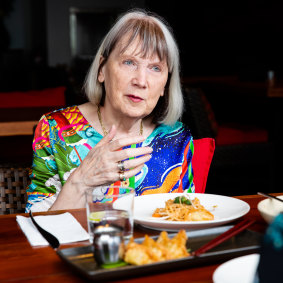
“I know how distracting it can be if you are having an interesting conversation and have to eat and order as well,” she says. “Although I won’t be eating much. But you must order something that you would really like, perhaps duck or prawns; that would make me feel a lot better.” I tell her that I am happy with her vegetarian choices of golden tofu (which she says “sounds lovely”), crispy dumplings and pad Thai.
Infuzions Thai in Cammeray is our venue because of its proximity to a studio where the Balmain-based Dowrick has been recording the audio book for Intimacy and Solitude. As it happens, recording has been completed, so there is plenty of time to move around the largely empty restaurant in search of the best spot for recording and photography.
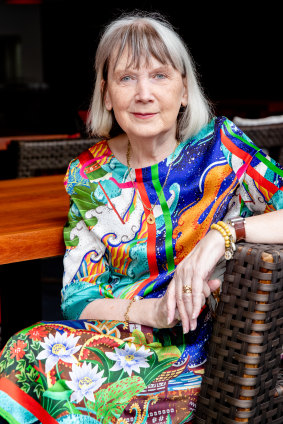
Dowrick’s vibrantly patterned dress, in what interior designers would call “jewel” colours, blends well with the richly coloured Thai cushions and warm woods. “Lead, Kindly Light,” she jokes, quoting a famous hymn, as we search for the most flattering spot. In addition to being a versatile author of almost 20 fiction and non-fiction books, and a psychotherapist, Dowrick is an interfaith minister who was based at Pitt Street Uniting Church from 2006 to 2017. More recently she has been co-leading “sacred gatherings” at the InnerSpace Centre in Five Dock.
Advertisement
null
It quickly becomes clear that the meal is secondary to Dowrick, who I have met several times over the years through her publishing work and journalism. She wrote a popular Inner Life column for Good Weekend between 2001 and 2010, and was a regular guest of both Geraldine Doogue and Tony Delroy on ABC radio. These days she contributes opinion pieces to newspapers, primarily on social justice, human rights and ethical issues. And as she is my friend on Facebook, I am also aware of the joy she reaps as a mother and grandparent – and of her “later life” marriage in 2017 to Darwin-based paediatrician and health activist Paul Bauert. (“Because he lives 4000 kilometres from my home, I can continue to evolve my understanding of intimacy as well as solitude!”)
Today, and perhaps always, conversation and ideas interest her. Dowrick is a woman of intense blue eyes, a direct gaze and gently probing questions; she invites confidence and confidences, and indeed becomes the interviewer as much as the subject. It is fortunate that she arrived with her background dossier.
First published in 1991, Intimacy and Solitude was an international bestseller and has been revised and expanded several times since then. The latest edition was sparked by a recognition that the unpredictable events of 2020 had made the book’s message more relevant than ever. It is an encouragement for readers, a message of hope that blends readable case studies with deeply considered but accessible wisdom. Dowrick is convinced that we all have the potential to respond to both familiar and new situations freshly and creatively, especially if we renew our closeness to ourselves and to other people.
Comedian and author Magda Szubanski, musician Clare Bowditch and politician Kristina Keneally are among her raft of fans.
“If the pandemic taught us anything at all, it is that we are utterly and inevitably connected – and not only with this earth on which we wholly depend in all its brilliance, beauty, fearsomenesss and biodiversity,” Dowrick writes in her new 7000-word introductory essay. “COVID-19 showed us plainly that we protect ourselves best by willingly and generously protecting one another – even when separate or ‘distanced’.
“As powerful as those two potent words are individually – intimacy and solitude – they together describe and evoke a steadiness of inner support and resourcefulness that brings more than resilience and inevitably extends beyond ourselves to other people.”
‘My instinct has been unwavering: that not just I, but most of us, want to do at least somewhat better in our connections with others.’
Dowrick says that in addition to interviewing many people for the book, and “surveying screeds of psychological wisdom for the finest ideas”, she reviewed her own rich catalogue of “missteps” as well as what had made life “most worth living”. “My instinct has been unwavering: that not just I, but most of us, want to do at least somewhat better in our connections with others.
“A relatively healthy sense of self lets you accept what others can give you, even when it isn’t quite what you yearned for … It’s also dependent on trusting that your life matters – whether or not it is lauded by others. And that you deserve to care for yourself as respectfully and supportively as you would a trusted and cared-for friend.”

Dowrick was born in New Zealand and spent some of her formative years in isolated Maori and Pacific Island communities, where her parents were teaching. Her mother, Mary, died in her late 30s, when Dowrick was eight. It was, of course, a truly terrible experience and not one that she wishes to dwell on overly in an interview.
However, in her book she writes of the loss, which has affected the rest of her life: “Unsurprisingly, I was incapable of much self-care, never mind what ‘independence’ adds up to. I had gained immeasurably from the years of unstinting love my mother could give me when she lived. She was also, in her moral and emotional intelligence, in her creativity and pride in her profession as a gifted teacher and her commitment to service to others, an exceptional example to me.”
In the late 1960s, a lack of career opportunities in New Zealand for a clever and determined young woman led Dowrick to head for London where, with delight, she fell into book publishing (where senior women were still a rarity and her colleagues, mostly men from public schools, addressed each other by their surnames).

Her star rose. At the height of “second wave” feminism, in 1977, she convinced British publishing entrepreneur Naim Attallah to back a groundbreaking feminist imprint, The Women’s Press, and became its first managing director. Writers Janet Frame, Andrea Dworkin, Michele Roberts and Lisa Alther were among those who joined the list and, in 1983, with the Commonwealth publication of Alice Walker’s Pulitzer Prize-winning The Color Purple, commercial success was added to its cult status.
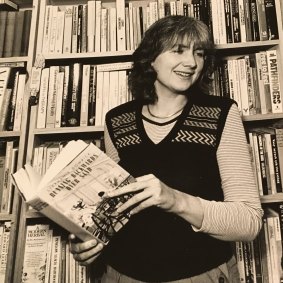
Shortly afterwards, Dowrick moved to Sydney and had two children, Kezia and Gabriel, in quick succession; her first novel, Running Backwards over Sand, which tells of a journey of self-exploration by a young woman who has lost her mother, was published in 1985. Subsequently, she worked part-time as a publisher at Allen & Unwin and broadened her writing to focus on self-development and further explored spirituality, most particularly through the work of German poet Rainer Maria Rilke (on whom she wrote a PhD thesis that evolved into a book, In the Company of Rilke).
On learning to live with isolation, the author, an “impatient patient” who fell ill for four months and was in hospital for 10 weeks before the pandemic hit, says that while the lockdown was a crisis of communication for social beings it could also offer “an opportunity to consider with fresh interest how we can more thoughtfully support others – receiving with grace and gratitude what they may have to give”.

While many have been feeling “flat”, she says it is important to be more consciously open to receiving, even when what’s coming your way doesn’t quite fit your expectations of how things should be. Like any change, some detachment is needed to see things anew, as is stillness, which is best achieved by not being constantly busy. (“Being busy is for me a psychological defence.”)
“In illness, our world shrinks. In social isolation, our world shrinks. Yet it’s precisely now that our vision must enlarge. Choosing to be the smallest bit more generous, perhaps more tolerant in both directions (giving and receiving), is itself an act of empowerment, an act of self-respect and even love – for ourselves and for all with whom we share this planet.

“When we’re down, our thoughts leap into a future that’s frightening. When we slow down, by contrast, we can experience this moment and – when we can – infuse it with greater vitality and hope. We can surround people and situations with the energies of loving-kindness and care, rather than anxiety or raw terror. And when we do this, we ourselves will benefit.”
The afternoon is slipping away, but Dowrick proposes we move on to coffee and pavlova. She wants to ask me some more questions.
Infuzions Cammeray
439 Miller St, Cammeray
(02) 9957 1122
Daily, 11.30am-9.30pm
Intimacy and Solitude by Stephanie Dowrick is out now from Allen & Unwin.Save

Shona Martyn is Spectrum Editor at The Sydney Morning Herald. She was previously the Publishing Director of HarperCollins, the founding editor of HQ magazine and an editor of Good Weekend.Connect via email.
MOST VIEWED IN CULTURE

Archibald, Wynne winner Nicholas Harding dies

Netflix star ‘forced’ to reveal sexuality over accusations of queerbaiting

Five gigs you shouldn’t miss in Sydney in November

The celebrities bailing on Twitter after Elon Musk’s takeover

This is the Jennifer Lawrence we’ve not seen in a decade

Inside the birdcage: $200,000 guests, a giant hat and smelly toilets
FROM OUR PARTNERS
SMH RECOMMENDS

National‘You’re a dead man’: Olympic champ Brooks ‘bashed by bikies’, court told

LifestyleThe day racewear died: The Melbourne Cup is about fashion now

WorldPrince Harry’s memoir a ‘beautiful read’ not a takedown, say insiders

SMHNetflix star ‘forced’ to reveal sexuality over accusations of queerbaiting
PROMOTED

Gut SolutionTop doctor: simple tip flushes out years of digestive waste

Health BreakthroughsTwo Gummies Before Bed Might Relieve Years of Joint Pain & Arthritis

VoltModSimple Trick To Cut Electric Bills Takes UK By Storm

Compare Hearing AidsPensioners born before 1962 are now eligible for new hearing aids

Fungus HelperDoctors Amazed: A Simple Tip Against Toenail Fungus (Test Tonight)

Care by VolvoThe new pure electric C40 Recharge. Subscribe or buy online.

Good Life PlusStop Playing Unrealistic Lotteries, With Unrealistic Odds, Try This Instead!

Travelzoo£129pp: Deluxe 3-night central Rome break incl. flights
Thank you for reading the Herald
Share this:

Do thoughts precede words? Puzzling about thoughts
Words do not express thoughts very well. They always become a little different immediately after they are expressed, a little distorted, a little foolish.
Hermann Hesse
Read more at http://www.brainyquote.com/quotes/keywords/thoughts_4.html#mRu4yti7qp26ervD.99
Hermann Hesse
Read more at http://www.brainyquote.com/quotes/keywords/thoughts_4.html#mRu4yti7qp26ervD.99
When we are with a child before she learns to speak,we see she nevertheless is ils thinking.Some people such as Wilfred Bion put forward the idea that wild thoughts are there like wild animals,seeking a mind that will think them
Related articles
- Defining Metaphysical Literature (intothebardo.wordpress.com)
- Taking Flight (mahajunaid.wordpress.com)
- “So she thorou… (chunkychook.wordpress.com)
- #DailyBookQuote 26Sep13 : Hermann Hesse’s Siddhartha (bhuwanchand.wordpress.com)
- Miriam Pielhau: Beginnings (huffingtonpost.com)
Share this:

An interview with the poet Khaya Ronkainen[ life from South Africa to Finland]

http://poetryblogroll.blogspot.co.uk/2018/02/life-of-poet-khaya-ronkainen.html
Extract
I understand Finland has very advanced social systems. What impresses you most about it?
Khaya: What impresses me is the accountability and transparency on how public funds and taxpayers’ money are used in creating a dignified and decent living for all. The accessibility of education, free and everyone’s right, regardless of background, impresses me the most.
Sherry: It impresses me as well. In North America, we are losing rights left and right at the moment.
When did you first begin to write? Did it help you with the culture shock of finding yourself in a new place?
Khaya: Ah! The famous question…*laughs*. I can’t say for sure. As a child I preferred to write than to talk. This means I did a lot of letter writing, you know, more like the Dorothy Osborne kind of writing; long reports about rural life to my cousins and friends living in cities.
But it was when I moved to Finland that I actually started putting meaningful stories down. It was a way of dealing with culture shock, and so words became my friends.
Sherry: I love that: “words became my friends.” They do give comfort. When did you branch into poetry?
Khaya: I don’t think I branched out into poetry, Sherry. I’ve always been in it, even before I attempted to write it. I’ve always been a lover and a reader of poetry with influences such as S.E.K. Mqhayi and Tiyo Soga (Xhosa poets/writers), to name just a few.
I even had a crush on John Keats himself, during my high school years…*laughs* when a boy trying to impress me recited Keats’ Endymion. I thought, wow! I want to do that. But then I went to study business and got swept away a bit, whilst I chased the bottom line.
So, I returned and pursued poetry seriously, when I got stuck in my novel writing; a project that is still pending. Luckily at the time, I was also doing studies in English Philology (as part of a career change), and the process of writing poetry sort of came naturally.
Sherry: I love that you branch out in all directions, exploring all life offers. What do you love about poetry? What makes it sing for you?
Khaya: I love how poetry pushes limits with language and form. Its ability to make us pause, be in the moment, and remind us that water is still wet. The process of birthing a poem; the whisper, the nudge, the build-up and the release that eventually leads me to write with urgency. That like any other art form, poetry doesn’t belong to the creator but to the people.
To quote one of my writer friends, Khutsie Kasale, “Poetry is something more sacred and authentic. It is a gift of words birthed through the artist that come straight from the hands of God.”
So, I love that poetry means different things to different people depending on where it finds them.
Sherry: Such a good explanation! I read on your blog that you come from the Xhosa people, who have a strong tradition of oral storytelling. Do you think that is reflected in your poetry, that you are carrying on the tradition in your work? Do you remember a grandmother or someone in your family, who told great stories that caused you, as a little girl, to dream?
Khaya: I mentioned earlier on that I don’t think I branched out into poetry, I’ve always been in it. By this I mean, a Xhosa child, (or an African child for that matter), learns quite early in life who they are. That is, a knowledge of their origin, past history and culture because African cultures pride themselves on clan names.
So, a child learns about the notion of iziduko/izibongo through chanting of a multitude of family clan names; ancestors and heroes (living and dead) from the elders.
Chanting of clan praises is poetry itself; oral poetry that overlaps with a song. Thus, in my writing I’m always trying to emulate that rhythm and harmony.
Sherry: I envy you that rich cultural heritage. I see it, too, among the First Nations people where I live – such an ancient, proud, traditional culture.
Would you like to share three of your poems here, and tell us a bit about each one?
Khaya: Before I share, it’s important to point that my work often examines duality of an immigrant life; loss and gain. And the “I” doesn’t always mean the writer but the speaker.
Word Roots
Of origins I do not know
Theories varied and accepted
Making sense and no sense
Words are my friends.
Words that go forward
In prose and in books
Words that return
In verse and in song.
Of classical and medieval
Renaissance and modern
It’s Twa, the forage and pastoral
Tshawe, the ancestral heroes I seek
Diminished words found
Not in history books
Accepted words whose
History is esteemed
It’s Nongqawuse‘s words I thirst;
A prophecy from uQamata
Words older than writing
Dramatic and creative
Praise poems of no particular
Historical period. Folk tales
Of Tokoloshe terrifying
Children and adults alike.
Infidel words, beginnings
I do not know but whose
Oral tradition leaves me
Smitten in a trance
Speaking in tongues
Descending the Great Lakes
Borrowing from Khoi
To click a sound.
A tradition of Xhosa poetry
Whose metre measured not
In literary magazines, yet rhyme
Rings loud in Grahamstown
Words murmured teasing
With foreplay, words chanted
Exploding into a climax
Do scratch an itch
Spoken and sung
Barbaric and censored
Roots of word
I seek.
Khaya: This poem examines relationship with languages. It was inspired by a Poetry Festival held in my city, Tampere, in 2015. The theme was Syntyjä, Syviä, loosely translated as “root of words”.
Journeys I’ve Travelled
I’ve been to the north
I’ve been to the south
Journeys —
left me floating in between
(where both worlds depart)
and with no claim to either.
Suburbia no longer white
we sip tea and spend hours
discussing weather, whilst
the sun shines in black rural.
In song and dance we quench
— thirst vanquished.
I’ve been to the city
I’ve been to the country
Allow me the misguided view
with diluted memories, for
I build a world with these
smatterings of my life.
Khaya: I think this one is self-explanatory.
Summer
What would you have me say of you?
Ours is an obscure relationship
You led me believe I was your baby
A summer baby―
Because down south, October simmers
Spring overlapping with summer.
What would you have me say of you?
As if immaterial, now you tell me I am
An autumn baby―
Because up north, October teases
Skies weep fearful of winter.
Khaya: And the last is a poem excerpt from my upcoming chapbook that I’m hoping to release in spring 2018. I wrote it in celebration of the centenary of Finland’s Independence.
Sherry: Thank you for these, Khaya. You express yourself so well. I especially love the Xhosa words included in your poem. And we look forward to your book.
When you aren’t writing, what other activities do you enjoy?
Khaya: During my spare time, I can be found wandering in nature, hiking and backpacking, amongst other things, with my husband.
Share this:

Beginnings
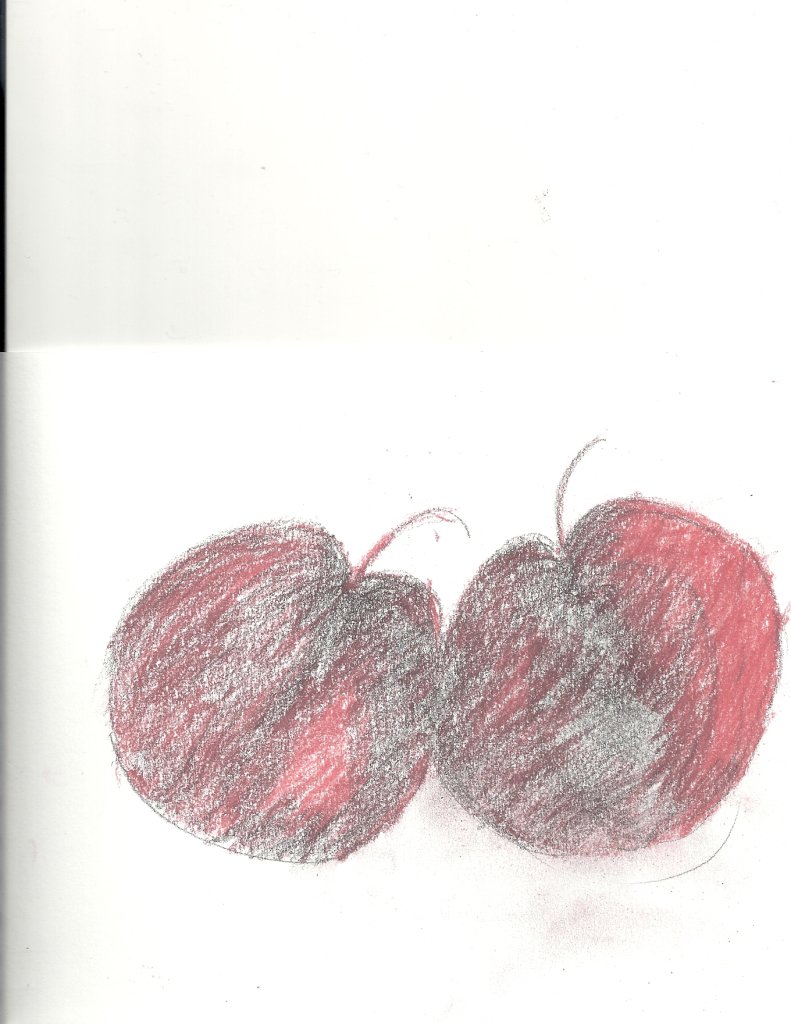
The tree is stretching upwards to the sun
Soon its fruiting year will have begun


 How my heart speaks