Sylvia Plath: The Dialogue Between Poetry and Painting
Extract
While Plath is traditionally categorized as a confessional poet, critics like Howe and Davison fail to recognize the ekphrastic quality of many of Plath’s poems. As defined by the Oxford English Dictionary, ekphrasis is “a literary device in which a painting, sculpture, or other work of visual art is described in detail.” Each poem in which Plath comments on or discusses a work of visual art can be defined as an ekphrastic poem. Ekphrastic works are interactive and draw clear links between writers and artists. By writing an ekphrastic poem, one enters a pre-existing conversation; one work could not exist without the other. In essence, many of Plath’s works are dependent on works of others, showing her deep veneration for the painters whose works she incorporates in her own.
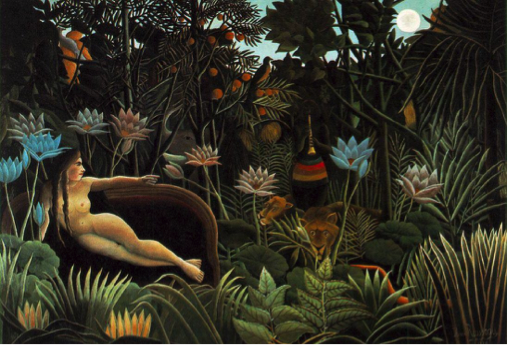
THE DREAM, HENRI ROUSSEAU, 1910.
“Yadwigha, On a Red Couch, Among Lilies,” Plath’s 1958 poem, was written in response to Henri Rousseau’s The Dream, painted forty-eight years prior in 1910. The painting, Rousseau’s last and largest work, places a young nude female reclining on a red sofa in the middle of a lush jungle, full of vibrant foliage and lively animals. According to the Bulletin of the Art Institute of Chicago, “Though the public was thoroughly perplexed, the artists rightly hailed The Dream as one of the milestones of modern art” (“The Henri Rousseau Exhibition,” 20). Plath, in her poem, points to the perplexed reaction of the public, choosing to address Rousseau about his painting by discussing their questions.
Plath responds to the structure of Rousseau’s painting in a compelling way. The painting appears to have a random composition; elephants, lions, birds, monkeys, and other animals seem to be randomly strewn about the canvas, interlaced with overwhelming amounts of greenery and lilies; mysterious snake charmer is shown emerging out from some trees, and the nude figure, Yadwigha, is arbitrarily thrown onto the canvas lounging on a sofa. There is no clear order to how Rousseau arranges things. Additionally, the subject depicted, a nude on a couch in the jungle, is incredibly random and perplexing. However, Plath contrasts this randomness by approaching her poem in a methodical way. She chose to write her poem in sestina form; a sestina is “a poem of six six-line stanzas (with an envoy) in which the line-endings of the first stanza are repeated, but in different order, in the other five” (Oxford English Dictionary). The form is structured, complicated and deliberate. Plath clearly put a lot of thought into how the poem was arranged.
For the sestina’s six line-endings she repeats, Plath picks the painting’s most pertinent images and concepts: “you,” “couch,” “eye,” “moon,” “green,” and “lilies.” “Lilies,” “green,” “couch,” and “moon” are all visuals that stand out in Rousseau’s work. The repetition of the painting’s pertinent images allows the reader to envision the painting through her words and points to her astute attention to detail and respect for the painting. Her use of “you” underlines that this is a poem in which she is talking both to Rousseau and Yadwigha (depending on the stanza) because she wants to interact with both the artist and the subject. “Eye” represents the “eyes” of different aspects of the painting [“under the eye/Of uncaged tigers and a tropical moon,” (4–5), “Dreamed yourself away in the moon’s eye” (28)]; Rousseau’s vision [“But to a friend, in private, Rousseau confessed his eye” (35), “To feed his eye with red” (38)]; and the eyes of critics and museum patrons [“It seems the constant critics wanted you… To turn you luminous, without the eye” (8, 12), “The couch glared out at the prosaic eye” (20)]. This emphasis allows Plath to differentiate between artistic vision and critical response, recognizing that there is merit to both points of view. She notes that art is meant to be created and commented on. Plath features the imperative relationship between artist and critic, taking on the role as critic by writing her poem. In turn, her poem is a piece of art—she is aware that it will be criticized, just as Rousseau’s painting was. This recognition through mentioning critics directly in the work signals a parallel Plath draws between Rousseau and herself, making her connected to the art of the past. She is clearly mindful of “the presence of anyone but herself,” unlike what Howe asserts.










 Made by Katherine
Like watercolour pictures in the rain
Our colours mingle yet the originals remain.
Two watercolor paintings without frames,
Became one picture over time,
Yet both of us are there.
Our colors blended naturally,
Now all the hues are shared.
I love your colors intermixed with mine:
Together they have made a new design.
A Watercolour painted by the rain,
We shall go, but our Watercolor Love remains
Made by Katherine

Like watercolour pictures  in the rain
Our colours mingle  yet the originals  remain.
Two watercolor paintings without frames,
Became one picture over time,
Yet both of us are there.
Our colors blended naturally,
Now all the hues are shared.
I love your colors intermixed with mine:
Together they have made a new design.
A Watercolour painted by the rain,
We shall go, but our Watercolor Love remains
 How my heart speaks