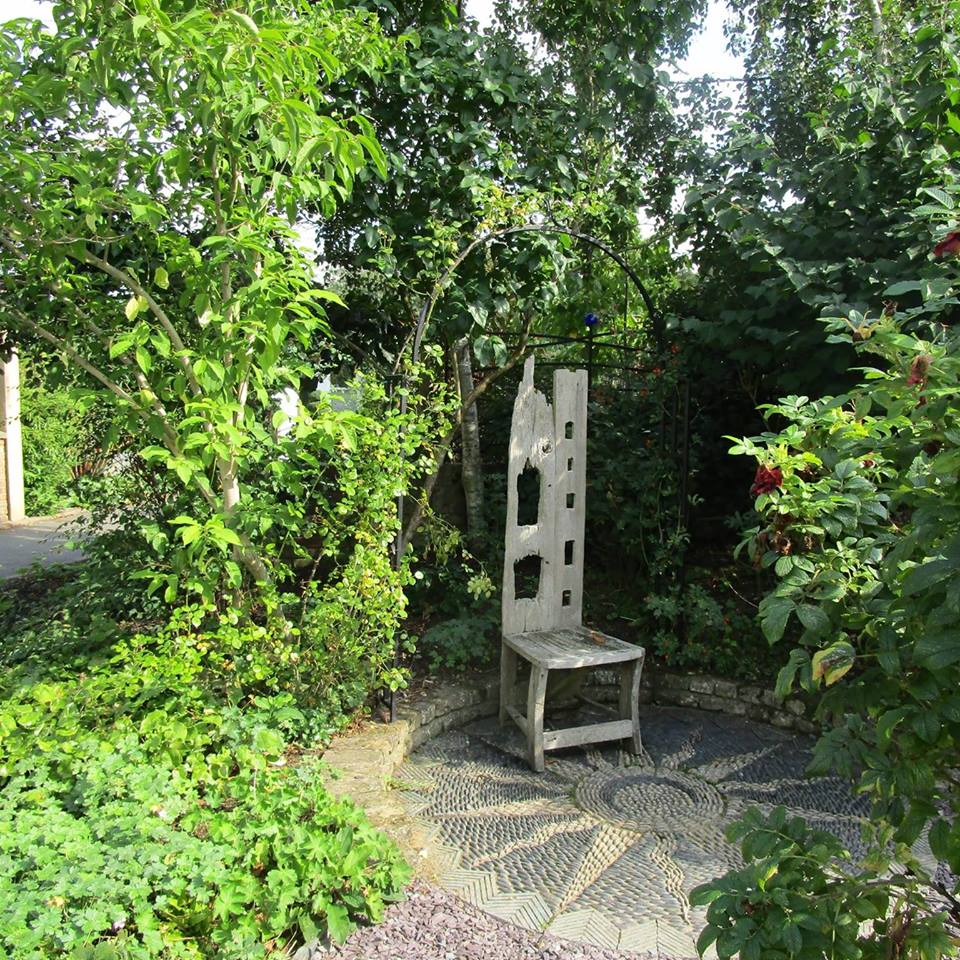
If the cat speaks, purr it

If the cat speaks, purr it
The King won’t get his horse to speak to you.
I nearly had kittens when the cat wanted to mate.
My nervous system is involuntary
I am introverted and good at yoga  based topology
i  took my final degree with a thermometer
I never could spell Schrodinger nor could I tell anyone.
I could try psycho-analysis or compromise and be a psycho.
I wanted bereavement counselling so I married a dying man.
I like reading, it’s just the words that annoy me.
My husband slept in the shed as he wanted me to get a boyfriend.Preferably bisexual.Anyway, the cat didn’t like that.He had a very yelling nature.

MATHS
I spent 9 years studying maths and I realised it’s basically notation for notions
If you estimate you can run across the road before that fast car can hit you, you are unconsciously doing calculus.The hard part is making it conscious.


Such marvelled worlds can’t be designed

Looking at the garden as a world
The overgrown becomes a rich terrain
Where myriad living forms seem uncontrolled
But  make a balanced whole in shades of green

What I hear are calls from nesting birds
The sway of  breeze among forsythia’s gold
The patterned  snails, the slugs cannot be heard
Nor can the slow worm’s wiser words be told

The  pattern is a natural life, a wood
Where Cambridge monks had ponds  and trees
Ten Cedars tall were chopped till dead
But still remain their long striped bees

Small in your eyes, infinite in mine
Such marvelled worlds can’t be designed


Great quotations about the writing process

14440649_776415159165031_3908335990492769132_n.jpghttp://inventingrealityeditingservice.typepad.com/inventing_reality_editing/2015/08/five-great-quotations-about-the-writing-process.html


From Rob Bignell’s Blog

Undervaluing sleep,darkness and reverie

_92576100_angus

BBC News image

http://www.vancouverobserver.com/blogs/betweenus/writer-urges-us-reclaim-our-sleep


At issue here is our inner life. In a chapter called “The Social Divide,” Duff describes the widening gap between sleep and waking consciousness. She briefly traces the history of the marginalization of not only our own subjective experience, but also the mythologies that once provided its context.

“I was most familiar with Greek mythology,” she explained. “[The Greeks] paid a lot of attention to sleep and dreams and how that material is worked in us. I was surprised to find out how my Eastern philosophical traditions had studied sleep. Three or four thousand years [later], we think we’ve just discovered it. But there’s so much folklore and cultural life passed down from generation to generation. Everything that mothers learn from their mothers to promote sleep [like] lullabies.

“With the Enlightenment we sort of erased our awareness. Darkness became aligned with [what] we were tying to rise above—emotions, feelings. We wanted rational control, and you can’t control sleep. Sleep is one of the ways we return to nature. By responding to alternating phases of light and darkness, we return to our natural cycles, and join with all of life.”

Sleep and health

It’s no news that regular sleep is important to our overall health.  In her work as a counsellor, Duff has found increasingly that a good night’s sleep is instrumental—even essential—to our emotional well-being. As part of her intake process, she routinely asks her clients how they are sleeping.

“Once they got more sleep,” she said, “their issues became more manageable. Even bipolar disorder and major depression are often preceded by six months of sleep problems.”

On the other hand, as she states in the book, the “effects of sleep disruption on mood, perception, and behavior are so strong” physicians sometimes misdiagnose patients as having psychiatric disorders when those patients “simply need better sleep.”

Along with diagnoses come medications. In a chapter on the commercialization of sleep, Duff notes: “The use of sleeping pills among adults between twenty and forty-five doubled between 2000 and 2004. In 2011, 60 million Americans filled prescriptions for sleep medications, up from 46 million in 2006.”

Statistics that I find deeply disturbing.

The problem is not so much the amount of sleep we get or how we get it, as it is our relationship with sleep.

“We want to commodify it,” said Duff. “[We want sleep to] help our days be better rather than offering its own vantage point. It’s about productivity. We keep going over the day’s events, but we process them with a different mind, much more associative, which works more by Gestalt. That’s why people will come up with solutions [when they’re asleep]. It’s non-conscious processing, which goes on when we’re awake as well. But we don’t pay attention to that either.”

Duff points out that the problem isn’t with science, but with “scientism”. She is glad that scientists are paying attention to sleep and making serious studies, but she worries about them “jumping on the bandwagon of making money—selling us machines and pills.”

She encourages us to take back our sleep, which she likens to a “n

And poignancy

For three years I’ve not seen the apple tree
Although it must be there, I cannot look.
It’s full of blossom in its industry

My heart  has faltered,  memories besiege
I cannot escape into  my  books
For three years I’ve not seen the apple tree

I might pray for life  or be deceived
By guests who want to sample what I cook
It’s full of butter, cream  and poignancy

When will my watch be over, when my plea?
I hate to read the papers.see the crooks
This year I shall  see my apple tree

Can I  be consoled in my deep grief
In meadows full of poppies and corn stooks?
Apple blossom  shows the trees’ belief

When he died,  the pillars  marble shook
We bent down and kissed the Holy Book
For three years I’ve not seen the apple tree
Eve is  weeping  in deep mystery


To Walberswick we went in that old boat

Th broken lamp   once lit our little night
In silent harmony, we read, or sewed and wrote
The smaller cheaper  lamp now  gives  me light

I wish the shining lamp was in my sight
Oh, your  mellow voice. I miss its notes
The broken lamp   once lit our little night

God does not assist me in my plight
Nor does he send me Joseph’s coloured coat
A smaller cheaper  lamp now  gives  me light

Remember Southwold and the river Blythe?
To Walberswick we went in that old boat
There we bought the lamp and blue bowls bright

Now memory is  of  teal green seas at Hythe
The burning  stubble, Saxon cliffs well-wrought
My smaller  world  seems withered, over scythed

Joy and sorrow twined teach  nothing’s bought
The sacred flame extinguished can’t be caught
The broken lamp   brings sorrow   to my sight
But shadowed memories  of our life  ignite


As we are poets


I wear my heart displayed upon my face.
Attentive readers find their meaning there..
Where feelings thought too deep to be expressed
Can shine demurely where they do not scare.

As Freud observed we're never quite disguised
Betrayal is our body's real motif
The message comes conspicuous from the eyes..
Bright sparkles or your tears of blackest grief.

The answer to a question seems to leap
 Yes or No is visibly revealed.
The blush that spreads so fast across the cheeks
Both bold and shy unable to conceal.

Your face tells me you lied when Love you wrote.
Yet let us sing our songs as we are poets.

The gold forsythia gleams like holy fire

The gold forsythia gleams like  holy fire
Deep within its heart  rest  nesting birds
Sun so bright is free and not for hire

We need new Spring when  human  tongues turn liars
As politicians  prance  with gun and sword
The gold forsythia gleams like  hellish fire

The natural world is  breath and so inspired
But where is God and where the sacred Word?
Sun so bright is free and not for hire


Sleeping Beauty lay within deep briars
Yet  silent bombs destroy    the heart unheard
The gold forsythia gleams like    warning fire

For the risen God, we join the choir
Singing for creation with  new words
Sun  delights, is free and  makes no pyre

Glory in the little nesting birds
Singing blackbirds, love is everywhere
The gold forsythia gleams like   undreamed fire
Sun so well endowed  makes well our eyes

Slighter than a cobweb’s weave of silk

Chiloschista-parishii_2018-2
Orchid copyright Mike Flemming published with permission
When our skin feels  vulnerable and frail
Slighter than a cobweb’s weave of silk
Then doubt may hold us back like iron rails

Fearful of bad news in our new mail
Our mood swings like a seesaw at fast tilt
Then our hearts feel vulnerable and frail

Like a frightened dog with drooping tail
Bad news  strikes like a  sword plunged to the hilt
Pain may hold us back like  prison rails

We sentence our own souls  and give no bail
Fearful of the strong, from iron built
Oh, how our hearts feel vulnerable and frail

Like a shoe encumbered with a nail
Our being harms us  through our own bad will
Pain  imprisons us like iron rails

Fear of judgement and our end term bill
Takes from us our goodness and goodwill
When our skin feels  delicate and frail
Then doubt may trap us in our self-made jails


The mirror crackles

The sun  enfolds me  in its wealth of  light
Caressing eyes and making  love seem right
Forgot,the  lonely darkness in a trance
When spring begins its equinoxal dance
Forgotten too is  how the frost can bite
And how warm lethargy  turns day to night
As we lie indoors like parasites
Into  lighted windows, I will glance
A minor crime when  brightness   draws my sight
Here’s a drying rack with clothes  mutant
Here’s a sill entirely filled with plants
Imagine you’re  a spy and see our plight
The mirror crackles, full of long-held spite


The politics of poetry

14344115_771415966331617_8026319798659632806_n

https://www.poetryfoundation.org/poetrymagazine/articles/69080/the-politics-of-poetry


“Many objections can be made to these assumptions, but it’s important to note first that poetry and politics are both matters of verbal persuasion—that is, both have strong connections to the art of rhetoric. Admittedly, poets and politicians are typically trying to persuade us of very different things, yet the two worlds have far more in common with each other than either does with, for instance, the world of Brazilian jujitsu. In light of that, one would think poets might get a little more respect from political speakers, and that political speakers might refrain from comparing their purely verbal existence to the decidedly non-verbal world of physical violence.

But they don’t. Instead, the relationship between American poetry and American politics is confused and confusing, with politicians sometimes describing the highest moments in political life as “poetic” (“I have a dream”), and other times offering up poetry as a symbol of empty talk. And of course, American poets are even more conflicted. Rare is the poet who doesn’t view himself as deeply invested in political life, and yet the sloppy, compromised, and frequently idiotic business of democracy—which is, for all its flaws, the way most political changes occur in this country—rarely attracts the attention of our best poets. Is this the inevitable order of things? Or are all the talkers simply talking past each other?

* * *
We might first ask: Why are they talking about each other at all? We don’t spend much time wondering what poetry has to do with neuroscience or television writing or college basketball, yet these are important areas of American life that involve assertions about truth, form, morality, and the nature of culture—all subjects regularly claimed as poetry’s turf. Yet the connection between poetry and politics interests us in ways that the arguably more obvious connection between poetry and linguistics does not. Why? ”


Read the article