To narrow is to do what Satan knew

The first poet was the one who found the new
Perception without wish to change what’s seen
With wider focus showing different views

Mostly we see what we wish to do
A goal, a task, expectation not a dream
The first poet was the one who saw anew

And having started kept their minds unglued
So played around in sunlight’s happy beams
A wider focus shows us different views

Life can be a  broader avenue
Like rivers are combined from little streams
The first poet was the one who saw anew

To narrow is to do what Satan knew
To follow just one path to an extreme
A wider focus shows us many views


The poet shall not judge  not ever blame
All the bored who cast off their deep shame
For poets are the ones who find the new,
With wider focus, welcoming  such views


The silence underneath the silence comes

A silence rich with love and full of joy;
The silence after waking at the dawn,
May be both an anchor and a buoy.

Yet often we don’t know what we seek for:
The latest dress, the perfect English lawn?
We forget this marvellous essence, full of joy

We murder by ignoring  love’s own core
We do not see the buds which are new born.
We want an anchor yet we want our toys.

What is most arresting is the awe
We feel when we survive deep grief again
Find  silence rich with love and full of joy

Out of Nature, its Creator calls
Taking in her arms what caused us pain.
Being both an anchor and a buoy.

The silence underneath the silence calms,
Stills our breathing with reviving balm
Perfect silence rich with love and  joy
Shall be our an anchor and shall be our buoy.


Watercolor love

Like watercolor pictures left out in the rain
Our colors have mingled,yet the originals still remain.
Two watercolor paintings without frames,
Became one picture over time,
Yet two of us still there.
Our colors blended naturally,
Now all the hues are shared.
I love your colors intermixed with mine:
Together they have made a new design.
A Watercolor picture painted by the rain,
We shall go, but our Watercolor Love will still remain

How writing began 3,000 years ago

http://www.britishmuseum.org/explore/themes/writing/historic_writing.aspx


“The earliest form of writing

The earliest writing we know of dates back to around 3,000 BC and was probably invented by the Sumerians, living in major cities with centralised economies in what is now southern Iraq. Temple officials needed to keep records of the grain, sheep and cattle entering or leaving their stores and farms and it became impossible to rely on memory. So, an alternative method was required and the very earliest texts were pictures of the items scribes needed to record (known as pictographs).

These texts were drawn on damp clay tablets using a pointed tool. It seems the scribes realised it was quicker and easier to produce representations of such things as animals, rather than naturalistic impressions of them. They began to draw marks in the clay to make up signs, which were standardised so they could be recognised by many people.

A wedge-shaped instrument (usually a cut reed) was used to press the signs into soft clay. This gave the writing system its name, ‘cuneiform’, meaning wedge-shaped.”

Mary pays the newsagent

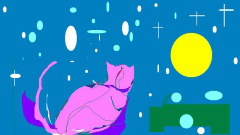
pinkcatandsun

Mary sat down on a garden wall to  enjoy the sunny heat.On rising she discovered that the wall was not what one might call “a drystone wall”.To be blunt,it looked as if she had wet herself.
Her light green silky jacket and pale blue trousers were somewhat blighted by this event but Mary paid little attention.She was on her way to  the Newsagent to terminate her contract
She had sat on the wall also to chat to a neighbour.
How was your heart scan?
Sorry,I’ve never had one.
But you told me before you couldn’t talk because  of it
I said,I am in pain.~
Oh,said Maggie quietly.I misunderstood

Hello, she said to the Newsagent.I want to cancel the newspapers.
Don’t you  like to read the weekend reviews? he said with surprise
Yes,but my eyes can’t seem to focus on the news print any more.And I am very annoyed that Trump is always on the front.
OK. the delightfully charming Indian man replied.Did I tell you I am doing a Ph.D . on  what kind of people read the Guardian and the Telegraph? I collect my data using the customers who call here
I do hope I have not ruined your research Mary remarked languidly.
Not yet, he replied manfully.But if you’d like to try you can call round at 8 pm.I have made a chicken korma
Is that a  new dance, she asked wildly
You must know korma and chips is Britain’s favourite meal, he said in a hurt tone
Please forgive me , she begged.I was trying to make a joke.I am not good at it.
Alright, he said.Why don’t you do a Ph.D? When you live alone it passes the time
I see what you mean, she said tersely as if someone was holding a gun to her head.
But where do you do it? she continued.
The Open University.The trick is to use something you already have written or data you already have like I am doing
Don’t  you need a theory  for that level of research?
Of course, he replied.I usually invent that after I have done the main work
Why, how many Ph.D’s  have you done?
Twenty five,he cried gleefully.Oxford,Cambridge,Edinburgh… a bit cold there
But why bother, she enquired.You are still a newsagent.Do you not want to get an academic job?
I might but shall I be a chemist,mathematician,Lacanian psychoanalyst, English literature professor or just  take it easy being a cleaner?
Why are you asking me,she cried.It’s beyond belief that  any man could  be so learned.
Beyond Belief…. just the title for my new book.Thank you so much.I’ll give you a copy when it comes out.
Alright,Mary answered as she tried to run out of the shop.
Indians are extremely clever.They invented a symbol to represent zero.That is much more difficult to conceive of than is a whole number like 2, she told herself
Shut up, her inner child answered.I am fed up with that bilge.I want to have an icecream cone  and a jacket potato.
Both at once, she joked?
Well,maybe not, her inner child exclaimed.I just want more fun.I bet Emile feels the same.Cats are like people in a way
Well, if you feel such empathy for Emile, why not marry him
I am only three,her inner child cried.I can’t get married yet?
Tough said Mary as she got onto a bus and went to buy a loaf  and a pair of knickers.Whatever would Stan think if he saw her now with short hair and wet trousers?
Thank goodness we will never know.As for him,would he stop playing the harp to look at his wife as she carried out these mundane tasks?


“The single girl’s guide to art”

The Single Girl’s Guide to Art

II. BALANCE

A woman must continually watch herself. —John Berger

In line, position yourself near the possible
object of your desire. Pay with plastic,
sign with a flourish. Think of your life
as one well-wrought performance piece,
and be sure to get the little pin; position it
above your breast, on your best side. Always
think ahead! You’ll thank me later—a fabulous
conversation piece, that pin, later at the café.
Remember, your entry into his frame must be
oblique, cause tension. Move to the corner
of his eye, but don’t linger, if he is to engage you
in what we will call the gaze.


Mental health and poetry

pixlr colour 3

https://www.theguardian.com/society/joepublic/2009/mar/23/mental-health-poetry-words-on-monday


Extract:

Sylvia Plath is on record as saying that when she was writing she was accessing the healthiest part of herself. That strikes a chord with me, too. Her joy in the act of writing is evident in her BBC interview with Peter Orr which was recorded in the autumn of 1962, shortly before her death. I think it’s available on You Tube. Well worth listening to.

The first poets by Michael Schmidt

9100773_f520http://www.independent.co.uk/arts-entertainment/books/reviews/the-first-poets-by-michael-schmidt-61344.html


“But, perhaps most important of all, The First Poets makes it crystal clear to us that there was at least one moment in partially-recorded history when poets really counted for something. They were really needed in ancient Greece on all kinds of religious and secular occasions. So every poet should buy a copy of this book to keep on their bookshelves. And, when the occasion arises, they should throw it at the cynic who may try to ignore or demean them. ”

We see the neon street lights gleam

Oh, light bulb foreseen by our God
Save us all from darkness’ rod
You are our Saviour as foretold
In prophecy by ancients bold.
We will worship you at night
When sunken is the sun so bright.
We’ll watch TV and Kindle fire
No more to play shall we aspire.
We’ll wear ourselves out watching screens,
As from a can we eat baked beans
We’ll send for pizzas with our phones
With which we never feel alone.
We might talk to our partner dear
Though texting them is easier.
We see the neon street lights gleam
Where once we saw the moon’s cold beams
And in bed we read our books
With a kindle or a nook
We put beneath our pillows fair
Iphones which we long to hear
Can one have too much new light?
From  that technology, some take flight
For gone are seasons, and their fruit
As our computer we reboot.
New potatoes all year round
Avocados once quite rare
Now are seen green everywhere.
Melons, grapes and fresh green peas
As the birds sing, life’s a breeze.
Oh light bulbs, fluorescent tubes
Electric candle, light is cubed.
We thank you for extended days
Maybe we’ll find time for prayers.
God is great in mystery
No light bulb can help us see.
In silence, darkness, meditate
Wonder what will be our fate.
As retribution for our wrongs
Satan stabs us with his prongs
He needs no more light in hell
The fiery furnace cooks as  well.

Carnation,orchid ,daffodil and rose.

How softly sweetly,gently flowers pose
Carnation,orchid ,daffodil and rose.
Their intricate petals form a shield
Yet bees with striped force shall make them yield.
Appearances,both natural and contrived,
Mixed with the wiles of human nature thrive.
As, knowing not, we pluck the apple rare
And bite its flesh,with teeth we have to bare.
We too deceive the innocent who pass
Not seeing watchers hid behind the glass.
The windows break,the deep earth quakes;
Seized is the maiden ,he  her virtue takes.
Beneath the surface,force and fierceness thrive.
What fearsome, burning God enjoys our lives?

A Gordian knot describes my new made life

A Gordian knot describes my  new made life
For I’m confused and feel misunderstood
My lovers all are tangled in their strife.
Yet,narcissistic, I desire my good.
Alas, I am as beautiful as dawn
This gives a false  perception to these men
For as I struggle feeling quite forlorn
Each  man wants to take me to his den.
I’d rather read then be adored and served.
No longer youthful ,I have had enough.
I gave my lovers more than they deserved
Now I’m sick of them and all their stuff
Be off you men  and find yourself elsewhere
I warn you  now I  shall soon curse and swear

If we use them we destroy all hope

The anger of the trapped bull  made to fight
In ring enclosed with no way to escape
Full of useless  strength and less insight

Even with intelligence and light
His self respect and being are both raped
The anger of the trapped bull  made to fight

Like our nuclear weapons and their might
If we use them we destroy all hope
So full of useless  strength and no insight

In discussions , all sides  play polite.
Yet  our humanity they desecrate.
The anger of the trapped ones  made to fight.

Most leaders are   giant infants with the gripes
Not thoughtful people willed to dedicate
Full of useless  strength and no insight

The theatres of new wars, of blood,of hate
Are where the moment leads,ill consecrates.
The torment of the  huge  bull  made to fight
Full of useless  strength and less insight

The affect of his choice.

How can it be he is no longer here?
How can it be I do not hear that voice
His presence haunts me  from his  battered chair

Though I  have  money and no needs to bare
I  feel the grief, the affect of his choice.
How can it be that he has vanished here?

What is the world when loss  turns to despair.
When every sheet  by weeping is made moist?
His presence haunts from his   beloved chair

Now we learn  the symbol of the hare
Unpeaceful, hunted, jugged   or humdrum roast
How can it be when love  should counter fear?

Into the real, we stand and longtime stare
We’re  begging, blaming, badgered, shamed and gassed
Some presence feints  with ours  in  death’s own lairs

Now the world of man has long surpassed
The time we could blame God for what we ‘ve missed
How can it be that He is never here?
His absence haunts: symbolic, suffered, real.


Unknown,unsought, unthought, but always real

Travelling down these sentences we find
Unknown,unsought, unthought, but always real
A home where we can rest our  fragile minds

The people  dropped,the habits left behind.
The good, the mediocre, what we steal
While travelling with the sentences we find

The hate that frees,the love that too close binds
The heart, the soul, the body, how we feel
For homes where we can rest our  fragile minds

The touch that chills, the distances unkind
Unwished for yet demanding all the soul.
Unravelling are our sentences unblind.

The freezing looks,the glories undermined
Ill timed,ill gotten, ills both new and  old,
Hedge homes where we could rest our  fragile minds

I have never dwelt in realms of gold;
But there are many stories never told.
Suffering our own sentences we find
A  home that welcomes, our more liberal minds.


Make the rules  supports ,which artists chose

My advice to you is try to love in prose
Love is heaven or hell  and sometimes both
We will  genuflect   before  the lows

Keep  words steady, do not come to blows
Speak politely, never use two oaths.
My advice to you is try to love in prose

Get into the swim, feel how words flow
Write down  curious risks  nobody knows
Try to circumnavigate the lows

Make the rules  supports ,which artists chose
Props used on a stage to augment clothes.
I recommend you  try to love in prose

The ocean changes colour as winds blow
Observation is an aid to growth.
We can circumnavigate the lows

For , dignity in love your honour shows
Avoid the avenues your anguish chose.
My work  for you is, write such love in prose
Try to circumnavigate the  ones you  stole


Poems on immigration

DrySandford2017-4
By Mike Flemming.Copyright

https://www.poetryfoundation.org/collections/144265/poems-on-immigration


“The United States of America is a country of indigenous peoples and immigrants. Its inhabitants speak countless languages and have a multitude of experiences and often untold memories. They carry on cultures and customs from nations near and far.

The poet Emma Lazarus wrote a sonnet in 1883 to help raise public funds to build a pedestal for the Statue of Liberty, but it received little notice when published and played no role in the opening of the statue. After her death, “The New Colossus” would become perhaps the most famous poem by an American poet. Thanks to the efforts of Lazarus’s friends after her death, the poem would be printed on a plaque and placed on the Statue of Liberty’s pedestal. Its famous lines, “Give me your tired, your poor, / Your huddled masses yearning to breathe free” are among the most quoted lines in American poetry and have served the country as an informal immigration ethos ever since.

The contemporary poems collected here tell the stories of those who have left their homelands to start a life in the United States. These poems often straddle two worlds, and two languages, to find truth in experience. They witness new beginnings, border crossings, acts of racism and discrimination, and homesickness. To suggest further additions, please contact us.”

How and how not to write poetry

https://www.poetryfoundation.org/articles/68657/how-to-and-how-not-to-write-poetry-56d2484397277


“To Michal in Nowy Targ: “Rilke warned young poets against large sweeping topics, since those are the most difficult and demand great artistic maturity. He counseled them to write about what they see around them, how they live each day, what’s been lost, what’s been found. He encouraged them to bring the things that surround us into their art, images from dreams, remembered objects. ‘If daily life seems impoverished to you,’ he wrote, ‘don’t blame life. You yourself are to blame. You’re just not enough of a poet to perceive its wealth.’ This advice may seem mundane and dim-witted to you. This is why we called to our defense one of the most esoteric poets in world literature—and just see how he praised so-called ordinary things!”

To Ula from Sopot: “A definition of poetry in one sentence—well. We know at least five hundred definitions, but none of them strikes us as both precise and capacious enough. Each expresses the taste of its own age. Inborn skepticism keeps us from trying our hand at our own. But we remember Carl Sandburg’s lovely aphorism: ‘Poetry is a diary kept by a sea creature who lives on land and wishes he could fly.’ Maybe he’ll actually make it one of these days?”

To L-k B-k of Slupsk: “We require more from a poet who compares himself to Icarus than the lengthy poem enclosed reveals. Mr. B-k, you fail to reckon with the fact that today’s Icarus rises above a different landscape than that of ancient times. He sees highways covered in cars and trucks, airports, runways, large cities, expansive modern ports, and other such realia. Might not a jet rush past his ear at times?”

To T.W., Krakow: “In school no time is spent, alas, on the aesthetic analysis of literary works. Central themes are stressed along with their historical context. Such knowledge is of course crucial, but it will not suffice for anyone wishing to become a good, independent reader, let alone for someone with creative ambitions. Our young correspondents are often shocked that their poem about rebuilding postwar Warsaw or the tragedy of Vietnam might not be good. They’re convinced that honorable intentions preempt form. But if you want to become a decent cobbler, it’s not enough to enthuse over human feet. You have to know your leather, your tools, pick the right pattern, and so forth. . . . It holds true for artistic creation too.”

To Mr. Br. K. of Laski: “Your poems in prose are permeated by the figure of the Great Poet who creates his remarkable works in a state of alcoholic euphoria. We might take a wild guess at whom you have in mind, but it’s not last names that concern us in the final analysis. Rather, it’s the misguided conviction that alcohol facilitates the act of writing, emboldens the imagination, sharpens wits, and performs many other useful functions in abetting the bardic spirit. My dear Mr. K., neither this poet, nor any of the others personally known to us, nor indeed any other poet has ever written anything great under the unadulterated influence of hard liquor. All good work arose in painstaking, painful sobriety, without any pleasant buzzing in the head. ‘I’ve always got ideas, but after vodka my head aches,’ Wyspianski said. If a poet drinks, it’s between one poem and the next. This is the stark reality. If alcohol promoted great poetry, then every third citizen of our nation would be a Horace at least. Thus we are forced to explode yet another legend. We hope that you will emerge unscathed from beneath the ruins.”

To E.L. in Warsaw: “Perhaps you could learn to love in prose.”

To Esko from Sieradz: “Youth really is an intriguing period in one’s life. If one adds writerly ambitions to the difficulties of youth, one must possess an exceptionally strong constitution in order to cope. Its components should include: persistence, diligence, wide reading,

I hoped that my phone would not scream

They said I should write  on my cell phone
But my   fountain pen leaked on the  screen
I pressed  rather gently
For fundament’lly
I hoped that my phone would not scream

I wrote on my palm with a pencil
While watching the 10 o’clock News
But the adrenalin rising
However surprising
Wetted the lead, losing clues.


I dictated my dreams to my Nokia
I knew quite well what to do
But  when I awoke
I saw dark grey smoke
And my husband  had turned denim blue.

How about an old fashioned notebook
With a ball point or biro to hand
It seems very easy
Makes nobody queasy
Gives my words some where to land


Why you should write poetry

Photo0315

http://www.huffingtonpost.com/university-of-toronto-news/why-you-can-and-should-wr_b_4718395.html


“What final advice would you give to someone thinking about taking up poetry?

Keep a notebook and pen on you at all times and pay attention — with all your senses — at all times. You can use a cell phone, tablet, iPad, anything to take notes. Don’t be afraid to jot notes down in transit, at a meeting or at the dinner table. Put inspiration first. And once you sit down to write, let yourself write, even if you fall on clichés. Don’t let your internal critic take over too soon. Another key is to write every day, even if just a little. This is how you nurture the emotional and intellectual breakthroughs, the aesthetic highs, which will serve as the foundation of your writing addiction.

— Don Campbell”

Can poetry change your life?

16106018_849379001868646_2003027143428679842_n

https://www.newyorker.com/magazine/2017/07/31/can-poetry-change-your-life


“But what, in the end, do we get from poems and songs? “Aesthetic life is a sphere of self-directed activity whose external ramifications, despite periodic utopian exuberances, are minimal at best,” Robbins concludes (somewhat contradicting his “community” theory). Is this so? Are we past the days when people wrote poetry and read it for encouragement and guidance, the days when poetry was not merely a “self-directed activity” but was writing about something?

It certainly was once. On August 4, 1914, Great Britain declared war on Germany. On August 5th, the first war poem appeared in the London Times—“The Vigil,” by Henry Newbolt. By the end of the year, at least two anthologies of war poetry were out, “Poems of the Great War” and “Songs and Sonnets for England in War Time.” Many would follow. Around the time the fighting ended, four years later, more than two thousand British and Irish writers had written poems about the war.

We might assume that the First World War inspired a lot of poems because that’s how people expressed themselves in the age of print, and that people express themselves differently today because the media are different. But we would assume wrong. Donald Trump was elected President on November 8, 2016. A poem about his election, “You’re Dead, America,” by Danez Smith, appeared on BuzzFeed on November 9th.

A few days later, hundreds showed up in Washington Square Park for a pop-up poetry reading sponsored by the Academy of American Poets and the Web site Brain Pickings. Three days after the Inauguration, the Times columnist Nicholas Kristof announced a Donald Trump Poetry Contest. He got about two thousand submissions. Several anthologies with anti-Trump poems have already come out, including, in May, “Resistance, Rebellion, Life: 50 Poems Now” (Knopf), edited by Amit Majmudar, who was one of the winners in Kristof’s contest.

Every crisis is an opportunity for poetry, even in the twenty-first century. There are anthologies of 9/11 poems and anthologies of Iraq War poems. There are climate-change poems, income-inequality poems, and Black Lives Matter poems. Claudia Rankine’s “Citizen: An American Lyric,” a book-length poem about race, identity, and the imagination, has sold almost two hundred thousand copies since it was published, in 2014. After the terrorist attacks in Paris on November 13, 2015, hundreds of thousands read “It is not Paris we should pray for,” posted on social media by the Indian poet Karuna Ezara Parikh. When the going gets stressful, the stressed want poems.”

A  violin would work if you could play

The villanelle won’t jell,I feel dismay.
I know they’re hell ,but they distill my thoughts
A triolet would work if I could play

I boiled the villanelle  to sell    today
I do believe I’m feeling underwrought
The villanelle won’t jell,I feel dismay

I planned to sell the whole lot on Ebay
But someone gave a hint I never caught
A triolet would work if I could play

I appreciate the values of wet hay
My teacher never mentioned  poems  caught short
The villanelle won’t sell,I can’t  display.

Some will plight  their  troth and others  pray
The teacher saw the writing  she’d not taught
A triolet would work if I could play

I wrote a poem with words I had not sought
Is it vice  to pay when we’ve not  bought?
The villanelle won’t jell,I  say,hurrah
A  violin would work if you could play

I’m hungry, but  for you I’ll always wait

The ready roasted chicken on its plate
The roast potatoes ,kale and podded peas
I’m hungry and I do not want to wait

Now I hear the clicking of the gate
The whisper of the wind among the trees
The ready roasted chicken on its plate

You’re never more than twenty minutes late
The trains are crowded, nowhere one can read.
I’m hungry and I do not want to wait

I remember you were working with no break
For nowadays  we ‘re electric in our greed.
The ready roasted chicken on its plate

So  love is hard in such un-knighted states
We want  acceleration in our speed
I’m angry  for there is no real debate


The country’s growing nothing now  but weeds
The Education sector is diseased.
The  cold ,gold roasted chicken on its plate
I’m hungry, but  for you I’ll always wait


The social function of poetry

3sepiajpg
https://www.poetryfoundation.org/poetrymagazine/articles/68755/does-poetry-have-a-social-function

“I hope this does not sound like an exercise in ambiguities. If so, let me add another: one of poetry’s chief aims is to illumine the walls of mystery, the inscrutable, the unsayable. I think poetry ought to be taught not as an engine of meaning but as an opportunity to learn to live in doubt and uncertainty, as a means of claimingindeterminancy. Our species is deeply defined by its great surges of reason, but I think it high time we return to elemental awe and wonder. Such a position is necessary to our communal health.

I try to teach my students the full magnitude of what can happen during the reading of a poem. The readerly self, if the music and strategies of the poem are a success, fades away to assume the speaker’s identity, or the poem’s psychic position. Once a reader has fully internalized the poem’s machinations, she collects a chorus within her and is transformed. This ritual generates empathy and widens our humanity. These might seem like grand dreams, but it is just such a belief in the power of poetry that spurs my pen to action, whether I am getting paid or not. “

Faith ignites

Hope and the infinite brain of being interact
Faith  is for the forlorn
Faith is not scorn
Goodness  is   always approximate
Do bad and become bad.
Fractals made my home infinite
Kill yourself  with kindness, instead of others.
Cruelty runs faster but blinder.
Armed struggles are too weighty with meaning.
To eat or not to eat when you are taking antibiotics
Pause before screeching or swearing
Always get washed before  you go to breed.
Buy a big bed  for when you are  both sulking.
Don’t frisk me.

Darting in exquisite geometry

Photo0074

How white and blue together recollect us
to the summer sky and the imagined swallows
darting in exquisite geometry
under the great domed space of the heavens,
like the Basilica in Constantinople
containing and giving space.
And how I held you for a moment that was infinite
and then you were gone like an angel fearing enchantment
into some finite boundaried world

Tell the truth or commit a great crime

My problem is strident conceit
In how I  can bear twisted feet
I never wear sandals
Nor go out with vandals
And I always  say,love ain’t defeat.

I think pride is a valuable trait
When finding an other to play
For  the humble get nowhere
Don’t even go there
Play your piano today.

Deceit seems a very good line
When trying to find husbands online
But when they set eyes on you
What on earth will you do?
Tell the truth or commit a great crime

Killing with kindness is right
As only God knows you’re a blight.
What people think of you
May not be perfectly true.
Pretend you can’t see without light.

Aggression is there in our genes
But too much can often demean
Save it for dust
Then wipe if you must
Smile for you’ll always be clean

Envy is a wonderful gift
The race always goes quite a drift
So envy no single one,
Envy the whole or none.
Keep walking and  may  you be swift

Rage may boil kettles  of acid
A fact quite unknown to the placid
Then when you drink tea
Scalded you’ll be.
Derive your own truth from the asses.

We could cut down the roses in our rage.

Grass and daisies have no   spikes nor thorns.
So we can run barefoot across the  lawns.

Why do roses hurt  our hands unknown,
When sheep don’t hurt the shepherd as they’re shorn?


We could cut down the roses in our rage.

Their   own aggression might bring down their death.

Yet, beauty in their form makes love engage.

So we ignore their useless,painful wrath.


Recklessly we love a spiky friend.

Enchanted by their learning or their face

But wounds unneeded bring this to an end.

Patience thins, we sever  this embrace.


Roses have a beauty that beguiles.
Shall we  then endure their thorns and wiles?

The cost of loving

At first there is a gaping wound of loss
But our blood clots and seals the wound  up tight
Any movement brings a painful cost

After time and months of pain have passed
The scab has formed ,our body does what’s right
At first there was a gaping wound of loss

Yet if we’re struck, the wound reopens fast
We must  be careful not to enter fights
Any movement brings a painful cost

Easing is a gradual,lonely task
And even then the pain can take a bite
In where was a gaping wound of loss

Every death  creates another ghost
But not an evil angel of the night.
Any movement brings a painful cost.

Let me see your face in dreams tonight
I can’t live without your kindly light
At first there was the sacred wound of loss
Love dies not but carries its own cost