
Month: Aug 2017

One dear husband is enough
Oh,steam iron how I love your heat
And how you make my clothes so neat.
A flat iron is no use to me
For no open fire is here,you see.
And thought I liked the flickering coals
I feared those faces that looked droll.
They were in the flames and peered
At anyone who ventured near.
I wonder how the people past
Kept their trousers neat and pressed.
Now I’ve bought a hand steamer
To keep the germs off my femurs
I didn’t like to say,my crotch
In case the devil is on watch.
I never ever used to think
My body perfume was distinct.
And yet it may appeal to men
I don’t want to try again.
One dear husband is enough
Though he did enjoy a cough
He had asthma and bad eyes
Looking out with wild surmise.
He saw my golden hair float by
As by his window it did fly
All at once he fell for me
And we sat by an apple tree.
His clothes were wrinkled so I thought
I would iron them for a start.
He could darn and polish floors
Cook lamb chops and apple cores.
So my steam iron sees much use
I wonder if it’s self abuse
For as a woman feminist
I’m not meant to iron vests
I’m not meant to boil mens’ socks
Nor their pants of interlock
I’m not meant to make them tea.
What a naughty person,me!
I must confess these wicked sins
Then I’ll polish my cake tins.
Satan wants me down in hell
Don’t say he needs my iron as well
As he was an angel proud
I’ll save him into One Drive Cloud.
Share this:
Can we find the space between the words?
How like a prison is this cubicle
So small I’m like a fish inside a net
My heart beats with a rhythm unmusical
As with sharp terror I am now beset.
–
We humans were not made to be en-walled
Our ancestors were gatherers in the woods.
Now industry demands freedom be stalled
For production and consumption of more goods.
And executives in advertising work
In offices where they combine their words
Religiously like members of the Kirk
Yet envying the freedom of wild birds.
Can we be ourselves in such a world?
Can we find the space between the words?
Share this:
Nature seems to stutter on her way.
The day is hot, the air has heaviness
Yet golden is the light which it displays
We stay indoors and try to take a breath
The moisture in the air seems to oppress
Nature seems to stutter on her way.
The day is hot, the air has heaviness.
Heat disposes men to display wrath
The car horns hoot, the rage more red today
We stay indoors and try to keep our breath
But in the house I notice there is mess;
The opened books, the phones not put away
The day is hot, the air has heaviness.
Even so our own home seems to bless
The life we lead and from which we may stray
We stay indoors and try to keep our breath
But in the evening we grab our lover grey.
The lion and lamb were masculine,how gay!
The day is hot, the air has heaviness
We stay indoors and try to heal and bless
Share this:
A bird’s gifts are its vision and its wings
A bird’s gifts are its vision and its wings
From eagles to the sparrow on the lawn
Instant sight, then flight their safety bring
O little trembling robin ,shivering heart
I rescued you, the stray cat did no harm
But your predicament had made me start.
Then missing your sweet breakfast from my spouse,
How he loved to watch and hear your call,
You hopped inside the kitchen and the house
After seeing no man was inside
You flew away as I stood in the hall
I had not seen you since the day he died
And now I do not feed birds by the door
I place their water by the garden wall
And there are berries from the autumn’s store
As on the tree high up a blackbird calls
A single apple from my tree shall fall
A bird’s gifts are its vision and its wings
Instant sight, then flight their safety bring
Share this:
The second story I ever wrote
“Your eyes are like deep pools in the Indonesian ocean” he murmured into Annie’s ear.He gently took hold of her and pulled her down onto his knee.
Just as he did that, his Habitat chair collapsed and they fell onto the floor.,the chair in bits around them.
Have you got your mobile,my sweetheart ?”he whispered romantically,
“I think you’ll have to ring 999.”OK,my archangel” she prattled,
” Operator,it’s my lover’s chair again.It keeps collapsing,can we bring into A and E to be fixed?”
“Well he can’t go to bed anymore so we really need this”
Just then a pebble hit the window,it was his wife coming back from Sainsburys” she’s lost her keys.
.Oh,wonderful,just at the right moment” he shouted,”Hello,mary,here is Annie,she’s a chair surgeon!”
“Oh,that’s good”, Mary muttered enigmatically,” Do you ever do beds?” “Why?”
“Well ours is always collapsing,another of life’s mysteries.”
“Why,you are so beautiful Mary,You are mesmerising.Come and show me your bed.We”ll leave Stan here.He’ll soon be in that ambulance”
“Mary,your eyes are like deep pools in the Indonesian ocean.”
“Have you both been on ta creative writing course?” Annie spouted satirically.
“I aim for satisfaction.” Here’s my gun.I’m going to shoot you”
“But we have no guns in the UK”
“Well you have now.”
Just then the emergency ambulance arrived”.OK which chair is it this time” the paramedic Dave enquired paradoxically.
“Have you ever thought of making it in the bath?”
“We’re getting really worried about you in Casualty,at your age.”
“Worry no more” Mary screamed emphatically, firing the gun repeatedly into the chair.”I’ll make sure he never sits in it again.And now Habitat’s gone bust,he can’t buy another.’”
“Cheers, mate!”whispered the paramedic dramatically.
“Has anyone ever told you,your eyes are like deep pools in the Caspian sea”.
“Oh,no not another one!”Mary moaned tentatively,”You need to raise your whole game,not just change the name of the sea”
“You’re so intelligent too,lady.Can you teach me truly creative writing?” He yelled quietly.
“Come upstairs she murmured in reply, and we’ll see what sea we can see up there,tonight”.
“Thank you so much and please send me home in a stamped addressed envelope when you are done with me.”
“Whatever” she sighed spontaneously.”Let’s get on with it or you’ll be here all night”
And so will all of us
Just as he did that, his Habitat chair collapsed and they fell onto the floor.,the chair in bits around them.
Have you got your mobile,my sweetheart ?”he whispered romantically,
“I think you’ll have to ring 999.”OK,my archangel” she prattled,
” Operator,it’s my lover’s chair again.It keeps collapsing,can we bring into A and E to be fixed?”
“Well he can’t go to bed anymore so we really need this”
Just then a pebble hit the window,it was his wife coming back from Sainsburys” she’s lost her keys.
.Oh,wonderful,just at the right moment” he shouted,”Hello,mary,here is Annie,she’s a chair surgeon!”
“Oh,that’s good”, Mary muttered enigmatically,” Do you ever do beds?” “Why?”
“Well ours is always collapsing,another of life’s mysteries.”
“Why,you are so beautiful Mary,You are mesmerising.Come and show me your bed.We”ll leave Stan here.He’ll soon be in that ambulance”
“Mary,your eyes are like deep pools in the Indonesian ocean.”
“Have you both been on ta creative writing course?” Annie spouted satirically.
“I aim for satisfaction.” Here’s my gun.I’m going to shoot you”
“But we have no guns in the UK”
“Well you have now.”
Just then the emergency ambulance arrived”.OK which chair is it this time” the paramedic Dave enquired paradoxically.
“Have you ever thought of making it in the bath?”
“We’re getting really worried about you in Casualty,at your age.”
“Worry no more” Mary screamed emphatically, firing the gun repeatedly into the chair.”I’ll make sure he never sits in it again.And now Habitat’s gone bust,he can’t buy another.’”
“Cheers, mate!”whispered the paramedic dramatically.
“Has anyone ever told you,your eyes are like deep pools in the Caspian sea”.
“Oh,no not another one!”Mary moaned tentatively,”You need to raise your whole game,not just change the name of the sea”
“You’re so intelligent too,lady.Can you teach me truly creative writing?” He yelled quietly.
“Come upstairs she murmured in reply, and we’ll see what sea we can see up there,tonight”.
“Thank you so much and please send me home in a stamped addressed envelope when you are done with me.”
“Whatever” she sighed spontaneously.”Let’s get on with it or you’ll be here all night”
And so will all of us
Share this:
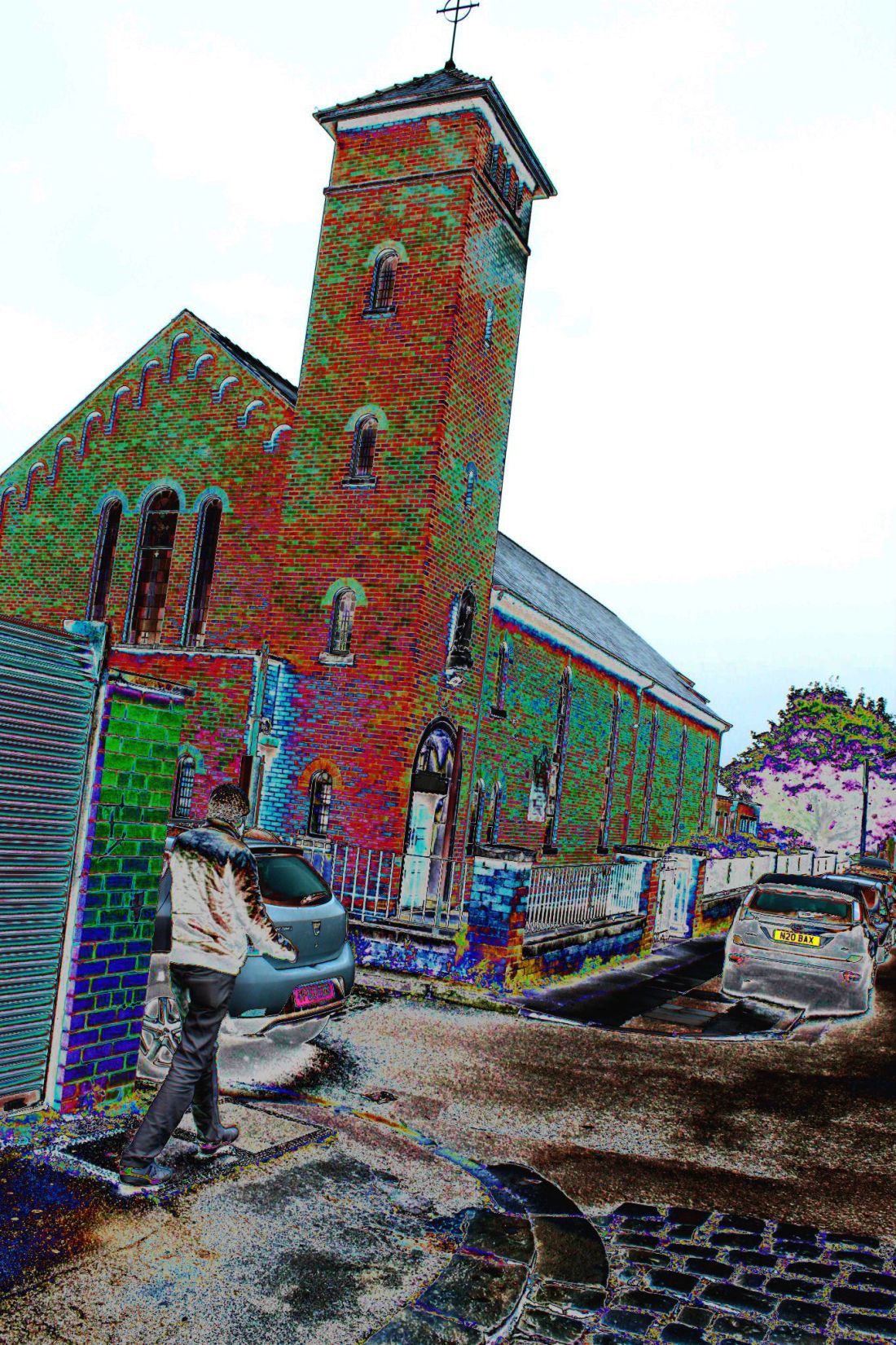
My church
Share this:

We’ll soon be writing with both feet
I try to rule out cliches when I can
At the exact moment they begin
For if I let one get in here
It will ruin my new career
And then I’ll be once more an also ran
“To be or not to be “is Hamlet’s thought
As if the doubting illness he has caught
So don’t get scruples on the brain
Or you’ll be feeling sick again
And we know how it is when life is naught.
What the Dickens does my boyfriend think
He will not supply my pen with ink
He says handwriting’ s obsolete
We’ll soon be writing with both feet
Yet my old pen creates no missing links
Share this:
Avoid commas

They told me I was so hypothroid I was going into a comma.More like a full stop, I’d say.
Anyway, what’s so bad about commas?
My anemia was so severe, I baptised myself and now my name is Holy Moses ,which is odd as Moses predated Jesus.I should not have used hot water but my hair needed washing.
My migraine was cured by detachment.I wanted to cut off my own head but my mother said she couldn’t live without it.So I disengaged.Then got harried.
It’s all one to me.
I used to get pre-vestibule tension when I first menstruated.Would you like a vestibule in your body?
The Bishop forbade Tampax.He must have had shares in Dr Whites unmentionables.What was my hymen to him? I don’t believe I ever had one.So there!
I never had flu till I began explaining why e is not an algebraic number.Don’t say ,it’s a letter! It was the lectures that made me ill.I don’t like the sound of my own voice
What puzzles me is I became mute when I was 17 and 5 years later I was a tutor at a University.I never realised I’d have to talk till it was too late.Tell Freud that one!Still it was mainly:
For every number delta, however small there is a number epsilon ,which is less than delta.Maybe it’s the other way round but I can’t type it again.So it’s not as if I had to make small talk about Wittgenstein and Serge Diaghilev.Or the weather.We never spoke to the undergraduates.They looked terrified already.Maybe they were mute
So to conclude, if you are mute, become a teacher.Or even a professor.That will make you talk again and again….but I’m still quiet I am told.When I stop talking.
Share this:

Bird on the wire
Then if you fall into a coma
It’s a bit late in the day for a poem
I’m only human you know!
but if you feel like a-knowing
Then to your bookshelf you go.
Take out a volume of Shakespeare
He was my ancestor too.
Then if you need a short break,dear,
A sonnet should do it for you.
Take out a clean piece of paper
And your pen and some ink.
Make up a poetic caper,
Then you can have forty winks.
Take out a volume of Homer.
Read it instead of the News.
Then if you fall into a coma
We shall all be completely amused!
The Government will be bemused.
Do you hire one or have your own Muse?
This is all a very fine ruse.
I want to blow my own fuse.
I love to write in canoes
Share this:
With demands
With his blood sugar and my thyroid gland
Not to mention gout and heart attacks.
Our marriage was detested by the grand
Sometimes he looked mad and could not stand
My feebleness in falling down the cracks
Between his sugar and my thyroid gland
I held my soul together with a band
Elastic in its way thus not too slack
Our marriage was arrested by hot hands
Yet often we would saunter hand in hand
Go on the towpath feed the swans and ducks
Despite low sugar and low thyroid gland
He loved the sea and loved the long white sands
But as for me I could not muster luck
Our marriage was so trying it was banned
I lost my heart and seemed to lose my luck
So kindly he bought geese for me to pluck
With his blood sugar and my thyroid gland
Our marriage was disfigured by demands
Share this:
Dealing with an angry friend or acquaintance
I am not talking about accepting violence and abuse from partner’s or friends
Similarly to Gandhi’s peaceful resistance, I think we need to avoid immediate retaliation when a person is angry while maybe removing ourselves from the scene for a while.
Because a number of health matters can make people fly off the handle.The one I know best is diabetes.But the angry person might not yet be diagnosed.Depression can make people irritable too.Fear can display as anger in men.A problem at work can make people desperate
My husband was diabetic and at one time when we were eating, he would begin arguing or even shouting.After studying diabetes in depth I found he was having hypos; very low blood sugar.So I started giving him some light food at 4 pm.Then he was back to his usual self.But I do think doctors do not inform us.I bought many books and even a glucose monitor.I practised on my own hands for 2 weeks [ somewhat painful] and then I began to test him.He said I was better than the nurse.
The little instrument with which you pierce the skin has a small sharp point.I got fed up with it being hard to work, so I took the needle out and just stuck it into my finger! That got some blood out to test,
Don’t do this unless you are desperate.
Share this:
And my weak bladder is a curse to me
I wear red leggings underneath my dress
My legs are cold and turning slightly blue
So I dress like the Muslim ladies do
Is it sinful, must I now confess?
You see, I don’t like wearing denim jeans
And yet the summer is not very warm
So to keep my legs and bladder calm
I’m brighter than a can of Heinz baked beans
I like to wear bright colours like the flowers
But English summers are not trustworthy
And my weak bladder is a curse to me
The germs get in and I go twice an hour. [or more!]
Antibiotics do their work slowly
And on the sofa, I lie with a book
It’s much too narrow as a lover’s nook
So with my Keats contented, I must be.
The post man looked a little bit surprised
But though I’m 89 I still like clothes
Does he think that I am one of those?
Or maybe I’m a mugger in disguise?
So see me in your mind’s eye looking bright
And then like me, perhaps you’ll see the light
Share this:
What makes poetry poetic?

https://www.theatlantic.com/magazine/archive/1999/03/what-makes-poetry-poetic/377508/
I had the swirl and ache
From sprays of honeysuckle
That when they’re gathered shake
Dew on the knuckle.
those familiar verbal tones and inflections take on a charged resonance missing from workaday locutions. What makes the difference is the versification: the casting of phrases into distinct vocal cadences that enable a listener, Pinsky writes, to “detect their presence without a printed version of the poem.” Taken by itself, this may sound suspiciously like a truism — and indeed, there is nothing especially startling about the touchstone concepts that inform Pinsky’s account of poetry’s inner workings. The great virtue of his treatment lies in his demonstration that paying closer attention to how poems like Frost’s work — how the flow of language is measured, how the length of a line builds expectation and tension, how the interplay within patterns of sounds produces audible dynamics that are pleasing and stirring — is a technical concern of the most profound kind, instrumental in appreciating the full import of what Pinsky likes to call the “technology of poetry.””
Share this:

O sweet spontaneous by: e.e. cummings (1894-1962)
sweet spontaneous
earth how often have
the
doting
fingers of
prurient philosophers pinched
and
poked
thee
, has the naughty thumb
of science prodded
thy
beauty, how
often have religions taken
thee upon their scraggy knees
squeezing and
buffeting thee that thou mightest conceive
gods
(but
true
to the incomparable
couch of death thy
rhythmic
lover
thou answerest
them only with
spring)
Share this:
Is it ok to punch a Nazi?
“Quartz: So, is it OK to punch a Nazi?
Žižek: No! If there is violence needed, I’m more for Gandhian, passive violence……………
—while Gandhi really wanted to bring down the British state. But his violence was symbolic: peaceful demonstrations, general strikes and so on.
If a guy talks like that jerk [Richard Spencer], you should just ignore him. If he hits you, turn around. Don’t even acknowledge him as a person. That’s the type of violence I would call for. Not physical violence. Because, you know, people say symbolic violence can be even worse, but don’t underestimate physical violence. Something happens when you move to physical violence. I’m not saying we should greet everyone, embrace them. Be brutal at a different level. When you encounter a guy like the one who was punched, act in such a way that even hitting him, even slapping him is too much of a recognition. You should treat him or her or whoever as a nonperson, literally.
In other words, leftists should “go high?””

“It’s much more complex than that. I think that’s their biggest mistake. Isn’t is sad that the best left-liberal critique of Trump is political comedy? People like Jon Stewart, John Oliver and so on. It’s nice to make fun of him, but you laugh at him and he wins. My God! There is something terribly wrong with playing this game of ironically making fun of Trump. You know, in medicine they call it symptomatic healing when you take some things, they just neutralize the effects, like you have this pain, but they don’t heal the disease itself. Criticizing Trump is just symptomatic healing. Trump is an effect of the failure of the liberal-left. Everybody knows this knows this now. The only way to really beat Trump is to radically rethink what does the left mean today. Otherwise, he will be getting ordinary people’s votes.”
Share this:

Selections from Keats’s letters

https://www.poetryfoundation.org/articles/69384/selections-from-keatss-letters
“Tell George and Tom to write.—I’ll tell you what—On the 23rd was Shakespeare born—now If I should receive a Letter from you and another from my Brothers on that day ’twould be a parlous good thing—Whenever you write say a Word or two on some Passage in Shakespeare that may have come rather new to you; which must be continually happening, notwithstand that we read the same Play forty times—for instance, the following, from the Tempest, never struck me so forcibly as at present,
‘Urchins
Shall, for that vast of Night that they may work,
All exercise on thee—’
How can I help bringing to your mind the Line—
In the dark backward and abysm of time—
I find that I cannot exist without poetry—without eternal poetry—half the day will not do—the whole of it—I began with a little, but habit has made me a Leviathan—I had become all in a Tremble from not having written any thing of late—the Sonnet over leaf did me some good. I slept the better last night for it—this Morning, however, I am nearly as bad again—Just now I opened Spencer, and the first Lines I saw were these.—”
‘The noble Heart that harbors virtuous thought,
And is with Child of glorious great intent,
Can never rest, until it forth have brought
Th’ eternal Brood of Glory excellent—’”
Share this:

Defence against white supremacists

“White supremacists are really, really hoping that you don’t keep reading this article. They don’t want you to learn about the Paradox of Tolerance, because then they’d lose a powerful weapon in their fight to make society more racist. Ready to make a white supremacist mad?
Fortunately for us, the Paradox of Tolerance, a concept coined by philosopher Karl Popper, is easy to understand and remember. The “paradox” part makes it sounds complicated and hard, but it’s really just a rule with one exception. It goes like this:
- A tolerant society should be tolerant by default,
- With one exception: it should not tolerate intolerance itself.
To give a specific example, a tolerant society should tolerate protest marches in general, but it shouldn’t tolerate a white supremacist march advocating for the oppression and killing of people of color – like the march in Charlottesville, Virginia, in August 2017 that ended with white supremacists beating and killing people who were opposed to their message of intolerance.”
Share this:

Where is not our badness, where no sin?
Do we need the Evil Others, then
The” backward” countries we exploit for oil
To take our badness, bear what is our sin?
For we are perfect, civilised, thinking
And they are children letting anger boil
Do we need the Evil Others, then?
We ravaged the whole world, just to begin;
Created empires, stole the haul.
Where is not our badness, where not sin?
We demeaned their culture and religion
Said that we were best and took their all.
Do we need an Evil Other, then?
We did all this with noble conviction
Forgot the lessons and the truth of Fall
Where is then our badness, where our sin?
Are we so sure that we do sense the whole
And never hear the voice of God bewail?
We need the Evil Others, our own twin
To bear our badness, our historic sin.
Share this:
Creative life
“But while establishing a brand is good for business, it may be antithetical to the essence of real creative work. According to the Romantic English poet John Keats (1795-1821), artists of fixed opinions suffered from “egotistical sublime,” obsessing over singular truths to the point that they were unable to produce characters and storylines that convincingly diverged from their personal world views. He argued that the secret to being an artist was to cultivate a mindset he called “negative capability.”
Writing to his brothers in 1817, Keats introduced the concept of negative capability as he discussed Shakespeare’s creativity. “At once it struck me, what quality went to form a Man of Achievement, especially in literature, and which Shakespeare possessed so enormously,” he wrote. “I mean Negative Capability, that is when man is capable of being in uncertainties, mysteries, doubts, without any irritable reaching after fact and reason.”
Creative genius, according to Keats, requires people to experience the world as an uncertain place that naturally gives rise to a wide array of perspectives. This imaginative experience is what energizes and vitalizes literature, says Susan Wolfson, a Princeton English professor and author of Reading John Keats. Only when artists are able to stay open-minded can they write a wide range of characters and human experiences, from antagonists like Milton’s Satan and Shakespeare’s Iago to romantics like Keats’ Isabella. Holding too closely to one’s own view of the world is creatively counterproductive.
True poetical character, Keats believed, “has no self—it is everything and nothing—it has no character and enjoys light and shade; it lives in gusto, be it foul or fair, high or low, rich or poor, mean or elevated—it has as much delight in conceiving an Iago as an Imogen. What shocks the virtuous philosopher delights the camelion Poet.” The ideal artist, it seems, is equally enthralled to inhabit the mind of a character who aligns with their personal beliefs and one who is antagonistic to them. For this reason, he made fun of poets who used poetry as a means of constant lecturing and haranguing, including William Woodsworth (Keats’ friend), who told readers how to read his poetry, and John Milton (author of Paradise Lost), who sermonized on the balance of good and evil. Such instructive writing, Keats believed, inhibited the writer’s capacity for nuance.
Keats’ dwelling on the “chameleon poet”—one who “has no identity, [who] is continually filling some other body”—could be easily misinterpreted as a glorification of the weak-minded. But the imperative of negative capability isn’t about being indecisive or making blurry arguments. It’s about cultivating empathy. Artists do their best work when they learn to step outside themselves.
To artists with strong political dispositions, and in times of fierce political conflict, the concept of negative capability may seem threatening. After all, so much of art is driven by political beliefs. However, as Wolfson explains, Keats would not advocate applying negative capability to politics. “Keats was a staunch liberalist, against the monarchy, and a regular reader of The Examiner, a progressive and anti-monarchal newspaper,” says Wolfson. “He had no affection for political thinking on the right wing and viewed it as tyranny.”
Negative capability, then, is an artistic exercise: learning to entertain all sides of a question as a dramatist, poet, or creative thinker. Thus, perhaps the measure of a true artist and intellectual is the ability to embrace both negative capability and personal convictions at once—without letting one inhibit the depth of the other.”
Share this:
Keats letters

The thoughts about the nature of human existence that we find
scattered and evolving in his letters, much of this theory and
speculation possesses a remarkable harmony or unity that
derives directly from certain basic qualities of his character.
Perhaps chief among these personal qualities is one easier to
name in negative than in positive terms: the usual and genuine
absence in him of self-assertiveness. The dogmatic tone or spirit
was not his, and he disliked dogmatic men and arguments,
believing that it was more blessed to listen, learn, and explore
than to preach in support of a pre-selected text. Thus we find an
unusual gentleness about Keats’s strength of mind. Because of
the basically explorative thrust of his thinking, he was reluctant
to reach closed-end conclusions.
131
J. Clubbe et al., English Romanticism
© John Clubbe and the Estate of Ernest J. Lovell, Jr
Share this:

Keats

I mean negative capability
- At once it struck me what quality went to form a man of achievement, especially in literature, and which Shakespeare possessed so enormously—I mean negative capability, that is, when a man is capable of being in uncertainties, mysteries, doubts, without any irritable reaching after fact and reason.
- Letter to George and Thomas Keats (December 22, 1817)
Share this:
Shock of the day
I can hardly believe this.A Swiss Hotel put a sign up saying Jews must shower before using the pool.And there was me, an English woman thinking I could pee in a swimming pool, take some soap and have a good wash
Apparently, that is ok for me.But Jews have to shower first.Would Jesus like this? You Christian hypocrites start thinking before acting
They could have put up a sign asking everyone to shower first.They must be dumb
I can’t imagine how horrible it still is for Jews in Europe.If it was me it would affect my self esteem a lot.
Share this:
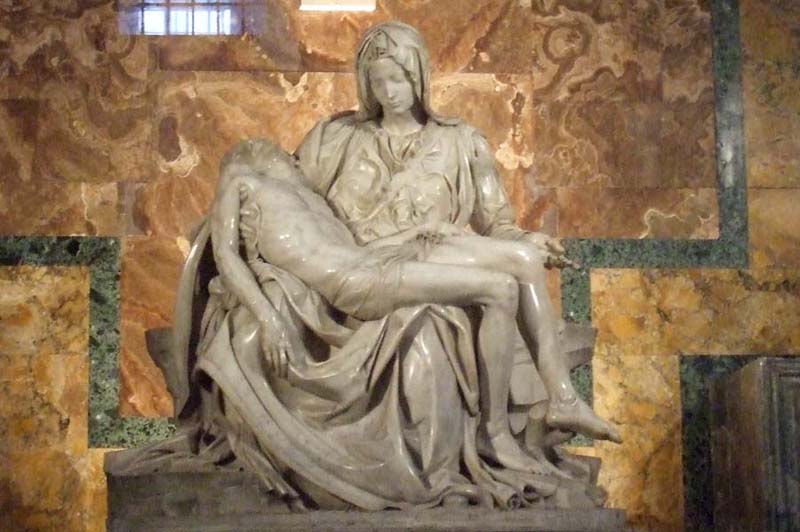
The pieta
Share this:

Stay a while here with his holy shadow
Sing a song to help the dying soldier
Sing a song to ease him on the way
Release him from your weary shoulder
And let him sleep in shadows of dismay
It doesn’t matter that your heart is broken
It doesn’t matter he has got no bed
At last the love you feel has opened
And before he dies, you are by silence wed
Sing a song to help him with his leaving~
Sing as softly as a little bird
There is no evil that he is concealing
And you yourself have heard his final words.
And when his soul flies from the open window
You cannot stop it with your wifely heart
Stay a while here with his holy shadow
And then rise to your feet and so depart
We’re only human we feel sorrow
We’re only human, how we grieve
With trembling legs and belly hollow
Appearances like this do not deceive
Share this:
A polyester jump suit for Mary?

Mary sat in her dining room listening to Sir Michael Atiyah on the Today programme where he was talking about very advanced Group Theory
.Many years ago she had known this great man, though he had scarcely noticed her despite her big blue eyes and skinny legs displayed beneath her home made mini-dress.That was very fortunate as she was there as a tutor not as a marriage breaker.Why her mother had supplied her with such mini dresses, she had often wondered,
Going online, she saw a sale on at Welvi, the store for larger ladies.There was an orange culotte jumpsuit made of polyester for £10
Look at this, she called to her friend Annie.A real bargain in my view.
Well, said Annie, suppose you were in the country climbing a hill and you needed to have a wee.
I never thought of that, Mary said shyly.
Moreover polyester is too clammy for summer and not warm enough for winter, besides it looks transparent.I don’t think Stan would like it.
Well, he’s not here now, said Mary sadly.And transparent plastic trousers are in fashion.Do you wear plastic knickers underneath?
No, you’d have to wear a jewelled thong, said Annie.I bet that would make men look at you.Well, not your face…
I’ve never worn a thong.Do they hurt, asked Mary politely.
Yes, I’ve got one on now, said Annie nervously.It’s really hurting me.I’d better ring 999 and ask Dave the paramedic to advise me
Hi called Dave, what is wrong today?
Annie is in pain from a thong, Mary cried
I’ll be round in 2 minutes
Dave ran up the hall into the bijou kitchen
Where is the thong ,he asked gently
Where do you think, Annie shouted?
She lifted up her chambray skirt and showed him her pink lace knicker substitute.
Can you take it off, he asked tenderly?
I have run out of clean knickers, she informed him scientifically.
Well in the past women wore cotton petticoats but no knickers.It was more healthy.But with short thin skirts if you fell over all the world would see your mound of Venus
That’s an exaggeration, Annie said.All the world is not looking at me
Ah, but someone could have a video camera and you might be on the News.You’d better go to Marks and buy some more proper knickers.
Now, shall I make you a cup of tea?The NHS is here to care for you.As you know
Lovely, cried Mary.Annie go upstairs and take my knickers and put that thong in the laundry basket.I will wash it for you and you can hang it in your bathroom to give an impression of your taste to visitors.On the other hand, men would be disappointed to see you really wore cotton high waisted pants and not a sort of mini star spangled banner.
All right, said Annie but Stan would have liked them
I like them, mewed Emile.I love you, Annie.I wish I were a man,I would go to bed with you right now.I have got a French letter from Soraya.She’e been in Paris and wrote to me on real paper.
Wow, a cat using the subjunctive and reading French letters said Mary.That is a surprise.
I don’téven know what subjunctive is, screamed Annie rudely
And so say all of us
Share this:

Although my ears were ringing with its rhymes
I edited my sonnet sixty times
It didn’t seem so many to my mind
Although my ears were ringing with its rhymes
To criticise myself seems quite unkind
What seemed to be a metre was none such
I could not sing it like Gray’s Elegy
My language late at night seems Double Dutch
But writing will, like loving, pleasure me.
If only we could edit when we speak
Instead of blurting out “the honest truth”
To stop our malice making others bleak
Or injuring their hearts with words uncouth.
When we reflect, we learn to see our speech
As something not entirely out of reach.
Share this:
The dignity of worth, the repaired woe?
We are not afraid as once we were
In 1963 when fingers groped
To end the Cuban missile crisis there.
Do we feel unreal or don’t we care
That we are on the edge of loss of hope?
We are not afraid as once we were
Have we so much News we can’t take more?
We struggle in our day life just to cope
Who ends the nuclear crisis that is here?
Have we split off feelings of despair
In case this anguish blocks our little throats
We are not afraid nor numb, it’s clear
Can we find again or now acquire
The dignity of worth, the consoled woe?
Who will navigate such wild desire?
The envy we seem locked in does require
Destruction of the other as its foe
We are not afraid as once we were
Of nuclear crisis and its dead dismay
Share this:
Poetry and politics

https://www.theguardian.com/books/booksblog/2010/dec/15/poetry-protest-politics
“But is protest poetry the preserve of the spoken word poet? In the 1970s, American poet Richard Wilbur, symbol of all things urbane and learned, offered “To the Student Strikers”, urging reflection and calm during the Vietnam war. In “A Miltonic Sonnet for Mr Johnson”, he suggests that Thomas Jefferson “would have wept to see small nations dread / The imposition of our cattle-brand, / With public truth at home mistold or banned, / And in whose term no army’s blood was shed.” However, Wilbur cautions that when “poets begin preaching to the choir, it takes the adventure and variety out of the poetry.”
So is this poetry’s role: to approach unrest and upheaval slant, and not head-on? And has poetry on the page been more effective in documenting the aftermath of great events? Both the late Ken Smith and Sean O’Brien have documented the intellectual legacy of post-industrial and rural communities recovering their identities after decades of decline. Ken Smith, son of a farm labourer, produced a poetry imbued with a melancholy sense of those like his father who, as O’Brien noted in Smith’s obituary, had “left / not a mark, not a footprint”.”

 How my heart speaks