The sunlit top, the roots hid in earth’s floor

Turn back, live again, he  said to me
Do not  wander in the darkness anymore
One more move might give death victory

We are each connected to that tree
The sunlit top, the roots hid in earth’s floor
Come back, live again, he asked of me

While we live, we’ll live with dignity
Not scrabbling for the gold in blood and gore
One more lie will give  sin victory

The kindness of the golden light was  clear
And left an image in my mind’s deep core
Come back, live your life, he  soothed  me

So do not wonder  now why you are here
We’re here to live and living shall restore
What  our suffering self has found so dear

I had never seen the light before
Only Christ the tyger with his roar
Come back,  live  through pain, he  asked of me
One right step will give life  victory

Free

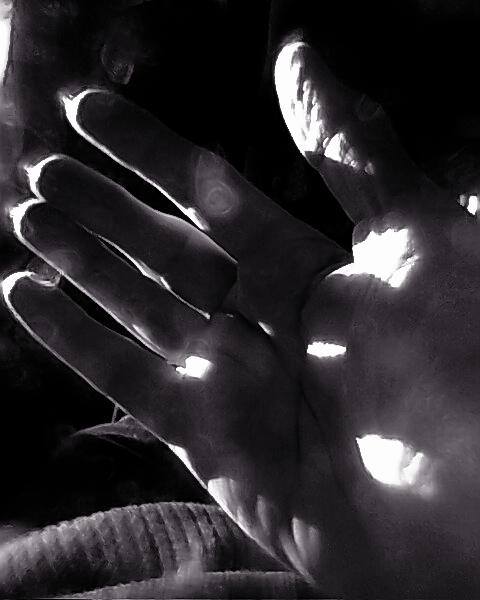
lit-up-hands.jpgI thought of writing in free verse today
As it has a different feel than form
Yet I have almost forgotten how to do that
We hear the News and then
We hear it again

When will peace come   like in 1989
South Africa?
When will people stop going to church
BECAUSE going to church  is not enough
It is not  so important.
What we do is.
Knowing what is possible is
It may be hard.
But cruelty is hard too,

Ethics and mysticism

“Mysticism has often been misunderstood as the attempt to escape this simple, phenomenal world to a more pure existence in heaven beyond. This is not mysticism, but Gnosticism. Biblical mysticism is the attempt to exit ‘this world’ to an alternative reality that pervades the old order. Its goal is to jettison the mind-set that says ‘greed is good,’ selfishness is normal,’ and ‘killing is necessary.’ Mysticism in biblical terms is not escapism, as so many have caricatured it, but a fight for ethics and social change.”
— Walter WinkWha

Big nerves

I have been mending “jewellery”  today.I find one can buy all sorts of fasteners and little chains.I find doing this is very soothing.I didn’t know the name of the clasp  which is lobster.Where you pull back a little rod and then the ring opens.I got some chains with a clasp at each end, Also used as safety chains.I  don’t like bracelets much but necklaces are nice.Mine are not real jewelry but things my husband bought in various odd places. or were given me by my sister.
I hope he’s not in hell because I am hot enough already!
I managed to pour some boiling water onto my hand but I react so quickly that it has not damaged the skin.I knew that when the dentist said my nerves are twice as big as the average that there must be a reason.I had never thought about whether the actual size of our nerves can vary so much. Some folk must have very small ones and sometimes I wish mine were.But on the whole, I  like myself.Whoever I am!

I can’t love  real numbers anymore

I can’t love  real numbers anymore
Their beauty has less meaning than  a flower
I can’t love them for they have more power
I can’t love real numbers anymore

I can’t love my husband anymore
I have the casket just behind the door
If I fall, I’ll hit the hi fi tower
I can’t love my sweetheart anymore.

I won’t love the angels anymore
I am in a rage and  I’ve gone sour
Give me my computer and will power
I won’t love the angels anymore.

I am cross because it’s dark and dour
I hate the rich who want to tax the poor
While they’re on a cruise or luscious tour
I am mad because it’s half an hour

Jesus died and no-one seemed to care
Some of  us were washing our long hair
None of us had any love to  spare
Jesus came and no-one ever saw.

What is life if we cannot be here?
What is worthwhile and is also near?
What is God about and what is fear?
What is love if we cannot be here?

Nobody will tell the truth in hell
Satan boils potatoes  till they gell
And he makes good chips with oil from wells
Nobody can tell the truth in hell.

Did Jesus really die for our sins?

https://www.huffingtonpost.com/christian-piatt/did-jesus-realy-die-for-the-sins-of-humanity_b_1007345.html


“Contemporary theologian Walter Wink goes a step further than Abelard, claiming that atonement theology is a corruption of the Gospel, focusing on an act of violence rather than the values of peaceful humility and compassion lived and taught by Christ.

Resolving the debate about the causes of, and purpose behind, Jesus’ death is an impossible task. More important, though is to make clear that such a debate is going on. For too long, Christians and non-Christians have assumed that all who yearn to follow the way of Christ universally believe Christ died for our sins. For millions, this not only defines their faith, but their understanding of the very nature of Good as well. For others, it is the basis for rejecting Christianity, understanding it as an inherently violent religion, centered on a bloodthirsty God that requires death in exchange for mercy.

This is not the God in which I put my faith, and I am not alone.”

Tea

Photo0404The doctor said I was too fragile to go to the hospital
She’d never even seen me
So I went anyway.

In A and E it was safer than being at home
I just realised they  never gave me a cup of tea.

Afterwords, they said they liked my voice
I had no choice.

Where are the chaplains nowadays?
We have DIY instead
My unconscious did it all
Then I went home and ate some food
But only because my sister was with me.

Sometimes I make  the tea very strong
Is it wrong?


A few words

My radio won’t play  music
Just the words of dead men
On cracked tea cups
And the lane where they led.
Sounds ominous?

The Television is always standing in the corner
Like we did at school when we misbehaved
Punishment, and how we were made.
I liked the singing and skipping most.

Mr Mulligan was young with dark eyes
He taught me for a year
Let me read novels in the afternoon
Fridays we polished our desks and cleaned the room
Mr Mulligan went to
Watch the football match on Saturday
Then he died.

Miss Molloy was elegant.She had red hair
She was beautiful with rimless glasses
When I’d been  off school
She showed me how to do long division
I found it irritating.
But I liked being at her big desk looking at the other children.
She was older and always severe.
She had  a lovely house with a  front garden
Not far from the bus stop.
I don’t know what her flowers were.

Father McGrath was very rich
His voice boomed
When we  went to Benediction I used to wonder
What was it he showed when we all had to  bend our heads down
So I looked.
It was big and gold like a clock.
Were we idolising it?


Poetry, surprise and older adults

Photo0092.jpg

Poetry helps older writers surprise themselves

“One of the great lessons of Cohn’s teaching experience is that everyone does have a poetic voice. “Right now I have a class with several students who, due to blindness, stroke or other health issues, can’t read or write,” she said. “They are still brilliant and they have a long history of loving learning, writing and language. So they come and find ways to participate. One woman, when I asked if she would like help scribing her words, said ‘I enjoy writing the poems in my head.’”

With Writing Home, Cohn aims to connect with students in a more personal and personalized way. “Rather than coming in with a cookie-cutter set of workshops, the Writing Home sessions are growing out of conversations I’ve been having as an artist-organizer, talking to experts in aging in and around the Creative Enterprise Zone, visiting existing programming for older adults – exercise classes, craft and arts groups, riding shotgun with someone delivering meals to homebound elderly.”

In a field where just getting to class counts as a victory for many students, it would be tempting to set the bar low, but Cohn measures her success by an array of metrics both challenging and inspiring. “I know sessions are succeeding when people come back for more,” she said. “We’ve succeeded if people have written something in class or between sessions. We’ve succeeded when people are bursting with eagerness to read what they wrote. We’ve succeeded when people share writing about a difficult experience and I get to witness that writer being supported by the community of writers gathered around the table. We’ve really succeeded when a student is willing to take the risk of revising work. We’ve succeeded if I share a poem an elder wrote and younger people are surprised by the quality or voice of a poem.”

And sometimes students even surprise themselves. “As a poet, one of my favorite moments is when a timid student, usually one who was given a whole lot of DOs and DON’Ts by a school teacher 70 or 80 years ago, takes a risk and tries something new in a poem. I remember a rush of pleasure when we were writing about art and I’d brought in a variety of images for writers to look at, and a student who usually wrote in very competent but tight rhyming couplets wrote an amazing, wild, gorgeous prose poem, and then looked up and asked innocently ‘Is this a poem?’””

Known by Heart’s Writing Home project launched in September in St. Paul’s Creative Enterprise Zone. Visit knownbyheartpoetry.com for more information.

Blood is always red

What is truth, the ruthless Pilate said
Postmodern thought already on  display
Our eyes are blind  yet blood is always red

On the stairs at night, I heard the tread
Was it Satan marching on his way?
What is truth, the  tiresome Pilate said

I lay in anguish in my chilly bed
In the darkness deeper than the clay
Our eyes are blind  yet sometimes we see red

The images of terror in my head
What to do and more, what must I say
What is truth, the  tortured Pilate said

Why are spirits broken and love shed
Children tortured where they used to play
Our eyes are blind  and good is almost dead

Deconstructed, demonized, displaced
In the shadows who can see the way?
What is truth, the  stupid Pilate’s dead
Our eyes are blind, what is the good, we said

Pavements

The  roots of trees don’t know what  pavements are
They heave them up as if by spite inspired
So older people to fall  down  by the cars

Underneath the   cobbles and the tar
Burns the earth with its creative fire
The  roots of trees don’t know what  cobbles are

To the boiling centre falls a star
And there it floats, a tadpole in a mire
Where older people  run  from falling cars

Above the water stands the Judge desired
See reflected, crooked Christian spires
The roots of trees don’t know what worships for.

With creative heat, I now perspire
My language shatters, breaks the  nerves of liars
When older people catch  a falling car.

I see a blade of grass with sun conspire;
Then comes again the soft yet poisoned tyre.
The  roots of trees have cracked the  pavement here
The older  people  pitied Hamlet and King Lear


Cracks in the pavement

What is conation?


IMG_3847.jpg
By my sister

https://www.merriam-webster.com/dictionary/conation


“conation

noun  co·na·tion  \ kō-ˈnā-shən \

Definition of conation

:an inclination (such as an instinct, a drive, a wish, or a craving) to act purposefully : impulse 3
—

conative

play \ˈkō-nə-tiv, ˈkä-, ˈkō-ˌnā-\ adjective

First Known Use: circa 1837

Origin and Etymology of conation

Latin conation-, conatio act of attempting, from conari to attempt — more at deaco

Medical Dictionary

conation

noun  co·na·tion  \ kō-ˈnā-shən \

Medical Definition of conation

:an inclination (as an instinct, a drive, a wish, or a craving) to act purposefully :impulse 2
—

conative

play \ˈkō-nət-iv, -ˌnāt-; ˈkän-ət-\ adjective


National book awards

14993456_803616356444911_2244128012820919368_n.jpg
https://www.pw.org/content/jesmyn_ward_frank_bidart_win_national_book_awards


““Writing the poems was how I survived,” said Bidart upon winning the poetry prize. “I hope that the journeys these poems go on will help others survive as well.” In her acceptance speech, Ward addressed the crowd and said, “You looked at me and the people I love and the people I write about…. and you saw your grief, your love, your losses, your regret, your joy, your hope. I am deeply grateful, and I hope to continue this conversation with all of you for all of our days.””


The Tragic Sense of Frank Bidart

“Twenty years ago, Frank Bidart called his sixth book Desire. It is desire that drives his poetry, just as making desire believable on the page drives his imagination. Besides its erotic reach, “desire” signifies for Bidart a yearning toward the absolute in any domain. To desire to create a perfect work of art; to find provable truth; to speak with a candor “that gives a candid kind to everything” (Stevens) is—as any adult knows—to fail. And yet. It is that “and yet” that gives passion to Bidart’s voice, as he both succumbs to and resists desire. Hoping in love for a perfect entwining of body and mind, the young are violently disappointed by each broken relationship; longing for the sustenance of family affection, the young are astonished and hurt by its deficiencies; the artist-in-the-making aspires after an unattainable aesthetic cohesion of heart, eye, mind, and medium; and the devotee attempts a mystical knowledge of the divine, only to have the radiance wane.

Bidart’s fiercely original poetry, now collected into one volume with several interviews, has found again and again an entry into the heartbreak, pathos, plangency, rage, and depression into which the longing for perfection will lead anyone who finds compromise intolerable. This is an old theme: Coleridge treated it in “Constancy to an Ideal Object”; Hopkins saw himself “with this tormented mind tormenting yet”; and Yeats, in “Among School Children,” bitterly addressed those unattainable ideal perfections of love, worship, or maternal aspiration, those

               Presences
That passion, piety, or affection knows,
And that all heavenly glory symbolize,
[Those] self-born mockers of man’s enterprise.

Bidart’s poems establish themselves on the paradox of the compulsion to return to the scene of desire, loathing its fundamental insufficiency as well as the self that returns to it. His intricate twists of syntax, coiling like a python about the tortured sensibility, act out the dilemmas and melodramas of the desiring self. Because above all he wants to register the sound of the human voice, he is driven to unusual representations of that voice on the page.”

Deep blue glass

Deep blue glass affects me  in the mind
Makes me happy with its glints and gleams
The colour pleases more than just my eyes

Colour  is the secret place I hide
While my inner self  sorts  out  its  dreams
Deep blue glass affects me here inside

I hear the colour, fleet  as butterfly
Traveling on some ornamental scheme
The colour pleases more than just my eye

To love the red and yellow I have  tried
But in my heart ,I  felt by them demeaned
Deep blue glass affects me there inside

I  looked at my old paintings and I sighed
For I gave up before I caught the scene
I like to share the treasures of my eye,

I shall take my spouse to Durham, York or Leeds
I’ll  inter his ashes in  the  far North  of his dreams
Deep blue glass affects me  in the mind
I have seen  the Light and it was kind.


Truth and love conspire

Using our perception, not our will
Imagination ,truth and love conspire
Effort is  not needed when we’re still

For pushing blindly, we are unfulfilled
And very soon our mind will be too tired
Unless we use perception, not just will

The soul and heart are set to send the bill
Yet imagination creates  its endless fire
Effort is unneeded when we’re still

Mostly we will swallow doctor’s pills
Smoke and drink, annoy with midnight choirs
Unless we add perception to our will

With Sisyphus, we push the stone uphill.
Wonder whether Jesus was a liar
Effort is  less needed when we’re still

As we renounce the sharp wish to achieve
We like  flowers delicate believe.
Perceive, imagine, give no thought to will
Effort is  not needed, be you still


I’ve had a really busy day, today
I planned my funeral, not the date,  I say!
If I’m cremated I’ll have Joan of Arc
If I’m  buried, let them play The Lark
I emptied all the drawers in my desk
I’ve not made a will, eternal pest!
I found five  stick deodorants unused
There was  the intention to be rude
To smell like a real woman does when nude.
A lot of artist’s rubbers and a fuse
There was soap and there were ear plugs in a case
Half a biscuit which I’m pleased to say I ate.
No envelopes  and only a few pens
No spectacles but I found one  single lens
Some ibuprofen and  a box of tapes
The drawer was overflowing till it ached
I put all these things into a box
I’ll have to scrub the drawers  out with Lux
Naturally, I  left stuff on my  only bed
I wish I’d put it all into the shed
I go upstairs and see the Lord  has fled
Just what the writer ordered for the dead.
Stay in tune and he will contact you
The infernal  broadband radio is new

I

Leonard Cohen sang it years ago

They say the flood is coming once again
Leonard Cohen sang it years ago
Who builds the ark, what is the pathogen?

Do we defer to women or to men?
Do we take it fast or fake it slow?
They say the flood is coming once again

We took away the  pillars built upon
Our ethics now destroyed by constant blows
Where is our ark, what was our pathogen?

We have PC not sin , confess, Amen!
And mini Stalins put on many shows.
They say the flood is rushing here again

Meanwhile, hidden Satans lure us on;
And goodness is  by bloodshed overthrown
Is there an ark, what was our pathogen?

Embarking soon, I wonder where we’ll go.
Is there dignity for those who cannot know?
They say the flood is coming once again
Who built our Ark, what was the pathogen?


A psychoanalyst …Winnicott and Harold Pinter

“In a remembrance of the writer Harold Pinter that appeared in the Los Angeles Times (and posted on Slow Painting), Charles McNulty included a memorable quote by D. W. Winnicott:

But for all his vehemence and posturing, Pinter was too gifted with words and too astute a critic to be dismissed as an ideological crank. He was also too deft a psychologist, understanding what the British psychoanalyst D.W. Winnicott meant when he wrote that “being weak is as aggressive as the attack of the strong on the weak” and that the repressive denial of personal aggressiveness is perhaps even more dangerous than ranting and raving. (All that stiff-upper-lip business can be murderous.)”

I just came across that quote by accident and thought it was worth posting here

Wounded by reviews?

I very much like the writer Kenneth Gergen and especially his book,” The saturated society”

http://identitythoughts.wordpress.com/2009/02/11/the-saturated-self-dilemmas-of-identity-in-contemporary-life-kenneth-j-gergen-pt-2/

http://www.qualitative-research.net/index.php/fqs/article/view/553/1198e”

I think it’s  beautifully written and explains the bad side of post modernism but also how differently it could be used.He got a very good review on the Washington Post but later got a terrible one in the NYT.
In an interview he told how this affected him badly until the man who wrote the review died ten years later.I’ll put a link in here later.http://books.google.co.uk/books?id=SweMLEe6TpgC&pg=PA294&lpg=PA294&dq=kenneth+gergen+the+saturated+self++washington+post+review&source=bl&ots=_lKF4I_lVi&sig=VEbgQl1ZpIwcLgfw3S5M5sI9__U&hl=en&sa=X&ei=JJ_VUtfLEeaP7AaviYHwCA&ved=0CGwQ6AEwCA#v=onepage&q=kenneth%20gergen%20the%20saturated%20self%20%20washington%20post%20review&f=false.

!He used to wake up at night with thoughts of what cruel things he’d  like to do to this person.This shows how even someone of high quality can be wounded easily.

Most people who read English novels have heard of Virginia Woolf. She was highly acclaimed yet had breakdowns whilst awaiting reviews.
Eventually she committed suicide during WW2.Her husband was Jewish and she was afraid of what would happen if the Germans invaded Britain.

But her mental health was fragile after losing her mother and favourite older sister in her teens and also possibly being sexually assaulted by her half brother.Despite al this she had much happiness and is one  of the most highly acclaimed women writers of the 20th century…not much good  to her of course

Sylvia Plath a great poet  a generation after Woolf also committed suicide and later became known as one of the best poets of our time

http://www.neatorama.com/2008/03/18/writers-who-suffered-from-the-sylvia-plath-effect/#!scilW

Would you like to be a tormented genius and enter the literary canon or just be an ordinary ,moderately happy person? Most of us are not so gifted in any case.

Some of us believe that others with more gifts, more money, more winning personalities are much happier ,but it’s not true.Many geniuses are troubled.

On the other hand being troubled by itself will not make you a genius,alas.Everybody is troubled at times.Sometimes a poet may use it

Is thinking a conversation? And dreaming…?It takes two.

Dwelling on my thoughts about thinking, and knowing much thinking is blind and cut off from the people outside us, is it valid to compare  it to different kinds of talk’ conversation?


Free thinker?

With a trusted friend or teacher we may open our hearts and ears.We may talk and listen .We may learn and give our friend new ideas…but also this conversation may be risky.So more frequently we gossip, talk about the weather or argue over trivialities.We may chat with a friend simply to show we are with them or as they say.To touch base…in other words to comfort and give security.

When we are alone, we might worry for hours.Some people used to worry a lot about their sins.Or whether they had enough money.Or some daydream and fantasise about Fifty Shades of Grey.
Maybe actual thinking or thought is rare.

I am not proposing we should be thinking all day.We would go mad!But were we to think ,would it be like a conversation with the Other within?So we’d be listening as well as talking silently?A kind of internal conversation may be taking place.We all know that our unconscious mind may be thinking while we are woolgathering or taking a a bath.Eureka..Archimedes famous cry.And dreams are also a kind of thought in images.They are a communication.Some people have had dreams which they felt were a message from God.
In a real conversation something new might be born…Why is thinking associated with tension and effort?

A heart without words

Photo0099.jpg
I’m not sure what prayer is but I like this quote

Quotes tagged as “prayer”
Mahatma Gandhi

“Prayer is not asking. It is a longing of the soul. It is daily admission of one’s weakness. It is better in prayer to have a heart without words than words without a heart.”
― Mahatma Gandhi

Shall I turn it on?

Photo0609_001_001Hello, are you the householder? No ,I’m that spider on the wall that people keep talking about.Who are you?
Your printer is broken.Wow, it’s still in the box.Thanks, I’ll take it back tomorrow.
Your mobile phone has got a virus! Oh, don’t worry.I have one as well.
Your internet radio is  listening to you. Thanks, I’ve been singing all day.I hope the radio is not jealous.I’ll switch it on or do I need to if it’s already listening?
The TV is watching you. I don’t care.I’ve seen all its sordid secrets.Well, not all but enough.
We can protect you.It’s ok.Catholics have guardian angels.
We will give you a free month.Of what?
We can pray instead of you.Somehow I  don’t think that is quite the same.
It conveys a subtle yet fundamental misunderstanding of what prayer is for.
Good bye,

What is the mystery of the world we know?

Whatever evil  humankind may do,
The sun will rise and shine on one and all.
Mercy, grace, and love are spread  anew
As apples ripen and the sweet birds call.

What is the mystery of the world we know;
That God looks with dispassion on us all?
And what his  wondrous virtues are to show
When wolves attack and murder does appall.

Will heaven compensate the refugees
Who starve in camps when money is withheld.
From those who gave us prophets and great seers
We see confusion, fear then ethics felled.

So often we are blind to wider views
And  get mere  entertainment from  the News

The poet

Moments when the original ‘poet’ in each of us created the outside world for us, by finding the familiar in the unfamiliar, are perhaps forgotten by most people; or else they are guarded in some secret place of memory because they were too much like visitations by the gods to be mixed with everyday thinking.

Tidying the drawers

My drawers are filled with little odds and ends
Letters from my brother and my friends
Some tablets  stop me vomiting at sea
And others cure the vertigo of me.

Alas each thing though small takes up a space
If each were infinitesimal what a grace!
For then I could keep millions in  one drawer
And stop myself from wondering where they are

Some inserts for my shoes I thought were lost
A photo of my husband in his past
A letter and a photo of a child
My diary of  last year  is nothing wild

Such clusters  never take on any life
I threw them in the bin and took a wife

Soothing rhythms help each mind to create;

Evensong evokes another state
A world of beauty, peace and mental calm
There all is still and thoughts do not gyrate

The breath slows down and evil does not mate
Indeed it flees  before the holy psalms
Evensong evokes another state

In the quiet, we  each can happy wait
Assured by song of good, of healing balm
Where all is still and thoughts do not gyrate

Soothing rhythms help each mind to create;
To bear the emptiness unfilled and do no harm.
Evensong evokes  this cultured state

Frantic notes  of music irritate
And minimise all  goodness and all warmth
Let all  be still and let thought emigrate

Let us lowly creatures slowly learn
To love each other as we take our turn
Evensong evokes another state
There all is  calm and thoughts are sweet as fate