
https://www.theguardian.com/science/2010/oct/17/benoit-mandelbrot-obituary
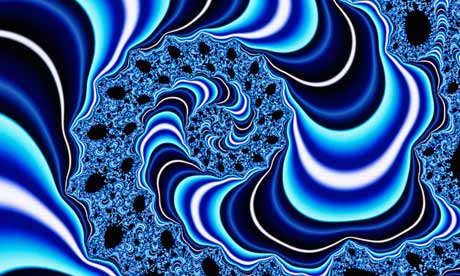
Extract
At the start of his groundbreaking work, The Fractal Geometry of Nature, he asks: “Why is geometry often described as cold and dry? One reason lies in its inability to describe the shape of a cloud, a mountain, a coastline or a tree.” The approach that he pioneered helps us to describe nature as we actually see it, and so expand our way of thinking.
The world we live in is not naturally smooth-edged and regularly shaped like the familiar cones, circles, spheres and straight lines of Euclid’s geometry: it is rough-edged, wrinkled, crinkled and irregular. “Fractals” was the name he applied to irregular mathematical shapes similar to those in nature, with structures that are self-similar over many scales, the same pattern being repeated over and over. Fractal geometry offers a systematic way of approaching phenomena that look more elaborate the more they are magnified, and the images it generates are themselves a source of great fascination.
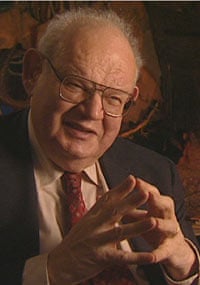
Mandelbrot first visualised the set on 1 March 1980 at IBM’s Thomas J Watson Research Centre at Yorktown Heights, upstate New York. However, the seeds of this discovery were sown in Paris in 1925, when the mathematicians Gaston Julia, a student of Henri Poincaré, and Pierre Fatou published a paper exploring the world of complex numbers – combinations of the usual real numbers, 1, -1 and so on, with imaginary numbers such as the square root of -1, which Gottfried Wilhelm Leibniz had labelled “that amphibian between being and not being”. The results of their endeavours eventually became known as Julia sets, though Julia himself never saw them represented graphically.
It was Mandelbrot’s uncle Szolem who initially directed him to the work of Julia and Fatou on what are termed self-similarity and iterated functions. In my documentary The Colours of Infinity, shown on Channel 4 in 1995, Mandelbrot told me how he set about developing his approach: ‘”For me the first step with any difficult mathematical problem was to programme it, and see what it looked like. We started programming Julia sets of all kinds. It was extraordinarily great fun! And in particular, at one point, we became interested in the Julia set of the simplest possible transformation: Z goes to Z squared plus C [where C is a constant number. So Z times Z plus C, and then the outcome of that becomes a new Z while C stays the same, to give new Z times new Z plus C, and so on]. I made many pictures of it. The first ones were very rough. But the very rough pictures were not the answer. Each rough picture asked a question. So I made another picture, another picture. And after a few weeks we had this very strong, overwhelming impression that this was a kind of big bear we had encountered.”

 How my heart speaks