
Like watercolours left out in the rain
Our colours mingled,yet the originals still remain.
Two watercolour paintings without frames,
Became one picture over time,
Yet two of us still there.
Our colours blended naturally,
Now all the hues are shared.
I love your colours intermixed with mine:
Together they have made a new design.
My watercolour painted by the rain
We die but our Watercolour Love remains
Day: May 21, 2019

Joining its reflection
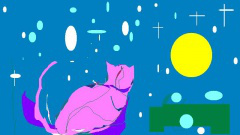
Two whole worlds.
One small cut.
One little chink.
Hard to find.
Very,very hard.
One small place
Where a very little cat
Could slip right through
The geometrician ‘s cut.
Cat could slip right through.
Just,slip straight through.
Joining it’s own reflection
On the opposite side.
The mirror’s other side.
And if I caught that tail,
If I caught her little tail,
She could pull me through,
She could pull me through,
So she and I too
We’d be on the other side,
The wrong way round,
On the opposite side.
So when you looked in,
If you looked in,
You would see me there,
Looking out at you,
From the opposite side.
From the opposite side.
And the cat beside
Looking very small,
Very,very small;
But very, very real.
How do you think you’d feel,
If I was looking out,
Staring at you
From the opposite side?
I can’t get back.
I can’t find Riemann’s cat
and without that pussy cat
I can’t find Riemann’s cut.
I think I’m in a trap.
I cannot find that cat.
So she can’t find the cut
To get me back,
She can’t bring me back
To where I was before.
Oh,how queer,
To have two of me in here.
I hope I’ll get on well
With my other self,
Behind the looking glass.
No one looking in,
But two are staring out.
From that other world.
I am looking out,
I’m looking out
To see if you are there.
One of you’s with me
That makes the total three.
Oh,dear me,
I should not have grabbed
Little pussy’s tail.
I didn’t really know
Where she meant to go.
“Wherever have you been?
Where do you think you’ve been
To get so filthy black,
And where’s your pussy cat?”
She never came back.
Never came back
From the opposite side.
Mother thought I’d lied.
I don’t tell lies,
But I can see my cat
Staring out at me.
Staring out at me
From the other side.
From the opposite side
Of my looking glass.
My lovely looking glass
Has trapped my tiny cat
On the opposite side.
On the opposite side
On the other side
Share this:

A new name for Rosa?


It is a truth totally unacknowledged by human beings that Professor of Linguistics and Word Mismanagement Rosa Benchez hates her own name.It is for this reason, she is keen to get married.Unfortunately ,her only suitor is Charlie Blogge. the well known TV biology expert
Does Rosa Blogge sound any better, she asked her friend Amy Panicker.
I find it hard to judge ,Amy answered. Ar least it’s not Bloggess. But there is another answer.
Rosa and her cat Lucy looked up expectantly.
Go on tell us!
Change your first name.Have you got any other name besides Rosa? Don’t say Wooden or Iron,I beg you.
Rosa looked surprised.
In a way that is harder emotionally,she began, because that’s what all my friends and family call me
They must have been dim to call you Rosa, Amy cried.
Don’t say that.Who wants to be compared to a light bulb?
Well ,who wants to be compared to rows of benches? Amy retorted.
Well. grandad was called I.Ron Benchez. Rosa shouted.He was from the USA.
Thank God ,he is not the President,Amy smiled
I think that is stupid.The name of the person has no bearing on how they can lead a government.
Well,how about Trump? Is it a real name or did they pick it from knowing the word trump from card games,Amy asked quietly
I have no idea,said Rosa.I shall look it up now
Wow, you have a new iPhone!
Charlie gave it to me,Rosa confessed shyly, blushing dark pink
You had better check whether he is tracking you, Amy told her anxiously.You never know what men will do nowadays.
But can’t you track folk on Samsungs or Nokia Lumias? said Rosa in her mellow voice.
I don’t think it is very romantic to give a lady a smartphone instead of some jewellery,Amy cried.
You can sell jewellery but who wants a second-hand iPhone.
As a matter of fact ,some old Nokias from the 90’s are now worth a few hundred pounds
So if you have one keep it unless your home is already overflowing with collections of pens,watches old newspapers and cats like my friend Percival’s, Rosa retorted.
Percival? what is his last name?
Joyce.Rosa whispered.He is related to the writer James Joyce.
Rosa Joyce…. how does that sound?
Well as you know any word you keep repeating begins to sound odd and the same is true of names.Even the nicest name like Katherine With-Doubt begins to sound odd when delivery men ask you for it.
Are you with doubt? one had asked her, she told me
Who is without doubt? she had replied courteously.
Who indeed said the clever Polish doctor working in the UK delivering stuff for Amazing,dot com.He lives round the corner: Thom Without-Doubt
Thank God you are not called that.
Amy asked Rosa if she could make a pot of tea.They sat in the old orange walled kitchen eating cream crackers and cheese and sipping hot tea.
Lucy was eating some cat biscuits and suddenly had a good idea
Why don’t you and I swap names, she mewed to Rosa with a loving smile.
Do you know,said Rosa, I am so fed up with names I shall change mine to a number if we carry on like this
Do you think 678 Benches sounds any better,giggled Amy.
I was thinking more of a name like Platonic form or pyramid
How does Platonic Benchez sound. Or Platonic Blogge?
And so ask all of us.
Share this:

The trauma of facing deportation

https://www.newyorker.com/magazine/2017/04/03/the-trauma-of-facing-deportation
Extract:
She believes that people cannot be truly healthy unless they have trygghet, a word that in English translates as “security” but which has a broader meaning in Swedish: trust, a sense of belonging, freedom from danger, anxiety, and fear. The modern Swedish welfare state was built on the idea that it must safeguard trygghet for its citizens, minimizing the risks to which they are exposed. “Security is the most basic foundation of the individual,” the Swedish minister of social affairs explained, in 1967. “Nothing good has ever come out of insecurity.”
Share this:

If any man proposed,I’d feel a blow
I do not need a diamond ring I know
Once the final treasure of a wife
But wish to entertain with trumpet show
But missing an engagement, I feel low
I’m down and out, I have no proper life
I do not need a diamond ring ,oh,no.
If any man proposed,I’d feel a blow
Here I see young Hamlet and his knife
I wish for grandeur from Chanel cologne
My long gone children haunt me as I sew
I mend the world, I wish to do it thrice
We do not need a diamond -horn to blow
I shall be humbled by the summer snow
The ice upon my cake is thick and white
I wish for heat , wish for the sun to glow
Shall Jehovah come to earth and smite
Those who hurt by envy and by strife?
I do not need that ring but love alone
I wish to entertain with fun and groans
Share this:
Sadness in its force has an allure
The memory of my loss still gives me pain
I do not wish to feel it anymore
The butterfly is battered once again
The waiting with its vigilance is strained
As if a monster shuffles to my door
The memory of my loss, oh heart of pain
Who for love will risk this sadness named?
Who is criticised for spirits poor?
The butterfly, the storm will come again
Life is hard and wildness can’t be tamed
Sadness in its force has an allure
The memory of my loss still gives me pain
Leaving Sodom, salt dissolves in rain
I must look forward with a vision pure
The butterfly find pleasure once again
The loss of movement we may each endure
The ills of age won’t have a final cure
The memory of my loss will fade with time
The fluttering flower gives joy yet has no fame
Share this:
The philosophy of poetry
https://philosophynow.org/issues/114/The_Philosophy_of_Poetry
Extract:

 How my heart speaks