How I found a hint of heaven through gazing at pashminas: deepening our worlds

Pashminas

When people talk of there being an invisible world behind this one I don’t understand

but I have had some experiences which gave me a deeper connection to this world

I’ll just describe one.I have some pashminas in my bedroom of bluey, violet, and turquoise soft wool. For aesthetic reasons, I have hung them from the picture rail opposite the window.

I was sitting up there one day in January 2003. The sun was rising and was low in the sky being winter.I sat there quietly.I turned round and saw the pashminas illuminated by the sun.

For a few minutes I was transfixed by a strange luminous beauty which of course is always there but when we are busy we don’t take time to look at things just for their own sake.

Well, another reason was that I was not trying to have a mystical experience..I just happened on it by chance.

Or as some American psychotherapist has said, we view the world with selective inattention. We ignore what is not one of our goals for the day.

We need to leave a little space

Pashminas 2

How to knit your first row

How to knit: You must have two large needles. You put one under each arm.,So far I’ve not gone beyond that but it’s hard to keep them under my arms all day.I gather I need some wool.Is this what is known as wool-gathering”?I buy some wool in the shop and come back.I have to “cast on” so that’s why men go boating so they can “cast off”…

To cast on you make a loop in the wool and slide it onto the needle.It’s easier using thick wool and thick needles. This loop is your first stitch.To make another, insert the left hand needle into the loop, wrap the wool around it and pull it through the first loop  then slide it onto the needle giving you two stitches. Repeat one hundred times and you now have your first row

Isn’t it hard explaining how to knit! It’s harder if you use sewing needles. think I’l cook instead.

By the way,a row is pronounced to rhyme with sew. Otherwise, you’d be knitting your first argument and why would you do that?

Acrostic?

Long ago the apple tree
Overhung the dark green lawn
Vertical in mystery
Everlasting in the dawn

Youth and winter disagree
Overland and over sea
Underneath, the  clouds  agree

Deep in soil the worms  will work
Each one with its unique quirk
After feasting they will lie
Round  the rim of a dark sky
Eloquence is good to find
Sometimes it will us remind
This is where we must be kind

No  bridge destroys its power, no currents sin

The geese have moved their flight path to the East
I miss the  gladness of their graceful wings
And wish I were a bird and not a beast

In the river, they have had their feast
While the sparrows watched and gently sang
The geese are gone, their flight path’s to the East

Seeing their grace at sunset gave me peace
The  natural  world such beauty to us brings
The wish I were a bird and not a beast

North East London’s  cut up by the Lea
No  bridge destroys its power, its currents sing
The geese have moved their flight path  further East

The geese do not  make nests  in a  tall tree
But dwell upon the water  like the swans
I wish I were a bird or honey bee.

As the infant  wisely grabs and clings
So the geese will fight  if threat descends
The geese have moved their flight path to the East
Oh, to fly at sunset  with the least


Concrete for the Temple?

https://blog.sagradafamilia.org/en/divulgation/reinforced-concrete-for-the-temple-of-course/


8297

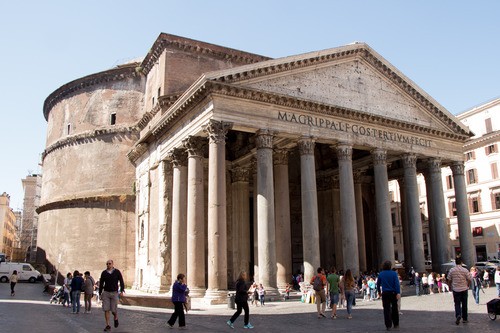
The Pantheon from Ancient History

Extract

WHEN WAS THIS CEMENT FIRST USED?

Building with cement and concrete may seem like a modern invention but these materials were used in Roman times. Of particular note is Pozzolanic cement, used by Roman engineers to build water channels, piers and watermills after they discovered this material can harden underwater. The name comes from the town of Pozzuoli, on the slopes of Mount Vesuvius in Italy, and the most well-known example of building with this type of cement is the Pantheon in Rome, from 123 AD. Its lightness without sacrificing strength is another great quality of this material, which is why it was used to build the great dome: with its diameter of 43.3 metres it is still the largest made of un-reinforced concrete in the world to this day.

It took nearly two millennia to surpass this size and was made possible by innovations in reinforced concrete, first used by Italian architect Pier Luigi Nervi in the 1960s.