Wendy Cope: “I can’t die until I’ve sorted out the filing cabinets”
As Wendy Cope donates her archive to the British Library, is the literary world at last taking her seriously
WENDY COPE, PHOTOGRAPHED BY THE NEW STATESMAN.
“Let’s go back to this thing about there being a story,” Wendy Cope says as we sit on a bench by the canal in Ely. “There’s a story of how a depressed primary school teacher became quite a well-known poet.”
She is being characteristically understated. Cope is one of the best-known and among the bestselling British poets of recent decades. Her first collection, Making Cocoa for Kingsley Amis, was full of “the kind of poems journalists enjoy”. As a result, it became, by her own admission, almost too successful. “I’ve never been more famous than I was, suddenly, in 1986,” she says. “I did find it very difficult to cope with all the demands that were being made on me.”
She quickly decided that she didn’t want to become “some sort of media personality, always on radio quiz shows”, and retreated to her study. She observes, with a touch of pride, that she is one of the few poets who don’t need to supplement their income by teaching creative writing courses.
After WWII had broken out, Kolbe and a few other priests remained in his hometown monastery where he organized a makeshift hospital. He was arrested in September 1939, briefly held for several months, and then released in December. The Germans gave him the option to sign the Deutsche Volksliste as he was half-German by birth and, could claim rights as a German under Nazi rules. However, he was very adamant he would not do so. The Germans allowed him to continue his publishing work although, on his release, he used it to begin printing anti-Nazi publications.
Kolbe set about doing more work to save his people, but this time, he did much more than establishing a hospital. He and other monks at his monastery worked to shelter refugees from the rest of Poland, and they hid as many as 2,000 Jews during the Nazi invasion.
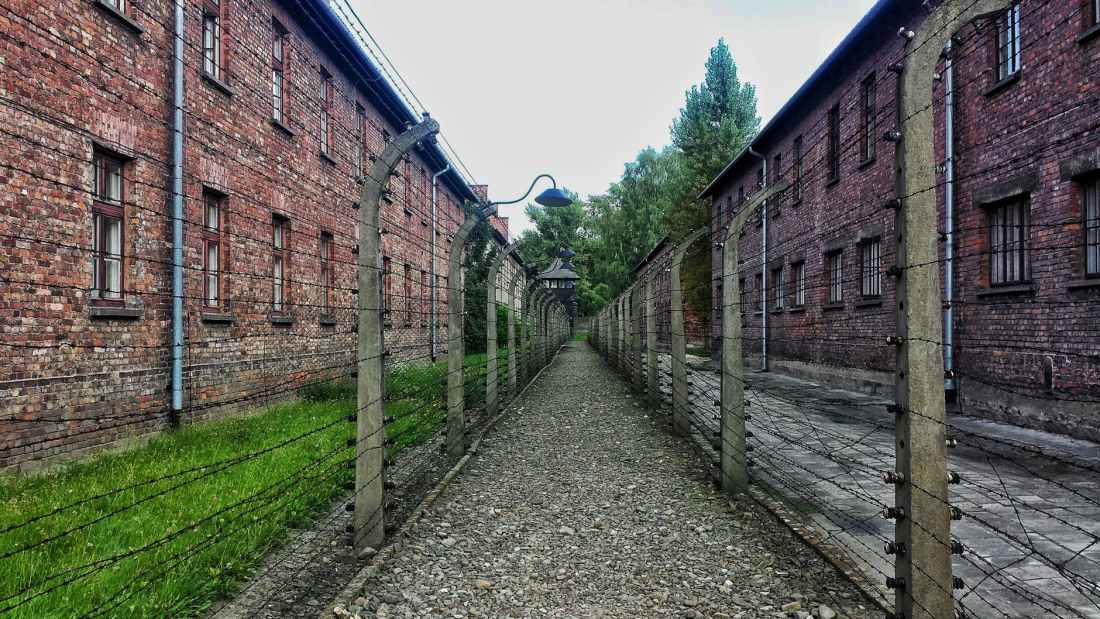
In February 1941 the Gestapo shut down the monastery and arrested him and his fellow monks. He was sent to Pawiak Prison, before being transferred to Auschwitz.
Maximilian Kolbe first from left.
A Priest in Auschwitz
During his time in the concentration camp, Kolbe continued his role as a priest, but it caused problems for him. There were many instances where he was subjected to harassment and violence, including beatings and lashings. Once he had to be taken to the prison hospital.
In July 1941 several prisoners escaped from the camp, so the deputy commander picked ten men to be punished, to discourage others. They were placed in an underground bunker and not given food or water until they starved to death.
One of the men chosen was Franciszek Gajowniczek. He was a Polish army sergeant who had been captured in Slovakia. When learning about his fate, he reportedly cried out, “My wife! My children!” Kolbe volunteered to die in his place.
The assistant janitor at the camp later reported that Kolbe led the other prisoners who had been chosen in prayers when in the underground bunker.
Kolbe outlived the other nine prisoners. He remained calm throughout the experience and was found by his guards to be either kneeling or standing in the middle of the cell at all times. The guards eventually tired of waiting for him to die, and gave him a lethal injection of carbolic acid. He calmly took the injection, and his remains were cremated.”
Note:
At that time cremation was not allowed for Catholics so it is a double injury to deprive his family or religious order of a Requiem Mass and burial for him in a Catholic graveyard
What gives meaning to our love and pain?
Love is missing,sex is cheapened now
The values of the heart have been disdained
What a laugh, we lit eternal flames
Fascism rides again, we had no clue
What gives meaning to our love and pain?
Marriage is demoted, life’s a game
If we see, whatever shall we do?
The values of the heart have been disdained
The doctor’s here, he limps in , he is lame
He has no wisdom, no goods to endow
That which may give meaning to our pain
The still,small voice is now by actors feigned
The mighty Tempest has no eye of calm
The values of the heart have been disdained
Where are they who’s hearts can feel, can warn
Whose minds are wise, who notice with alarm?
Who gives meaning to our love and pain?
The values of right minds, we have disdained




 How my heart speaks