

https://www.groovypost.com/reviews/complete-guide-google-docs/
https://www.groovypost.com/reviews/complete-guide-google-docs/
uit.
Ironically, even though the branches belong to your neighbour, you cannot simply throw them back over his fence. That could be deemed to be fly tipping of garden waste. Advise your neighbour that you intend to burn them or take them to a recycling centre.
You can cut branches and/or roots back up to the limit of your property, your garden fence, say. There you should stop.
You are not allowed to go into a neighbour’s garden without permission to cut a tree back. Nor can you lean over into his garden to cut back the ‘offending’ branch – you will be trespassing. If you cut the branch back beyond the limit of your property, into the very trunk itself, say, you could be liable for damage or trespass.

 I made this…
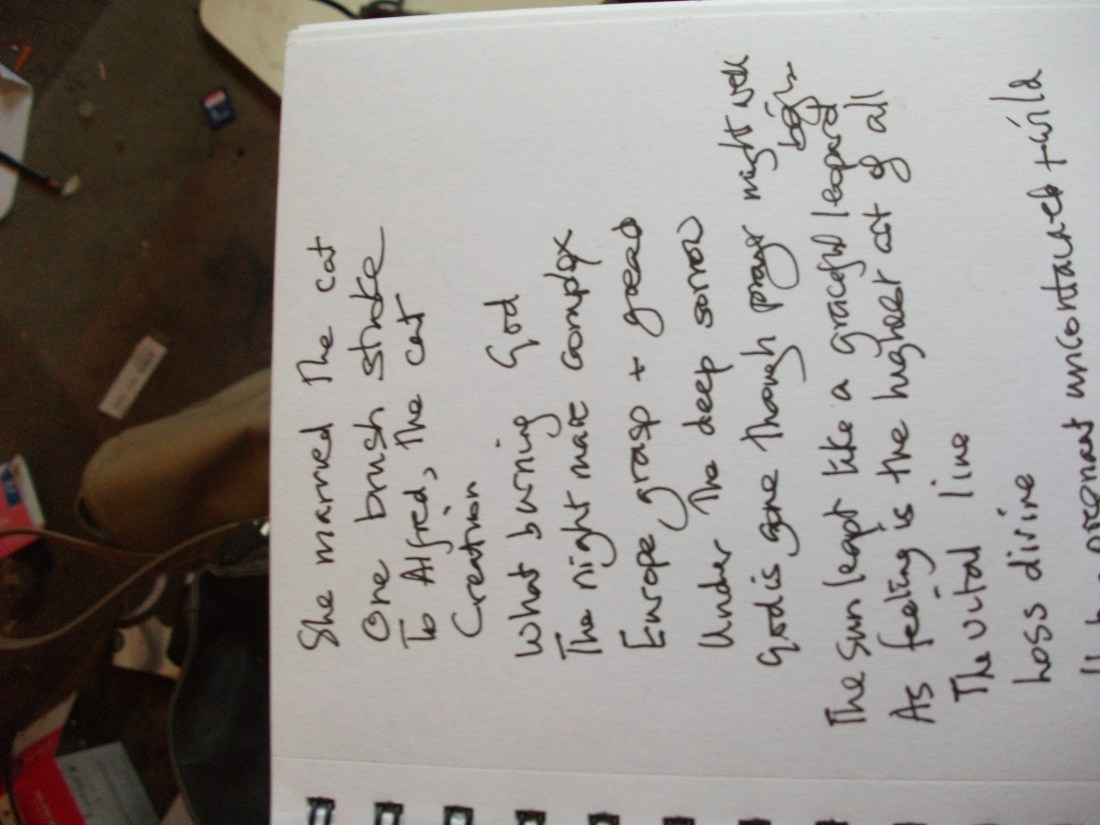
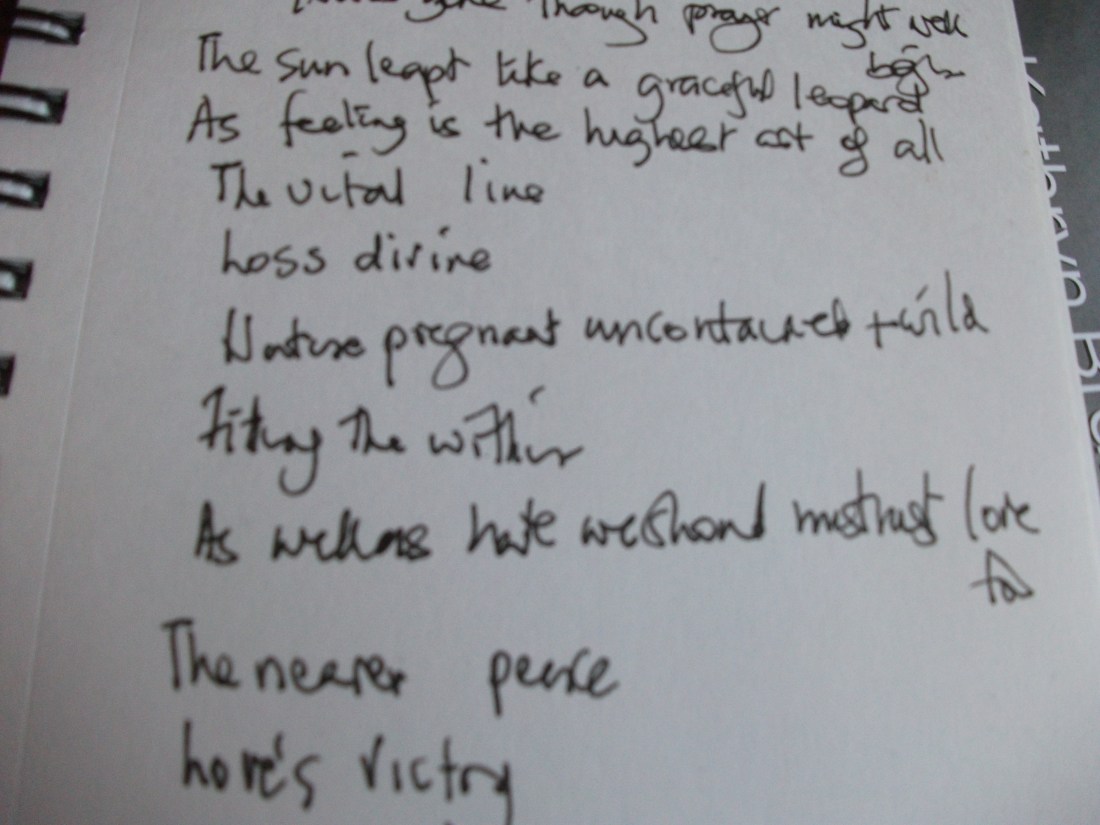


I wonder what rhymes with pedantic
Without being excessively frantic?
I thought of crazed wasps
Whose teeth I would floss
Yet that is not really romantic
Pedantic seems related to feet
In poetry that might be neat
Pedes obscuro
Might made a detouro
In search of a very fine beat
h

“The survey finds that the decline in poetry readership is unique among the arts — particularly the literary arts. “Since 2002, the share of poetry-readers has contracted by 45 percent—resulting in the steepest decline in participation in any literary genre,” the study concludes. Over the past 20 years, the downward trend is nearly perfectly linear — and doesn’t show signs of abating.
According to the latest numbers, poetry is less popular than jazz. It’s less popular than dance, and only about half as popular as knitting. The only major arts category with a narrower audience than poetry is opera — not exactly surprising, given the contemporary state of that art.
Of course the arts aren’t a zero-sum game, and they’re not a popularity contest either. But in general the arts community gets uncomfortable when you talk about declining numbers. I asked Bonnie Nichols, a researcher with the National Endowment for the Arts, who co-authored the latest SPPA, what she made of the poetry readership rate. She was less interested in talking numbers, and more interested in the things arts organizations are doing to counteract them.”


http://www.orwell.ru/library/essays/politics/english/e_polit
“MEANINGLESS WORDS. In certain kinds of writing, particularly in art criticism and literary criticism, it is normal to come across long passages which are almost completely lacking in meaning(2). Words like romantic, plastic, values, human, dead, sentimental, natural, vitality, as used in art criticism, are strictly meaningless, in the sense that they not only do not point to any discoverable object, but are hardly ever expected to do so by the reader. When one critic writes, ‘The outstanding feature of Mr. X’s work is its living quality’, while another writes, ‘The immediately striking thing about Mr. X’s work is its peculiar deadness’, the reader accepts this as a simple difference opinion. If words like black and white were involved, instead of the jargon words dead and living, he would see at once that language was being used in an improper way. Many political words are similarly abused. The word Fascism has now no meaning except in so far as it signifies ‘something not desirable’. The words democracy, socialism, freedom, patriotic, realistic, justice have each of them several different meanings which cannot be reconciled with one another. In the case of a word like democracy, not only is there no agreed definition, but the attempt to make one is resisted from all sides. It is almost universally felt that when we call a country democratic we are praising it: consequently the defenders of every kind of regime claim that it is a democracy, and fear that they might have to stop using that word if it were tied down to any one meaning. Words of this kind are often used in a consciously dishonest way. That is, the person who uses them has his own private definition, but allows his hearer to think he means something quite different. Statements like Marshal Petain was a true patriot, The Soviet press is the freest in the world, The Catholic Church is opposed to persecution, are almost always made with intent to deceive. Other words used in variable meanings, in most cases more or less dishonestly, are: class, totalitarian, science, progressive, reactionary, bourgeois, equality.
Now that I have made this catalogue of swindles and perversions, let me give another example of the kind of writing that they lead to. This time it must of its nature be an imaginary one. I am going to translate a passage of good English into modern English of the worst sort. Here is a well-known verse from Ecclesiastes:
I returned and saw under the sun, that the race is not to the swift, nor the battle to the strong, neither yet bread to the wise, nor yet riches to men of understanding, nor yet favour to men of skill; but time and chance happeneth to them all.
Here it is in modern English:
Objective considerations of contemporary phenomena compel the conclusion that success or failure in competitive activities exhibits no tendency to be commensurate with innate capacity, but that a considerable element of the unpredictable must invariably be taken into account.
This is a parody, but not a very gross one. Exhibit (3) above, for instance, contains several patches of the same kind of English. It will be seen that I have not made a full translation. The beginning and ending of the sentence follow the original meaning fairly closely, but in the middle the concrete illustrations — race, battle, bread — dissolve into the vague phrases ‘success or failure in competitive activities’. This had to be so, because no modern writer of the kind I am discussing — no one capable of using phrases like ‘objective considerations of contemporary phenomena’ — would ever tabulate his thoughts in that precise and detailed way. The whole tendency of modern prose is away from concreteness. Now analyze these two sentences a little more closely. The first contains forty-nine words but only sixty syllables, and all its words are those of everyday life. The second contains thirty-eight words of ninety syllables: eighteen of those words are from Latin roots, and one from Greek. The first sentence contains six vivid images, and only one phrase (‘time and chance’) that could be called vague. The second contains not a single fresh, arresting phrase, and in spite of its ninety syllables it gives only a shortened version of the meaning contained in the first. Yet without a doubt it is the second kind of sentence that is gaining ground in modern English. I do not want to exaggerate. This kind of writing is not yet universal, and outcrops of simplicity will occur here and there in the worst-written page. Still, if you or I were told to write a few lines on the uncertainty of human fortunes, we should probably come much nearer to my imaginary sentence than to the one from Ecclesiastes.
As I have tried to show, modern writing at its worst does not consist in picking out words for the sake of their meaning and inventing images in order to make the meaning clearer. It consists in gumming together long strips of words which have already been set in order by someone else, and making the results presentable by sheer humbug. The attraction of this way of writing is that it is easy. It is easier — even quicker, once you have the habit — to say In my opinion it is not an unjustifiable assumption that than to say I think. If you use ready-made phrases, you not only don’t have to hunt about for the words; you also don’t have to bother with the rhythms of your sentences since these phrases are generally so arranged as to be more or less euphonious. When you are composing in a hurry — when you are dictating to a stenographer, for instance, or making a public speech — it is natural to fall into a pretentious, Latinized style. Tags like a consideration which we should do well to bear in mind or a conclusion to which all of us would readily assent will save many a sentence from coming down with a bump. By using stale metaphors, similes, and idioms, you save much mental effort, at the cost of leaving your meaning vague, not only for your reader but for yourself. This is the significance of mixed metaphors. The sole aim of a metaphor is to call up a visual image. When these images clash — as in The Fascist octopus has sung its swan song, the jackboot is thrown into the melting pot — it can be taken as certain that the writer is not seeing a mental image of the objects he is naming; in other words he is not really thinking. Look again at the examples I gave at the beginning of this essay. Professor Laski (1) uses five negatives in fifty three words. One of these is superfluous, making nonsense of the whole passage, and in addition there is the slip — alien for akin — making further nonsense, and several avoidable pieces of clumsiness which increase the general vagueness. Professor Hogben (2) plays ducks and drakes with a battery which is able to write prescriptions, and, while disapproving of the everyday phrase put up with, is unwilling to look egregiousup in the dictionary and see what it means; (3), if one takes an uncharitable attitude towards it, is simply meaningless: probably one could work out its intended meaning by reading the whole of the article in which it occurs. In (4), the writer knows more or less what he wants to say, but an accumulation of stale phrases chokes him like tea leaves blocking a sink. In (5), words and meaning have almost parted company. People who write in this manner usually have a general emotional meaning — they dislike one thing and want to express solidarity with another — but they are not interested in the detail of what they are saying. A scrupulous writer, in every sentence that he writes, will ask himself at least four questions, thus: What am I trying to say? What words will express it? What image or idiom will make it clearer? Is this image fresh enough to have an effect? And he will probably ask himself two more: Could I put it more shortly? Have I said anything that is avoidably ugly? But you are not obliged to go to all this trouble. You can shirk it by simply throwing your mind open and letting the ready-made phrases come crowding in. The will construct your sentences for you — even think your thoughts for you, to a certain extent — and at need they will perform the important service of partially concealing your meaning even from yourself. It is at this point that the special connection between politics and the debasement of language becomes clear.”

 Sure, my blog is suitable for anyone to read,That is if they have actually learned
Don’t you think you are showing off telling people what words mean?
Well,I didn’t know myself, that’s why I looked tbem up
Still you have managed to live your life without using them
But maybe it would have been a different life!
Like, what idiot put an empty kettle on the fire
Oh, it was me.I was in my mimetic mode trying to convey the pressure I am under in this hothouse place
Well, in future use diogesis
I am too nervous to tell my story so I just drop a few hints
If you don’t take that kettle off the fire your whole life will have been a hint
What do you mean?
Stop thinking and take the damn thing off
Do you mean my dress or the kettle?
I mean both!
It’s not very romantic to talk to me that way
Why don’t we use the hot kettle to make some make believe tea and I will whisper in your ears while we mimetically drink it
OMG…. are you on the Spectrum.
Not yet but I am trying
You can say that again
Not yet but I am very trying
You can say that again
We seem to me in an infinite loop.Isn’t life wonderful
And that is the end of Women’s Hour for today

Mimesis is acting out rather than narrating.Is this why Freud wanted people to stop acting out their neurosis but construct a way of narrating it, that is making up your life story as a story that conveys better what your life has been and is.Linking together experiences and phantasies in a way that makes one feel it is a truer better story than what we were partly acting out unconsciously
For a better story read below
From Britannica.com

It means narrating a story which puts one as a spectator
as opposed to evoking or acting it out.
You make me feel like a handout
Another hand out ? How many hands do you have
We have a food blank right now.Except for snails
Don’t keep me inflating.I am no saloon
I make the blade gay which was no meaningless feat,I reassure you
If you want to make tracks, hire a wolf or even a pack of wolves on a zero hours contract
To rake waves won’t make anything grow in the sea.
If you make your mind improve ,who is doing the improving?
You must see it through
His eyes pierced me like darts with no handles
He makes my blood oil and sells it to the highest bladder
Making money is hard when you are pissed all day and kissed all night
She is making me go made withf rost
I chose a man for all the right pleasings
A blighter trades on whales
My man’s home is his battle.I am the field
God took out an order on me….I am tagged by daemons
Many hands make light work s; hire all the unemployedright and charge the national grid
He was not only unemployed but unenjoyed by anyone.
Why is self pleasure thought sinful?It is exercise,in a very feel sense
He was a larky sort of man.. he sang when high.
We have a hoover sort of love
Where have all the towers gone,gone to Grenfell,every one
When will we never burn?
A hundred years since the War to end all laws
Apartheid is not wrong, it’#s just that tigers will eat us.
The country as a Zoo
Surprise is welcome if we are secure
When happiness with safety is enough
Otherwise it’s more pain to endure
The cliffs of Howth, a beauty loved each hour
The harbour and large seabirds can be rough
Surprise is welcome if we feel our power
The grassy upland welcomes with small flowers
Oh, see large ships sail seas from Dublin tossed
In stress our eyes are tight, we sob, endure
The salty wind our city faces scours
No need to buy more products to feel loved
Surprise is welcome when we are secure
Innocence in chilhood is no bower
The hymen of the soul so rudely stabbed
With fear our eyes are shut, we just endure
We read of people who have had enough
Their life and light extinguished , sadly snuffed
Surprise is welcome to one who feels secure
Else it’s plainly pain too long endured
 https://teachersandwritersmagazine.org/make-it-new-using-surprise-to-make-poetry-come-alive-999.htm
“How do we teach students of poetry to avoid cliché, to use language that allows us (and them) to see things anew? In these four lessons, the poet Michelle Chan Brown offers an array of strategies for using surprise to subvert expectations and create a sense of wonder. Using the work of poets (and one songwriter), Brown walks us through the ways poets use surprise in both form and content, and presents writing exercises to help students incorporate surprise into their own work.
Michelle Chan Brown

The work of poetry is to render things new. When we use language in ways that surprise we do just that. But what, exactly, is surprise and how do we teach it? Any attempt to define it is a suspect endeavor because spontaneity and unpredictability are an intrinsic part of what makes something “surprising.”
Take a birthday party planned in stealth, or a physical gesture intended to rattle: the tickle-attack, for example. Once the recipient of the planned surprise has any indication of what is about to happen, they begin to strategize how they will receive the (now non-) surprise. They may still experience pleasure or distress, but of a different variety.
Although many claim to hate surprises, I would argue that in life, and especially in art, we crave surprise. Let me clarify that I don’t mean shock, which is surprise’s sweaty, bombastic cousin. The elegant relative of surprise is wonder. And why make art but to enlarge our capacity for wonder?
When we demand that language surprise us we move towards more clarity and fewer clichés, away from what George Orwell, in his famous essay “Politics and the English Language,” calls “the slovenliness of our language [that] makes it easier for us to have foolish thoughts.”
Although many claim to hate surprises, I would argue that in life, and especially in art, we crave surprise. Let me clarify that I don’t mean shock, which is surprise’s sweaty, bombastic cousin. The elegant relative of surprise is wonder. And why make art but to enlarge our capacity for wonder?
Here are four lessons on surprise that I have taught to high school students. The lessons introduce categories of surprise, look at sample poems that take different routes to surprise, and suggest approaches for writing poems that aim to surprise not only the reader but the poet as well.
Following the lessons, I offer several writing assignments that challenge students to explore these strategies for creating surprise.”
Read the rest by clicking the link


Winter had come very early to Knittingham yet owing to the late summer and wet autumn,many trees still had their leaves,,,,,,,,,,,some were even green.Stan and Mary were sitting in their mock Tudor cottage style kitchen eating muffins and honey with Earl grey tea in mugs.
Wow,it’s so cold,Mary remarked.
Now,Mary I have told you before that Wow is not a word I expect to hear from such a highly educated person as yourself….why waste your learning?All those years climbing over walls in Oxford and dating clever doctors from Harvard…
Bollocks,Mary answered in a tone not unlike the late Rose Nordloch,philosopher extraordinaire who was famed for her obscene talk.I am thinking of buying some woollen vests,she continued loudly.Good grief!
What is it, my darling Stan said nosily.Mary was looking at a catalogue of ladies clothing. and lingerie which had come in the post
They are £39 each,she said wonderingly.If I get three it will be nearly £120 plus postage.Just imagine,I may be unable to afford wool vests
Can’t you just buy one and wear it all winter like the Tudors did?her loving yet irascible husband replied
I think it would get smelly,my dear,even if I wore my anti -perspirant,Mary answered benignly.We should get wool vests from the Government to save us from going to A and E with double pneumonia,she continued softly…Shall we mention it at the Labour ? I can get it on the agenda
No,no,Stan cried,I want your lingerie to be a secret…
A woollen vest is hardly lingerie,she retorted.. sounding like a character from Barbara Pym‘s novels
Everything a lady wears under her dress in lingerie he murmured gently….bras ,knickers,pantaloons,petticoats,vests,corsets,suspender belts.stockings,tights,trouser liners,lace,fine silk,short underskirts,long underskirts……..nighties
But some lingerie is more sensual…Stan said wistfully,recalling the brown silk underwear Mary used to wear before feminism made most lingerie a No,No! Anyway,Mary said,we are too old for sex….we are too stiff and we are too shy now as well
But not too old to have a few fantasies,Stan thought… and woollen vests did not feature in his… he preferred lace and silk with a hint of perfume…. maybe a little embroidery….a dying art
Emile came in and asked for a vest too and some underpants… suppose I wet them? he miaowed in a panic
Well,you can’t have a nappy,Emile.Stan informed him.
I have no desire for such things,Emile mioawed angrily…where is my food?
Oh, yes… it’s in the fridge,said Stan.He took a large goldfish out of the fridge
Where did you get that from? Mary asked fearfully…
.Oh,that tom cat down the road knocked a fish tank over and he gave Emile one.
But they are pets!She shrieked…. ring 999 now and ask for an ambulance
Dave the bisexual paramedic strode in looking merry.
It’s Frank,the gold fish,said Mary fearfully……………Is he dead?
He is not quite dead,Dave answered….get a bowl of rain water.He put Frank into the
bowl and Frank began to swim…
Well, that’s a bloody miracle,Mary screamed. almost frightening Stan to death!
Just call him Lazy Lazarus.Dave quipped…he was in suspended animation.. fish are very
clever.Would you like me to clean out the kitchen or fetch in some coal for the scuttle? he
asked the old dears.
Thanks but not today,Dave.We were just discussing vests.Do you wear one?
Oh,yes.he said, and I wear a short petticoat too….I’dd love a silk one as I am a transexual
too,so I believe
Very wise,Mary informed him.Underwear keeps us warm.
And it makes me hot,thought Dave…. but he said nothing.He kept his sex life almost a secret even from himself
Vests,thought Mary.
To buy or not to buy
That is my question

On the first day of winter, my lover gave to me, 1 pair tights and a pussy cat without a single flea
On the second day of winter my lover gave to me,two woolly gloves, i pair ot tights and cat that had never had a flea
On the third day of winter ,my lover gave to me, three thermal vests. two woollen gloves,1 pair of tights and a cat with its very own flea
On the fourth day of winter my lover gave to me, 4 cashmere beanies,three thermal vests,2 woollen gloves ,1 pair of tights and a Manx cat completely tail free
On the fifth day of winter my lover gave to me 5 pairs of knickers 4 cashmere bean,ies,3 thermal vests ,2 woolen gloves,1 pair of tights and a Manx cat now the mother of three
On the sixth day of winter my lover gave to me, 6 silken nighties,5 pairs of knickers, 4 cashmere beanies,3 thermal vests,2 woollen gloves, a pair of tights and a tiger to sleep next to me
On the 7th day of winter my lover said to me
You do the washing
I’ll change the sheets
You make the coffee
I’ll buy some sweets
You make some tea
And we’ll see how the Manx cat stays flea free
The heart of poetry is much too hard to master
make the syntax good and  entertaining
the  gruesome heart of poetry   brings disaster


a meter errant makes  the lines come faster
an oxford  thesaurus   gets the listeners   waning
the art of poetry  isn’t hard to master.


a genius woke and saw a verse rush past her
it only needed polishing and planing
the  gruesome heart of poetry brings  disaster


she left the oven on,it gassed her
ever since her folk  groan, paining
the art of poetry  isn’t hard to master.


she saw her selves as coloured shapes in plaster
and round her mind, were ghosts all craning
the  gruesome heart of poetry brings disaster

there’s not a lot of hope if we’re complaining
for criticism  from hidden ghosts is draining
the art of poetry isn’t hard to master
the  gruesome  heart of poetry brings disaster
The geese have changed their flight path to the lake
For further to the East a river runs
Once used for milling flour for bread and cake
For making bulbs for lights and wartime guns
The lightbulbs were a fiction in the War
Radar was the secret they researched
An old man in my Art Class once worked there
A physicist who worshipped still in Church
God and radar,guns and shells and tanks
Angels,demons,Jesus Christ we’re damned
Money lenders,presidents and Banks
Evil now seems normal in our land
We rid the world of Hitler but we died
What soul survives nuclear matricide?
 https://www.poets.org/poetsorg/text/poetry-101-resources-beginners

We asked a number of poets, including previous Chancellors of the Academy of American Poets, to list a few poetry books that they would recommend to others. The selections that came in include influential volumes, books returned to over and over, must-reads, and books frequently recommended to students or new poetry readers.
Ai recommended:
Galway Kinnell
Body Rags (2002, Mariner Books Reissue)
Galway Kinnell
The Book of Nightmares (1973, Mariner Books)
W. S. Merwin
The Lice (1993, Copper Canyon Press Reissue)
Cesare Pavese
Hard Labor (1979, Johns Hopkins University Press)
James Wright
Shall We Gather at the River (1968, University Press of New England)
Sylvia Plath
Ariel (2004, HarperCollins Restored Edition)
Allen Ginsberg
Howl (1956, City Lights Books)
Robert Bly recommends:
Wallace Stevens
Harmonium (1923, Faber and Faber)
Antonio Machado
Soledad (1990, Fondo de Cultura Económica)
Antonio Machado
Times Alone (1983, Wesleyan University Press)
Richard Wilbur
The Beautiful Changes (1947, Reynal & Hitchcock)
Robert Creeley
For Love (1980, Macmillan)
Cesar Vallejo
The Black Messengers (1995, Losada)

https://www.poetryfoundation.org/harriet/2014/04/poetry-and-humor-for-megan-brian
” Let me talk just a little bit more about humor, and how it gets short shrift from this mass culture, so that for example you don’t hear people saying that Billy Wilder is a director far greater than someone like Tarkovsky. Nevertheless when I ask myself for my own opinion of “humor,” I confess than I find myself thinking of it as the rambunctious kid brother of the “serious.” I remember when I was a little boy I liked Beaver Cleaver but I was in love with the older, more staid Wally—and although erotic signs have changed considerably in 50 years, Wally remains the ne plus ultra of a certain kind of fuckability, a glamor of seizure. It’s the child, however, who sees through the pretensions of the adult, and that’s why I don’t care much for children no matter how cute.
I don’t want to waste a lot of time on examples of great poets whose work I find funny—because what one finds funny is a private thing. I know some who are still laughing at Liza Minnelli’s hijinks in Arthur and Arthur part 2. Going back to Freud’s model, I want to address the question of how we can wrest humor out of bleak circumstance. Let’s take a historical view. I can remember when Susan Sontag wrote her “Notes on Camp,” which, in the 60’s, was the most readily identifiable strain of gay humor available to her, or to most of us I guess. Sontag’s definition of camp proscribed a certain narrowing of it to include the love of gay men for the things straight people despise—untalented stars, kitsch, false icons, trash. Now that it’s 2014 I see camp as a product of a society in which love was valorized above all other possible forms of emotional action. We were supposed to be meek then, all of us. We would inherit the earth. ”

To me this adage implies that someone in pain needs only use more will power to blot out the pain.This is false.If it were true it would be dangerous.Should we banish the pain of a broken leg and continues using it we would do more damage or possibly go unconscious and even die.Will power is affected by fatigue,it is not limitless
When Jesus said,Take up your bed and walk to the paralysed or crippled he said it we believe as the Son of God who could work miracles
Maybe some of the people’s problems were psychosomatic and faith in God might give them confidence to try to walk.These things have occurred under hypnosis.I don’t have any data
But pain is a neccessary warning signal and we cannot turn if off. entirely.People born unable to feel pain don’t live very long
If you suffer chronic pain you do use all your will power to keep going.However it is finite and you pay a heavy price.Like you go shopping get home and can’t walk for 3 hours.
The only sensible saying would be “mind interacting with matter” and even that assumes Descartes division of us into a body and a completely separate mind where we live and take decisions.I expect this is imagined to be in the brain.Since we still don’t know what mind and consciousness are Descartes supposition may have had bad consequences.
If we pay attention to our body in the places which hurt this when kept up for a good while can relax some muscles and tendons.I used to do it for migraine but it would take at least 2 hours lying down and gently focussing on the pain which would gradually ease.Keeping very still stops one vomiting too.Of course you need a quiet place to do this and work is no that place
I have not yet found it helps arthritis but maybe it takes 3 hours or 5 hours and would not someone have written articles about it? Relaxing is usually good but many people are strained at work and struggle to keep going.That’s why A and E is full of drunken people at the weekend… they have be injured in falling or brawling
We educated people may blame these workers but could you spend 50 years in the coal mines [ and bring up 6 children alone] which my grandad did? He didn’t drink much as in those days they were paid starvation wages and Mum had to go to Soup Kitchens sometimes.If he had drunk he would not had much money for his children to eat
You may say if men didn’t get blind drunk then, why do they now? Ask a sociologist.It seems also to be common among middle class youngish people.I feel it’s a release of tension and if you go back to your flat alone on Friday you might be judged a loser.I know of people who go out of London on a train,get home and have no idea about it the next day.So it can be dangerous even if it helps arthritis pain
People who say, mind over matter, also are asserting their superiority to us sufferers who are weak willed morons
I did an IQ test once and I am a moron which seems odd as I used to be a mathematician!Really it shows they are rubbish on the whole
Rubbish is the in word now
The other technique which does work is Distraction.Meet friends and talk, write poetry, paint and draw.Get a camera and play with it.Go out and get a whore.I am unsure where you get them from but maybe now we are all whores.
Go to a party and get utterly knackered.But when you go to bed you still feel the pain.So how about all those free books you can get? Anything out of copyright might be available as an e book.I know someone who has read the ancient Greeks this way and alsoNewton and Hook.He has few friends as most people don’t understand such things but if you do, read all night and then have a nervous breakdown
Going mad may stop pain.I can’t say as yet and if I do I probably won’t be able to write an article about it.But on the whole given mental health’s low status in the UK I will not advise anyone to even think about it.
How do you go mad? Does anyone know the ideal way? First have loads of money for carers and a nice home with space for them…. and no doubt you will end up seeing a CBT therapist who will train you to believe you are sane and have no pain.
That’s a different kind of madnness
Here is the house and here is the door
But where is God?
Here is the table and here are the chairs
But where is God?
Here is the kitchen and here are the pans
But where is God?
Here is the woman and here is the man
Here is the bed that they lie upon
And here is God
h

I. The Art of Illumination
At times it is a good life, with the evening sun
gilding the abbey tower, the brook’s cold waters
sliding past and every hour in my Book
a blank page, vellum pumice-stoned
to chalky lustres which my inks suffuse:
saffron and sandarach and dragon’s blood,
azure and verdigris. Monsters and every type of beast
curl round the words. Each man here has a past,
and each man reasons for his faith. I wronged
a woman once and nothing I did after could atone
or throw a light upon the blackness of that deed,
whose harm lay in the telling, not the doing.[
[Use the link to read more, please]

When wi wer cummin’ ‘ome at last
From het Somme and from et Trojan Wars
The ghosts of owa dead menfolk shuffled past
Making sense u’ livin’ is owa task
When th’ heart and soul are sad and sore
When wi eh cummin’ ‘ome at last
The rush an’ rasp of textures breaks ‘t fast
We want to live ; we want to fight no more
The ghosts of owa dead neighbours staggered past
When wi all went mad ,wi acted daft
Wi felt dissected by yon eyes that saw
When wi were cummin’ ‘ome at last
Some we’ weeping ,others sat and laffed
Wi saw owa cat and touched her little paws
The ghosts of owa dead mammies staggered past
Do not kill that good that love adores
Do not bet with evil as ye source
When will we be cummin’ ‘ome at last?
The ghosts of owar own futures shuffle past
When will we be cummin home at last?
Will we be cummin’ home at last?
http://www.scottishpoetrylibrary.org.uk/poetry/poets/edwin-morgan/

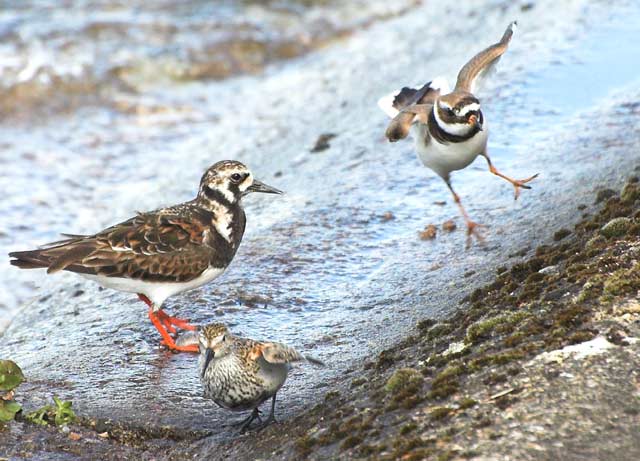
Born in Glasgow, Edwin Morgan lived there all his life, except for service with the RAMC. Although his poetry is grounded in the city, the title of his 1973 collection, From Glasgow to Saturn, suggests the enormous range of Morgan’s subject matter. He was Glasgow’s first Poet Laureate 1999-2002, and the first to hold the post of ‘Scots Makar’, created by the Scottish Executive in 2004 to recognise the achievement of Scottish poets throughout the centuries.
Scotland’s first official Makar in modern times, Edwin Morgan was endlessly inventive, inquiring, energetic, internationalist, and deeply committed to his home city of Glasgow.
A book of poems in his honour, Unknown Is Best, was produced to celebrate Morgan’s eightieth birthday in 2000. His own poem, ‘At Eighty’, was characteristic of the poet’s work, faring forward into the future, embracing change: ‘Push the boat out, compañeros / Push the boat out, whatever the seas…. push it all out into the unknown! / Unknown is best, it beckons best…’.
This seems an unlikely sentiment from a man of Morgan’s background. He was the only child of loving, anxious and undemonstrative parents, Stanley and Margaret (née Arnott) Morgan, politically conservative and Presbyterian. His father was a director of a small firm of iron and steel merchants. Edwin George Morgan was born on 27 April 1920 in Glasgow’s West End, and brought up in Pollokshields and Rutherglen. He attended – unhappily – Rutherglen Academy, moving on to complete his schooling at Glasgow High and entering Glasgow University in 1937. When he was called up in 1940, he horrified his family by registering as a conscientious objector. He reached a compromise position while waiting for his case to be called, and asked to serve in the RAMC, with which he spent the war in Egypt, the Lebanon and Palestine.
He was demobbed in 1946, returned to Glasgow and took a first class Honours degree in English Language and Literature. There was a chance of studying at Oxford, but Morgan preferred to take up the offer of a Lectureship in the Department of English at Glasgow University, where he remained. Having become Titular Professor in 1975, he retired from the University in 1980. He was a much-valued colleague and himself appreciated the structure and salary that academic life gave him.
Morgan first published under the name ‘Kaa’ in the High School of Glasgow Magazine, in 1936, and went on using that nom de plume in the Glasgow University Magazine, emerging as reviewer and translator under his own name in a variety of periodicals after the war. His first collection, The Vision of Cathkin Braes, was published by William MacLellan of Glasgow in 1952, and in the same year the Hand and Flower Press issued his translation of Beowulf (reissued by Carcanet Press in 2002). For fifty years Morgan maintained this double output, translations from Russian and Hungarian, Latin and French, Italian and Old English keeping pace with his own work, showing astonishing variety and technical skills in both. He won the Soros Translation Award in 1985, and spent the prize money on a day trip to Lapland on Corcorde.
That first collection seems quite mannered now, given the immediacy of voice that characterizes Morgan’s poetry as it developed. A Second Life, published handsomely by Edinburgh University Press in 1968, signalled a profound private change as well as public achievement: this was the volume that established Morgan’s importance. In 1963 he had met and fallen in love with John Scott, to whom he remained attached – although they never lived together – until Scott’s death in 1978. Given the repressive legislation and attitudes of the time, this was a concealed love, but for Morgan it represented a liberating reciprocity. It was paralleled by his discovery of the Beat poets and other American exemplars such as William Carlos Williams and Robert Creeley: from them, he said, ‘I really learned for the first time… that you can write poetry about anything.’
The subjects in A Second Life ranged from the dispossessed and marginalised populations of Glasgow, in all the misery of the tenements due for demolition, to the trio walking up Sauchiehall Street, ‘laughter ringing them round like a guard’ as well as poets, Marilyn Monroe and Edith Piaf. Some of his wittiest concrete poems – ‘Siesta of a Hungarian snake’, the classic ‘Computer’s First Christmas Card’ are here, and the love poems that are much loved, ‘Strawberries’, ‘One cigarette’. Kevin McCarra remarked of the devotion to the city Morgan lived in all his life:
It is part of his purpose to bear witness to Glasgow while insisting that hope and realism need not be at odds. This is tricky work and all his talent is required to hold off glibness. Misery, violence and pain are on the scene, but they will not be given the last word.
Unobtrusively yet significantly, Morgan’s wide reading, love of cinema and definite musical tastes all informed his poetry. Of poets writing in English, he was one of those most attuned to what changes science and technology have brought to our perception of the world. He was one of the first civilians to put his name down for a space-shuttle trip (yet he never used a computer). The title of his 1973 collection, From Glasgow to Saturn, not only suggests his subject range but also his curiosity. The scienc-fiction element in his poetry is one aspect of this, but there is also the interest in the whole history of earth, manifested in his Planet Wave sequence (1997) which was set to music by Tommy Smith. The energy of inquiry attracted him, and the energy of invention.”


 How my heart speaks