Humour

MigrantHawkerI made an old friend laugh a  lot when I suddenly switched from Educated English into my broad  Lancashire accent.She was thunderstruck.I’ve never spoken like that before in front of her.I sound  like Thora Hird.. I look like her.Am I her double?

Where the cow slips there slip I
How come this beauty?
Where the bull rings, there ring I
Ravel your duty
There’s no  deliverance
From heeding life  at once
To learn love’s wisdom

“There are no ordinary people”

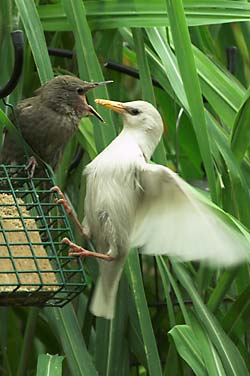
WhiteStarling_2011

 Photo by Mike Flemming copyright

“There are no ordinary people. You have never talked to a mere mortal. Nations, cultures, arts, civilization—these are mortal, and their life is to ours as the life of a gnat. But it is immortals whom we joke with, work with, marry, snub, and exploit—immortal horrors or everlasting splendours.” To embrace this account of the human person, which is of course a traditional Christian one, is to decenter the world of politics—not to ignore it, but to shift it toward the periphery, to see it as among the second rather than the first things. (Lewis, The Weight of Glory, p 46; Jacobs, p 56)

C S Lewis ,best known as the author of Narnia, was an Oxford Don who wrote  about Christianity [Mere Christianity]


Do what’s better, not what’s worse

Oh, mother, father take me back
I’ve lived the pain, I ‘ve felt the rack
I wanna see Jesus.
Take me to that  wall they  built
Let me see where blood’s been spilt
I wanna see Jesus.
Oh, take me back to where I was
The enemy may well be us,
Not Jesus.
What did all those sermons do?
Did they say he was a Jew?
Oh, Jesus.
Did he want the First Crusade
It is his blood  the priest creates
Lord Jesus.
I don’t like the way things are
I am getting tired of war
Kill Jesus.
What has human wisdom done
From Wittgenstein to Abraham?
Cripes, Jesus!
Does research improve our lives
As for grants, the scholars strive?
Ask Jesus.
We may have  chemotherapy
Radiation, history.
Where’s Jesus?
You’d think that after all the years
We’d have used  up all our tears
Sweet Jesus.
Love your neighbour as yourself
Give 1% of all your wealth
Aye, Jesus.
Do what’s better, not what’s worse
I see another fragrant hearse.
It’s Jesus.
See the plastic Crucifix
See  him  dying with dry lips
Bend your knees, confess your sins
Otherwise,  the Devil wins
Not Jesus.
We destroy the good we hate
Envy writhes and with pride mates.
The progeny will wreck the earth
Eden’s burning as drones pass.
No, Jesus.No Jesus.
Know Jesus.

A brave novelist

https://www.theguardian.com/lifeandstyle/2018/aug/19/i-was-scared-of-losing-my-sight-then-writing-brought-me-clarity


“Before, says Peretti, she was “very scared of showing people I had a disability. For a long time, I tried to be better than a ‘normal’ person. It was stupid. Now I know that we are all different, and we only have to be ourselves. I am this way: a writer, a woman, a person with a disability.”

Like a child afraid of the dark, the unknown filled her with dread. “Now I know that no one can control the future. We don’t know what will happen tomorrow.”

For Mafalda, a keen goalie, letting in a goal because she doesn’t even see the ball coming and being ditched by her oldest friend, are particularly unexpected. Without self-pity she crosses “having a best friend” off her list of essential things. “I thought, for a long time,” says Peretti, reflecting on her own attempts to suppress her need for human connection, “that it was very hard for other people to be close to someone with a disability, or problems in general. But it wasn’t hard for me to be with marginalised refugee children. It’s not hard to be with someone who needs help.

“Being lonely was a great fear of Mafalda’s, and of mine. It is a sort of death, being lonely. Finding a true friend, a real friend, is the most important thing for Mafalda – and for me as well.””

Friday’s Child by Auden

    He told us we were free to choose
But, children as we were, we thought—
“Paternal Love will only use
Force in the last resort

On those too bumptious to repent.”
Accustomed to religious dread,
It never crossed our minds He meant
Exactly what He said.

Perhaps He frowns, perhaps He grieves,
But it seems idle to discuss
If anger or compassion leaves
The bigger bangs to us.

What reverence is rightly paid
To a Divinity so odd
He lets the Adam whom He made
Perform the Acts of God?

It might be jolly if we felt
Awe at this Universal Man
(When kings were local, people knelt);
Some try to, but who can?

The self-observed observing Mind
We meet when we observe at all
Is not alariming or unkind
But utterly banal.

Though instruments at Its command
Make wish and counterwish come true,
It clearly cannot understand
What It can clearly do.

Since the analogies are rot
Our senses based belief upon,
We have no means of learning what
Is really going on,

And must put up with having learned
All proofs or disproofs that we tender
Of His existence are returned
Unopened to the sender.

Now, did He really break the seal
And rise again? We dare not say;
But conscious unbelievers feel
Quite sure of Judgement Day.

Meanwhile, a silence on the cross,
As dead as we shall ever be,
Speaks of some total gain or loss,
And you and I are free

To guess from the insulted face
Just what Appearances He saves
By suffering in a public place
A death reserved for slaves.

The quick of human flesh was dragged and torn

The death of God implies he did exist
And of his sayings many were possessed
The still, small voice, the burning bush, its fire
The prophets ,Moses ,Jesus, Jeremiah

On God, a  snail without a shell , we trod
On his face of love,  we  left much blood
The quick of human flesh was dragged and torn,
Oh, tortured people, God lived in your forms

Tear your finger nail side,see it bleed
Imagine pain both dreadful and unseen
Where was God’s own dwelling place, we cry
To the lowly, he was in the sky.

God was buried live in  earth  which shrieked
My people,where are they, ah can  none speak?


A number of Jews who survived the death camps went to their old homes in Eastern Europe.I am not saying which country
They were buried live.The earth heaved for hours

A human haversack [ dialect words]

A kettle beylin on het fire means home
A place of greater safety, allus known
Mi mam wer  mekin  bread and  dad wer heah
I  live now cos mi daddy drank that beer

T’cat wer sat down on   our old rag rug
I was in ‘t kitchen  peeling spuds
We had ehn old gas cooker  and a sink
Otherwise we’d only pen ‘n ink

Mi ballispipes are useful as I hum
Hopin’ song will bring mi daddy home
But  now and then they cause some people wrath
Like a woman in my  Wensday morn Art Class

She shouted ,is there summat wrong wi’ you?
Where to start, is Confession ever new?
Abaht mi singin’ I  don’t sing bi will
I think it’s daddy, he is wi’ mi still

Oh daddy I  don’t miss your ballybalt
On my bum it left eternal welts
Yet you sang me lullabies and   I rode  on ye back
A livin’ ,breathin’ ,human haversack

Religious rites: are they of any real value?

starling2

This photo is from Mike Flemming’s Natural History Blog

http://home.btconnect.com/mike.flemming/

Auden and God


“In the 1950s and 1960s his  [Auden’s ]religious views began to coincide with those of the Protestant theologian Dietrich Bonhoeffer, whose letters from the Nazi prison where he was eventually murdered had expounded an adult, “religionless” Christianity that had left behind all childish fantasies of a protective, paternal God. Bonhoeffer’s God experienced human suffering: “It is not some religious act which makes a Christian what he is, but participation in the suffering of God in the life of the world.” Auden told friends that of all the doctrines that the early Church had condemned as heresies (such as the Gnostic and Manichaean heresies that regarded matter as inherently fallen or demonic), the only one in which he believed was patripassianism, the doctrine that the Father voluntarily suffered with the Son.”

A strange experience by WH Auden

One fine summer night in June 1933 I was sitting on a lawn after dinner with three colleagues, two women and one man. We liked each other well enough but we were certainly not intimate friends, nor had any one of us a sexual interest in another. Incidentally, we had not drunk any alcohol. We were talking casually about everyday matters when, quite suddenly and unexpectedly, something happened. I felt myself invaded by a power which, though I consented to it, was irresistible and certainly not mine. For the first time in my life I knew exactly—because, thanks to the power, I was doing it—what it means to love one’s neighbor as oneself…. My personal feelings towards them were unchanged—they were still colleagues, not intimate friends—but I felt their existence as themselves to be of infinite value and rejoiced in it.

WH Auden