
Day: Jan 15, 2018

My writing as an image

Share this:

Music for the evening
Share this:
A good blog
via Talk less, listen more, ask questions
Share this:
A letter from Button

1,New Rd
Button
Suffolk
IPS0 0NO
UK
Dear Annette
I meant to write before but seeing you kept mentioning rubbish I had wondered if I should prune my blog and leave only the best poems here.However it is hard for me to decide,I don’t even remember many

I find I have to write a lot of so-so stuff before my mind and heart get working.It’s like exercise.But your letter was so funny, it cheered me up.What a pity we live so far apart.
Maybe we could hang out on Google Mail!I have no idea what it means,do you?
I miss getting letters with handwriting on them.Wondering whose it might be etc.Why don’t we do that? It would be very pleasurable to see your unique writing on an envelops
I had problems with my homework too.I decided to do Double Maths at A level as it would not take so much time up and then I could read novels.I didn’t know why or how we should do Lit Crit yet the English teacher cried when I was not down for A level.I do regret my error as it is a great sociial handicap although my optician who is Jewish says it’s no problem to them to have an intellectual wife.Still I am a bit too old to try another culture as I might mortally offend a hundred people at a stroke, and vice versa
I can see now what a blessing it might have been to read all the great writers and get paid to do it but curiosity also led me into maths as well.To be honest it was somewhat boring for a long time until we reached the higher slopes.Ah, well
Life goes so quickly.I’m reading Plath’s Journals and I see how she worried away so much of her time.That is a big mistake.Use worry for energy
Too much for girls to decide too rapidly when they are so gifted yet also want a family.And her psychoanalyst was not fully qualified
It seems to me the therapist “sold” her a story
I feel deprived of her later work.What a wonder it might have been
I look forward to hearing from you
With love
Mary, Emile and Stan’s old robin
Share this:

If you want to write spam comments

Always keep beauty near you when checking for spam
1.Never get your English grammar correct.
2.Make sure your comment is not relevant to the post you put it on
3.Never ask me to pass it on to the Relevant person
4 Do get a few spelling errors in when you offer writing advice
5.Be sure that money advice is very suitable for a poem about death
6 Always use American English if the blogger is in the UK and vice versa
7.Always over-compliment the writer.
8 Never use a dictionary unless for killing beetles or impressing others
9 Tell poets they should write for an Angling Magazine.
10 Never read a post before you comment
11 Try commenting on an infinite number of posts daily.
12 Study maths instead of spamming
Share this:

The homeless
The homeless are mocked as failures as they starve
The churchyard has no benches anymore
We harden up our hearts so we can strive
Is it then a curse to be alive?
People sleep on pavements by shop doors
The homeless are called failures as they starve
Yet, monarchs and new presidents survive
When it’s clear they’re pigs ,or rather, boors
We’ve hardened up our hearts as on we strive
I feel most would be happy to revive
A culture which has got a cushioned floor
The homeless are called failures as they starve
A shell may well protect us till it breaks
We see we are no safer than a whore
We’ve hardened up our hearts and risked our lives
What are our true values at the core?
Who would choose a baby to adore?
The homeless are labelled failures as they starve
We harden up our hearts but do not thrive
Share this:
The novelist of the month:Stanley Middleton

Extract:
“The novel also gains resonance from echoes of other works, in particular Eliot’s The Waste Land. Fisher may be 100 miles north of Margate Sands, but, like Eliot, he is busy connecting nothing with nothing; his name is a reminder of Eliot’s Fisher King, that emblem of sterility; and the conversations he has with other holidaymakers are strongly reminiscent of the snatches of chatter in Eliot’s poem. (In another novel, the darkly titled Married Past Redemption (1993), a character unknowingly quotes Eliot, so he’s certainly in his mind, and Holiday has its sprinkling of other literary references; Fisher is, after all, cultured man. Middleton would also, as a musician, have been aware that Edwin Fischer was the name of a particularly good pianist, best known for his interpretations of Bach.)
Such resonances can be taken or left; the novel’s power, which builds slowly but unmistakably, is its own. And Middleton is the most forensically acute of observers: if you want to know exactly what Britain was like in the early 1970s, then you won’t do better than to read this.”
Share this:

The News now clings to us like superglue
What is it lowers our spirits,makes us blue
When it’s dark and wet and damp as moss
Even when we’re mobile,wealthy too
On the News they mention epic flu
People dying, what is it we’ve lost?
What is it lowers our spirits,makes us blue
The News now clings to us like superglue
There are no beds for patients but the frost
Even when we’re mobile,wealthy too
Is it meaning that we don’t pursue
Boring work makes hearts feel lonely,lost
What is it lowers our spirits,makes us blue
Is there no compassion and no clue?
One day to the scrap heap we’ll be tossed
Even when we’re mobile,wealthy too
Fragile in the company of ghosts
We can’t cook the usual Sunday roast
What is it lowers our spirits,makes us blue
Even when we’re housed and wealthy too?
Share this:
Can we be happy when the News is bad
Extract
” Stop telling yourself that you need to feel upbeat, and it begins to seem less pointless to make some tiny effort to address one or two of those problems: to take on a small weekly volunteering role here; to make a modest donation to charity there. The solution to feeling so despairing about the news, in short, is to let yourself feel despairing – and take action, too. “One of the great things about everything being so fucked up,” Jensen likes to say when speaking to audiences, “is that no matter where you look, there’s a lot of work to be done.”
Don’t kid yourself that you will single-handedly eradicate nationwide or global problems; instead, define and pursue small-scale goals, like joining a campaign with some connection to the issues that trouble you the most. Focus on activities you enjoy: these will be much easier to sustain. And there is certainly some relief in attending to your own wellbeing. Exercise, sleep, time spent in nature, meditation and socialising are all proven paths to increased happiness; they’re cliches, but only because they really work – and it isn’t self-indulgent to make time for them.
Paradoxically, it’s through taking action, despite not feeling happy about the situation, that a deeper kind of happiness can arise. (That’s certainly the implication of research on the emotional benefits of volunteering, charitable giving, community involvement and political protest.) Jensen has written that people sometimes ask him why he doesn’t just kill himself, if things are as bad as he says. “The answer is that life is really, really good. I am a complex enough being that I can hold in my heart the understanding that we are really, really fucked, and at the same time that life is really, really good. I am full of rage, sorrow, joy, love, hate, despair, happiness, dissatisfaction, and a thousand other feelings. ”
Share this:
Wendy Cope’s humour

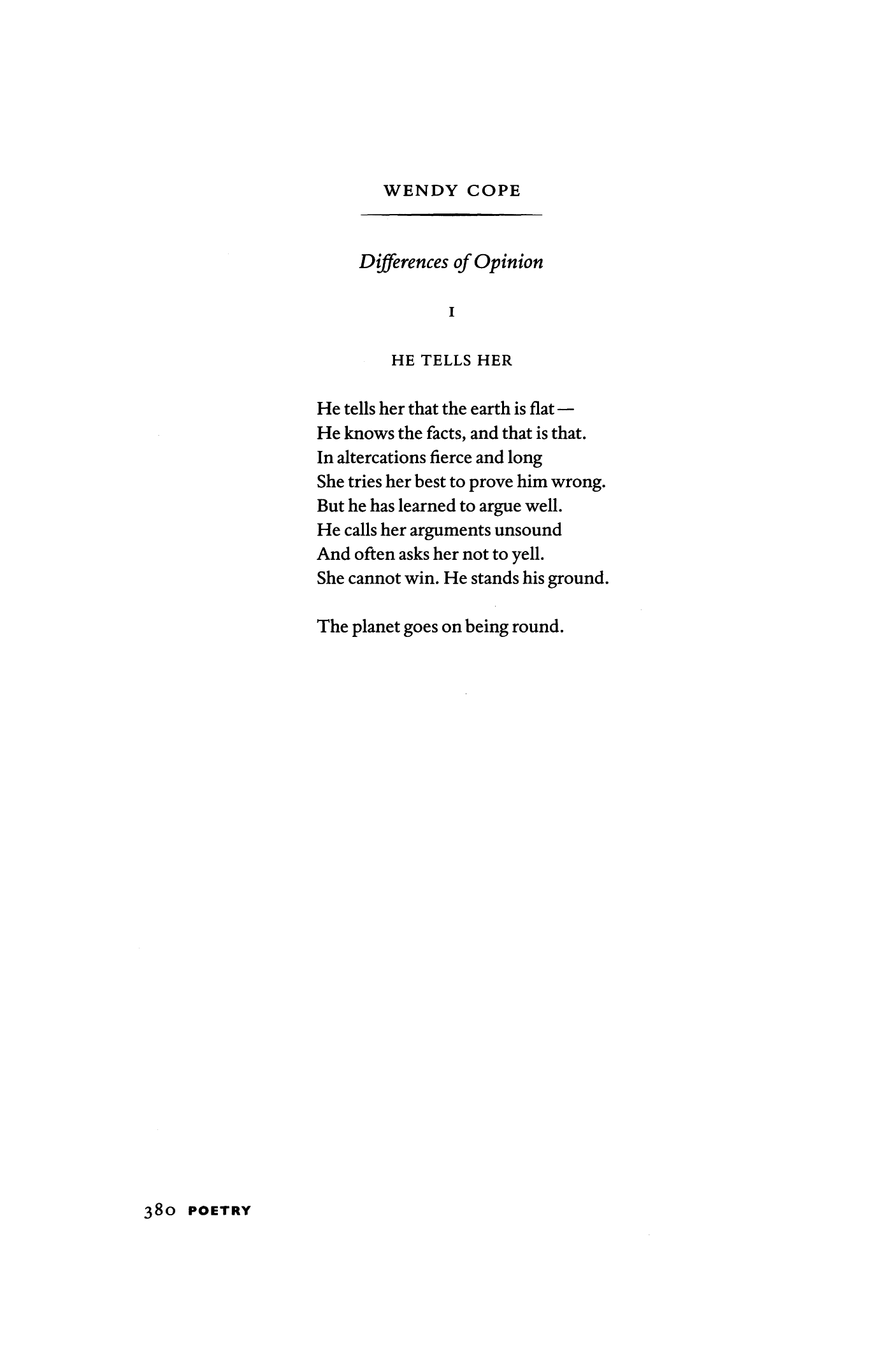

Poetry after Trump’s election
 https://www.theatlantic.com/entertainment/archive/2016/11/still-poetry-will-rise/507266/
“Campaign in poetry; govern in prose,” the old adage goes. This moment, though, has in many ways flipped that idea: The 2016 presidential campaign was decidedly lacking in poetry. Yet in its aftermath, as Americans consider the contours of their new government, they are, often, turning to poems: to Cope and her gallows humor. To Maya Angelou and her songs of self-love. To Adam Zagajewski. To Adrienne Rich. To Riz MC. Vox, on Wednesday afternoon, published a post headlined, “Feeling terrible right now? Maybe some poetry will help.” The Guardian had one listing “poems to counter the election fallout—and beyond.” The Huffington Post, for its part, offered “18 Compassionate Poems To Help You Weather Uncertain Times.”
Megan Garber: Why do you think it is that poetry seems to be resonating so deeply at this particular moment?
Don Share: Well, it’s always been speaking to people—and it’s always been speaking to people about the kinds of things they’re taking about now, because one of the things poetry is really good at is anticipating things that need discussion. Poets are kind of like—it’s a bad metaphor, but—canaries in a coal mine. They have a sense for things that are in the air. Partly because that’s what they do—they think about things that are going on—but partly because they take their own personal experience and see how that fits in with what they see in the world. A lot of people might think that poetry is very abstract, or that it has to do with having your head in the clouds, but poets, actually, walk on the earth. They’re grounded, feet-first, pointing forward. They’re moving around and paying attention at every moment.
And a poet wakes up and thinks, “You know, anything is possible.” They imagine things before they’re possible. The reach and power of the imagination means that poetry will always be with us, that it will always be important, that it will always be part of what goes along with our culture, our politics, our personal feelings and relationships.

 How my heart speaks