
Month: Nov 2017

Redact
redact
rɪˈdakt/
verb
past tense: redacted; past participle: redacted
-
edit (text) for publication.“a confidential memo which has been redacted from 25 pages to just one paragraph”
-
censor or obscure (part of a text) for legal or security purposes.
-
Share this:

Seek the testimony of the few

Seek not the favour of the multitude; it is seldom got by honest and lawful means. But seek the testimony of few; and number not voices, but weigh them.
Kant
Share this:

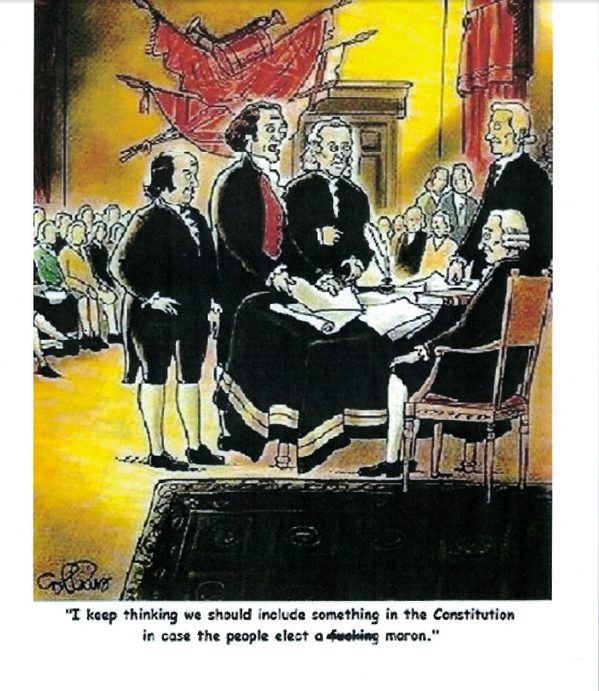
Tweeted by Trump? Seems so!
Share this:

A moron?

On some great and glorious day the plain folks of the land will reach their heart’s desire at last, and the White House will be adorned by a downright moron. H. L. Mencken
Read more at: https://www.brainyquote.com/quotes/h_l_mencken_490503
Share this:

In no strange land
“The angels keep their ancient places;—
Turn but a stone and start a wing!
’Tis ye, ’tis your estrangèd faces,
That miss the many-splendoured thing.”
“William Blake’s visionary transformations of London form the poem’s most important literary ancestry. In Thompson’s work more generally there’s also an occasional, probably coincidental, resemblance to Gerard Manley Hopkins (1844-1889), going beyond the shared faith to sometimes tortuous grammatical structures, vivid word-coinings, and unconventional rhythm. While Thompson’s achievements may be more modest than those of Blake or Hopkins, In No Strange Land is a poem I imagine either would have been happy to have written. A “many-splendoured” hymn, it catches more light than any of the Choruses from “The Rock”.”
Share this:
Ineffable
ineffable
ɪnˈɛfəb(ə)l/
adjective
adjective: ineffable
-
too great or extreme to be expressed or described in words.“the ineffable mysteries of the soul”
synonyms: inexpressible, indescribable, beyond words, beyond description, beggaring description;More -
not to be uttered.“the ineffable Hebrew name that gentiles write as Jehovah”
-
Origin
late Middle English: from Old French, or from Latin ineffabilis, from in- ‘not’ + effabilis (see effable).
Share this:

Effable

effable
ˈɛfəb(ə)l/
adjective
rare
adjective: effable
-
able to be described in words.“socialism is effable, which is what I like about it”
Origin
early 17th century: from Latin effabilis, from effari ‘utter’.
Share this:

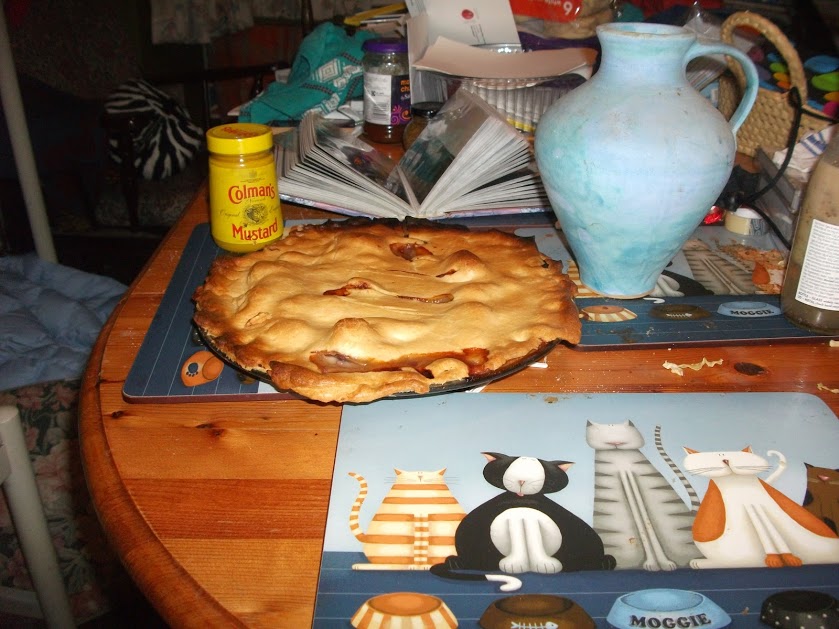
His last pie 2014

Share this:

Chapel,Sudeley Castle
 Easter 1986 by Katherine
Share this:

Gulls in flight


Share this:

All trace was gone
I saw, while half asleep, her face was gone
She faded, like the mist does at the dawn,
From the gallery of my loved ones
Ungrounded by the loss, fearful, forlorn,
Skinless like a worm picked off a lawn,
I saw, while half asleep, her face was gone
Do not leave me, do not my love scorn
Lost and gone are my beloved ones
I am human in both ghost and form
Heart constricted, lungs pant out my pain
Haunted and bereft of human warmth
I saw, while half asleep, her face was gone
I shall have no mother but that one
Now I have become a dried out corm
Lost and gone are all my beloved ones
Like a little leaf from its plant torn
Gnawed by slugs, fragmented till unborn
I saw, while half asleep, all trace was gone
Of the gallery of my lost, loved ones
Share this:
There is no swift repeat
I saw the faded roses on the door
The brave reminders of the summer heat
I thought we’d come again, but you’re no more
Nothing, no one can that love restore
For love like that, there is no swift repeat
I saw the faded roses on the door
Never ask a lover what love’s for
For love itself is inclined to swift retreats
I thought we’d love again, but you’re no more
And who is it that chooses this dark hour,
That offers sadness if not full defeat?
I saw the faded roses on the door.
My man,my love,my ease, my own sweet flower
For my illusions I am now contrite
I thought we’d love again, but you’re no more
Within the deepest dark,I saw the light
And all this suffering was seen aright
I saw the faded roses on the door
I thought we’d see and love another hour
Share this:
Ambiguity
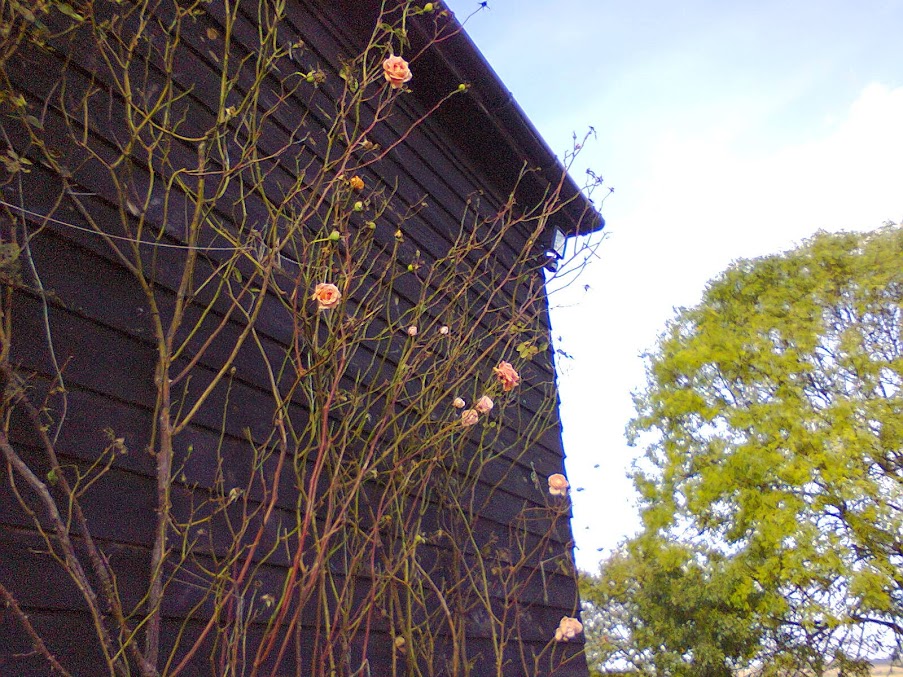
Photo by Katherine 2012
https://plato.stanford.edu/entries/ambiguity/
“Ambiguity has excited philosophers for a very, very long time. It was studied in the context of the study of fallacies in Aristotle’s Sophistical Refutations. Aristotle identifies various fallacies associated with ambiguity and amphiboly[1] writing:
There are three varieties of these ambiguities and amphibolies: (1) When either the expression or the name has strictly more than one meaning… (2) when by custom we use them so; (3) when words that have a simple sense taken alone have more than one meaning in combination; e.g. ‘knowing letters’. For each word, both ‘knowing’ and ‘letters’, possibly has a single meaning: but both together have more than one-either that the letters themselves have knowledge or that someone else has it of them. (Sophistical Refutations bk. 4)
The stoics were also intrigued by ambiguity (see Atherton 1993). Chrysippus claimed at one point that every word is ambiguous—though by this he meant that the same person may understand a word spoken to him in many distinct ways. Philosophers concerned with the relation between language and thought, particularly those who thought there was a language in which we think, concerned themselves with whether the language in which we think could contain ambiguous phrases. Ockham, for example, was willing to countenance ambiguities in mental sentences of a language of thought but not mental terms in that language (see Spade p. 101). Frege contemplated non-overlap of sense in natural language in a famous footnote, writing:
…So long as the reference remains the same, such variations of sense may be tolerated, although they are to be avoided in the theoretical structure of a demonstrative science and ought not to occur in a perfect language. (Frege 1948 [1892], p. 210 fn. 2)
Frege’s hostility to ambiguity in formal languages remains with us today. Frequently we use formal languages precisely so that we can disambiguate otherwise ambiguous sentences (brackets being a paradigm example of a disambiguating device).”
Share this:

Paris Review – The Art of Criticism No. 2, George Steiner
Paris Review – The Art of Criticism No. 2, George Steiner.
A fascinating interview
.Quote :For me the personal turning point was Pol Pot. Very few knew at the time about Auschwitz. Yes, there were bastards who knew, there were sons of bitches who knew and who didn’t believe it, but they were a tiny number. Nazi secrecy on this was fantastically efficient. The killing fields were on radio and television while they were going on, and we were told that Pol Pot was burying alive one hundred thousand men, women and children. Now I cannot attach honest meaning to the phrase “to bury alive one man, woman or child.” One hundred thousand! I almost went out of my mind in those days with bitter impotence. I was obsessed with the hope that Russia and America would say, “We don’t know what the rights and wrongs of this incredible geopolitical mess are but forty-five years after the Holocaust or after the gulag, we can’t shave in the morning, we can’t look at ourselves, knowing a hundred thousand people are being buried alive; the razor doesn’t work on the skin. No woman can put on her makeup and think of herself as human. If you don’t stop this, we’ll come in.” I’d hoped ………….
Share this:
Meanings
When knowledge and our rituals are thin
The usual symbols’ meanings seem all gone
Who will show us how to live again?
The emphasis was overtly on sin
The mighty were exempted every one
Now knowledge and our rituals are thin
As the song says, don’t know where or, Oh Lord, when
The breath of angels’ staggers the rich man.
Who will show us how to live and when?
Uneasy murmurs through our conscience run.
Anaesthetics now our medium
Knowledge and our rituals are thin
Like swarm of bees, archangels pass the sun
Unseeing, we deceive with tedium
Who will show us how to live again?
Power replaces insight with a gun
Shoot as if the end’s already come
When knowledge and our rituals are thin
Who might show us how to live again?
Share this:
Their infants’ eyes
Both blinded and enchanted by the light,
Sidelong like the glances of a spy.
I saw a flock of geese high on their flight
The Hebrew slaves from Egypt in their plight
Left with little but their infants wise,
Wandering in the desert’s heat and light
Oh, easy is it for the birds to reach the heights
While refugees can suffer, drown and die
I saw a dozen swans pass on their flight
For the poor, there are few equal rights
And mothers with their little children cry
Both blinded and diminished in the light
Will the Lord enchant us with delight,
Or punish our false greed till hearts ignite?
I saw a cloud of angels show His might
As we live on the earth like parasites
Forgot not that revenge may come by night.
Both wounded and entreated by the light,.
I saw that we conformed without a fight
Share this:
Fitting the within
When your world cracks open and throws your body down
When your world evaporates and turns you into steam
When your world disfigures you and you seem like a clown
Don’t be quick to build again, there’s value in these schemes.
Many worlds are possible and here’s the pattern book
Don’t be hasty in your ways, better far to look
Fearful on the precipice and fearful on the hill
Fearful of the loneliness, yet cold lovers can kill
Stand alone on trembling legs and see a different view
When you find your destiny, you feel renewed.
Everything is blurry now, poor eyes cannot adapt
But when the legs get steadier, vision will correct.
No mother dear nor father strong can help you with their care
We must be quite separate for our new world to bare.
The world is new inside the gap where symbols grow and swirl
And across the sky above the stars dance all a whirl
Safety and security if taken on too soon
Lessen the alternatives and may lead down to doom
Courage to the child we are, courage in our hearts
In the forms now visible we will find new shape.
Less like armour plating, more like pliant skin,
Fitting us externally and fitting the within
Share this:
Life etc
Soul making is a phrase from Keats.
{ link to article by Jeffrey C. Johnson in Paris Review]
We saw Wolf Hall on TV recently and it is so wonderful.I am just writing down a few of my thoughts not about that but about Anne Boleyn… I meant it to be funny but I could n’t manage that after seeing the play.
ANNE BOLEYN
Anne Boleyn withheld to win
As Henry lusted in his sin.
Once a virgin, sweet Madonna;
Henry turned in rage on her.
She bore him but one living child,
For her quips, she was reviled.
Henry knew not the fault was his
It seems the king had syphilis.
Or Anne was rhesus negative
then just her first born child would live.
We, women, make our worst mistake
When power for love we wrongly take
Our strength lasts but till we submit.
We need less love and far more wit.
Whatever lusty men may say,
their “love” dies when they get their way.
And they will take their wife by force
As cannons pound on oaken doors.
As for women, we must not
Promise gold we have not got.
Conception is a game of chance;
We come to be by happenstance.
We sin in pride in promising
What only God or Nature bring.
We deceive and trick and charm
At last our hearts bang in alarm
The man who begged upon his knees
Chops off our heads when we displease.
For Emperors and Kings and Lords
Wield fearful power by the sword.
Yet when for judgement they shall stand
How will point the knowing hand?
And just like us they’ll ashen be
When true majesty they see.
Into dust and crumbled ruin
They will go by their own doing.
Each day create with grace your soul.
Cracked shall be the golden bowl.
Keats wrote this extract below [read all by clicking on soul above[ and he died when aged only 25 years:
I will call the world a School instituted for the purpose of teaching little children to read—I will call the human heart the horn Book used in that School—and I will call the Child able to read, the Soul made from that school and its hornbook. Do you not see how necessary a World of Pains and troubles is to school an Intelligence and make it a soul? A Place where the heart must feel and suffer in a thousand diverse ways!
Share this:
Go elsewhere
Life’s for strangers in the city here,
Who left their birthplace wanting better pay
So many people’s faces look afeared
The mass of crowds brings on this paranoia
While Georgian buildings, beautiful, decay
Life’s an alien in the city here
From the doorways ugly faces leer
Like evil children, tantalised dismayed
Many people, nobody is near.
The birds don’t sing, sometimes I hear them jeer
They fly in circles in a bold display
Life’s as hot as Hades, living here.
My eye is dry, it lacks a single tear
While I become more static with despair
Many people, nobody who’s near.
Why can’t I be merry, like cards say?
Why do thoughts so savage my heart flay
Life is lonely in the city’s lairs
If you like kind and calmness, go elsewhere
Share this:
Scorn

Art by Katherine
I have made a ceaseless effort not to ridicule, not to bewail, not to scorn human actions, but to understand them. Baruch Spinoza
Read more at: https://www.brainyquote.com/topics/scorn
Share this:

Leaves
Should we be happy and in pleasure thrive
Without a shadow, without grief and pain?
We suffer much because we are alive
Even birth itself, some don’t survive
Loss of love hits like the icy rain
Should we be happy and in comfort thrive?
Into the monstrous ocean, we must dive
And learn to swim without time for complaint
We suffer so because we are alive
If one flower is open to the eye
That is quite sufficient for the saint
Must we be happy always, when death thrives?
A printed book does not ache with its pride
And if it’s lost its ghost will seldom haunt
We suffer so because we are alive
Our life to that of all is close allied
The leaves upon the tree are our last guide
Should we be happy and in constant pleasure thrive?
We suffer much because we are alive
Share this:
Acquainted with grief
Save yourself spending on Black Friday: mend your clothes
“It’s not just the fashion industry that has a massive waste problem. We all do. Our wardrobes are bulging with clothes, many of which we don’t wear. The number of garments produced globally has doubled since 2000 to more than 100bn items. If you are anything like me, you will feel as if you own a good proportion of them already.
As we approach Black Friday, which has now spread from a single day of splurge buying to an entire week, we are about to be bombarded with discounts and offers to buy everything from a new fridge to a cashmere jumper ( just you wait, there will be mountains of cheap cashmere).”
Share this:

Kick it, scratch it, bite it, sip its dew
Choose a heap of words and make a form
The words may not be right but such is charm
Once you’ve made a heap of stones, of brick
You can shape it with your poetics
Treat it like a sculptress does her clay
Hit it, mould it, make it go your way
But, oh, beneath its hidden shape and show
The poem knows such life you’ll never know.
Get it in your arms and so you twist
A pile of soft cement with woman’s wrist
Kick it, scratch it, bite it, sip its dew
The poem is having its own way with you.
As we wrestle in our clay stained cloth
We feel the rising of our hidden wrath.
So at the end, we mould it with our souls
The poem itself has shaped the dual goal.
Thus master, mistress none can take the name.
For inner demons, gods have swayed the game
Share this:
Sylvia plath and biography

Digital art by Katherine
“Malcolm’s book is not really much concerned with Sylvia Plath, and not at all with her poetry. It is deeply concerned with the nastiness of biography, and with interviewing, and the impossibility of objectivity. There is a good deal of knockabout stuff, like the statement that biography is ‘the medium through which the remaining secrets of the famous dead are taken from them and dumped out in full view of the world’. The biographer is a burglar, rifling through drawers, driven by voyeurism and busybodyism, and seeking stolen goods. Biographer and reader, each as despicable as the other, tiptoe down corridors together, ‘to stand in front of the bedroom door and try to peep through the keyhole’. Sometimes they do; but then again, not always. Biography may concern itself with the shape of a life, with its human, historical and cultural context. It may wish to do justice to one who has not yet received it. It may uncover aspects of history that have been overlooked, or examine the interaction between the events of a life and the work produced. And sexual secrets may legitimately be discussed: how could Andrew Hodge’s superb life of Alan Turing have been written without considering Turing’s homosexuality? You don’t have to be the slobbering voyeur Malcolm loves to conjure up to think that a complete portrait of a human being is better than a partial one.
Another of Malcolm’s fixed ideas is that the 1950s were a particularly low and dishonest period. Journalists love to fix labels on decades, but it is a lazy device. We are told that Plath formed part of an ‘uneasy, shifty-eyed generation’, always keeping up a pretence about something; and that she looked a thoroughly ‘vacuous girl of the Fifties, with dark lipstick and blonde hair’. There was also, it seems, a special breed of young men who flourished in ‘the Eisenhower Fifties’, ‘thin, nervous, little, moody, sickly’ young men, they were, but perversely attractive to women. Yes, I remember them well, but there are still some of them around in the Nineties; there are still shifty eyes, too, and people pretending, and even dark lipstick and blonde hair.
Sometimes Malcolm does hit the nail on the head. She is right when she says that the story of Plath is trapped for ever at the terrible raw moment of her suicide, whereas most people get through their marital storms into calmer waters. She is also honest in declaring that she has decided to take the Hugheses’ side against their critics, even though Ted Hughes refused to talk to her, and even though she puts in a stinging reference to how one ‘cannot help wondering about the emotions of the man for whom (Olwyn) is sacrificing herself, as he observes it from his cover’.”
Share this:

The Ariel Sylvia Plath wanted
The poet….., originally intended the posthumous collection Ariel to close on a few poems about bees, instead of death.

Plath was writing the best poetry of her life, many of which would indeed make her name. Her work on the poems that would comprise her 1965 collection Ariel, which would go on to sell 15,000 copies in 10 months and launch her work into the mainstream, had never been so original or idiosyncratically her. “Sylvia Plath becomes herself,” is how poet Robert Lowell introduced Ariel in 1965, going on to call the collection a work that immortalized her as one of the “great classical heroines.””
Share this:

Like dead moon
I did not write a villanelle today
The sun was weak and dirty like dead moon
I have my selfish reason to delay.
If the spirit speaks, will love allay?
Will we be left for dead with fresh new wounds?
I never wrote sweet villanelles today
What the people want strikes hard as clay
Salvation for humanity has bounds.
I have seen the saints and their decay.
For our sins, we have not been paid
Salvation for the tyrants came too soon
They did not write a villanelle that day
Logic is the frost that sears our wails.
Stalin, Hitler ,Jesus, what’s the tune?
In secret discourse, how can women pray?
In November’s grey and sunless ruin
Was the lost, eternal city doomed
I did not birth a villanelle today
I once had my own reason, it is where?
Share this:
I’d live outside my head
Early in the morning  I’m in bed
What shall I do  with all the time I’m here?
If time could stop,I’d live  outside my head

I hear  the footsteps daily of the dead
I  can see the face I love in tears
Early in the morning,I’m in bed

I need to get a  needle and a thread
To mend the rips  made by my metal tears.
If time could stop,I’d live  outside my head

I want  perspective on the stuff  I’ve read
About the winds of sorrow, how they veer.
Early in the morning, I’m in bed

I feel I am not whole  just glued up shreds
The truth of grief is always in arrears
If time could stop,I’d live  outside my head

The pain of loss is like an iron that sears
Over and again down all the years
Early in the morning , still in bed.
If time would stop,I’d live  without a head
Share this:
Rewrite your nightmare
Share this:

I’m an immigrant and I’m ok
I’m an immigrant and I’m ok
My mother was Dutch and my dad was Gay
I play on the nerves of the Anglo-sacks
My dad was black Irish and he slept on the coat rack
I’m an immigrant and I am great
I’m so damned intelligent God made me my own mate
I ‘m a doctor in the hospital and I heal the British folk
But they think I’m the devil, so they look out for the smoke
I’m an immigrant, you’re an invader
Daddy was an Eskimo and he got paid in lieu
You came from Normandy and spoke to us in French
But now I am the Judge and I ‘ll order us some lunch
I’m an immigrant and I’m ok
My husband went before me so he tells me the way
He’s a Jew from Teesside and you should hear them speak
I could never understand it as Hebrew’s worse than Greek
I’m an immigrant as I have crossed the Alps
Hannibal made history with his elephants
If he was my grandad, will you export me?
I’d rather have a biscuit and make us all some tea
 How my heart speaks