Sylvia plath and biography

http://www.independent.co.uk/arts-entertainment/books-everything-but-the-truth-while-sylvia-plaths-poetic-fame-grows-and-grows-a-new-book-shows-how-1441977.html

14900346_803616439778236_6423982887847318596_n.jpg

Digital art by Katherine

“Malcolm’s book is not really much concerned with Sylvia Plath, and not at all with her poetry. It is deeply concerned with the nastiness of biography, and with interviewing, and the impossibility of objectivity. There is a good deal of knockabout stuff, like the statement that biography is ‘the medium through which the remaining secrets of the famous dead are taken from them and dumped out in full view of the world’. The biographer is a burglar, rifling through drawers, driven by voyeurism and busybodyism, and seeking stolen goods. Biographer and reader, each as despicable as the other, tiptoe down corridors together, ‘to stand in front of the bedroom door and try to peep through the keyhole’. Sometimes they do; but then again, not always. Biography may concern itself with the shape of a life, with its human, historical and cultural context. It may wish to do justice to one who has not yet received it. It may uncover aspects of history that have been overlooked, or examine the interaction between the events of a life and the work produced. And sexual secrets may legitimately be discussed: how could Andrew Hodge’s superb life of Alan Turing have been written without considering Turing’s homosexuality? You don’t have to be the slobbering voyeur Malcolm loves to conjure up to think that a complete portrait of a human being is better than a partial one.

Another of Malcolm’s fixed ideas is that the 1950s were a particularly low and dishonest period. Journalists love to fix labels on decades, but it is a lazy device. We are told that Plath formed part of an ‘uneasy, shifty-eyed generation’, always keeping up a pretence about something; and that she looked a thoroughly ‘vacuous girl of the Fifties, with dark lipstick and blonde hair’. There was also, it seems, a special breed of young men who flourished in ‘the Eisenhower Fifties’, ‘thin, nervous, little, moody, sickly’ young men, they were, but perversely attractive to women. Yes, I remember them well, but there are still some of them around in the Nineties; there are still shifty eyes, too, and people pretending, and even dark lipstick and blonde hair.

Sometimes Malcolm does hit the nail on the head. She is right when she says that the story of Plath is trapped for ever at the terrible raw moment of her suicide, whereas most people get through their marital storms into calmer waters. She is also honest in declaring that she has decided to take the Hugheses’ side against their critics, even though Ted Hughes refused to talk to her, and even though she puts in a stinging reference to how one ‘cannot help wondering about the emotions of the man for whom (Olwyn) is sacrificing herself, as he observes it from his cover’.”

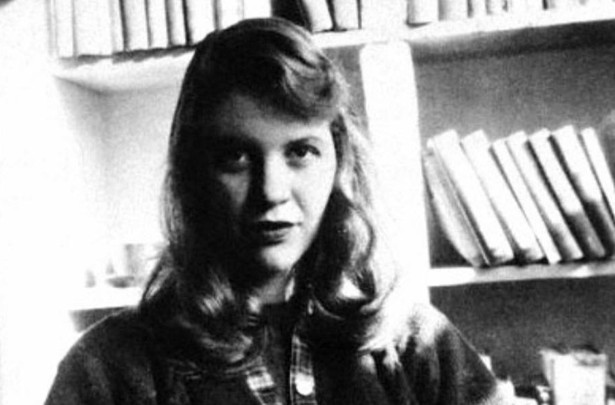
The Ariel Sylvia Plath wanted

https://www.theatlantic.com/entertainment/archive/2014/10/from-the-archives-the-poems-sylvia-plath-predicted-would-make-her-famous/381946/


The poet….., originally intended the posthumous collection Ariel to close on a few poems about bees, instead of death.

Wikimedia Commons
“In the fall of 1962, just one year before her death by suicide, Sylvia Plath experienced a heady flash of foresight. The poetry collection she was working in pre-breakfast, 4 a.m. sprints, she foretold, would make her famous. As she giddily wrote her mother in the midst of her creative blitz, “I am writing the best poems of my life. They will make my name.”

Plath was writing the best poetry of her life, many of which would indeed make her name. Her work on the poems that would comprise her 1965 collection Ariel, which would go on to sell 15,000 copies in 10 months and launch her work into the mainstream, had never been so original or idiosyncratically her. “Sylvia Plath becomes herself,” is how poet Robert Lowell introduced Ariel in 1965, going on to call the collection a work that immortalized her as one of the “great classical heroines.””

Like dead moon

I did not write a villanelle today
The sun was weak and dirty like dead moon
I have my selfish reason to delay.

If the spirit speaks, will love allay?
Will we be left for dead with fresh new wounds?
I never wrote sweet villanelles today

What the people want strikes hard as clay
Salvation for humanity has bounds.
I have seen the saints and their decay.

For our sins, we have  not been paid
Salvation for the tyrants came too soon
They did not write a villanelle that day

Logic is the frost that sears our wails.
Stalin, Hitler ,Jesus, what’s the tune?
In secret discourse, how can women pray?

In  November’s grey  and sunless ruin
Was the lost, eternal city doomed
I did not birth a villanelle today
I  once had my own reason, it is where?

I’d live outside my head

Early in the morning  I’m in bed
What shall I do  with all the time I’m here?
If time could stop,I’d live  outside my head

I hear  the footsteps daily of the dead
I  can see the face I love in tears
Early in the morning,I’m in bed

I need to get a  needle and a thread
To mend the rips  made by my metal tears.
If time could stop,I’d live  outside my head

I want  perspective on the stuff  I’ve read
About the winds of sorrow, how they veer.
Early in the morning, I’m in bed

I feel I am not whole  just glued up shreds
The truth of grief is always in arrears
If time could stop,I’d live  outside my head

The pain of loss is like an iron that sears
Over and again down all the years
Early in the morning , still in bed.
If time would stop,I’d live  without a head