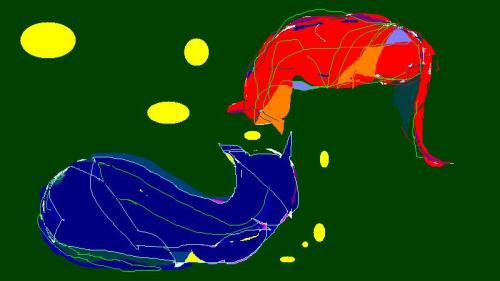
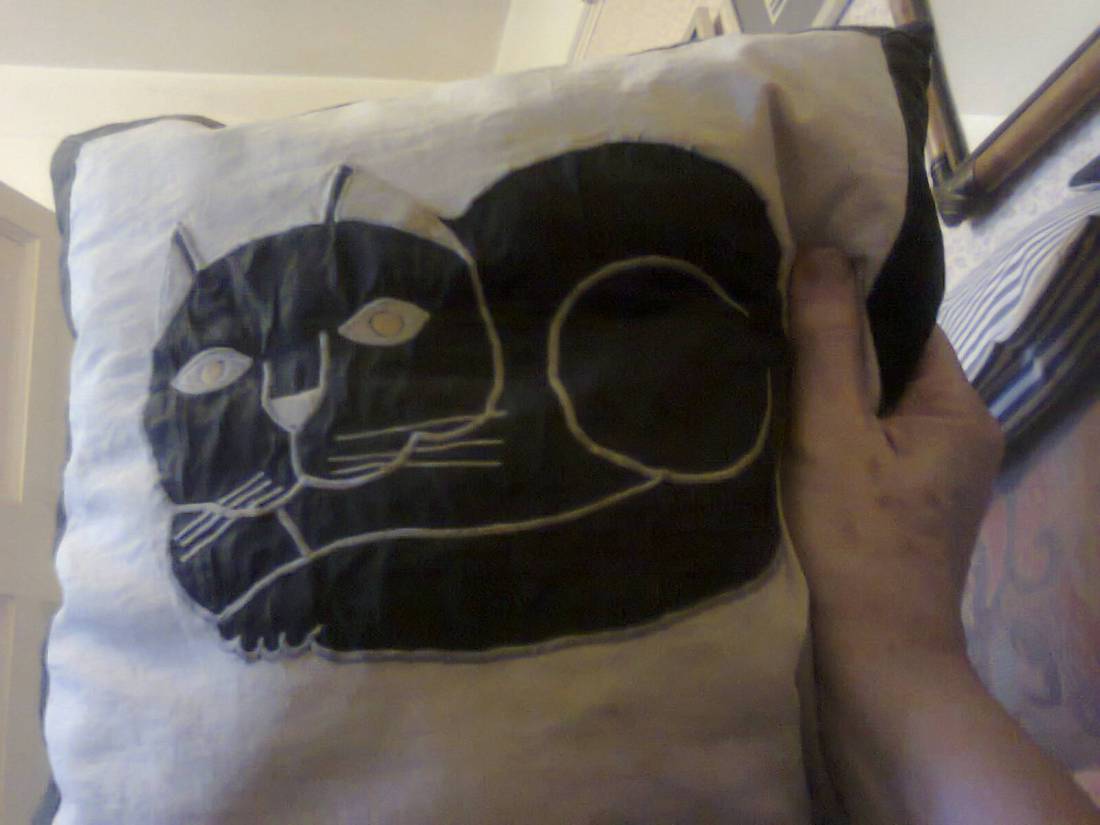
My muse has gone to Hades, is it hell!

My muse has gone to Hades, is that hell?
I   sing for her  while my heart palpitates
Lord, I’ll be  in  demonic  space as well

I think my little cat has  lost her bell.
On my plight, I sit and meditate
My muse has gone to Hades, is it hell?

The cat can’t phone, if only she could  yell.
I  hear my thoughts  and manic,  agitate.
Soon I’ll be  in  demonic  space as well

I wish that animals could use a cell.
All they can do is eat and procreate
My muse has gone to Hades, Villa Knell

I hear that poets should show but never tell
All I can do  with wit is cogitate.
Will  I   fly   to inner  space as well?

I earn enough,more than the going rate
I use black pens and you should see my state
My muse has gone to Hades,  give her hell
Damn,  I  am   lured to  ink dark  space as well!

Elemental as a storm

A force far deeper than our anger
Elemental as a storm
Annihilating all before it
Terror makes man’s rage perform.
 
This force fearing self is threatened
Runs to rise and to protect,
Most murderous when we’re most alarmed
Rage the enemy detects.
 
Over-riding other feelings
Deprives us of the power to think
Like a nuclear tsunami
Disconnecting human links
 
Reddened vision,focused,narrow;
Eyes locked onto enemy’s
All the wider context losing,
Wipes out our good memories
 
Like a mother tiger fighting,
And the cornered eagle’s force;
We will destroy what we think other
Without bitter,pained remorse.
 
Nature made such to protect us;
Yet our perception can be wrong.
Once the flood of feeling takes us
All reflections seems too long
 
Later, if we see our victims,
Will we know that we have erred?
For hate deceives ourselves and others
When our inmost terror’s bared.
 
How can we step back and ponder,
See life from a wider view?
How can we become less blinded,
So we see our world anew?
 
Succumb not to final despond
Succumb not black despair.
Always there are those who see.
Always there are those that care.
 
Tempered by reflective wisdom
Rage can change when understood.
When we find another being
Who contains our frightful flood

The recent political surprises in the West

From  the latest issue of the LRB

http://www.lrb.co.uk/v38/n24/jonathan-lethem/diary?utm_source=newsletter&utm_medium=email&utm_campaign=3824&utm_content=ukrw_subsact


49365167-cached

We were warned by Richard Rorty in 1998:

Something will crack. The nonsuburban electorate will decide that the system has failed and start looking around for a strongman to vote for – someone willing to assure them that, once he is elected, the smug bureaucrats, tricky lawyers, overpaid bond salesmen, and postmodernist professors will no longer be calling the shots.

We were warned by Sheldon Wolin in 2003:

The elements are in place … a weak legislative body, a legal system that is both compliant and repressive, a party system in which one party, whether in opposition or in the majority, is bent on reconstituting the existing system so as to permanently favour a ruling class of the wealthy, the well-connected and the corporate, while leaving the poorer citizens with a sense of helplessness and political despair, and, at the same time, keeping the middle classes dangling between fear of unemployment and expectations of fantastic rewards once the new economy recovers. That scheme is abetted by a sycophantic and increasingly concentrated media; by the integration of universities with their corporate benefactors.

We were warned by Carl Jung in 1938:

He is like a man who listens intently to a stream of suggestions in a whispered voice from a mysterious source and then acts on them … The true leader is always led. We can see it work in him. He himself has referred to his Voice … That is why he makes political judgments which turn out to be right against the opinions of all his advisers … When this happens, it means only that the information gathered by his unconscious, and reaching his consciousness by means of his exceptional talent, has been more nearly correct than that of all the others, German or foreign, who attempted to judge the situation and who reached conclusions different from his. And of course, it also means that, having this information at hand, he is willing to act upon it.blythburgh_church_-_roof_angel

Yet tigers spring and care not when we scream

Was this Earth designed for life or death,

When wired up cheetahs surf the desert sands

Seeking prey to stave off hunger’s wrath?

This hunt’s repeated over all our lands.

And in deep seas of green we find the curse

Of being pursuer or of becoming prey.

Blood in water looks to me much worse

Yet God requires that we should kneel and pray

Rare flowers can snatch and eat the striped bee

Programmed by genes to fertilize and feed.

I grieve a violent  God exacts a fee.

Loves to see his creatures as they bleed.

Nature soothes our souls when life’s all green.

Yet tigers spring and care not when we scream

Liberation psychology

Click to access PSLarticle.pdf


Some of the material in this article was previously presented at:- Community and Critical Psychology conference – Birmingham Sept. 2003 British Psychological Society – History and Philosophy section conference, March 2002. Community and Organisational Psychology Research group, Manchester Metropolitan University, January 2002. This is part of a longer project with aims of understanding the development of Latin American Social Psychology of Liberation, and reviewing its potential contribution to theory and practice of applied psychology in the British (and related) context. The article is based on a) reading the literature in Spanish (and where available) in English, but not the Brazilian literature in Portuguese; b) attendance at the International Congresses of Social Psychology for Liberation in 2001 and 2002; c) discussions with Latin American and other colleagues working within this framework; d) visits to Venezuelan community social psychology projects in 1996 and 2002, and e) the resp

Therapising people’s problems led to the current political situation

http://www.independent.co.uk/voices/donald-trump-brexit-neoliberalism-individualism-cognitive-behavioural-therapy-a7413501.html


Quote:An example? Encounter groups . These meetings were an attempt to help individuals work together to tackle internalised oppression. However this kind of collective work soon became co-opted by ideas such as self-actualisation. The inner world was to be explored now not for the collective endeavour, but in the pursuit of individual happiness. Mass activism began to wane as the sale of self-help books mushroomed, carrying within their pages the message that responsibility for growth and happiness rested firmly in the individual. Why, after all, go to a feminist encounter group, when the tools for enlightenment lay in a self-help book one could peruse at home?

The side effect of the rise of therapy culture was a de-politicised understanding of embodied distress, and a certain navel gazing. The causes of anger and anxiety were located solely in individual’s childhoods or, as the 21st century beckoned, genes. Consideration of power relations and the structural causes of inequalities became a lefty side project, getting in the way of developing “brand me”, or a side note at the end of academic articles. Alternative ideas of the self received a special kind of ridicule – a phenomenon we see in the reaction to Corbynism today. Alternative ideas within psychology got sidelined.

What happened to all the refugee children in Calais?

rumoursofwar2


https://www.theguardian.com/world/video/2016/dec/08/child-migrants-after-calais-video

Six weeks after the Calais migrant camp was demolished, unaccompanied minors scattered around France are still waiting to hear of their fate from the Home Office. Lisa O’Carroll, Mat Heywood and John Domokos meet one young refugee who fled death in Darfur desperate to be reunited with his radiographer brother in Liverpool

Give children imaginative space

6390429_8d9779479d_m


http://celebritybabies.people.com/2009/02/06/teri-hatcher-creates-imaginative-space-for-emerson/

“I’ve created a space for my daughter to have a very imaginative life by removing television and video games,” the 44-year-old actress says. “It’s not like I banned them, we just never watched television when she was growing up.” As a result, Emerson has benefited greatly. Explains Teri,

“It left a space to fill with running around the yard pretending to be Peter Pan and making poison soup that you feed to the witch, just whatever crazy idea you want to come up with that ultimately, I think, lets children work out issues of their own growth and their own timely experience. I think that’s what dreams are about. That’s what imagination is about.”


T

Imaginative space

photo0112


How do I find imaginative space between what I know of the facts?

Quote@

What you’re trying to find is the “anarchic, gift-conjuring, un-knowing part” of the writer’s mind, as Rose Tremain puts it, and it’s not easy. Presumably, you’ve decided your policy – your personal ‘rules’ for this project – about what you can change or invent, and what you must stick to. But that leaves a lot of stuff which you don’t dare let your free brain conjure with.

I suggest that you make a firm decision to grant your researched facts no more special status than you would the facts about your home town, say, or where you grew up. Then try all the ways you already know of growing a scene or a story out of those materials. Or try some of these. For all of them, forget there’s any such thing as “allowed” or “not allowed”; you can always tidy things up later, but for now let anarchy rule