Release me

Amuse me with your smile and with your laugh
I am not made of stainless steel nor gold
Only then can l let anger pass

You seem so tired,shall I put out the trash?
I’ll make the dinner, think of what you told
Tease me with your smile and with your laugh

On Sunday you looked pained during the Mass
I could not tell you then as I’m not bold
So then I did not let my anger pass

To study you ,I need a new Compass
I need a map that we can both unfold
Compel me with your smile and with your laugh

My love is ever deep and vast
But mostly it is private never told
But then I cannot let my anger pass

At least in bed, you never seem too cold
As in your arms my body you enfold
Release me with your smile and with your laugh
So then we will make love  and thought shall pass

Making poetry their own

IMG_0608.jpghttps://theconversation.com/making-poetry-their-own-the-evolution-of-poetry-education-74671


Extract:

In the mid-20th century, it became less important for schools to make citizens or teach English language through memorized lines. Instead, poetry in schools separated into two strands: “serious poetry” and “verse.” Serious poetry was studied; it was officially sanctioned, used to teach literary elements like iambic pentameter, rhymed couplets, metaphor and alliteration. Verse, on the other hand, was unsanctioned – playful, irreverent and sometimes offensive. It was embraced by children for the sake of pleasure and delight.

By the late 20th century, classrooms and curricula began to value the sciences over literary expression and information and technology over art. The study of any poetry – serious or not – became marginalized, seldom occurring except in AP courses preparing students for college literature study.

Poetry in the classroom today

Though the late 20th century saw a decline in the study of poetry in schools, recent decades have seen an upsurge in poetry that is more relevant and more accessible to young people.

For instance, if in the past, schoolchildren learned poems written almost exclusively by white men glorifying a sanitized version of American history, recently students have begun to read poems by poets who represent racial, ethnic, cultural or religious diversity as part of their heritage. This represents a major development in the world of poetry for children.

The holy fires burn acid, ice and cold

The alchemist can turn base  metal  gold
The symbol of salvation caught in words,
The holy fires burn acid, ice and cold

We need an aid in  holding firm our souls
Until the  still, small  voice  speaks and is heard
The alchemist can turn base  metal  gold

There is another kind of fire, I have been told
Based on rage and anger and hot words
The holy fires burn acid, ice and cold

Yet as we see our own misdeeds unfold
We see more gently, envy is less stirred
The alchemist can turn base  metal  gold

Noone’s without sin when souls are bared
I and You can bring forth that Love Third
The holy fires burn acid, ice and cold

Can we look on God, what human dares?
Yet  our ordeal by fire is what we share.
The alchemist can turn base  metal  gold
The holy fires burn acid, ice and cold

Are not all us humans somehow lamed?

A lost and cold old cat  sleeps  as I write
Giving  yelps  of  pleasure as he dreams
I welcome such a  presence in the night

I feel less defenceless in daylight
Without a self, the mind rotates its screens
A lost and cold old cat  sleeps  as I write

What gives brazen images their might,
For like old demons, unknown faces  scream?
I welcome  a  beast’s presence in the night

Anxious, we confront a judge and court
Like children pulled from bed to angry blame
Still a  lost, cold cat  sleeps  as I write

When did we commit our crimes of hate?
Are not all us humans somehow lamed?
We welcome  a  kind presence in the night

Sins of hate and envy run like streams
Yet in the midst of blackness,brightness gleams
A lost and cold old cat  sleeps  as I write
I welcome his warm  presence in the night

Poetic imagination

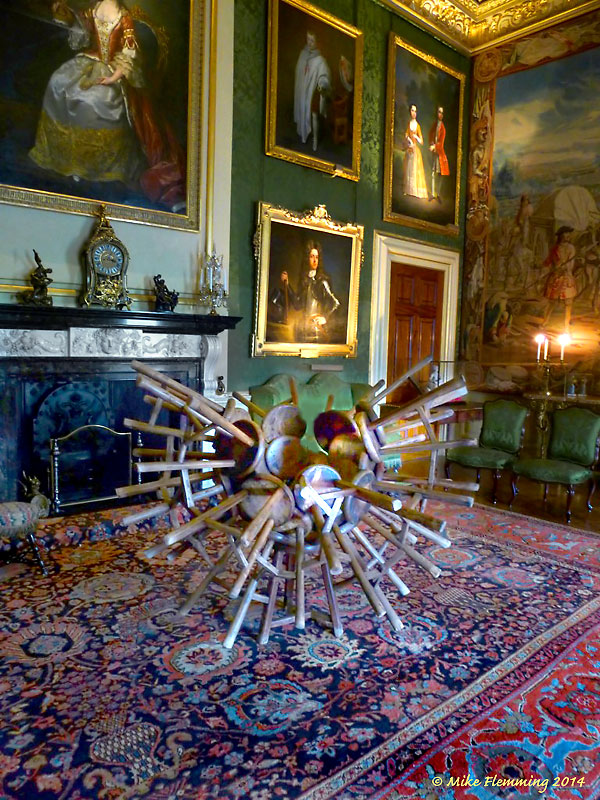
Blenheim_AiWeiwei-4.jpg


“Most importantly, the example shows that we cannot draw a sharp boundary to distinguish some language as intrinsically poetic.  We can apply our poetic attention to commonplace language, and thereby give that language unexpected depth and importance.  Indeed, poets such as William Carlos Williams purposefully challenge us to extend our sensibilities and find the poetry in everyday language, whenever they construct poems with familiar vocabulary and cadence.

How do we cultivate the poetic imagination?  We must attune ourselves, however we see fit, to the features we notice in a poem, as a prompt to experience its language more deeply.  This search for significance can target any noticeable feature of the poem—regardless of the meaning, if any, the feature might literally encode. We can listen to the sounds and rhythm of the poem. We can feel its syntax and structure. We can even attend to its visual shape and layout before us, as the poet e. e. cummings often invited his readers to do.

However, even when we explore the familiar domains of sound, meter, rhyme and line, we must be prepared to explore the variable and open-ended significance of each observation.  We saw, for example, the different effects of lineation in the Missed Connections poem.  There is no one meaning or effect for parsing lines; for annotating lines; or in juxtaposing the two. What we find in all these cases is just a formal contrast, an echo of further differences, which we can appreciate more deeply only by probing the poem further. This variability underscores the creativity poets and readers bring to their art.”

Poetry and ruthless careerism

IMG_20180224_172908.jpg
Ink and tea by Katherine

https://www.huffingtonpost.com/2010/03/08/poetry-and-ruthless-caree_n_490451.html


“No, writing great poems is not a prerequisite to being a famous poet. It might be a hindrance. Write one great poem and people will say, “Why are all of that poet’s other poems not as good as the great poem?” Write two great poems and they’ll say, “Fluke! Look at these other 1,000 very ordinary poems!” And so on. There’s no pleasing these haters. That is why you must destroy them with your steady success: that ever-spinning blade that cracks the ice. Be cautious before all else! Caution leads to eventual greatness.

How can you become the most important poet in America by tomorrow? It’s not as hard as you think. Poets used to have to pass out poetry-reading flyers by hand, one at a time, or publish poems one at a time in magazines, slowly building a career. But technology has changed all that. Now you can spam every poet in America with every new poem. Start a fan page for yourself and your books on Facebook. Blog about your every thought—they don’t even have to be astute thoughts. Most poets in America have boring office jobs in which they are screwing around on the Internet most of the time. Just mention the names of as many contemporary poets as you can in all your blog posts. You will catch all the self-googlers self-googling. Self-promotion is the only kind of promotion left. Without poetry reviewers to rely on, only you can spread the word about your product. And if you spread it suddenly, relentlessly, brutally, then you’ll have name recognition from here to Hawaii . . . and that’s all you need, because there are two kinds of poets: those you’ve heard of and those you haven’t. Almost all of us fall into the latter category, but not you! If only you take my advice.”
Sylvia Plath,Elizabeth Bishop,W H Auden,Anne Sexton,Shakespeare,Katherine Smith,W B Yeats, James Joyce

Love….

Love thinking about you.

Love,thinking about you.

Love thinking,about you……

Thinking about you,love.

Thinking love about you.

You, thinking about love.

You thinking about love?

You love thinking about….

You about,thinking love?

About you,love,thinking.

About thinking,love you.

About.com,Love Thinking

Love About.com, Thinking

Thinking,love About.com.

Come love,stop thinking.

How come there’s love about?

Think about it

He’s a Lord of Fun and Humour.

My husband has a rubber face,
He’s a wonder of the human race.
Some men have faces fixed and set;
My husband’s face is not like that.

He imitates our politicians,
Just like Rory Bremner can.
Though he has no wig or hair piece,
He can look like anyone.

Some nights I waken myself laughing
While I am in deep, sound sleep.
I am dreaming of his mobile features,
Contorted to a different shape.

He is skilled at telling jokes.
And he loves a good cartoon.
If I am feeling flu style blueness
He can get me up again.

He has a rather noble visage.
He gets attention he abhors.
In the bar on King’s Cross Station—
I was asked was he a Lord!

He’s a Lord of Fun and Humour.
He’s a Lord at Listening Well.
He’s unique, but so are you,
And all creatures that on earth do dwell

On writing

“There was a moment when I changed from an amateur to a professional. I assumed the burden of a profession, which is to write even when you don’t want to, don’t much like what you’re writing, and aren’t writing particularly well.”

— Agatha Christie, An Autobiography

Snow falls in winter,what a shock!

Photo0028.jpgFrom the Rochdale Herald

After blowing 28 million pounds on Winter Olympics the UK grinds to halt after first sign of snow

Peyongchang 2018 was the most successful Winter Olympics for team GB and just one day after the closing ceremony Britain has begun its annual mass panic as snow flakes have been spotted all over the country.

Corner shops and supermarkets have been totally cleared out of milk, bread and other essentials, but still at least we are the worlds best at going like a I bat out of hell on a tea tray even if we can’t make it the 1 mile round trip to the office because it’s a little bit slippy.

The British Olympic committee are hopeful that the great British public will be inspired by the games and pop down their local toboggan run or giant ski jump and get active during the big freeze however because no true Brit can get anywhere in this  weather the likelihood is everyone is just planning to stay home eat soup and watch Jeremy Kyle all day.

Many towns are already at a stand still with as much as 2cms of the white stuff falling in just 9 hours and every single school in the country has been closed until further notice.

People have been asked to definitely not call 999 unless they are actually dead and even then think twice about it.

UK does not have open borders for EU residents even while we are in the EU

Robin2018.jpghttps://fullfact.org/europe/border-security-eu/


Controls at the UK border

The British government retains full control over its own border controls. Travellers who hold EU passports can’t cross the UK border without having their passport or identity checked, and the same applies for travellers from non-EU countries.

The UK can, and does, perform passport and identity checks at its borders and refuses entry to travellers who do not travel with valid identity documents even if they are from another EU member state.

The benefit of holding an EU passport, or being the citizen of a European Economic Area (EEA) country (Norway, Iceland, Liechtenstein) or Switzerland, is that you travel through a separate channel at UK border controls. This normally results in a swifter identity check.

Non-EU citizens need to conform to all the UK’s border and immigration checks, even if they’re travelling from the EU, and are checked in a separate channel from EU, EEA and Swiss citizens. Citizens from outside the EU also face different visa, or visa waiver, requirements depending on the purpose of the visit and its duration.

There’s no difference here if the person is travelling from a Schengen or a non-Schengen country.

The requirements to enter the UK from outside the EU (for example, whether you need a visa) are a decision made by the UK government.

What this means for terrorism

Terrorism, just like many other crimes and other threats to countries’ security, operates across borders.

Concerns have been raised that terrorists may take advantage of refugee routes to Europe. As the UK retains its own border controlsand national control over asylum-seeking processes it has the capacity to address any such development itself.

In recent years, there’s also been more focus in the UK on ‘home-grown’ terrorism, as the House of Commons library and othershave said. The government has been developing policies to counter the development of extremist beliefs among UK citizens identified as vulnerable to radicalisation.

According to UK in a Changing Europe Fellow Richard Whitman, collective information sharing has evolved on criminal justice issues between the EU’s member countries to help them apprehend criminals, including sex offenders, people traffickers and terrorists, by unifying the procedures for and speeding up extradition and distributing security related information among EU members.

The UK has chosen to ‘opt in’ to some of these arrangements and cooperate collectively with other EU countries through the SIS, European Arrest Warrant (EAW),European criminal records system and EU-Interpol cooperation.

For example, the UK’s National Crime Agency issued 219 EAWs for suspects in other EU countries in 2013, and 228 in 2014. In return the National Crime Agency received 5,522 EAWs for requests in 2013, and 13,460 in 2014.

If the UK decides to leave the EU it might lose direct access to some these arrangements (such as the EAW which doesn’t currently apply to non-EU member countries). That said, other non-EU member states, such as Norway, still participate in the SIS without being members of the EU and have negotiated similar arrangements to the EAW.

Outside the EU, the UK would be free to decide on which issues and with which countries it would wish to pursue such cooperation. That isn’t much different to the situation now, according to Professor Whitman. The UK also already collaborates with other countries outside the EU, such as the US, on these issues on a one-to-one basis.

This article was written by academic experts at the UK in a Changing Europe initiative, with support from Full Fact, and used as the basis for a feature on ITV News at Ten. Any opinions or professional judgments of the authors are labelled as such.


Poem in a dark time

13103407_704717793001435_1095991632482779116_nhttps://www.poetryfoundation.org/poems/43347/in-a-dark-time

In a Dark Time

In a dark time, the eye begins to see,
I meet my shadow in the deepening shade;
I hear my echo in the echoing wood—
A lord of nature weeping to a tree.
I live between the heron and the wren,
Beasts of the hill and serpents of the den.
What’s madness but nobility of soul
At odds with circumstance? The day’s on fire!
I know the purity of pure despair,
My shadow pinned against a sweating wall.
That place among the rocks—is it a cave,
Or winding path? The edge is what I have.
A steady storm of correspondences!
A night flowing with birds, a ragged moon,
And in broad day the midnight come again!
A man goes far to find out what he is—
Death of the self in a long, tearless night,
All natural shapes blazing unnatural light.
Dark, dark my light, and darker my desire.
My soul, like some heat-maddened summer fly,
Keeps buzzing at the sill. Which I is I?
A fallen man, I climb out of my fear.
The mind enters itself, and God the mind,
And one is One, free in the tearing wind.
Theodore Roethke, “In a Dark Time” from Collected Poems of Theodore Roethke.  Copyright © 1963 by Beatrice Roethke, Administratrix of the Estate of Theodore Roethke.  Used by permission of Doubleday, an imprint of the Knopf Doubleday Publishing Group, a division of Penguin Random House LLC. All rights reserved.
Source: The Collected Poems of Theodore Roethke (Doubleday, 1961)

Lonely blue


I bought more cyclamen and thought of you
Wandering through wild flowers  by my side
I don’t know where to put them,they might die
Then I would feel so sad and lonely blue,
All we read of pain and love is true.
Yet we let our hearts stay open wide
I bought some cyclamen and wanted you
Wandering through wild flowers  by my side
I have loved not widely but a few
I have touched on bliss  and when it flies
I have touched the grief that truly  lies
I bought  cyclamen and recalled you

Trust the dark unknown, to hold us

Four o’clock- and the sun’s still glowing
Four o’clock – on a  colour bright day,
Up above, pink clouds are sliding
Down still sky, sweeping sun away.

Come back sweet sun, do not leave us.
Come back bright beams,we need  your light
Down on earth,it’s witch moon darkness,
While your  face is out of sight.

I see the orange clouds extending
I feel such width of sky lit bright.
But gently now, the mist surrounds you
And sweeps away that happy sight.

Into velvet blackness sinking,
Dazzling, dreaming darkness falls.
Goodbye to haste,and glare, and sunshine,
Time for reverie,night-time calls.

On the night-train’s gentle journeys,
On this  trackless train we ride
Strange new sights and haunting pictures
We will find in dreams’ designs.

In my night train,I’ll be happy
In such rich deep reverie.
We visit darkness in our sleeping,
There we learn its ecstasy.

Now we may have no God to hold us,
In His Hands of Living Love,
What will help us trust deep blackness
If there’s no Saviour from above?

Must we enter that great darkness,
Go back to dark from which we came,
Into dark all living creatures,
In that darkness find our home?

Trust the dark unknown, to hold us,
Trust the dark,both night and day.
Must we walk into that darkness
And trust it is our safest way?

What is character?


IMG_20180224_172908.jpghttps://www.merriam-webster.com/dictionary/character


Origin and Etymology of character

Middle English caracter, from Latin character mark, distinctive quality, from Greek charaktēr, from charassein to scratch, engrave; perhaps akin to Lithuanian žerti to scratch

Mirth?

Nothing is so low as  dark  dark. earth
Every living being turns to dust
Where  worms and beetles make no claim to worth

I wonder if they’re capable of mirth
As we parade our egos ,as one must!
Nothing is so low as  dark  dark. earth

From blackness comes creation and new birth
As little insects calm us with their trust
The  worms and beetles make no   noisy fuss

Life will happen, cannot be rehearsed
As the tide of life rides with true lust
Nothing is as good as  dark  dark. earth

Looking round, we tremble on our path
Are we selfish,are our actions just?
The  worms and beetles make no   worried fuss


Comes the day and comes the aged Nurse
Has she got your money in her purse?
Nothing is as   dear as  rich  dark. earth
Where  worms and beetles  ground us as they work


What is humility?

https://en.wikipedia.org/wiki/HumilitySouthLeigh_2012-3

“Outside of a religious context, humility is defined as being “unselved” a liberation from consciousness of self, a form of temperance that is neither having pride (or haughtiness) nor indulging in self-deprecation.[4][5] The materialistic view characterizes humility as self-restraint that frees oneself from vanity.

Humility is an outward expression of an appropriate inner, or self, regard and is contrasted with humiliation which is an imposition, often external, of shameupon a person. Humility may be misappropriated as ability to suffer humiliation through self-denouncements which in itself remains focus on self rather than low self-focus.[6][7]

Humility, in various interpretations, is widely seen as a virtue which centers on low self-preoccupation, or unwillingness to put oneself forward, so it is in many religious and philosophical traditions, it contrasts with narcissism, hubris and other forms of pride and is an idealistic and rare intrinsic construct that has an extrinsic side.”

 Rivers freeze and  fields are  thick with frost

Steam rose like a cloud of raging  dust
I’d left a copper pan on a hotplate
Yet all around the  ground was  thick  with frost

I did,I did, I did,I must confess
But surely I don’t need to emigrate
Steam rose like a cloud of raging   dust

Some feel shame and some feel overstuffed
With guilt and horror,hot as fiery grates
Though all around the  ground is  thick  with frost

So we do not like to take a risk,
Look for work and find a loving mate
Sins hiss like  black clouds of raging   dust

The ruler of our soul has iron fists
We’re seldom free enough to navigate
Rivers freeze and  fields are  thick  with frost

Fear and terror can annihilate
Then rage comes by to further isolate
Steam rose like a cloud of raging ghosts
Dispel such vision with a cold,cold frost


Is it really true more of us are diabetic?


https://www.obesitymyths.com/myth8.2.htm


I saw an article in the Guardian saying far more people in the UK are diabetic.But they don’t say that the definition has  been changed.There is no “absolute”  definition.It is  the level  at which diagnosis is made that has been falling.T

Poetry and identity

2015 03 04 moon tonight 2 jpg sig
https://www.theguardian.com/culture/culturevultureblog/2006/oct/05/shareyourfavo


“For my money, the best poem on the subject is WH Auden’s In Memory of WB Yeats, which unites issues of personal and literary identity, and explores the question of the extent to which authors can identify themselves with their work.

“For him it was his last afternoon as himself,” says Auden of Yeats’ dying day,

An afternoon of nurses and rumours; The provinces of his body revolted, The squares of his mind were empty, Silence invaded the suburbs, The current of his feeling failed; he became his admirers.

Now he is scattered among a hundred cities And wholly given over to unfamiliar affections, To find his happiness in another kind of wood And be punished under a foreign code of conscience. The words of a dead man Are modified in the guts of the living.

The brilliance of Auden’s poem, for me, is that not only does he raise these fundamental questions in some of the most fervent, lyrical lines I’ve come across in poetry, he also uses his poem to enact the point he is making. The poem is divided into three sections, and in the third, Auden pays ringing tribute to Yeats in lines that have an unmistakably Yeatsian flavour. The two poets merge for a moment on the page, identity becomes fluid, and Yeats comes alive again through Auden’s lines. It’s a heartstopping poem: I highly recommend you give yourselves a Poetry Day treat and read it.”

My vowels

_100192499_p05zfw5gSo what gives you anguish?
My bowels!
I don’t mean that kind of anguish.
You wait till you’ve been in and out all night
That’s a double entendre.
If only.
Still, it makes me grateful to have a bathroom with a radiator
Why, what do you do with that?
It keeps  me warm while I do Super Fiendish puzzles
Why  do those?
I can’t waste any time.
But when you die will God ask you how many you did?
I’ll ask him why my bowels  are so sensitive
It’s not just your bowels.
I wonder why they ate called bowels and if they are related to vowels?
B and V are quite similar in some languages.
Funny how we learn all the sounds as babies and we don’t even know we are doing it
Then we spend  years learning to read and write and we do know and for some it is hell
The average reading age here is 9!
So is that why people buy the Sun?
Apparently.What they should do is bring out a simplified version of a  paper like the Guardian
No, it lacks human interest.That’s what many of us want.Gossip,sickness,bravery, fires,death,cancer,bombs, heroism,scans,shingles and  flu
I don’t know how you can get to the doctor’s if you have flu as it makes you so weak
Then the doctor might catch it!
What would we do then?
Lie in bed and drink lots of water and read dirty books.Oh,pardon me.Clean books
You are so funny
i can do it without trying
Although listening can be trying!
Buy some ear plugs
Or stop talking
OK

Night,night