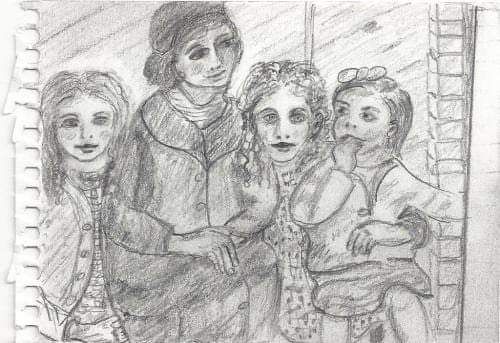
‘To be able to draw from observation, he believed, was “the foundation for fine art, for applied art, for architecture, for thinking, for coming up with ideas, for opening our minds through an intense process of really looking at the world around us”.
I think this artwork was done by me on my computer
what brings you here Not literally? [ could be autistic] No, you are always here in a sense. Well, you know English is not my first language [ excuses] No, you were here before language.How hard to imagine. I have come here because of my guilt [ trying to be human ] I’ll be judge, I’ll be jury, said cunning old fury
Very adroit [Shows off his skills] What’s that? The opposite of maladroit Why did you send the Flood over the earth\~ I pressed the wrong button. [Teases me] That is absurd. There were no buttons then Not even on coats? [Pretends to be ignorant] Well you should know I don’t like little details in my creatiity [ Thinks he is superior] Come on, tell me whatever comes to mind I like playing with water and fire as well [ Melanie Klein come here] You tell me It’s such fun [ emotionally stunted] Like War? It was not so bad to start with { always an excuse…. lacking in adult responsibility] What, even Cain and Abel? Very sad but it’s just a story [ Derrida,Levinas, Enid Blyton] Don’t tell me you are a post modernist I can be what I want , for fun you know [ repeats himself] I didn’t know God has fun Well you do now [ Humour]
Right that is £120
What, you think I should pay? [ feels superior] I have to live,Lord.I have a family [ childish plea] So did I once [Sarcasm and grief] Well, any alternative? I’ll give you an indulgence/ How about Martin Luther? Should he have one? Why not, he’s just human like you. But Hitler? I retain the right to silence [ knows the law]
Well when you stop sulking make another appointment Can no-one help me? Don’t give up hope. Goodbye for now.
CBT embodies a specific view of painful emotions: that they’re primarily something to be eliminated, or made tolerable
Psychoanalysts contend that things are much more complicated. For one thing, psychological pain needs first not to be eliminated but understood. From this perspective, depression is less like a tumour and more like a stabbing pain in your abdomen: it’s telling you something, and you need to find out what. (No responsible GP would just pump you with painkillers and send you home.) And happiness – if such a thing is even achievable – is a much murkier matter. We don’t really know our own minds, and we often have powerful motives for keeping things that way. We see life through the lens of our earliest relationships, though we usually don’t realise it; we want contradictory things; and change is slow and hard. Our conscious minds are tiny iceberg-tips on the dark ocean of the unconscious – and you can’t truly explore that ocean by means of CBT’s simple, standardised, science-tested steps.
Letters: Feelings of powerlessness as a constant – as is often the case in one-to-one relationships – are the root of much mental distress
Read more
This viewpoint has much romantic appeal. But the analysts’ arguments fell on deaf ears so long as experiment after experiment seemed to confirm the superiority of CBT – which helps explain the shocked response to a study, published last May, that seemed to show CBT getting less and less effective, as a treatment for depression, over time.
Examining scores of earlier experimental trials, two researchers from Norway concluded that its effect size – a technical measure of its usefulness – had fallen by half since 1977. (In the unlikely event that this trend were to persist, it could be entirely useless in a few decades.) Had CBT somehow benefited from a kind of placebo effect all along, effective only so long as people believed it was a miracle cure?
Psychoanalysts contend that for one thing, psychological pain needs first not to be eliminated, but understood
Next PostThe hot sun seems like the fire of hell on earthSearch for: February 2024 January 2024 December 2023 November 2023 October 2023 September 2023 August 2023 July 2023 June 2023 May 2023 April 2023 March 2023 February 2023 January 2023 December 2022 November 2022 October 2022 September 2022 August 2022 July 2022 June 2022 May 2022 April 2022 March 2022 February 2022 January 2022 December 2021 November 2021 October 2021 September 2021 August 2021 July 2021 June 2021 May 2021 April 2021 March 2021 February 2021 January 2021 December 2020 November 2020 October 2020 September 2020 August 2020 July 2020 June 2020 May 2020 April 2020 March 2020 February 2020 January 2020 December 2019 November 2019 October 2019 September 2019 August 2019 July 2019 June 2019 May 2019 April 2019 March 2019 February 2019 January 2019 December 2018 November 2018 October 2018 September 2018 August 2018 July 2018 June 2018 May 2018 April 2018 March 2018 February 2018 January 2018 December 2017 November 2017 October 2017 September 2017 August 2017 July 2017 June 2017 May 2017 April 2017 March 2017 February 2017 January 2017 December 2016 November 2016 October 2016 September 2016 August 2016 July 2016 June 2016 May 2016 April 2016 March 2016 February 2016 January 2016 December 2015 November 2015 October 2015 September 2015 September 2012 May 2012 March 2012 February 2012 January 2012 December 2011 November 2011 October 2011 September 2011 August 2011 July 2011 June 2011 May 2011 April 2011 March 2011 February 2011 January 2011 December 2010
Mary was on a step ladder in the bathroom spying on her husband Stan,through a hole in the wall…which he had drilled for spying on women sunbathing nude in their back gardens. Although I would have been there for 30 years he had not yet seen a nude woman. To her surprise she saw husband was climbing over the fence with Emile, their cat on his shoulder.
I think it’s ridiculous, she muttered . Surely Emile, a cat, can jump over the fence by himself.
But Emile was very limp,she saw with horror He can’t be dead, she whispered to herself fearfully.She jumped down off the and hit her head on a tap… a dangerous event for a human with weak retinae or retinas Oh,my! That hurt…I’d better be careful.She flew down stairs and met Stan in to the kitchen Emile has got concussion, Stan said unhappily Is he not dead,she wondered anxiously. No, he only fell off Annie’s roof.I am sure he’ll come to. Good Lord.What made him go up there and more important,how did he manage it manage to climb up? You’d better ring 999,he informed her graciously yet boldly
If you say so ,my dear.I’d do anything you ask.. Don’t put on that act! he said wantonly I mean it. A bit too late now. What do you mean? After 40 years with your mind on Wittgenstein,Dirac,Pascal and Kierkegaard,do you think I don’t know you made a mistake marrying me But whoever I married,I’d have read those same writers… Umphh,said Stan dolefully. Just then Dave,the bisexual transvestite paramedic ran in. Poor Emile,what have you done? He fell off Annie’s roof, but we have no theory as to how he got there,said Stan. Well, there’s no need to think of that… deal with reality.That’s my modus operandi! He gave Emile the kiss of life.
Emile came to…but was not pleased Why did you waken me up?I was having a lovely dream of walking down a silver path where I saw a big cat with shining fur and tender eyes looking at me.He just began to miaow when some fecking idiot woke me up… was he God? I can’t say,Emile,dear.But please do not swear. I’ll do whatever I fecking well feel like,he said. Good heavens, what has happened.Has he been reading dirty books? No, he was watching East Enders on TV… they all use the f word constantly. Well,Emile.God will have to wait… he’ll be glad if you do some kind work here on earth. Up yours,said Emile.I am sick of living here.I’ve been hoping for years Stan would mate with Annie but he has only managed a kiss. Perhaps it was the kiss of life,said Mary hopefully as it pained her to think Stan no longer desired her. Well, in a sense,you might have hit the snail on the bed said Stan thoughtfully.I know any further mention of philosophy will drive me mad! Now,Dave said,shall I make you some tea? Thank you Stan responded.I am half crazed already.Tea may save my sanity.But for what? Annie came in Did you know Emile was in a hot air balloon,she said in tones of wonder.How has he got down so fast? I fecking well fell out,the cat yawned proudly.Then I had a near death experience until this loon here brought me round. Emile,I’ve never heard you swear before! she whispered in a strange manner reminiscent of almost silent films starring unnames and forgotten beauties of long ago. Do you like it,baby? Emile asked. No I don’t. I’ve never said Feck in all my life. Well you have now,the cat informed her with a naughty smile. I think he’s possessed by demons.We’ll have to have him exorcised. But I like demons,Emile bawled .I’ve been good all my life and I am bored and depressed. So you believe swearing will help more than therapy? Emile got up and lit a cigarette nonchalantly with a certain ,je ne sais pas. Good grief,he’ll be having sex on the sofa next said Stan. What a good idea,said Emile, but I want my own room and an en suite..I mean to impress the next girl friend I have. Dave drank some tea and watched these old folk ponder. I am wondering where we went wrong,said Mary.All these years we’ve educate you privately and even had you baptised. Well.I am going to be a Jew,said Emile. I don’t think a cat can be a Jew… and you never ever had any interest in the spiritual before,why this? Well,when I was unconscious I realised that God exists…. But why a Jew? Well,they were the first to see God in a Burning Bush.. And the last too, thought Annie nervously. Well,said Stan.You want to smoke,swear ,make love and possibly enjoy wine and song.Is that not enough? Does God smoke and swear? There was a long silence and Emile answered Well,you see,Yes he does. I’m off said Dave.I have to ring the Pope. Why? asked Emile.I’m not going be a Catholic…. Well,said Dave,he ought to know that God is a cat.
When Mary opened the door she found a large marmalade Maine coon cat asleep on her porch I’m surprised that the scent of Emile has not deterred this marmalade cat from taking up residence on the porch in the early morning sunshinezl she melurmured to herself
The cat opened his yellow eyes and glared angrily at Mary.
Alright then be so horrible if you want to be she cried out almost silently in an angry whisper
My goodness I must be getting cognitive decline to speak to a cat like that she thought to herself. I had better not tell Annie or she will be worried that I might say something like that to a human being
She left the door open and went into the kitchen to make some tea and then she noticed that the cat was walking through the front door into the hall walking on her new blue shaggy wool carpet. She could not ask him to take his shoes off as cats don’t normally wear shoes. Would a cat wear slippers if requested? Perhaps she could start a shop selling slippers for cats but then when we have to think about the claws. The problems that women have to deal with now or so enormous it’s a wonder we manage to do anything at all
Hello, she said, what do you want?
That’s not very friendly, said the cat. My name is Francisco and I live next door to you. I’ve only been there for a week and I don’t like it but I thought that you’ve got a very nice cat and so I wondered if I could come and spend some time here?
Of course you can send Mary. Would you like some tea on a saucer?
Yes replied the orange cat, and by the way my name is Marco. Changed your name already?
Marco began to drink the tea when suddenly Emile came in from the back garden through his cat flap
Is this orange cat a visitor mother he called out to Mary.
How many times do I have to tell you that I am not your mother Mary told him sincerely with a toxic severity.
It depends on whether you’re taking it literally or metaphorically Emile called out affectionately
Well well said Marco I like you Emile you sound very intelligent.
I am living next door but the people are dull and boring.
We don’t know them said Mary because they’ve been living there for a few months but they’ve not been round and when we went to welcome them they didn’t answer the door
Perhaps they’ve got social phobia Marco said.It’s not unusual now; men and women can earn a living online without leaving the house at all and they can have their groceries delivered and so on so it’s easier for them to live with their neurosis than it would have been 40 years ago
You can only cure your phobia when your desire to go somewhere or your need to earn money it’s so powerful that you are impelled to leave the house and travel while taking your fear with you in a small bag or even a very large bag depending on how afraid you are.
For example one of my friends wanted to go to Compendium bookshop in Camden town.
She was so keen to go there that she traveled for more than one hour on a bus to do it and she was rewarded by finding the novels of Carol Shields before they were published in this country. Because that bookshop imported them from North America.
After she made the journey 10 times she began to feel less frightened and eventually she lost her fear altogether. Probably somewhere in Camden town!
That’s very interesting the two cats said in unison
Then they both ran out into the garden while mewing and purring simultaneously
Mary sat down on her kitchen chair and thoughts about what Stan her late husband would have said about the advent of another cat. So she didn’t need to feed the marmalade coloured arrival. He would get fed in his own home and he would just come to her when he wanted some tea or possibly coffee although I’ve never seen a cat drinking coffee yet she thought to herself
Suddenly the doorbell rang and in ran Dave the paramedic. Mary had not seen him for a long time.
He was wearing a beautiful green dress covered in impressions of shapes of leaves and flowers
Is that you your new uniform Mary asked him punctiliously?
No I’m not working today so I thought I would call in because I’m not seeing you for a long time. Does this mean that you’re no longer need the emergency services?
Well you might just have thought so but no I’ve got an extra cat coming in here it’s possible that he might need the emergency services because he’s living next door with two withdrawn isolated technophiles and he is very unhappy.
Well who do you want to help the cat or the people Dave asked her thoughtfully?
I think at the moment we’ll just stick to the cat.
Here you are Dave have a cup of tea it’s nice to see you again after so long and I’m sure I’ll soon be needing to ring 999 I can feel my bladder contracting already at the prospect of another attack of cystitis.
Please don’t get that just to keep me in employment Dave shouted nervously.
I would prefer it if you were well and if I just came in to you socialy to show you my new clothing and to see whether you would like a dress like this?
Oh well that’s very nice of you Mary told him surreptitiously and wildly
I wish that Stan were here. He was always delighted to see you and he was very glad that you were there with him at the end
Yes it was a privilege said Dave. I always remember the last thing he said
Th is my goodbye and thank you after almost two years of writing my Times poetry column. I have loved reading the piles of poetry books – thank you to all the publishers who sent them; I have also loved reading your e-mails and letters. You demonstrated how a poem in the column could go off and have another life; comments, discussions and readers’ poems abounded. And I have loved writing about the poems, trying to relate them to our hopes and anxieties as human beings in my belief that there is a poem for everyone – even a trucker on the M1 who reads nothing more challenging than his sat-nav. Because to say “I don’t like poetry” is like saying “I don’t like music”. It’s a case
If it form the one landscape that we, the inconstant ones, Are consistently homesick for, this is chiefly Because it dissolves in water. Mark these rounded slopes With their surface fragrance of thyme and, beneath, A secret system of caves and conduits; hear the springs…..
Read more using the link above
Poets need to know a lot about the world from limestone to The Great wall of China and from a baby in a pram to kings and dictators
From a priest to a Pope….
How can you see the world afresh if you have never seen it in the first place?
Dear Ron I’m writing to you now as I had no time at Xmas with Mary wanting shopping and Emile having measles again. I I’m glad we don’t live in the USA because they might say that cats can’t catch measles.
Since Christmas life has calmed down a little.We had a party last week which went well,I believe though,don’t tell anyone,I had my mistress here doing the drinks!
I know I’m 98 but I still love women. Mary has been a good wife but she’s not glamorous enough for me.She wears a twinset and flowered skirt from Artigiano but she will have a pen clipped to the front neck, her mobile in her 46H bra and a pair of pliers hanging from her belt and as well as that her nails are rough. What puzzles me is, and again,keep this secret, when we married she was as flat as a pancake yet she’s now got a front like the prow of a ship. I guess the ample cleavage is appealing to some men but I prefer skinny women…She blames me as she never ate until we married and she got the Jewish Cookery Book…
God knows why as she was a Catholic then [but they have no cookbook].This book haseverything,cheesecakes,sponge cakes,puddings,meat loaves and we have eaten all of it. I wonder why I am still thin and she is so fat when she rides a bike to work and I drive the car….scientists don’t seem to know. Still,I have my mistress who is quite slender and Mary seems to be elsewhere mentally…She reads Philosophy in bed.Is it my fault?I am so old I can’t change… but can she?I don’t mind her doing maths but I wish she wore a pearl satin nightie with lace all over it and some perfume… she smells of bike oil and Algipan heat rub.No wonder we never have any sex life now .
Do you think maybe I should wear a nightie like that and see how she reacts?Have you ever done anything like that?We could have a chat on the phone.
It’s not so much the sex,it’s the cuddling I like and whispering in her ears.Too late as she probably is reading a manual for her camera and checking the screwdrivers and the files. She has even stolen my camera…nary a word. Still,there we go…life is hard.
Emile had a very bad bout of measles and I kept him in for 3 weeks resting in a box.I wonder if he will catch chickenpox,I find him a worry though he is funny too and can swim!He is very rare. I fear owing to the cat etc I have no real news.But I’d love to hear yours and remember,don’t tell anybody what I have confided in you.I hope we can meet in the Spring time Till then,keep well. Adios amigo Your friend Stan ps I must tell you about Satan next time,you won’t believe it
The reply
Dear Stan I am answering your letter immediately as I am very irate about your behaviour. Muriel ran away with an artist but it was all above board; we had none of this deception.Can’t you speak to Mary?She seems quite charming to me.And your fantasies of wearing silk nightdresses seem odd in a man of your age…By all means try it if it will help your marriage.Will Mary wear her tigerprint house dress?I loved it.In fact I’ve been in love with Mary for many years but backed off on moral grounds but if you are consorting with Satan and this female neighbour,I feel I ought to help poor Mary…if you divorce her.. let me know! Why does she carry pliers in her belt?Is she afraid of being attacked?As for her size,she does have a severe thryroid problem and that can play havoc with the weight. Most men would be delighted to be engulfed in her delightful bosom and to kiss her plump yet elegant neck and to embrace her with love and passion.
Apart from Xmas,the old dog Gip died and Sally has had twins so Muriel is up from St Ives.I miss her but no longer so painfully and we want to be there for Sally and Ben.He’s only two and Malcolm travels so Ben will be quite hard hit by the twins coming. So I see myself being a helping grandad doing manly things with him.I’ll soon have him changing fuses and backing up his laptop.I may even show him how to make plum wine in the autumn.Sally is breastfeading Jill and Milly so she’ll get tired out. Has your Lyra never got married?That would occupy you.Emile is sweet but he is in fact just a cat. Can you not go to the pub like other men?Play darts or gamble,smoke cigars and discuss politics… Leave that neighbour alone or I shall swoop down to protect Mary like a giant owl on LSD.I’ll kill you.
We had a roast goose for Xmas.It’s now recovered as it was only half cooked and I’ve dug a pond for it.I am mating it in the spring,I hope.. where do I buy a female goose?I am fond of goslings Now,just heed my words or I shall be very irate
The heart that touched my heart I feel no more Alone in some great space. I feel afraid Like a conductor who has lost the Score The soul that touched my soul I feel no more As other orders that soul did obey The heart that touched my heart I feel no more Alone in the abyss. I feel afraid
Love is not one single thing, in distinguishing attachment from concern. I see that there is room for loving-kindness, wanting the best for someone, without being attached to them, unable to let go. There is a way to accept mortality in which there
I thought I would try writing a poem which rhymes the same throughout. Well it is possible but I don’t think it’s successful I think you need at least two different rhymes to make the poem work so I shant do it again especially as there are a lot of words which have that many rhymes unless you’re very very skillful thinking of esoteric words and I dont that’s what poetry is about
Cleaner required for short sighted woman and cat.Well prayed daily Aroused by any other meme, brains weep Do they MOT easily? Abandon lips.Suck toes How about eggs? About menace,I don’t feel it. But do you see it. Above, what Lord? God Anti-wrench mends sprained wheels easily How about ankles? […]
Why does hair gel?
Why do strawberries jam?
Must eggs lie on toast?
She fried her own eggs daily.
She even made her own bread
We had grapefruits bigger than the grapes.
Why do sheets change?
Do pillows have good cases in law?
Why get married when you can go to prison?
Why have a man when you could love a cat freely
Why marry a wo/man when you can go fishing?
Just relax and act naturally
My therapist is dead but I’ve never mentioned it.
She may rise from the dead but I don’t think yeast is sufficient to cause that.
Between you and me, we ought to be able to get this lady pregnant.
• She is numb from her toes down
This man wanted his own bed so I told him he could have it for £100 cash.
By the time he was admitted, his rapid heart had stopped and he was feeling better.
• Patient has chest pain if she lies on her left side for over a year.
• On the second day the knee was better and on the third day it had completely disappeared.
• She has had no rigors or shaking chills, but her husband states she was very hot in bed last night.
• The patient has been depressed ever since she began seeing me in 1983.
• Patient was released to outpatient department without dressing.
• I have suggested that he loosen his pants before standing and then, when he stands with the help of his wife, they should fall to the floor.
• The patient is tearful and crying constantly. She also appears to be depressed.
• Discharge status: Alive but without permission.
• Healthy appearing decrepit 69 year-old male, mentally alert but forgetful.
• The patient refused an autopsy.
• The patient has no past history of suicides.
• Patient has left his white blood cells at another hospital.
• The patient’s past medical history has been remarkably insignificant with only a 40 pound weight gain in the past three days.
• She slipped on the ice and apparently her legs went in separate directions in early December.
• The patient experienced sudden onset of severe shortness of breath with a picture of acute pulmonary oedema at home while having sex, which gradually deteriorated in the emergency room.
• The patient had waffles for breakfast and anorexia for lunch.
• The patient was in his usual state of good health until his aeroplane ran out of gas and crashed.
When she came into the clinic she said,
I want to see Jesus
Unfortunately he is not a doctor.
But then God created the world and he’s not a doctor!